You are sitting in a windowless conference room off the medicine workroom. The chair just slid you a draft offer letter. The header says “Clinical Instructor in Medicine.” You were expecting “Assistant Professor.” Same clinical work, same clinic template, same call schedule.
You ask, “Is this… a junior version of assistant professor? Or a completely different track?” The chair gives you the vague line every new grad hears: “Titles vary by institution; it is effectively the same.”
It is not the same. And the details matter for your career.
Let me break this down specifically.
The Core Distinction: Title vs Track vs FTE
Most residents fixate on the wrong variable first: the one-word title.
You actually have three different axes that define your job in academic medicine:
Title
- Instructor
- Assistant Professor
- (Later: Associate, Full Professor)
Track
- Clinician-Educator / Clinical Track
- Tenure / Tenure-eligible Track
- Research Track
- Pure Clinical (sometimes “clinical faculty,” “adjunct,” or “staff physician”)
Effort allocation (your FTE breakdown)
- % clinical
- % teaching
- % research / scholarship
- % admin
The mistake: assuming “Instructor” vs “Assistant Professor” tells you everything. It does not. But it does signal several things:
- How the institution views your academic potential
- How promotion will be evaluated and if there is a clear path
- How easy it is to later move to more competitive programs or tracks
- How much leverage you will have for resources (time, support, money)
If you remember nothing else: Instructor is often a “probationary” or “holding” title. Assistant Professor is a “true” entry-level faculty rank with a defined promotion track.
What “Instructor” Usually Means (And When It Is Fine)
“Clinical Instructor,” “Instructor of Medicine,” “Adjunct Instructor” — there are flavors. The structure is broadly similar across schools, but with nasty local variation.
Here is the real-world pattern I see repeatedly.
Common Uses of an Instructor Title
Bridge role for under-prepared candidates
Example: You did residency at a solid but not research-oriented program, have no publications, and you want an academic job at a research-heavy institution (think big-name university hospitals).They like you clinically. They hate your CV academically.
Solution: hire you as Instructor for 1–3 years, let you build some scholarly work, then consider promotion to Assistant Professor.Pure clinical workforce role with window dressing
This is the one people do not want to admit. Some hospitals essentially use “Instructor” as a dressed-up title for what, in practice, is a staff physician.High clinical FTE (0.9–1.0), minimal protected time, loose or nonexistent expectations for scholarship beyond teaching learners on the wards. Promotion path is vague or nonexistent.
Fellow-equivalent / super-fellowship role
Surgical subspecialties and some subspecialties use “Instructor” as a PGY-7++ limbo:- Full attending responsibilities in some settings
- Paid like a junior attending or high-end fellow
- More service than a true fellow, less support than a true faculty
These slots sometimes come with a teaching title but functionally are advanced training or “service fellowships.”
Visa or credentialing workaround
Occasionally an institution puts foreign-trained or visa-dependent physicians at Instructor technically while they sort out licensure, board eligibility, or internal credentialing. This one is less common but not rare.
So, is Instructor always bad? No. But you have to separate three questions:
- Is there a defined and realistic path to Assistant Professor (with written criteria)?
- Is your FTE all clinical, or do you have true protected time? Not imaginary protected time.
- Does the department actually promote Instructors or do people sit there for 8 years?
If they cannot show you names and timelines of people who went Instructor → Assistant Professor in your division, be suspicious.
Assistant Professor: The Real Entry-Level Faculty Rank
“Assistant Professor” is not just a fancier business card. It usually signals:
- You are officially on a promotion track (even if clinical track, not tenure).
- The institution expects some combination of: teaching, scholarship, and service.
- There is a defined promotion timeline (e.g., 6–9 years to Associate Professor review on many tracks).
- Your CV will look like “real” faculty when viewed by external institutions.
This is the title that matters for long-term academic credibility.
An Assistant Professor can be:
- Clinician-educator with 80–90% clinical time but real teaching roles and some scholarship.
- Clinician-researcher with 40–60% research.
- Tenure or non-tenure track, depending on how masochistic you are and how your institution defines tenure.
The details change by place. The critical point: Assistant Professor locks you into a career ladder. Instructor does not, unless they go out of their way to create one (few do).
How Different Institutions Use “Instructor” vs “Assistant Professor”
Let me give you the patterns that actually show up on offer letters.
| Institution Type | Instructor Role | Assistant Professor Role |
|---|---|---|
| Top-tier research med school | Bridge / heavy clinical | Track faculty, research or CE |
| Mid-tier academic center | Service clinician, CE light | Main clinician-educator role |
| Community affiliate program | Staff with teaching title | Rare, often leadership linked |
| Surgical subspecialty dept | Super-fellow / service fellow | True faculty, path to Associate |
At a big-name place (think Harvard, UCSF, Penn, Hopkins, Duke):
- Instructor in Medicine: often 80–100% clinical, minimal protected time, or a “prove yourself” position if you lack research credentials.
- Assistant Professor: implies either some research potential or a meaningful educator portfolio. They are investing in you as faculty.
At many mid-tier academic centers:
- Instructor might be used only for part-time, unboarded, or very junior transitional hires.
- Most full-time faculty start as Assistant Professor on the clinical track.
At community hospitals with academic affiliations:
- “Clinical Instructor” can simply mean “you supervise residents occasionally and we gave you a courtesy title.”
- Very limited promotion pathway and often no salary differentiation.
So you need to ask one simple, direct question during negotiations:
“At this institution, in this department, what is the expected entry rank for a full-time, long-term faculty member? Is that Instructor or Assistant Professor?”
If the answer is, “Almost everyone starts as Instructor,” that is one reality. If the answer is, “Only people with weak CVs or transitional hires start as Instructor,” that is another. Act accordingly.
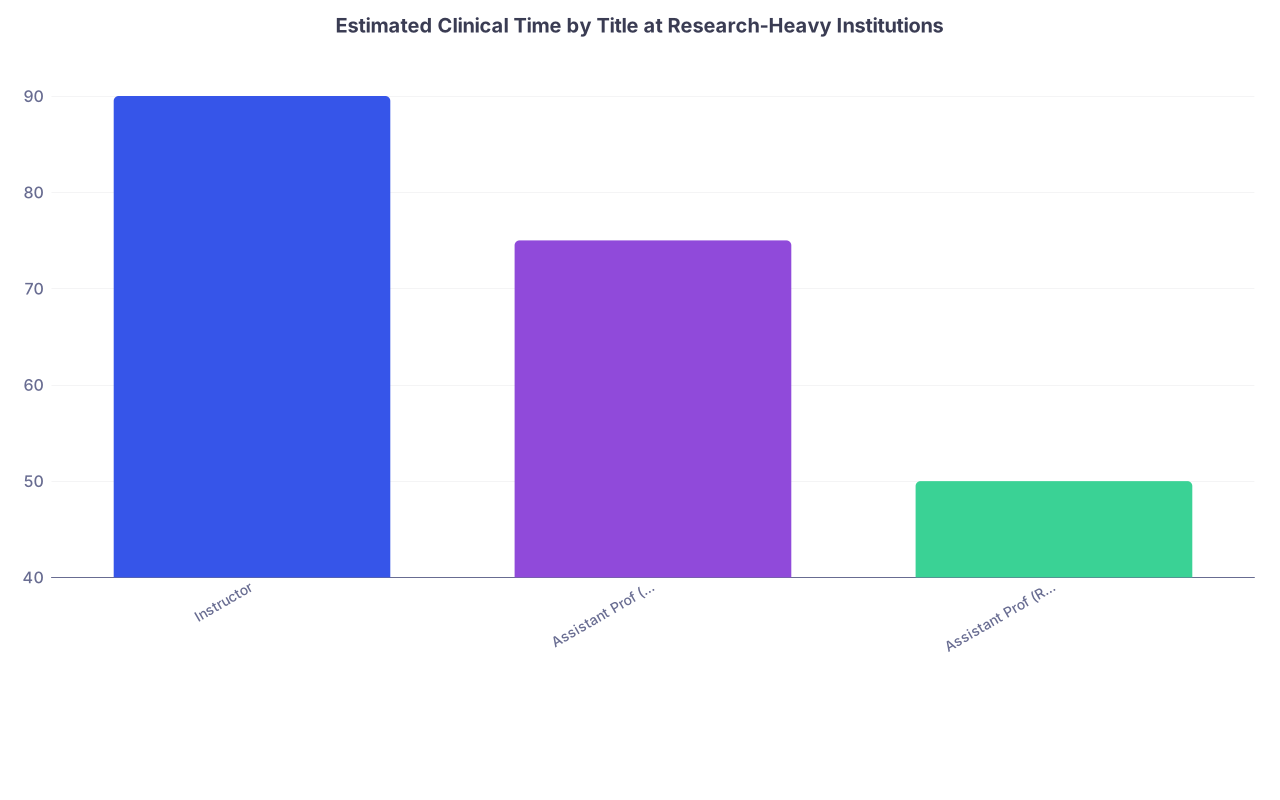
| Category | Value |
|---|---|
| Instructor | 90 |
| Assistant Prof (CE) | 75 |
| Assistant Prof (Research) | 50 |
Tracks: Clinician-Educator vs Research vs Pure Clinical
Now we layer in tracks. You can be:
- Instructor, Clinician-Educator Track
- Assistant Professor, Tenure Track
- Instructor, Pure Clinical
- Assistant Professor, Clinical Track
The rank is only half the story. Track dictates your evaluation criteria.
Clinician-Educator / Clinical Track
This is what most new hospitalists, general internists, and many subspecialists end up on.
Common features:
- 70–90% clinical time.
- Expectation of teaching (ward attending, lectures, small groups).
- Scholarship expectations:
- Educational innovations
- Quality improvement (with actual dissemination – posters, papers)
- Case reports, small studies, curriculum development
Promotion from Assistant Professor → Associate Professor:
- Usually requires a portfolio of teaching excellence, some peer-reviewed output, and evidence of regional recognition (invited talks, committee roles).
If you are an Instructor on the clinician-educator track, ask:
- “What specific scholarship is required to be promoted to Assistant Professor, and in what timeline?”
- “Is promotion automatic with time if expectations are met, or competitive with limited slots?”
If they cannot answer clearly, you are not on a true CE track. You are a warm body filling clinical shifts.
Research Track / Tenure Track
Different beast. These are not typically offered to you casually at the end of residency unless you have:
- A strong publications record
- Significant research experience or advanced degrees
- Clear commitment to grant-funded work
Here, Instructor might be a “research Instructor” with heavy lab time and salary partially from grants. That can be completely legitimate and a smart move if you are serious about basic/clinical research.
On the flip side: Assistant Professor on research or tenure track implies:
- Meaningful protected time (40–80%)
- Startup package, lab space, or clear support for grant writing
- A brutal but clear set of expectations to get R01 or equivalent funding / major educational grants
If someone is dangling “Assistant Professor, tenure track” in front of you with 0.8–0.9 clinical FTE and no funding, that is fantasy. They are using the word “tenure” as sparkle.
Pure Clinical / Staff Track
Some places have a separate non-academic line:
- “Staff Physician,” “Clinical Faculty,” “Attending Physician” with or without adjunct academic titles.
- Promotions in title may exist, but they do not follow traditional academic promotion criteria.
In these roles, “Instructor” or “Assistant Professor” might exist purely as courtesy with no meaningful difference in pay or expectations. That is fine if you truly want a clinical job and do not care about academic advancement. But be honest with yourself: in 3–5 years, will you wish you had more options?
How Titles Affect Pay, Promotion, and Mobility
You are probably wondering the money question. Let us be blunt.
Salary
There is no universal rule that Assistant Professor is always paid more than Instructor. Sometimes yes, sometimes no. It depends on:
- Clinical FTE (more clinical = more RVU-based comp)
- Department comp model
- Non-clinical FTE (usually paid at a lower hourly rate)
What I do see:
- At research-heavy centers, clinical Instructors often have similar or slightly lower base salaries than Assistant Professors for similar clinical FTE, but the real difference is in their future raises and bonus structures.
- At mid-tier centers, Instructor vs Assistant Professor can be tied to a salary band. Assistant Professors might access a higher pay range and promotion-based increases.
Do not assume the title alone dictates the number. Ask to see the salary scale by rank, if they have one.
Promotion and Time in Rank
Where the title really matters is your ability to move up.
Assistant Professor:
- Typically has a defined “up or out” window in some tracks (e.g., 6–9 years to be reviewed for Associate Professor).
- Promotion criteria and clock are often written and approved by the school.
- You accumulate “time in rank” that counts if you move to another institution (many will recognize your years as Assistant Professor).
Instructor:
- Frequently has no formal clock. You can sit indefinitely.
- Time spent as Instructor is often not counted toward promotion if you move; you may be re-hired as Assistant Professor and “reset” your promotion clock.
- At some institutions, Instructor years do not count as “faculty experience” when competing for certain leadership roles.
If you ever foresee moving institutions, being stuck at Instructor for too long can hurt you.
Mobility
External search committees understand that Instructor at some elite places functionally equals Assistant Professor elsewhere. But they still have to justify hires based on formal rank.
Roughly:
- 1–2 years as Instructor at a top-tier academic center, with clear scholarly productivity, is not a problem. It can even strengthen your CV if you use the time well.
- 5–7 years as Instructor with minimal publications and no clear promotion story? You will be seen as a career clinician without an academic arc.
This is why I tell residents: if you accept an Instructor role, get clarity on both:
- Expected timeframe for Assistant Professor promotion
- Written criteria and process for that promotion
Then treat that deadline like a fellowship graduation date. You are not supposed to stay a permanent Instructor unless that is explicitly your choice.
Red-Flag and Green-Flag Instructor Offers
Let us get concrete. You have an Instructor offer in your hand. How do you classify it?
Green-flag Instructor Scenario
- Institution: major academic center with reputation for research and education.
- Track: Clinician-educator or research track, clearly specified.
- FTE: 0.7–0.8 clinical, 0.2–0.3 protected for teaching / scholarship or research.
- Documentation: written promotion criteria for Instructor → Assistant Professor, with expectation of review in 2–3 years.
- Evidence: they can name multiple people in your division who made that jump on time.
This is basically a structured bridge position. If you want that institution and you need time to build your CV, this can be a rational move.
Yellow-flag Scenario
- Institution: mid-tier academic center.
- Track: “clinical” but with vague criteria, mostly service.
- FTE: 0.9+ clinical, “some time” for teaching and projects, not contractually protected.
- Promotion: “We usually move people up after a few years if they do well.” No written standard.
Here, you are essentially a service attending with a soft promise. You can take this if you care mainly about location or lifestyle, but do not pretend it is a clear academic pipeline. Push for Assistant Professor if most of their long-term faculty at your FTE are hired that way.
Red-flag Scenario
- Institution: any.
- Title: Instructor, “full-time faculty.”
- Track: “We do not really have official tracks.”
- FTE: 1.0 clinical, they call teaching “part of your clinical role.”
- Promotion: no written policy, no examples, lots of handwaving.
This is a clinical job wearing an academic Halloween costume. Perfectly acceptable if you just want to practice. Dangerous if you are telling yourself you are building an academic career.
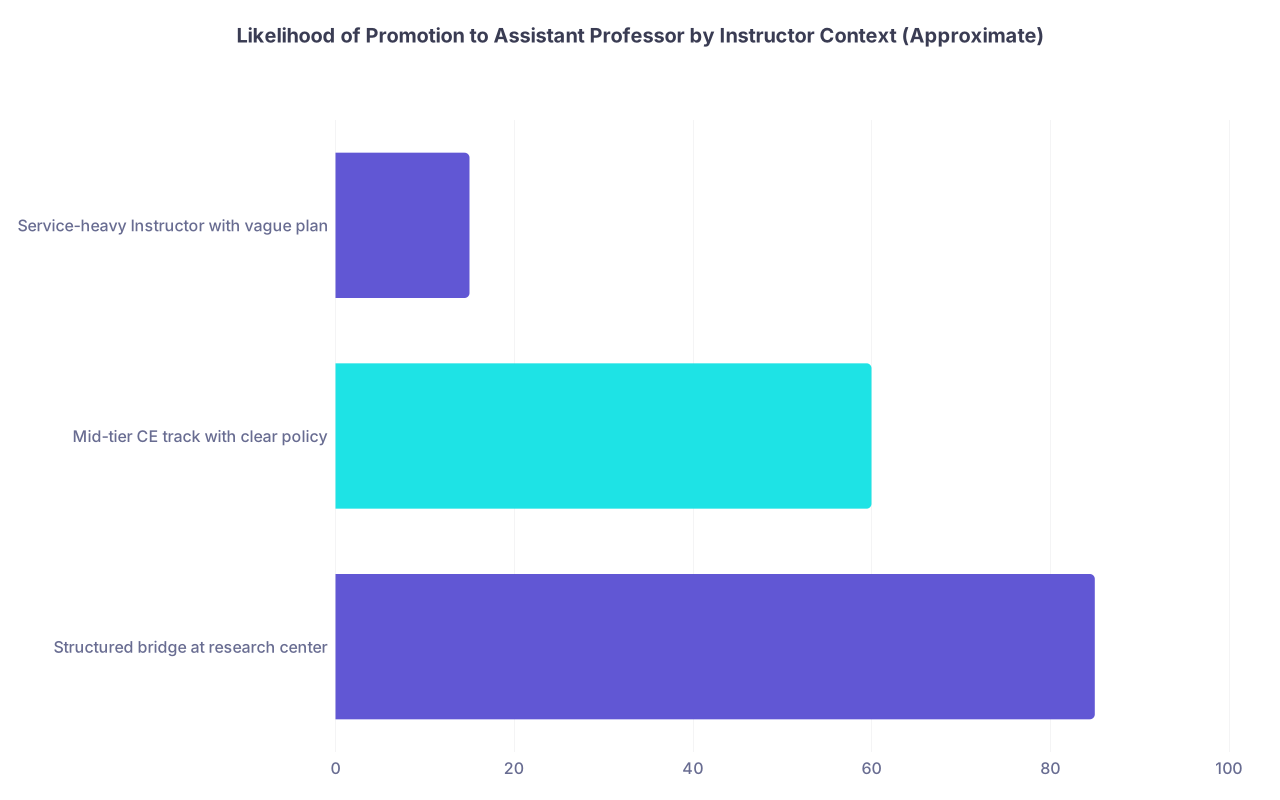
| Category | Value |
|---|---|
| Structured bridge at research center | 85 |
| Mid-tier CE track with clear policy | 60 |
| Service-heavy Instructor with vague plan | 15 |
Questions You Must Ask Before Signing Anything
Stop assuming HR or the chair will volunteer the key details. They will not.
Here is what you want, explicitly, in writing or in email at minimum.
“What is the official name of my track and rank?”
Get the exact wording: “Clinical Instructor of Medicine, Clinician-Educator Track” etc. Then you can look up the school’s promotion guidelines.“What is the standard entry rank for a full-time faculty member in my role?”
If most people doing the same job are Assistant Professors, you should ask directly why you are not.“What is the typical timeline and criteria for promotion from Instructor to Assistant Professor in this department?”
Ask for examples: “Who has done this in the last 5 years?”“Will I have contractually protected non-clinical time? How is it tracked and enforced?”
Protected time that disappears whenever the service is short-staffed is not protected time.“Is there a written promotion policy I can review for my specific track?”
Many schools publish these online. If they cannot give you a document, that is telling.“Will time spent as Instructor count as time in rank if/when I become Assistant Professor here?”
If it does not, that is effectively a longer probationary period.“How many Instructors in the last 5–10 years have been promoted to Assistant Professor, and how many remained Instructors long-term?”
The ratio matters much more than the marketing language.
You do not need to ask all of this in one interrogation session, but you do need the answers somewhere in writing. Future-you will be grateful.
Common Misconceptions Residents Have
Let me deal with the myths I hear every year in chief resident offices.
“Instructor is basically the same as Assistant Professor.”
No. Sometimes responsibilities overlap, but the career implications differ. Assistant Professor puts you on a promotion ladder. Instructor often does not.
“I can just switch to Assistant Professor later if I work hard.”
Maybe. If the system is set up for that. In many departments, title upgrades require:
- Open budgeted lines
- Faculty votes
- Dean’s office approval
This is not a simple “change of job title” form.
“If the job is at a big-name institution, any title is fine.”
Dangerous thinking. Big-name institutions are very comfortable using Instructor as service labor. Certain prestige programs are notorious for this. If you are going to grind, at least grind with a path.
“I only care about clinical work right now; title does not matter.”
You might genuinely feel that way. But life changes. Spouse gets a job across the country. You decide you want to apply for a VA position or another academic center. Suddenly your CV with 7 years as “Clinical Instructor” reads very differently than 7 years as “Assistant Professor.”

| Step | Description |
|---|---|
| Step 1 | Residency Graduation |
| Step 2 | On promotion track |
| Step 3 | Bridge role, 2-3 yr plan |
| Step 4 | Service job, limited promotion |
| Step 5 | Build CV for AP or move |
| Step 6 | Clinical career focus or change jobs |
| Step 7 | Develop portfolio for Associate |
| Step 8 | Offer Title |
| Step 9 | Defined path to AP? |
How I Would Approach Negotiation As a New Grad
Let us say you receive:
- Offer A: Clinical Instructor, 0.9 clinical FTE, generic “teaching and QI” language, moderate pay, at a big-name institution.
- Offer B: Assistant Professor, clinical-educator track, 0.8 clinical FTE with 0.2 protected time, at a solid regional academic center.
Here is the blunt reality: for long-term academic career prospects, Offer B is usually the stronger choice. Unless Offer A explicitly comes with:
- A clear 2–3 year path to Assistant Professor.
- Real opportunities for scholarship (access to mentors, support staff).
- Written support from leadership that they view you as a faculty pipeline, not just clinical coverage.
If you strongly want Offer A but hate the Instructor title, you can say:
“Given that my long-term goal is to build an academic career here, I’d like to discuss starting at the Assistant Professor level on the clinical-educator track, which seems more aligned with my responsibilities and goals. Can we review whether my CV meets your usual bar for that rank?”
If they say no, ask:
“Then can we define a written plan and timeline for promotion from Instructor to Assistant Professor, including the specific benchmarks you want me to reach?”
If they cannot do either, they are telling you, politely, that you are clinical labor first and potential faculty second.
Quick Reality Check: What Actually Matters 5–10 Years Out
- Search committees and promotions committees do not care that you “worked really hard as an Instructor.”
- They care about: your rank, your track, your output (publications, curricula, QI projects), and your reputation (letters, invited talks, roles).
A smart early-career move:
- If you accept an Instructor role, treat it like a time-limited fellowship. You have 2–3 years to build:
- At least a few peer-reviewed outputs
- A clear teaching portfolio
- Regional recognition in one niche area
Then either move up in that institution or jump to an Assistant Professor job elsewhere. Do not drift indefinitely.
Three Things To Remember
- Instructor and Assistant Professor are not equivalent. Instructor is often a probationary or service-heavy role; Assistant Professor is the real entry point to academic promotion.
- Track and FTE matter as much as title. A “nice” title on a 1.0 clinical FTE with no protected time is still a service job, not an academic career.
- Before you sign, force clarity. Ask exactly how people move from Instructor to Assistant Professor in that department, in what timeframe, and what happened to those who did not.
If you get those answers and still choose the job, at least you are doing it with your eyes open.