
Understanding the Post‑Residency Job Search Timeline
For a Caribbean IMG pursuing Addiction Medicine, when to start your job search can be as important as where you look. The physician job market in addiction medicine is strong overall, but timing, immigration status, and your training pathway (e.g., Caribbean medical school residency, SGU residency match, US fellowship vs. direct entry) will shape your opportunities.
This article focuses specifically on job search timing for Caribbean IMGs in Addiction Medicine—how far in advance to start, what to prioritize at each stage, and how to align your search with visas, boards, and your personal goals.
We’ll walk through:
- A realistic year‑by‑year and month‑by‑month timeline
- How your training path (fellowship vs. “experience route”) affects timing
- Coordinating visa planning with job offers
- When to start networking, interviewing, and contract negotiation
- Practical examples and common pitfalls to avoid
1. Your Training Path Determines Your Timeline
Before you plan when to start your attending job search, clarify which path into Addiction Medicine you’re taking. This affects both timing and type of positions you can pursue.
1.1 Common Addiction Medicine Entry Routes for Caribbean IMGs
ABPM Addiction Medicine Fellowship Path (most structured)
- US ACGME‑accredited residency (e.g., Internal Medicine, Family Medicine, Psychiatry, Emergency Medicine, Pediatrics, etc.)
- 1–2 year ACGME‑accredited Addiction Medicine fellowship
- Then sitting for the ABPM Addiction Medicine boards
“Practice Pathway” / Experience Route (where available)
- Completed residency in an eligible primary specialty
- A defined number of years of practice focusing on substance use disorders (SUD), often including a mix of:
- Direct patient care
- Time in SUD programs (inpatient, outpatient, OTP, telehealth)
- Documented CME and training in substance abuse treatment
- This route is time‑limited and has been evolving; requirements change, so check ABPM’s website.
Hospitalist or Primary Care Job with Addiction Focus
- You complete a standard residency (often through a Caribbean medical school residency path or SGU residency match).
- Take a hospitalist, primary care, or psychiatry job that allows:
- Large panel of patients with SUD
- Buprenorphine prescribing
- Involvement in detox or rehab units
- Over time, you transition increasingly into Addiction Medicine roles.
For Caribbean IMGs, the first path (fellowship) is usually the most predictable for board‑eligibility and job market positioning.
1.2 Why Timing Is More Complex for Caribbean IMGs
Caribbean graduates (including SGU, AUC, Ross, etc.) have specific timing pressures:
- Visa constraints (J‑1, H‑1B, permanent residency) heavily influence:
- Where you can work
- When you must secure a job offer
- Whether you can pursue fellowship first or need a waiver job
- Perception in the job market
- Many employers are open to Caribbean IMGs, especially if you trained at reputable programs.
- Some large academic centers may favor US grads, but addiction medicine demand often offsets this.
As a result, you cannot think about “when to start job search” in isolation; you must tie it to your visa clock, training dates, and board eligibility.
2. Global Timeline: From Residency PGY‑1 to First Attending Job
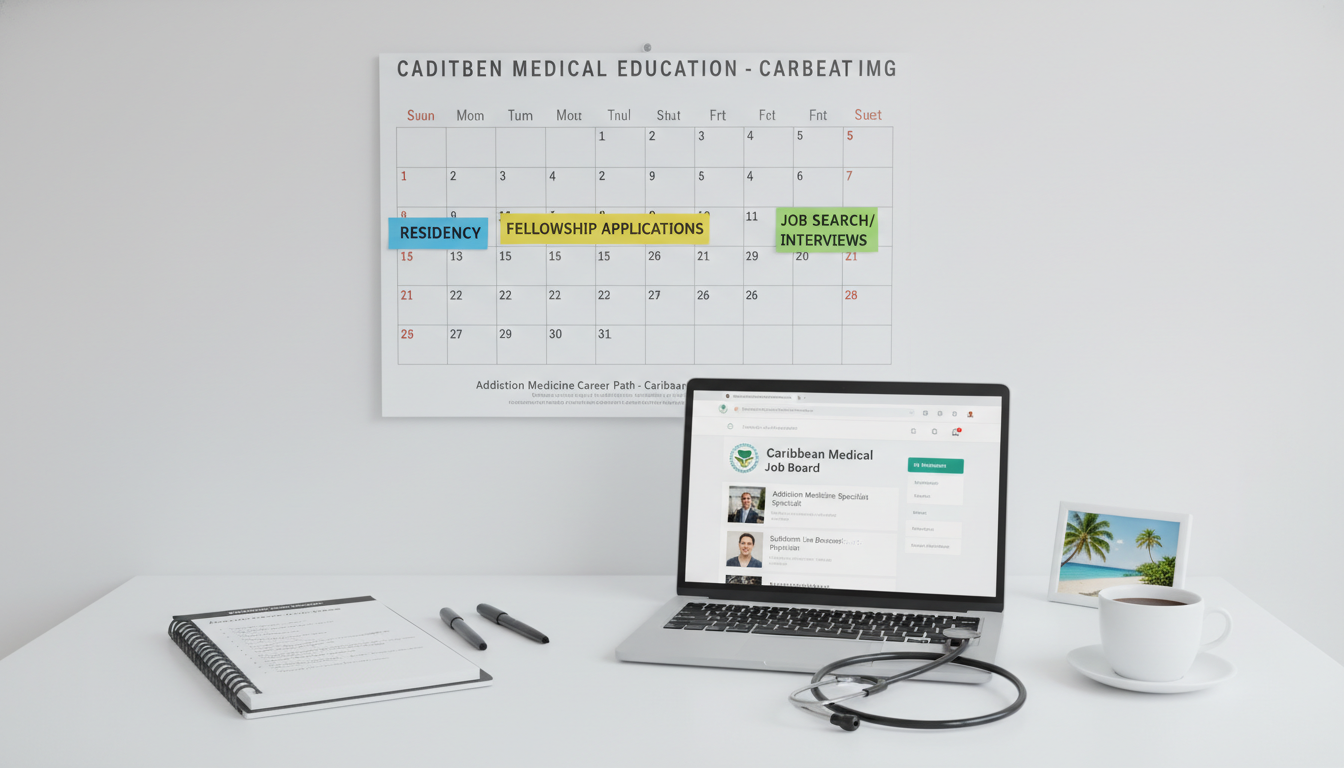
Below is a high‑level timeline for a Caribbean IMG wanting to end up in Addiction Medicine. We’ll assume:
- You are in a US residency (via Caribbean medical school residency placement such as SGU residency match or similar).
- You plan to pursue Addiction Medicine Fellowship, then an attending role.
Adjust this to your actual situation (e.g., if you skip fellowship or are already in fellowship).
2.1 PGY‑1 (Intern Year): Foundation and Future Positioning
Primary focus: Survive and learn, but quietly start positioning yourself.
Key timing goals:
- Months 1–12:
- Do not formally start your attending job search yet; it’s too early.
- Begin exploring Addiction Medicine:
- Seek rotations in psychiatry, consult liaison, detox units, pain clinics.
- Ask upper‑year residents or faculty involved in substance abuse training what paths they took.
- Start CV building:
- Quality Improvement (QI) projects on opioid stewardship, safe prescribing, or withdrawal protocols.
- Case reports or posters related to SUD.
- Clarify visa path:
- Understand your current visa type (J‑1, H‑1B, etc.).
- Meet GME office or immigration services to understand:
- Is fellowship on J‑1 possible?
- Will you need a J‑1 waiver job after residency?
Job search timing takeaway for PGY‑1:
Not the time for job applications, but absolutely the time to plan your long‑term Addiction Medicine trajectory.
2.2 PGY‑2: Prepare for Fellowship and Early Networking
Primary focus: Prepare for Addiction Medicine fellowship applications and identity as an addiction‑interested physician.
Key timing goals:
Months 13–18:
- Targeted substance abuse training:
- Arrange electives or research in SUD.
- Complete motivational interviewing, CBT basics, or MAT CME.
- Seek mentors in Addiction Medicine:
- Faculty at your hospital
- Local addiction treatment centers
- Attend regional or national meetings:
- American Society of Addiction Medicine (ASAM)
- Local Society for Addiction Medicine chapter
- Targeted substance abuse training:
Months 19–24:
- Decide formally if you’re pursuing fellowship vs. going straight into practice with addiction focus.
- If fellowship:
- Prepare personal statement and letters of recommendation.
- Map out programs that are friendly to IMGs and visa sponsorship.
- Start light networking with institutions you might want to work at in the future:
- “I’m a Caribbean IMG in IM training, interested in Addiction Medicine and planning to apply for fellowship next year.”
Job search timing takeaway for PGY‑2:
Still early for job applications, but start building the network that will later produce job leads. Your name should become familiar in local addiction circles.
2.3 PGY‑3: Fellowship Applications and Early Attending Market Awareness
If you’re in a three‑year residency (IM/FM), PGY‑3 is crucial. Timing here is mostly about fellowship, but you should also begin learning the physician job market in Addiction Medicine.
Key timing goals:
Months 25–30:
- Submit Addiction Medicine fellowship applications (timing may vary by program and match cycle).
- Attend interviews.
- Clarify which programs support:
- Visas (J‑1 vs H‑1B)
- Your goal of ultimately practicing Addiction Medicine full‑time.
Months 31–36:
- Once matched to a fellowship:
- Learn about the regional job market where your fellowship is located.
- Do local health systems hire addiction specialists?
- Are there large OTPs, FQHCs, VA systems, academic centers?
- Update CV and create a simple one‑page professional summary emphasizing:
- Caribbean IMG background
- Residency performance
- Addiction Medicine focus
- Learn about the regional job market where your fellowship is located.
- Once matched to a fellowship:
Job search timing takeaway for PGY‑3:
You don’t need to formally apply for attending jobs yet, but you should have:
- A clear understanding of where jobs are likely to be.
- A target list of practice settings (academic, community, OTP, telemedicine, VA).
3. During Addiction Medicine Fellowship: The Critical Job Search Window
For most Caribbean IMGs, fellowship is the main period to launch your attending job search. The timing here can make the difference between a rushed, suboptimal offer and a well‑negotiated position aligned with your goals and visa needs.
3.1 General Rule: Start 9–12 Months Before Fellowship Ends
In Addiction Medicine, many positions are not filled through formal “match‑like” systems. Instead, they’re posted throughout the year or created when a hospital recognizes a need. Because of this:
Ideal start for job search:
- Around September–December if your fellowship ends in June of the following year.
- In other words, 9–12 months before your planned completion date.
Why so early?
- Visa processing can take months.
- Some employers need time to create a position.
- You’ll want room to compare offers and negotiate.
3.2 Month‑by‑Month Breakdown During Fellowship
Assume a 1‑year Addiction Medicine fellowship (July–June).
July–September (Months 1–3): Foundation and Focus
- Clarify what you want:
- Academic vs. community vs. VA vs. private OTP.
- Urban vs. rural.
- Outpatient, inpatient consult, or mixed practice.
- Begin updating your CV:
- Add all Addiction Medicine rotations, research, and teaching.
- Ask faculty:
- “When should I start my job search in this field?”
- “Do you know systems that are recruiting addiction medicine physicians?”
September–November (Months 3–5): Start the Job Search
- This is often the optimal time to start sending CVs and emails.
- Identify targets:
- Institutions where you rotated or where faculty have connections.
- States open to visa sponsorship if you need it.
- Systems with strong SUD programs or growth plans.
- Reach out to:
- Department chiefs of psychiatry or internal medicine.
- Medical directors of addiction programs, methadone clinics, FQHCs.
- HR / physician recruitment for large hospital systems.
- Attend ASAM or similar meetings and have 10–20 printed CVs ready.
December–February (Months 6–8): Intensify Applications and Interviews
- By now, you should be actively interviewing:
- Aim for multiple interviews to compare offers.
- Prioritize sites that understand your visas needs and Addiction Medicine skills.
- Ask each potential employer explicit questions:
- “Do you sponsor J‑1 waiver/H‑1B?” (if relevant)
- “What proportion of my time will be dedicated to Addiction Medicine vs general IM/FM/psych?”
- “Is there protected time for teaching, program development, or research?”
- Keep communication organized with a spreadsheet:
- Employer, location, role type, visa support, salary range, call schedule, timeline.
March–April (Months 9–10): Narrow Choices and Negotiate
- Most Addiction Medicine jobs with July start will want signed contracts by now.
- This is the best window to:
- Clarify salary, productivity bonuses, and benefits.
- Confirm job description:
- Number of clinic sessions per week.
- Call responsibilities.
- MAT expectations (buprenorphine, methadone, naltrexone).
- Discuss professional growth:
- Opportunity to build new programs.
- Leadership tracks.
- Get any verbal promises in writing in the contract.
May–June (Months 11–12): Finalize Logistics
- Complete credentialing, licensing, DEA, and—if needed—buprenorphine credentialing (though the X‑waiver has been eliminated, some institutions still require internal approval).
- Prepare for relocation, onboarding, and transition from fellow to attending.
Key timing insight:
If you wait until March or April of your fellowship year to start looking, you will still likely find employment (the physician job market in Addiction Medicine is strong), but:
- You’ll have fewer choices.
- Visa timelines may become tight.
- Negotiation leverage may be weaker.

4. Visa and Immigration Timing for Caribbean IMGs
For many Caribbean IMGs, visa timing is the single biggest factor influencing when to start job search.
4.1 J‑1 Visa Considerations
If you trained on a J‑1 visa for residency and/or fellowship:
- You typically need a J‑1 waiver job after graduation, usually in a Health Professional Shortage Area (HPSA) or underserved area.
- Timing:
- Many states have J‑1 waiver application cycles that open in October and close when spots are filled.
- For Addiction Medicine, you may:
- Use your primary specialty (IM/FM/psych) to qualify.
- Or, in some cases, positions are structured to emphasize Addiction Medicine within primary care or psychiatry roles.
- Implication for job search:
- You often need to start searching at the very beginning of fellowship (or even late in residency if you go straight into a waiver job without fellowship).
- Coordinate with:
- Employer’s legal team
- Your program’s GME office
- An immigration attorney familiar with J‑1 waiver timing
4.2 H‑1B and O‑1 Considerations
If you are on H‑1B:
- You must consider:
- Cap‑exempt vs. cap‑subject H‑1B.
- Transfer timing between institutions.
- You may have slightly more flexibility than J‑1, but:
- Physician job search still should begin 9–12 months before transition because processing and credentialing take time.
If you may qualify for O‑1 (extraordinary ability) or are progressing toward permanent residency, factor in:
- Locations and employers more willing to support green card applications for highly specialized Addiction Medicine physicians.
- This can make academic centers or large systems attractive.
4.3 Practical Example of Visa‑Driven Timeline
Example:
You are a Caribbean IMG in IM residency on J‑1, then plan Addiction Medicine fellowship, also on J‑1.
- PGY‑3:
- Decide to do fellowship.
- Also start learning about states with J‑1 waiver friendly to Addiction Medicine or IM with SUD focus.
- Fellowship Year:
- July–September: Clarify if you will seek J‑1 waiver directly after fellowship.
- September–October: Actively apply for jobs in waiver‑friendly states, emphasizing:
- Your Addiction Medicine expertise
- Willingness to practice in underserved settings
- October–December: Work with chosen employer to submit waiver application when state window opens.
- Early next year: Once waiver secured, finalize contract.
Takeaway: For J‑1 physicians, job search may need to start even earlier than the generic 9–12 months, depending on waiver cycles.
5. Matching Job Search Timing to Career Goals in Addiction Medicine
Beyond visas and calendars, your long‑term vision in Addiction Medicine should influence when and where you search.
5.1 Academic vs. Community Addiction Medicine Jobs
Academic Addiction Medicine Jobs
- Often require:
- Evidence of teaching, research, or program development.
- Strong letters from academic mentors.
- Timing:
- Academic centers often recruit on an academic year cycle (July starts).
- Start inquiries at least 12 months ahead:
- Email division chiefs or program directors:
“I’m a Caribbean IMG completing Addiction Medicine fellowship next June. I’m interested in clinician‑educator or research‑oriented roles. Do you anticipate openings?”
- Email division chiefs or program directors:
- You may need additional time to build:
- A small research portfolio.
- Teaching experience.
Community / Private Addiction Medicine Jobs
- More flexibility in:
- Start dates
- Rapid hiring
- Timing:
- Many positions are filled within 3–6 months of the start date.
- Still, as a fellow, you should initiate contact 9–12 months ahead to:
- Align with your graduation date.
- Complete visa and credentialing.
5.2 Telemedicine and Hybrid Roles
The physician job market in Addiction Medicine increasingly includes:
- Tele‑buprenorphine clinics
- Hybrid outpatient and telehealth roles
- National virtual addiction treatment platforms
Timing considerations:
- Telemedicine companies often recruit continuously, which may allow for:
- Later job search or bridging roles.
- Supplemental income in addition to a primary position.
However, as a new attending (especially an IMG), it is usually advantageous to have at least one solid “home base” job (hospital, clinic, or system) with:
- Structured mentorship
- Interdisciplinary team support
- On‑site supervision while you transition from fellow to independent attending
6. Practical Strategies and Common Pitfalls in Job Search Timing
6.1 Strategic Steps for Caribbean IMGs
Back‑plan from your end date
- If fellowship ends June 30:
- Mark your calendar 12, 9, 6, and 3 months before that date.
- Assign tasks (CV finalization, first applications, interviews, negotiations).
- If fellowship ends June 30:
Leverage mentors early
- Ask at least 2–3 mentors:
- “Will you be willing to contact colleagues about job opportunities for me?”
- Provide them with:
- Updated CV
- Short “elevator pitch” about your goals in Addiction Medicine.
- Ask at least 2–3 mentors:
Targeted networking
- Present at local Addiction Medicine conferences as early as residency.
- Join ASAM and your state society; attend their job boards and career events.
- When you talk to potential employers, be explicit:
- “I am especially interested in substance abuse training, MAT expansion, and developing integrated SUD care pathways.”
Use multiple job search channels
- National physician job boards and dedicated Addiction Medicine job boards.
- Hospital system career pages.
- Recruiters who specialize in psychiatry and addiction.
- Direct emails to medical directors of addiction programs.
Prepare early for interviews
- Have your story clear:
- Caribbean IMG background and resilience.
- Why Addiction Medicine?
- How your residency and fellowship experience uniquely prepared you.
- Practice answering:
- “Where do you see yourself in 5 years?”
- “How comfortable are you managing complex dual‑diagnosis patients?”
- Have your story clear:
6.2 Common Timing Mistakes to Avoid
Starting too late (within 3 months of graduation)
- Risk:
- Limited employer options.
- Visa processing delays.
- Having to accept a suboptimal job hastily.
- Risk:
Focusing only on one type of position
- For example, only large academic centers or only big‑city OTPs.
- The physician job market is dynamic; you can start in one environment and move later.
- For first job, prioritize:
- Visa stability
- Strong team and mentorship
- Solid Addiction Medicine exposure
Underestimating credentialing and licensure time
- State licensure, hospital privileges, and payor enrollment can take 3–6 months.
- Start licensing applications as soon as you have a signed offer, sometimes earlier.
Ignoring contract review
- Even if the market is favorable, don’t rush.
- Budget at least 2–3 weeks for:
- Reviewing offer letter and contract.
- Consulting with a lawyer experienced in physician contracts (especially for restrictive covenants and immigration language).
FAQs: Job Search Timing for Caribbean IMGs in Addiction Medicine
1. When should I start my job search if I’m a Caribbean IMG finishing Addiction Medicine fellowship?
Begin exploring and networking about 12 months before graduation and actively applying around 9–12 months before your fellowship end date. For a June graduation, this usually means starting applications between September and November of your fellowship year, earlier if you have J‑1 waiver requirements.
2. Does coming from a Caribbean medical school (e.g., SGU) change my job search timeline?
The basic timeline is similar, but you must be more proactive with:
- Early networking and mentorship.
- Clarifying your visa and licensure pathways. Caribbean medical school residency graduates, including those from an SGU residency match, are well‑represented in US training programs, and the Addiction Medicine workforce need is high—so opportunities are there if you start early and stay organized.
3. How does my visa status affect when to start job hunting?
If you’re on a J‑1 visa, you often need to secure a J‑1 waiver job aligned with state cycles. This can mean starting job search planning as early as the start of fellowship, with active applications 9–12 months before graduation. For H‑1B or other visas, 9–12 months is still recommended to allow for transfers, processing, and credentialing.
4. Can I get an Addiction Medicine‑focused job without doing a formal fellowship?
In some cases, yes—especially in primary care, hospitalist, or psychiatry roles with a heavy SUD population and robust substance abuse training opportunities. However, a formal Addiction Medicine fellowship and board eligibility through ABPM substantially strengthen your position in the physician job market, particularly for academic or leadership roles. If you pursue the experience route, you’ll need to demonstrate several years of SUD‑focused practice, so your job search timeline should plan for that longer path.
By understanding the interplay between training milestones, visa requirements, and the addiction medicine physician job market, you can time your job search strategically and transition smoothly from Caribbean IMG trainee to Addiction Medicine attending.