
Understanding the Unique Job Search Timeline for Caribbean IMGs in Anesthesiology
For a Caribbean IMG in anesthesiology, timing your job search correctly can be just as important as your CV, letters, or interview skills. The U.S. physician job market for anesthesiologists is strong overall, but as a Caribbean medical school graduate and an international medical graduate (IMG), you face unique considerations—especially around visas, the anesthesia match, and your early-career positioning.
This guide focuses on when to start your job search, how to sequence key milestones, and how to adapt your strategy as a Caribbean IMG in anesthesiology.
We’ll anchor this discussion around:
- Where you are in residency (PGY-1 to PGY-4/CA-3)
- Your visa status and constraints
- Your goals (academic vs community vs locums; region; subspecialty)
- Realistic timelines for interviews, contracts, and credentialing
Big Picture: How Early Should You Start Your Job Search?
Most U.S. anesthesiology residents begin actively searching for jobs 12–18 months before completing residency or fellowship. As a Caribbean IMG, the “safe” window is typically:
- Exploration and networking: 18–24 months before graduation
- Active search and applications: 12–18 months before graduation
- Interviews and contract negotiation: 9–15 months before graduation
- Finalizing offers and signing: 6–12 months before graduation
Why earlier for Caribbean IMGs?
Visa timelines are rigid.
- H-1B and J-1 waiver processes require strict sequencing and legal review.
- Employers may need more time to confirm sponsorship and complete paperwork.
Some employers hesitate to sponsor visas.
- You may need a larger pool of potential employers.
- More time = more opportunities to find visa-friendly positions.
State licensing and hospital credentialing can be slow.
- Licensing can take 3–6+ months.
- Credentialing and payer enrollment add another 2–4 months.
You may still be building your network.
- Caribbean medical school residency graduates often have fewer “built-in” U.S. connections.
- Starting earlier gives you time to create and leverage connections.
The key takeaway:
As a Caribbean IMG in anesthesiology, do not wait until PGY-4/CA-3 spring to start. You should already be deep in the process by then.
Year-by-Year Timeline: From Early Residency to Your First Attending Job
This section walks you through what to do and when, using a typical categorical or advanced anesthesiology pathway. Adjust if you’re doing a fellowship (especially in critical care, pain, cardiac, or pediatric anesthesia).
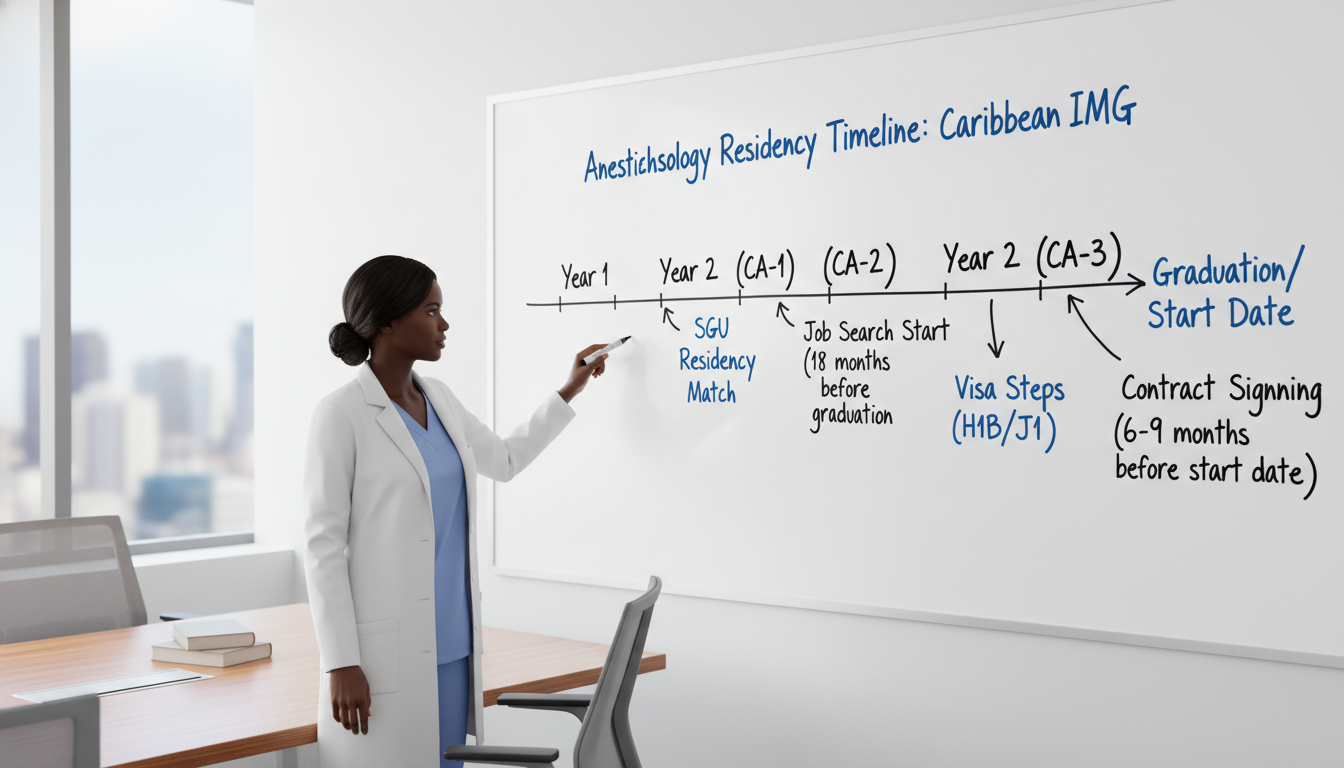
PGY-1 / Intern Year: Laying the Foundation (24–36 Months Before Graduation)
At this early stage, you are not yet applying for jobs, but this is the time to:
Clarify your long-term goals
- Community vs academic practice?
- Geographic preferences (coasts, Midwest, Southeast, rural vs urban)?
- Interest in subspecialty fellowship (e.g., pain, cardiac, ICU, peds)?
Understand the job market for anesthesiology
- The physician job market for anesthesiologists is strong in many U.S. regions, especially:
- Community hospitals
- Smaller cities and rural areas
- Certain states in the Midwest and South
- Large coastal academic centers can be more competitive and slower to hire.
- The physician job market for anesthesiologists is strong in many U.S. regions, especially:
Learn from your seniors
- Ask upper-year residents (especially other Caribbean IMGs) about:
- Their job search timing
- Visa-friendly employers they encountered
- How their Caribbean medical school residency background was perceived
- Ask upper-year residents (especially other Caribbean IMGs) about:
Keep visas in mind
- If you’re on a J-1, learn now about:
- J-1 waiver programs (state Conrad 30, VA, academic positions)
- Timelines and which states favor anesthesiology
- If you’re on an H-1B, understand cap-exempt vs cap-subject employers:
- University hospitals are often cap-exempt (easier transitions).
- Private practices may be cap-subject, adding complexity.
- If you’re on a J-1, learn now about:
Actionable tips (PGY-1):
- Join the American Society of Anesthesiologists (ASA) and your state society.
- Attend local anesthesiology meetings or webinars to understand the market.
- Keep an informal list of places (and practice types) you may want to consider later.
PGY-2 / CA-1: Early Networking and Career Exploration (18–30 Months Before Graduation)
Now, you’re firmly in anesthesiology training—this is a critical phase for networking and early planning, not yet full-scale applications.
Key objectives:
Refine practice type goals
- Academic center vs large private group vs hospital-employed model.
- Lifestyle: call vs no-call, OR-heavy vs ICU vs mixed practice.
- Regional variations in case mix and compensation.
Attend conferences strategically
- ASA annual meeting (and subspecialty meetings if you’re considering fellowship).
- Introduce yourself to:
- Recruiters
- Department chairs
- Former residents from your program
- As a Caribbean IMG, explicitly ask others who trained as IMGs how they approached timing and visas.
Build your professional brand
- Update your CV with:
- SGU residency match or other Caribbean medical school residency background.
- Research projects, QI projects, committee work.
- Make sure your Caribbean IMG journey is framed positively:
- Emphasize adaptability, resilience, and diverse clinical exposure.
- Update your CV with:
Start a “target list”
- Create a spreadsheet of:
- Regions and states you’d accept
- Academic vs community centers
- J-1 waiver or H-1B willingness (if applicable)
- Note any programs that have hired Caribbean IMGs in anesthesiology in recent years.
- Create a spreadsheet of:
Timing note:
By late CA-1, it’s reasonable to begin light conversations with alumni and contacts in your desired regions, mostly to understand the local physician job market and job search timing in those areas—not to secure a contract yet.
PGY-3 / CA-2: When the Real Job Search Begins (12–24 Months Before Graduation)
For most anesthesiology residents, CA-2 is the critical year to start your attending job search in earnest.
12–24 Months Before Graduation: Exploratory Outreach
At this point, you should:
Clarify your finish date
- Employers want exact:
- Residency completion date
- Exam plans (when you’ll take boards)
- If you’re pursuing a fellowship, your timeline shifts to the end of fellowship, not residency.
- Employers want exact:
Meet with your program leadership
- Program director and chair can:
- Introduce you to groups that have hired your graduates.
- Advocate for you with partner hospitals.
- Provide realistic feedback on your competitiveness for top-tier academic centers.
- Program director and chair can:
Start talking to recruiters
- National anesthesia recruiters
- In-house recruiters at academic centers or large groups
Ask directly: - “Do you sponsor H-1B or J-1 waiver visas?”
- “Have you hired Caribbean IMG anesthesiologists before?”
Align fellowship decisions with job search timing
- If doing a fellowship:
- You’ll search for attending jobs during your fellowship or late CA-3.
- If going straight to practice:
- Your job search for attending roles begins now, in CA-2.
- If doing a fellowship:
12–18 Months Before Graduation: Active Applications Begin
For a Caribbean IMG in anesthesiology, 12–18 months before your end date is usually the best window to:
- Send your first wave of applications.
- Reach out to:
- Groups and hospitals on your target list.
- Academic centers in regions where you’d accept offers.
- Begin scheduling interviews, especially if:
- You’re on a visa and need J-1 waiver or H-1B sponsorship.
- You are targeting competitive urban or academic positions.
Why this early?
- Academic centers often hire 12–18 months out, especially if they’re planning expansions.
- J-1 waiver jobs can be competitive and processed on a set cycle.
- Private groups may not know needs that far out—but many will start discussions if you are high-quality.
Actionable steps (CA-2):
- Polish your CV and a generic but professional cover letter.
- Create different versions tailored to:
- Academic anesthesia positions
- High-volume community/private group positions
- Start contacting:
- Anesthesia chairs
- Group partners
- Alumni you know from SGU or your Caribbean medical school who matched into anesthesiology
PGY-4 / CA-3: Interviews, Contracts, and Final Decisions (6–18 Months Before Graduation)
This is the peak period for your anesthesiology job search.

9–15 Months Before Graduation: Peak Interview Season
By early CA-3:
- You should already have:
- An updated CV
- A clear geographic and practice-type preference
- A sense of your visa needs and timelines
You’ll be:
- Traveling for on-site interviews.
- Meeting group partners, chiefs, OR directors.
- Getting a sense of:
- Call schedules
- Compensation (base + RVU + stipend)
- Partnership track for private groups
- Academic expectations (teaching, research, QI)
Timing considerations for Caribbean IMGs:
Visa confirmation before signing
- Ensure the employer is:
- Familiar with J-1 waiver or H-1B processes.
- Willing to use experienced immigration counsel.
- Ask: “How many IMG anesthesiologists have you successfully sponsored in the past 5 years?”
- Ensure the employer is:
Multiple offers take time
- If you are selective (particularly for major metro areas), expect:
- 3–6 months from first application to final offer.
- You may need to over-apply initially and then narrow down.
- If you are selective (particularly for major metro areas), expect:
Regional variability
- Rural and mid-size cities may move faster and be more IMG/visa-friendly.
- Prestigious academic centers might take longer, with multiple levels of approval.
6–12 Months Before Graduation: Contract Negotiation and Finalizing Offers
This is the phase where you should be close to signing.
What usually happens in this window:
- You’ve completed most of your interviews.
- You’re negotiating:
- Salary and sign-on bonus.
- Relocation assistance.
- Call schedule, FTE, and vacation.
- Visa support details (legal fees, filing timelines, waiver obligations).
- You’re finalizing one or two top choices.
When to sign:
- Many anesthesiology residents sign 6–9 months before completion.
- As a Caribbean IMG with visa needs, signing 9–12 months before completion is safer, especially if:
- J-1 waiver filings have specific state deadlines.
- H-1B transfers or new petitions must align with federal timing.
Key risk to avoid:
Waiting until <6 months before graduation without a signed offer can be dangerous for Caribbean IMGs, as visa timelines and licensing may not accommodate last-minute scrambling.
Special Considerations for Caribbean IMGs: Visas, Licensing, and Credentialing
Visa-Related Timing: J-1 and H-1B
For Caribbean IMGs in anesthesiology, visa issues often determine how early you must secure a job.
J-1 Visa (ECFMG-sponsored):
- You typically need a J-1 waiver job to avoid the 2-year home country requirement.
- Timing effects:
- You must identify an employer willing and eligible to sponsor a J-1 waiver.
- Many states have Conrad 30 programs with deadlines—some operate on a first-come, first-served basis.
- Ideally, you should:
- Have a signed job offer 9–12+ months before graduation.
- Begin your waiver process as soon as applications open in your target state.
H-1B Visa:
- Some residents are already on H-1B; others may seek H-1B sponsorship for their first job.
- Timing effects:
- H-1B cap-exempt employers (universities, some nonprofits) are more flexible.
- Cap-subject employers may need to align with the April application cycle.
- Again, signing 9–12+ months before graduation offers a buffer for legal processes.
State Licensing and Credentialing Timeline
Even after you sign:
- State license: 3–6 months (faster if you prepare documents early).
- Hospital privileging/credentialing: 2–4 months.
- Payer enrollment (if needed): ~2–3 months.
Because of this:
- Start your state license process as soon as you know where you’re going, often 6–9 months before your start date.
- Coordinate closely with your future employer’s medical staff office to avoid delays.
Job Search Timing After Fellowship (If You Subspecialize)
If you pursue a fellowship (e.g., pain management, critical care, cardiac, pediatric anesthesia), the timing simply shifts to the fellowship year, but the same principles apply.
During CA-3 (Before Fellowship)
- You focus on fellowship applications, not attending jobs.
- Still, keep job search timing in mind:
- Ask fellowship directors about local job markets.
- Identify sites that often hire their fellows as attendings.
During Fellowship Year
- Start 6–12 months before the end of fellowship, depending on visa needs.
- Earlier (9–12 months) if you require:
- J-1 waiver directly after fellowship.
- H-1B sponsorship at a new institution.
- Slightly later (6–9 months) may be acceptable if:
- You are transitioning internally within the same institution.
- You already have a strong network and no visa constraints.
- Earlier (9–12 months) if you require:
Your attending job search timing is now anchored to your fellowship end date, not residency graduation.
Caribbean Medical School Background: How It Impacts Timing and Strategy
Your identity as a Caribbean IMG—whether from SGU or another school—intersects with your job search timing in several ways.
From Caribbean Medical School to Residency: Setting the Stage Early
If you came through a Caribbean medical school residency pathway such as SGU residency match or similar:
- You already navigated skepticism about non-U.S. schools.
- You successfully matched into anesthesiology—an achievement that proves your capability.
- For the job market:
- Employers care more about your residency reputation, references, and clinical skills than where you did medical school.
- Still, some academic centers may remain more conservative.
This reality argues for:
- Starting earlier to maximize your pool of potential employers.
- Using time to showcase your strengths:
- Strong letters from U.S. anesthesiology attendings.
- Evidence of leadership, teaching, or quality improvement.
What Employers Want to See (And How Timing Helps)
Employers hiring Caribbean IMG anesthesiologists will be reassured if, by the time you’re actively interviewing, you can demonstrate:
- Stable performance on in-training exams and Step 3/board eligibility.
- Responsibility and reliability in OR and ICU roles.
- Good communication skills with surgeons, nurses, and patients.
- Clear, professional career goals.
Starting the job search 12–18 months early gives you time to:
- Strengthen any weaknesses (e.g., presentation skills, academic output).
- Gather excellent letters of recommendation.
- Present a coherent narrative of your path from Caribbean medical school to U.S. anesthesiology.
Practical Checklist: When to Start Each Phase of Your Job Search
Use this as a quick reference tailored to a Caribbean IMG in anesthesiology:
24–18 Months Before Completion (Late CA-1 / Early CA-2):
- Clarify geography, practice type, and visa constraints.
- Join ASA and state societies.
- Attend conferences; talk with alumni and seniors.
- Start a spreadsheet of potential employers and regions.
18–12 Months Before Completion (Late CA-2 / Early CA-3):
- Update CV and create a base cover letter.
- Begin active outreach:
- Contact recruiters.
- Email practice leaders and department chairs.
- Schedule early interviews, especially for:
- Academic centers.
- J-1 waiver or H-1B sponsoring employers.
12–9 Months Before Completion (Mid CA-3):
- Peak interview period.
- Narrow down to serious contenders.
- Clarify salary, call, partnership, and academic expectations.
- Confirm employer’s experience with IMG visas.
9–6 Months Before Completion (Late CA-3):
- Aim to sign a contract in this window, especially if:
- You need a J-1 waiver or H-1B.
- You’re moving to a new state with complex licensing.
- Begin state licensing and start credentialing paperwork as soon as possible.
<6 Months Before Completion:
- Ideally, you’re finalizing administrative details only.
- Avoid being in full job-search mode this late, especially with visa needs.
FAQs: Job Search Timing for Caribbean IMGs in Anesthesiology
1. When should a Caribbean IMG in anesthesiology start their attending job search?
For most Caribbean IMGs, an optimal window is 12–18 months before finishing residency or fellowship. Start exploratory networking around 18–24 months, begin serious applications and interviews 12–18 months out, and aim to sign a contract 6–12 months before completion—earlier on this range if you have visa requirements.
2. Does being from a Caribbean medical school (like SGU) delay my job search compared with U.S. grads?
Your calendar timing should be similar, but you benefit from starting slightly earlier and casting a wider net. The SGU residency match or similar Caribbean medical school residency background may matter less than your U.S. anesthesiology residency performance, references, and communication skills. However, because some employers are more conservative, more lead time helps you identify those who are IMG-friendly and willing to sponsor visas.
3. How do visas affect when I need to sign a contract?
If you’re on a J-1 and need a waiver, or on an H-1B needing sponsorship:
- Target contract signing 9–12 months before graduation.
- This allows:
- Time to process the J-1 waiver (often tied to state-specific cycles).
- H-1B petition filing and approval.
- State licensing and credentialing.
Without this buffer, even a strong job offer may be jeopardized by administrative delays.
4. Should I wait for the “perfect” job or accept an earlier, solid offer?
For a Caribbean IMG, especially with visa needs, it’s often wiser to prioritize a secure, supportive first attending position over holding out too long for a hypothetical perfect job. The physician job market in anesthesiology is dynamic; you can move later once you have U.S. attending experience. Signing a good (not necessarily perfect) offer 6–12 months before completion protects you from visa and licensing deadlines, while still allowing you to grow and transition in the future if needed.
By understanding and respecting these timelines, you can navigate the anesthesiology job market confidently as a Caribbean IMG—positioning yourself not only to land a job, but to start your attending career with stability, security, and room to grow.