
Understanding the Job Market Landscape for Caribbean IMGs in Global Health
Caribbean international medical graduates (IMGs) interested in global health occupy a unique position in the physician job market. You’re often navigating at least three overlapping worlds:
- the Caribbean medical school residency pipeline and match realities,
- the evolving global health residency track and fellowship ecosystem, and
- the post-training attending job search across domestic and international medicine roles.
To time your job search effectively, you need to understand how these three worlds interact over a 5–7 year timeline—from early medical school through residency and into your first attending position.
Important anchor points for Caribbean IMGs in global health:
- Your timeline starts earlier than you think. The job search for global health roles is heavily influenced by decisions you make in MS1–MS4 and PGY1–PGY2.
- Many global health positions expect prior field experience, research, language skills, and strong references from global health leaders—these take time to build.
- The SGU residency match and other Caribbean school match patterns show that program selection during the Match directly affects which global health roles you can realistically pursue later.
- Timing errors (starting too late, misaligned visas, no financial planning) are a common reason highly motivated IMGs struggle to secure the roles they want.
This article breaks down exactly when to start job search activities, what to focus on at each training stage, and how to position yourself for international medicine or global health–focused work after residency.
Stage 1: Medical School (Caribbean) – Laying the Foundation for Future Job Options
Your “job search timing” for global health doesn’t begin in PGY3—it begins in medical school. This is especially true if you’re coming from a Caribbean program and planning to train in the U.S. or Canada while ultimately working in global health.
Years 1–2: Preclinical (Basic Sciences) – Setting Direction, Not Applying Yet
You are not applying for jobs yet, but you are setting yourself up for where you’ll be employable later.
Key actions and timing:
Clarify your global health focus early (MS1–MS2):
- Public health and health systems?
- Tropical/infectious disease?
- Maternal–child health?
- Emergency and disaster medicine?
- Non-communicable disease in low-resource settings?
This focus will shape what residencies and fellowships you target and what global job types you can later apply for.
Build a credible early profile (throughout MS1–MS2):
- Join or help start a global health or international medicine interest group at your school.
- Seek remote or short-term research or QI projects with global health faculty (in the U.S., UK, or locally).
- Attend virtual conferences (e.g., CUGH, ASTMH, global emergency medicine meetings).
Why this matters for job search timing:
Employers in global health (NGOs, academic programs, global health departments) will look for a clear trajectory. If your CV only shows generic clinical training with no sustained interest before residency, you’ll be weaker in a highly competitive environment.
Years 3–4: Clinical Rotations – Building the Track Record Employers Want
As you enter clinical rotations and start thinking about the Caribbean medical school residency pipeline (including SGU residency match data and trends if you’re at SGU or a similar school), think of residency not just as training—but as a gateway to specific job markets.
Strategic timing and choices (MS3–MS4):
Choose clinical electives with signaling value:
- Rotations in inner-city, safety-net, or underserved settings.
- Global health–branded electives (even in the U.S.) or rotations with strong public health components.
- If available and visa-permissible, short supervised rotations in low-resource settings through partner institutions.
Gather mentors early (MS3–MS4):
- By mid-MS3, identify 2–3 mentors with recognizable global health credentials.
- Work toward at least one abstract, poster, or small publication with a global or public health theme.
- Ask mentors about:
- Which residencies support global health
- Which programs have a dedicated global health residency track
- How former trainees from your school have positioned themselves in global health roles
Align your residency target with future job categories: Different residencies open doors to different global health jobs:
- Internal Medicine / Family Medicine / Pediatrics
→ Primary care in LMICs, HIV/TB programs, NCD care, health systems roles, humanitarian NGOs. - Emergency Medicine
→ Humanitarian response, disaster medicine, trauma and acute care in low-resource settings. - Obstetrics & Gynecology
→ Maternal health programs, fistula repair programs, women’s health NGOs. - General Surgery / Anesthesia
→ Surgical missions, long-term surgical system strengthening, global surgery NGOs.
- Internal Medicine / Family Medicine / Pediatrics
Think of this period as positioning, not yet job-hunting. But the decisions you make here will determine the ceiling of the physician job market options available to you later in global health.
Stage 2: Early Residency (PGY1–PGY2) – When to Start the Real Job Search Planning
You officially enter the core of the physician job market pipeline in PGY1—but the actual attending job search comes later. Still, the timing of what you do in PGY1–PGY2 is decisive for your global health trajectory.
PGY1: Learn the System and Build a Global Health Niche
Primary goals (PGY1):
- Become a strong, safe clinician in your chosen specialty.
- Identify your global health niche and mentors within your residency program.
- Understand the visa and licensing constraints you’ll face as a Caribbean IMG.
Key timing points in PGY1:
First 6 months (PGY1, July–December):
- Focus on adapting to residency, EMR systems, and U.S. clinical standards.
- Ask your program director or chief residents:
- Does our program have a global health residency track or global health pathway?
- Are there faculty doing international medicine work (research, trips, long-term projects)?
- Join any global health committee or working group in your department.
Second 6 months (PGY1, January–June):
- Commit to at least one structured global health activity:
- A local refugee health clinic
- A project with a global health faculty member
- Telemedicine or implementation projects in low-resource settings
- Start lightly exploring:
- Which fellowships exist in your specialty (global health, tropical medicine, global EM, global surgery, etc.)
- Whether your long-term plan is:
- Direct entry into global health jobs post-residency, or
- Residency → Fellowship → Global health job
- Commit to at least one structured global health activity:
No formal job applications yet—but by the end of PGY1, you should have a clear mental model of the path you’re on:
Residency → Global Health Fellowship → Academic/global post
or
Residency → Direct NGO/mission/health system position.
PGY2: When Job Search Research Should Get Serious
PGY2 is when many residents start asking, “When should I start my job search?” For Caribbean IMGs in global health, the answer is:
- You begin planning and information-gathering in PGY2.
- You begin formal job or fellowship applications in late PGY2–early PGY3, depending on the path.
Key PGY2 actions and timing:
Early PGY2 (July–December):
Decide if you will:
- Apply for a global health fellowship, or
- Enter the global health job market directly.
Meet with:
- Program director
- Global health faculty/track director
- Institutional GME or careers office (if available)
Start keeping a working document or spreadsheet of:
- Global health fellowship programs of interest
- NGOs and organizations where you might want to work
- International universities and academic global health departments
- Visa or licensing issues that affect each option
Mid-to-late PGY2 (January–June):
For those pursuing fellowships:
- Identify application deadlines (often summer/early fall of PGY3, sometimes earlier).
- Begin drafting a CV and personal statement specifically emphasizing:
- Global health experiences
- Research or QI projects
- Language skills
- Cross-cultural experience
For those going straight into jobs after residency:
- Start having informational interviews with:
- Former graduates doing global health
- NGO physicians
- Academic global health faculty
- Clarify:
- What job titles exist (e.g., “global health hospitalist,” “medical officer,” “clinical lead,” “field physician,” “program director”).
- Which employers are open to hiring international medical graduates with Caribbean training.
- Expected salary ranges and loan repayment options (if available).
- Start having informational interviews with:
PGY2 is the research and positioning phase. You are not yet applying broadly, but you are ensuring that you won’t be late when the actual application windows open.
Stage 3: Late Residency (PGY3+): Active Job Search Timing for Global Health Roles
The most time-sensitive part of your attending job search typically happens between 12–18 months before graduation, sometimes earlier for fellowships. As a Caribbean IMG seeking global health roles, you must navigate two parallel processes:
- Mainstream clinical job market (hospital or group jobs, academic positions), and
- Global health–oriented positions (NGOs, fellowships, international posts, global tracks).
PGY3 (and PGY4 for longer residencies): When to Start Job Applications
A practical timeline:
18–24 months before graduation:
- For competitive global health fellowships, start:
- Contacting program directors
- Asking for mentorship in preparing your application
- Solidifying research, QI, or scholarly outputs
- For competitive global health fellowships, start:
Approximately 12–18 months before graduation:
- Fellowship applications: Often open and close around this window.
- Academic global health jobs: Some departments recruit a year in advance.
- NGOs: Larger organizations (e.g., MSF/Doctors Without Borders, Partners In Health, major UN agencies) may have slower onboarding and vetting; starting 12+ months early gives you time.
6–12 months before graduation:
Apply for:
- Hospitalist or primary care positions with a global health component (e.g., joint appointments, split time between domestic and global projects).
- Clinical jobs in smaller hospitals that have formal partnerships with hospitals in LMICs.
Solidify:
- State licenses and credentialing timelines.
- Visa plans (especially if you are on J-1/H-1B and need a waiver job before you can do extended international work).
Balancing Domestic Obligations and International Aspirations
As a Caribbean IMG, you may carry constraints:
- Visa requirements (J-1, H-1B, etc.)
- Loan repayment
- Strong desire to support family financially soon after training.
This affects when and where you can join international medicine roles.
Common timing patterns:
Residency → Domestic J-1 waiver job → Global health involvement on the side
- 3-year waiver job (hospitalist, primary care, EM, etc.)
- Use CME time or protected time (if available) to do short global health trips.
- Build a record of global contributions while meeting visa and loan obligations.
- After waiver completion, consider partial or full-time global health roles.
Residency → Global health fellowship → Split academic/global career
- 1–2 years of fellowship (with some field work).
- Transition into an academic job where part of your FTE involves international work.
- This path may delay peak earning years but can strongly enhance your long-term global health job options.
Residency → Direct NGO or international post (where visa allows)
- More feasible if:
- You have permanent residency or citizenship in the country where you trained.
- You can accept lower income initially while establishing yourself.
- Timing is critical: these jobs may require months of onboarding, medical clearance, and country-specific licensing.
- More feasible if:

Matching Job Search Timing to Job Types in Global Health
“Global health” is not a single job type, and timing your search correctly depends on what you’re targeting. Below are common categories, with ideal timing for Caribbean IMGs.
1. Academic Global Health Positions
These are roles in universities or teaching hospitals with titles like:
- Assistant Professor in Global Health
- Global Health Hospitalist
- Director of Global Health Programs (usually mid-career)
- Clinician-Educator with Global Health Focus
When to start your job search:
- 12–18 months before completing residency or fellowship.
- Earlier if:
- You are heavily research-oriented and need to align with grant cycles.
- You want a very specific institution that hires only occasionally.
Key timing actions:
- By early PGY3:
- Have at least one or two meaningful global health projects completed or in progress.
- Reach out to faculty at target institutions asking:
- What qualifications they look for.
- When upcoming positions may open.
- By mid-PGY3:
- Submit formal applications, attend conferences where you can meet decision-makers.
2. NGO and Humanitarian Work
Examples: MSF, International Rescue Committee, Partners In Health, major faith-based NGOs, humanitarian crisis organizations.
When to start your job search:
- 6–12 months before your planned start date.
- Some organizations accept rolling applications, but onboarding can take many months (interviews, training, background checks, vaccinations, licensing).
Key timing considerations for Caribbean IMGs:
- Check eligibility and passport / citizenship requirements early.
- If you need U.S. income first (for visa or loans), plan:
- Domestic employment immediately after residency.
- NGO/international deployments during leave blocks, sabbaticals, or later transitions.
3. Governmental and Multilateral Organizations
Examples: Ministries of Health, WHO, PAHO, CDC global programs (often require U.S. public health training or citizenship for some roles).
When to start your job search:
- 9–18 months before your ideal start.
- Government hiring cycles can be unpredictable and slow.
Important timing steps:
- Consider obtaining an MPH or related degree either:
- Before residency
- During residency (part-time)
- As part of a fellowship
- Track application deadlines carefully; many positions are tied to funding cycles.
4. Domestic Jobs with a Global Health Component
These may be positions in:
- Safety-net hospitals with international partnerships.
- Academic divisions that allow 10–30% of time for international medicine work.
- Hospitalist or primary care jobs at institutions with global health centers.
When to start your job search:
- 6–12 months before graduation, similar to mainstream clinical jobs.
- But you must ask early during the interview process:
- Is there a formal or informal pathway to get involved in global health?
- How do current attendings structure their time (domestic vs. international)?
This strategy is attractive for Caribbean IMGs who must prioritize visa stability and financial security but still want meaningful global engagement.
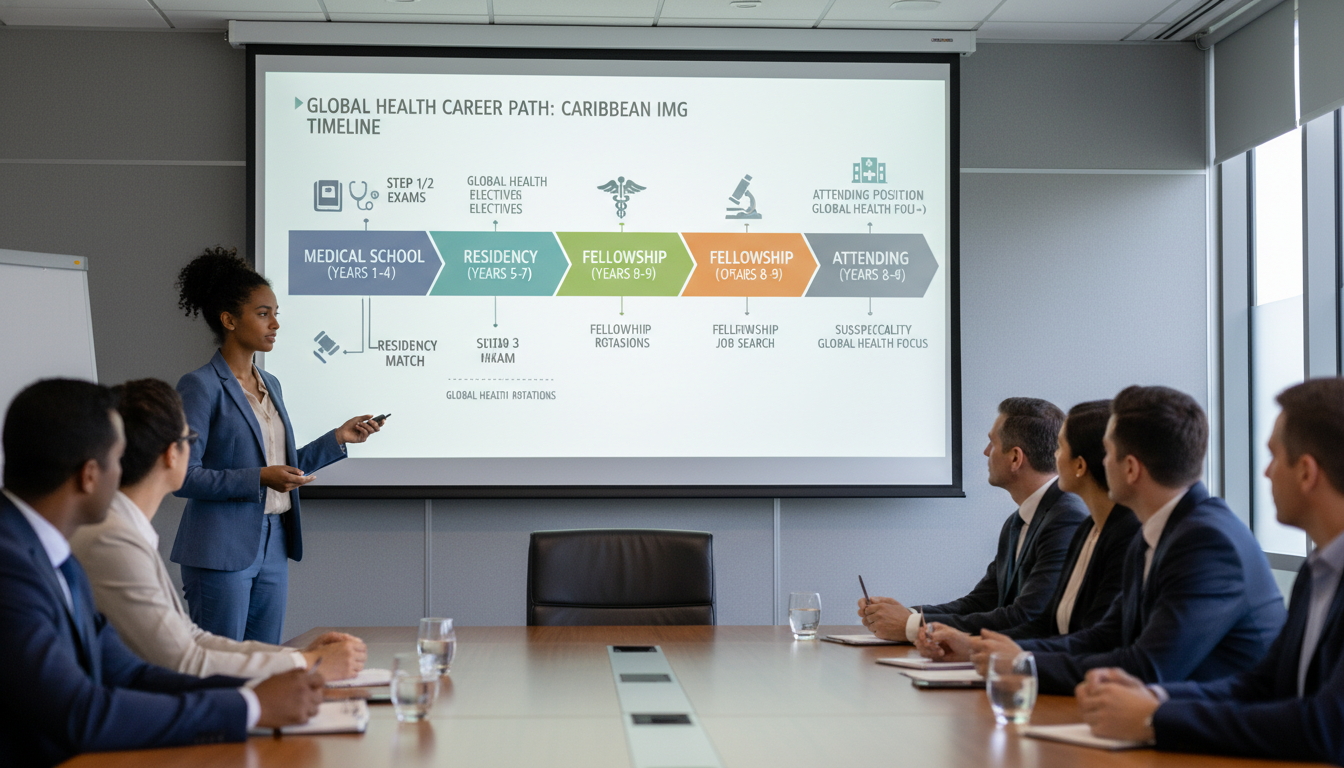
Practical Timeline Summary: From MS1 to First Global Health Job
Below is a simplified guide to when to start job search–related activities for a Caribbean IMG in global health:
Medical School (Caribbean)
- MS1–MS2:
- Decide your global health theme; join interest groups; start small projects.
- MS3–MS4:
- Choose rotations and mentors that support a global health trajectory.
- Research residencies with strong global health residency tracks.
Residency
- PGY1:
- Focus on clinical excellence.
- Identify global health mentors and your niche.
- PGY2:
- Clarify path: fellowship vs. direct-to-job.
- Start structured research and build a target list of programs/employers.
- PGY3 (and PGY4 where applicable):
- 12–18 months before graduation: apply to global health fellowships and academic/globally-oriented jobs.
- 6–12 months before graduation: apply to NGO roles (if going directly) and domestic jobs with a global component.
Post-Residency (Plus/Minus Fellowship)
- First 1–3 years:
- Balance visa/loan requirements with short-term or partial global health work.
- Continue to build a field-based track record that will support future promotions or transitions to more global-focused roles.
FAQs: Job Search Timing for Caribbean IMGs in Global Health
1. As a Caribbean IMG, when should I seriously start my job search for global health roles?
You should begin serious planning by PGY2 and formal applications 12–18 months before finishing residency (and/or fellowship). Earlier planning is especially important if you’re targeting competitive global health fellowships or academic positions. For many NGO roles, 6–12 months lead time is sufficient, but allow extra time for background checks and deployment logistics.
2. How does being a Caribbean IMG affect my timing compared to U.S. MD/DO graduates?
For Caribbean IMGs, timing is more constrained because:
- Visa issues may limit which domestic jobs you can take immediately post-residency, which in turn affects when you can go abroad.
- You may need to secure a J-1 waiver or H-1B–sponsoring job first, often in underserved areas, before having flexibility for extended international work.
- Some employers in international medicine may have eligibility rules around licensing, citizenship, or training background.
Because of this, you need to start **mapping out your options earlier—by PGY2—**and always keep visa and loan obligations in mind when deciding when and where to apply.
3. Should I take a global health fellowship, or go directly into the job market?
A fellowship is not mandatory but can be highly advantageous if you want an academic career, leadership roles in NGOs, or work with large global institutions. The trade-offs:
- Fellowship Pros:
- Structured mentorship
- Advanced training in research, policy, or implementation science
- Field experience and stronger networking
- Fellowship Cons:
- Delayed attending-level income
- Additional years before addressing loans or family financial needs
If your primary goal is sustained international clinical work with NGOs or smaller organizations, you can sometimes go directly into the field—but a fellowship often improves long-term stability and advancement.
4. How do I balance a domestic job search with global health aspirations?
Many Caribbean IMGs adopt a hybrid strategy:
- Secure a solid domestic attending job (often required for visa reasons and loan repayment).
- During interviews, explicitly ask about:
- Protected time for global health.
- Existing institutional partnerships abroad.
- Build a portfolio of:
- Short field rotations
- Telehealth and capacity-building projects
- Collaborative research with global partners
This approach lets you stabilize your career and finances while steadily building a global health track record, setting you up for more dedicated international roles later.
By understanding the arc from Caribbean medical school residency through the SGU residency match–style pathways and beyond, you can time your attending job search to align with the realities of the modern physician job market in global health. Planning early, choosing residencies that support a global health residency track, and starting applications well before graduation will give you the best chance to turn your global health vision into a sustainable, impactful career.