
Understanding the Job Market for Caribbean IMGs in Nuclear Medicine
Caribbean medical graduates entering nuclear medicine face a unique intersection of opportunities and constraints. Nuclear medicine is a relatively small specialty, with limited residency and fellowship spots and a geographically uneven physician job market. For a Caribbean IMG, these realities make job search timing not just important but mission‑critical.
Unlike larger fields such as internal medicine or family medicine, nuclear medicine positions are fewer, more specialized, and often highly tailored to institutional needs. At the same time, many employers still have biases—subtle or overt—about non‑US schools, including Caribbean medical schools. Yet, every year, Caribbean IMGs in specialties like nuclear medicine successfully secure excellent positions, especially those who:
- Strategically plan their job search timeline
- Leverage a strong residency track record (e.g., SGU residency match or other Caribbean medical school residency outcomes)
- Understand regional differences in demand and licensing
- Start early enough without sabotaging their current training obligations
This article focuses on when to start your job search as a Caribbean IMG in nuclear medicine, step‑by‑step from residency and fellowship through your first attending role. It is written for those who trained at a Caribbean medical school (like SGU, AUC, Ross, Saba and others), matched to nuclear medicine or hybrid programs, and are now navigating the nuclear medicine match → residency → job search → attending job search sequence.
Big Picture Timeline: From Nuclear Medicine Match to First Attending Job
To manage timing, first see the full arc:
- Caribbean medical school
- USMLEs, clinical rotations, letters, and applying to nuclear medicine‑friendly programs.
- Residency and/or fellowship training
- Traditional pathways:
- Diagnostic Radiology → Nuclear Medicine fellowship
- Internal Medicine/other primary specialty → Nuclear Medicine (1–2 year) fellowship
- Integrated Nuclear Radiology pathways (less common)
- Traditional pathways:
- Late training (PGY-4 and beyond)
- Deciding between:
- Pure nuclear medicine jobs
- Hybrid Nuclear Medicine + Diagnostic Radiology roles
- Academic vs private practice jobs
- Deciding between:
- Job search and contract negotiation
- Transition to attending life
The critical timing question is:
At what point during this training arc should a Caribbean IMG in nuclear medicine begin each phase of the job search?
The answer varies depending on:
- Your visa status
- Your training pathway (e.g., DR + NM vs pure NM)
- Academic vs private practice goals
- Geographic flexibility
- How competitive you are (publications, unique skills such as theranostics)
The rest of this guide breaks that down in concrete detail.
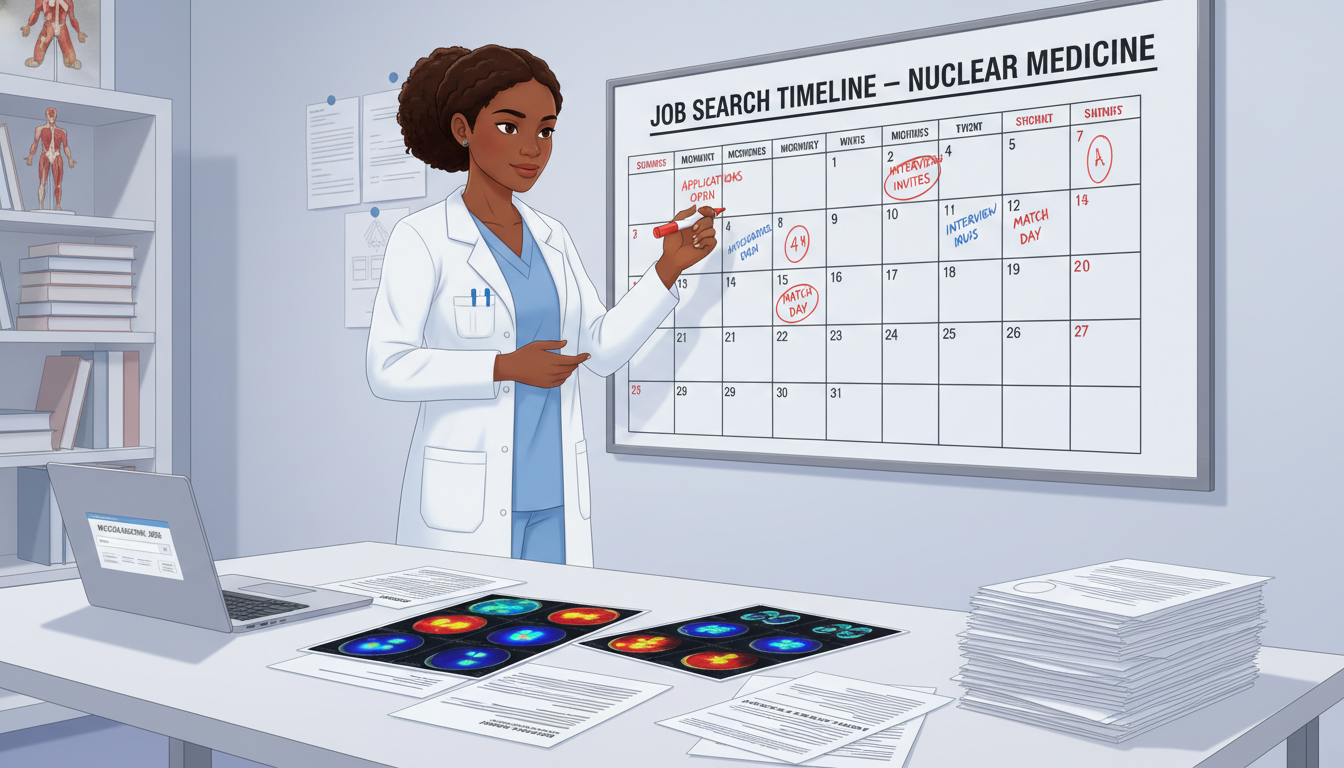
Year‑by‑Year: When to Start the Job Search in Nuclear Medicine
1. Early Residency/Fellowship (PGY‑1 to PGY‑3): Laying the Groundwork
You are not actively applying for attending jobs yet, but job search timing starts here in an indirect way.
Key goals in this stage:
- Build a CV attractive to nuclear medicine employers:
- Strong evaluations and procedure logs (e.g., PET/CT, SPECT/CT, cardiac nuclear, bone scans)
- If possible, experience in theranostics (Lu‑177, I‑131, etc.)
- Basic research or QA/QI projects that show initiative
- Clarify your long‑term practice goals:
- Pure nuclear medicine vs dual‑certified practice (e.g., DR + NM)
- Academic center vs private practice vs hybrid hospital‑employed model
- Geographic flexibility (rural, suburban, major metro)
- Learn the regional job landscape:
- Regions with higher demand for nuclear medicine (e.g., midwest, south, smaller cities)
- States more open to IMGs from Caribbean medical schools, based on alumni reports and mentors
What you should NOT do yet:
- Actively apply for attending roles; it’s too early.
- Negotiate contracts—you don’t yet have a firm graduation date, and your skills are still developing.
But you should be:
- Tracking where your seniors and alumni land jobs
- Attending nuclear medicine and radiology conferences (SNMMI, RSNA) and quietly networking
- Following job boards (even passively) to see what’s commonly requested
- Board eligibility/certification requirements
- Experience in PET/CT, cardiac nuclear, theranostics
- Expectations for call/coverage, academic productivity, and teaching
Practical example:
An SGU graduate in an ACGME‑accredited nuclear medicine fellowship in the Midwest starts attending local SNMMI chapter meetings during their first fellowship year. They don’t ask about jobs yet but arrange brief conversations with nuclear medicine attendings about their career paths. This early exposure frames their strategy for years ahead.
2. Mid‑Training (PGY‑4 to Early Final Year): Lining Up Your Options
This is when timing becomes more deliberate.
For many, this phase is:
- PGY‑4/PGY‑5 in Diagnostic Radiology, if planning an NM fellowship
- First year of a 2‑year Nuclear Medicine fellowship, if on that pathway
- Final year of primary specialty before nuclear medicine fellowship
At this point, focus on:
Clarifying whether you will do additional training
- A DR resident may be considering a nuclear medicine fellowship or a theranostics fellowship.
- An NM fellow might be considering extra imaging or oncology‑focused training.
- Timing impact: If you commit to more training, your attending job search shifts accordingly.
Understanding national trends in the physician job market for nuclear medicine
- Are PET/CT and theranostics services expanding in your target regions?
- Are job postings requesting dual‑boarded radiology + nuclear medicine physicians?
- Are pure nuclear medicine roles shrinking or stable?
Building your nuclear medicine identity
- Present at SNMMI or RSNA if possible.
- Collaborate on a small research or quality project.
- Become “the go‑to” resident/fellow for nuclear medicine cases at your institution.
Timing for preliminary exploration:
- 12–24 months before you expect to finish all training, you should:
- Start having informational interviews with faculty and program alumni about the job market.
- Ask them what the best timeframe is to start applying in your specific niche and geographic preferences.
- Update your CV and start drafting a general cover letter template.
For Caribbean IMGs, a crucial step here is to surface and address any perceived limitations:
- Visa status (J‑1 vs H‑1B vs US citizen/green card)
- Licensing complexity in specific states
- How your Caribbean medical school residency pathway is viewed locally
Use this time to identify visa‑friendly employers and states, especially if you will need J‑1 waiver positions.
3. Final Year of Training: When to Start the Actual Job Search
This is the most critical timing phase and where many IMGs either start too late or burn themselves out starting too early.
General rule of thumb for nuclear medicine:
- Start your serious attending job search 9–15 months before graduation
(i.e., before the end of all training, including fellowship).
But your exact window depends on your situation.
A. If You Are Visa‑Dependent (J‑1 or H‑1B)
For a Caribbean IMG needing a J‑1 waiver job or H‑1B sponsorship:
- Start 12–18 months before completion:
- Many employers are unfamiliar with waiver timelines and may underestimate how long paperwork takes.
- Some states have limited J‑1 waiver slots; competition can be time‑sensitive.
- You must align:
- Job offer timing
- State licensing
- Waiver application and approval
- Visa transfer or new petition
Concrete example:
You finish an ACGME nuclear medicine fellowship on June 30, 2027, on a J‑1 visa. You should actively start:
- Contacting potential employers: July–October 2025
- Interviewing and negotiating: Late 2025–Spring 2026
- Finalizing a signed contract: By mid‑2026 (approximately 12+ months before graduation)
- Beginning waiver and licensing processes soon thereafter
This sounds early, but for visa‑dependent Caribbean IMGs, late timing is the most common reason for last‑minute panic.
B. If You Do NOT Need Visa Sponsorship
If you are a US citizen or permanent resident:
- 9–12 months before graduation is usually adequate for nuclear medicine.
- In some competitive urban areas, starting 12–15 months ahead gives you an edge, particularly if:
- You want an academic position in a major center
- You have a niche focus, such as theranostics
Sample timeline (no visa, finishing June 2027):
- July–September 2026 (9–12 months out)
- Start emailing potential employers and replying to posted jobs.
- Ask mentors for direct introductions to department chairs or practice partners.
- October 2026–January 2027
- Active interviewing, site visits, second looks.
- Begin negotiating contract terms for top 1–2 offers.
- February–April 2027
- Finalize your contract.
- Begin onboarding, licensing, and credentialing.
- May–July 2027
- Transition period and relocation, in parallel with finishing fellowship.
4. Where to Look and How Timing Differs by Job Type
Timing also depends on whether you are targeting academic or private practice/community positions.
Academic Nuclear Medicine Jobs
Academic positions tend to:
- Have longer hiring cycles
- Post early, often 12–18 months in advance
- Require more steps (committee reviews, multiple interviews, sometimes national recruitment)
For a Caribbean IMG targeting an academic nuclear medicine role:
- Start scanning academic job postings 18 months before graduation.
- Begin informal conversations with department chairs or division chiefs 12–15 months out.
- At national meetings, ask explicitly about upcoming positions:
- “Will your institution be recruiting in nuclear medicine or theranostics in the next 1–2 years?”
- Academic centers may be more open to a candidate with a strong nuclear medicine research or theranostics profile, even if from a Caribbean medical school, especially if:
- You have publications
- You were chief resident or fellow
- You’ve shown clear commitment to teaching and mentorship
Private Practice / Community Hospital Nuclear Medicine Jobs
Private practices and community hospitals:
- Sometimes hire later and more reactively (e.g., when someone retires or leaves).
- May want someone to start within 3–6 months of an offer.
For these roles:
- 9–12 months ahead is usually a safe start.
- However, don’t panic if an ideal private practice job appears only 4–6 months before graduation; many are accustomed to this timeline.
If you want a hybrid job (e.g., 50% nuclear medicine, 50% general radiology):
- Pay attention to radiology job boards as well as nuclear medicine‑specific listings.
- Your DR credentials and comfort with cross‑sectional imaging will matter greatly.
- Timing is similar (9–12 months), but jobs might be more numerous in mid‑sized cities and community settings.

Step‑by‑Step: How to Execute Your Attending Job Search as a Caribbean IMG
Once you reach your job application window (typically 9–15 months before graduation), timing is about sequencing actions rather than just starting early.
Step 1: Clarify Your Non‑Negotiables and Flexibilities
Before sending any CVs, define:
- Non‑negotiables:
- Visa support (if needed)
- Required salary range (research local cost of living)
- Type of practice (academic vs private)
- Required percentage of nuclear medicine vs general radiology work
- Flexibilities:
- Geographic region(s)
- Mix of clinical vs research
- Call responsibilities
- Teaching expectations
Knowing this prevents you from wasting time on jobs that cannot work for you or your visa.
Step 2: Prepare a Tight, Focused Application Package (1–2 Months Before Launch)
Have these ready before you respond to job ads:
- Updated CV emphasizing:
- Nuclear medicine case volume
- Procedures (Y‑90, Lu‑177, cardiac nuclear, thyroid therapies, etc.)
- Any theranostics or molecular imaging exposure
- Teaching and leadership roles
- Two versions of a cover letter:
- Academic‑focused
- Private practice‑focused
- A short email pitch template you can personalize:
- Who you are (Caribbean IMG → US residency/fellowship → nuclear medicine expertise)
- When you are available to start
- Interest in their specific institution/practice
- Visa needs (if applicable) stated clearly but briefly
Step 3: Launch Your Search in Phases
Once within your target window (e.g., 12 months before graduation):
Phase 1 – Warm Network (Weeks 1–3)
- Ask your program director and mentors:
- “Do you know any nuclear medicine or radiology leaders who might be hiring in the next year?”
- Email alumni (including those from SGU or other Caribbean medical school residency pathways):
- Explain your graduation date and desired roles.
- Timing goal: line up 2–3 early informational calls.
- Ask your program director and mentors:
Phase 2 – Targeted Outreach (Weeks 2–8)
- Apply to posted jobs or email institutions of interest even if no ad is posted.
- Prioritize:
- Programs known to hire IMGs or Caribbean graduates
- Institutions you’ve encountered through SNMMI/RSNA networking
- Keep a spreadsheet with:
- Dates contacted
- Response status
- Interview dates
- Notes about culture, salary range, call, etc.
Phase 3 – Interviews and Re‑calibration (Months 2–5)
- After several interviews, reassess:
- Is your salary expectation realistic?
- Are your geographic preferences limiting options too much?
- Are employers receptive to your visa needs?
- Adjust your outreach strategy accordingly:
- Broaden regions
- Consider hybrid DR/NM roles if pure NM jobs are limited in your target area.
- After several interviews, reassess:
Step 4: Negotiation and Decision‑Making (Months 3–8)
Nuclear medicine jobs vary widely in:
- Salary
- RVU expectations
- Protected academic time
- Call burden
- Procedural support (physics, technologists, nursing)
For Caribbean IMGs, timing of negotiation is especially important:
- Do not delay responding to offers excessively—some private practices move quickly and may pull offers if not answered within a reasonable window.
- On the other hand, you may legitimately need 2–4 weeks to:
- Compare offers
- Consult mentors or a physician contract lawyer
- Confirm visa and licensing feasibility
If you have multiple offers:
- Prioritize long‑term growth and stability over purely higher initial salary.
- Consider:
- Will this job give you sustained nuclear medicine experience, or will you gradually be shifted into only general radiology work?
- Does the institution value your background and potential, or are you simply filling a service gap?
Special Considerations for Caribbean IMGs in Nuclear Medicine
1. Addressing Caribbean Medical School and IMG Bias
Some employers may have limited experience with Caribbean medical graduates or may associate “Caribbean medical school residency” pathways with weaker applicants. Counter this proactively:
- Highlight:
- Your US residency and/or fellowship pedigree
- Objective accomplishments (board scores, case volumes, publications)
- Leadership roles (chief resident/fellow)
- Provide strong, US‑trained nuclear medicine or radiology faculty references who can attest to:
- Your clinical acumen
- Reliability
- Teamwork and communication
- In conversation, briefly but confidently own your path:
- “I trained at [Caribbean school], then matched into [residency/fellowship] where I focused on nuclear medicine and theranostics. The diversity of my training sites has prepared me well to adapt to varied practice environments.”
2. Visa Strategy and Timing
For J‑1 waiver‑seeking nuclear medicine physicians:
- Identify states with open or flexible waiver policies early (during fellowship).
- Ask program alumni and your institution’s GME office which employers frequently sponsor IMGs.
- Understand that while some academic centers are open to visas, many private practices avoid the complexity—you need extra time to find those willing to engage.
3. Leveraging Conferences and National Societies
For timing and networking, SNMMI and RSNA are your best friends:
- Abstract submissions are often 6–9 months before the conference—plan ahead if you want your name visible when job discussions happen.
- Many institutions announce new positions informally at these meetings, months before an official job posting.
- Approach faculty directly:
- “I’ll be completing my nuclear medicine training in [year]. Would your institution be recruiting in nuclear or theranostics in the next cycle?”
- Having this information early lets you time your formal application more precisely.
After You Sign: Timing Your Transition to Attending Life
Once you’ve accepted a position, timing still matters.
6–12 months before start date:
- Initiate state licensure (some states are slow).
- Start hospital credentialing paperwork.
- For visas:
- Coordinate closely with your future employer’s legal team.
- Track all deadlines around DS‑3035, I‑612, waiver applications, H‑1B petitions, etc.
3–6 months before start date:
- Finalize housing and relocation.
- Request a graduation letter or training verification from your program, often needed for credentialing.
- Clarify your orientation schedule and initial expectations (how much NM vs other imaging, how call is shared).
Synchronizing all these steps with your training completion helps avoid gaps in employment.
FAQs: Job Search Timing for Caribbean IMG in Nuclear Medicine
1. When should I start seriously searching for a nuclear medicine attending job as a Caribbean IMG?
For most, the ideal window is 9–15 months before you finish all training. If you need a J‑1 waiver or H‑1B sponsorship, lean earlier: 12–18 months. Academic jobs also favor earlier outreach, often 12–18 months in advance, while private practice/community jobs commonly hire 6–12 months before your start date.
2. I’m a Caribbean IMG finishing a nuclear medicine fellowship on a J‑1 visa. How early do I need a signed contract for a waiver job?
You should aim to have a signed contract at least 12 months before fellowship completion, and start targeted job outreach 18 months before. This gives time for licensing, waiver processing, and any unforeseen delays. Some states and employers may be quicker, but late timing creates high risk of gaps in status or missed waiver cycles.
3. How does being from a Caribbean medical school affect my nuclear medicine job search timing?
Your training in the US (residency and fellowship) matters more than your medical school, but some employers may still have biases or be unfamiliar with Caribbean medical school residency pathways. Counter this with strong US references, clear documentation of your nuclear medicine skills, and proactive networking at national meetings. Start a bit earlier (toward 12–15 months out) so you have time to find employers who value your full trajectory.
4. Should I apply for attending jobs before or after the nuclear medicine board exam?
Apply before the exam if it falls near the end of your training. Most employers hire based on board eligibility at the time of hire, with the expectation you will pass the boards soon after. Waiting until after passing can significantly shorten your job search window; instead, clarify your exam date and preparation plan during interviews and keep employers updated once you pass.
By understanding both the macro‑timeline of your nuclear medicine training and the micro‑timing of applications, interviews, and visa steps, you can turn a potentially stressful process into a structured, strategic transition. For Caribbean IMGs, the key is to start early enough, target smartly, and leverage mentors and networks so that when graduation arrives, your next step as a nuclear medicine attending is already in place.