
Understanding the Timeline: From Caribbean Medical School to Urology Attending
For a Caribbean IMG in urology, timing your job search is almost as strategic as timing your residency applications. You’ve already navigated the complexities of a Caribbean medical school residency path and the SGU residency match or a similar match journey; now the question becomes: When should you start looking for your first attending job, and how should you structure that search?
Unlike some other specialties, the urology job market has specific patterns: hiring cycles, fellowship considerations, regional variations, and a comparatively small and network‑driven community. As a Caribbean IMG, you’ll also need to factor in visa issues, perceived bias in hiring, and the importance of early networking.
This guide breaks down what to do, and when, from the start of residency to your first year in practice, so you can approach the attending job search with a clear plan rather than last‑minute panic.
The Big Picture: Key Milestones on the Road to Your First Urology Job
Before diving into month‑by‑month timing, anchor yourself with the major milestones you’ll typically hit:
- Caribbean med school (MD/MBBS): Often at SGU or another Caribbean program; focus is on building a strong application for the urology match.
- Urology residency (5–6 years including intern year, depending on program structure):
- PGY‑1–2: Foundational training, rotations, deciding on fellowship vs general urology.
- PGY‑3–4: Increasing autonomy, research, and defining your clinical interests.
- PGY‑5–6 (if applicable): Chief year and/or fellowship application.
- Fellowship (optional, 1–2 years): Subspecialization—endourology, oncology, pediatrics, female pelvic medicine, reconstructive, etc.
- Attending job search: Overlaps with late residency or fellowship.
Broad timing rules for urology job search
There is no single “correct” date to start, but these are solid benchmarks:
If going straight into practice after residency
- Start serious search: 12–18 months before graduation
- Begin networking and “soft search”: 24+ months before graduation
If doing a fellowship first
- Start serious search: 12–18 months before fellowship completion
- Begin networking and exploring practice models: early in fellowship (months 3–6)
If you’re a Caribbean IMG on a visa (J‑1/H‑1B)
- Start exploring options and immigration constraints: at least 18–24 months before your intended start date
- For J‑1 waiver positions (e.g., underserved areas): begin discussions up to 2 years ahead.
These timeframes are more conservative than what many US MDs follow—but that buffer is useful as an international graduate in a competitive, relationship‑driven specialty.
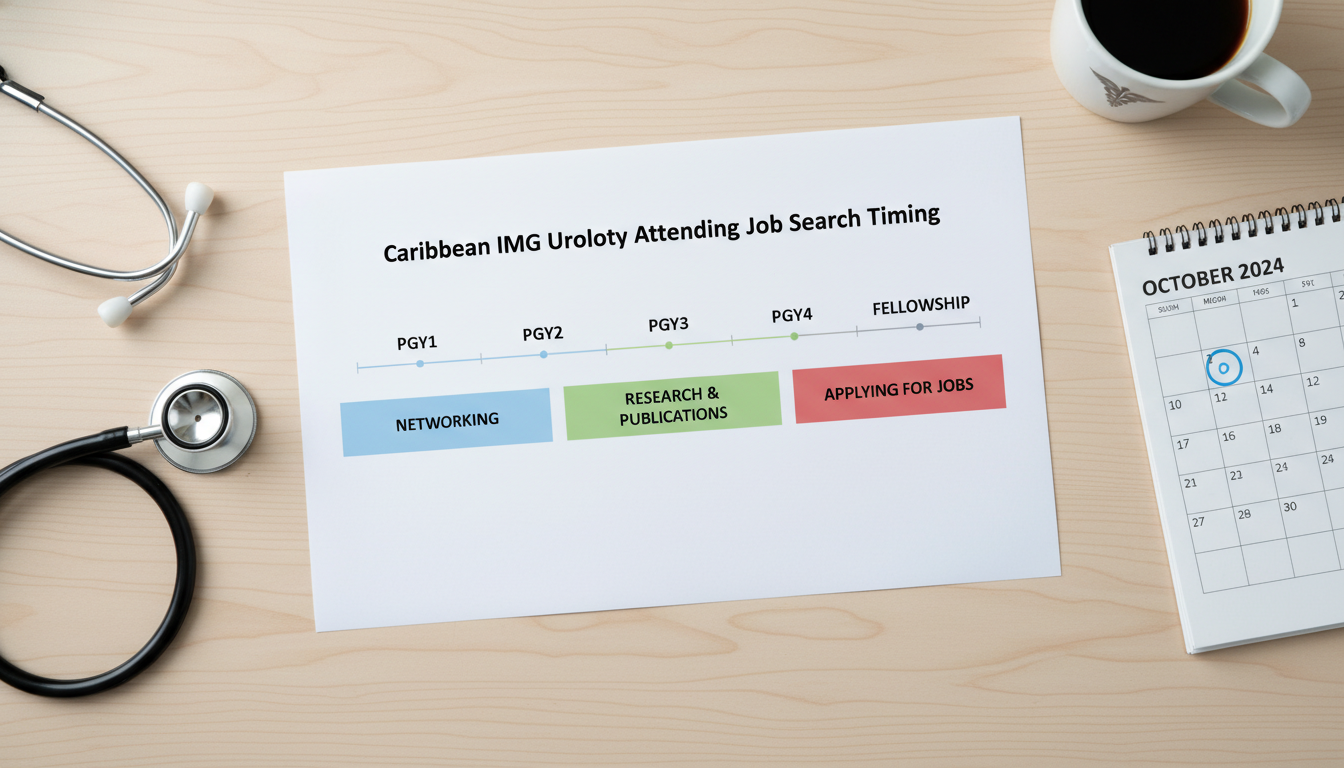
Year‑by‑Year: When to Start Your Urology Job Search
PGY‑1–2: Laying the Foundation (Not Applying Yet, But Positioning)
At this stage, your “job search” is indirect, but crucial:
Primary aims:
- Establish a strong clinical reputation with faculty and senior residents.
- Identify areas of interest: oncology, endourology, reconstructive, pediatrics, FPMRS, andrology, etc.
- Decide whether you’re likely to:
- Practice general urology, or
- Pursue a urology fellowship (important for timing later).
Key timing actions:
Start tracking your strengths and preferences
Keep a simple document noting:- Cases you enjoy
- Faculty mentors and how they practice (academic vs private)
- Any geographic preferences (e.g., East Coast vs Midwest; urban vs rural)
Clarify your visa/immigration path (especially as a Caribbean IMG)
- Find out how your residency program handles H‑1B vs J‑1 visas.
- Briefly explore what a J‑1 waiver job entails (if applicable).
- Note that certain regions and job types (e.g., rural hospitals, critical access hospitals) are more visa‑friendly.
At this point, you are not sending applications—but you are starting to understand where you might be employable and under what conditions.
PGY‑3–4: Defining Your Path and Starting Soft Job Exploration
By mid‑residency in urology, your choices start to have real consequences for the timing of your job search.
Primary aims:
- Decide between:
- General urology practice after residency, or
- Subspecialty fellowship (and which one).
- Start informal conversations about jobs and market needs.
- Build research and teaching profile if you’re considering academic urology.
Key timing actions:
Clarify fellowship intentions by late PGY‑3
- If you want a competitive subspecialty (oncology, pediatrics, FPMRS): have a draft CV and rough research plan by late PGY‑3.
- Meet with mentors to ask:
- What is the long‑term physician job market in this area?
- Do graduates of this fellowship easily find jobs? In what regions?
Start soft market reconnaissance (PGY‑3–4)
- Browse postings on:
- AUA Career Center
- Urology Times jobs board
- Large health system job pages
- Major recruiting firms (Merritt Hawkins, Jackson & Coker, etc.)
- Note:
- Which states have more visa‑friendly roles.
- Salary ranges for different practice types (academic vs private vs hybrid).
- Frequency of openings in your preferred regions.
- Browse postings on:
Attend conferences strategically
- At AUA or regional urology meetings:
- Go to career development sessions.
- Introduce yourself to department chairs and program directors—even a brief “I’m PGY‑3, originally from a Caribbean medical school, planning on general urology” starts to plant seeds.
- Some institutions will even do informal early recruiting at national meetings.
- At AUA or regional urology meetings:
You are still not in the full “application” phase, but your name should begin appearing on the radar of urology leaders in your areas of interest.
PGY‑5–6 (Chief Year) If Going Straight Into Practice
If your urology residency is 5–6 years and you’re not doing a fellowship, chief year is when timing becomes critical.
Ideal application window:
Start serious applications 12–18 months before graduation.
For many residents, that means:
PGY‑4 late / PGY‑5 early:
- Begin updating your CV and personal statement.
- Ask mentors for references and permission to list them.
PGY‑5 mid (about 1 year before you finish):
- Begin actively applying to positions.
- Respond to recruiter outreach and job board postings.
- Let your network know: “I’ll be available July of next year; I’m looking for general urology with a focus on [X] in [regions].”
Why 12–18 months is smart for Caribbean IMG urologists:
- Some hospital systems take 6–9 months (or more) to complete:
- Credentialing
- State licensure
- Visa petition processing (for H‑1B)
- J‑1 waiver approval (if applicable)
- As an IMG, you may need additional time to reassure smaller groups about:
- Visa logistics
- Prior training (Caribbean medical school + US residency)
- Board eligibility and timeline
Practical example:
- You finish residency June 2028.
- Recommended timing:
- Start applications: January–June 2027.
- Aim to sign a contract: October 2027–March 2028.
- Begin licensure and credentialing: As soon as contract is signed—ideally by early 2028.
If you wait until January 2028 to start, you risk having no finalized job by graduation, particularly if visa issues complicate start dates.
Fellowship Path: When the Clock Resets (But Not Completely)
If you do a 1–2 year urology fellowship (e.g., oncology, endourology, FPMRS), your serious job search usually starts during fellowship, not at the end of residency. But the foundation is laid earlier.
Before fellowship (late residency):
- Discuss with fellowship director:
- How their graduates typically find jobs.
- When they recommend you start applying.
- Whether they can place you in their network (often the strongest lead).
During fellowship:
Months 3–6:
- Update CV with fellowship details.
- Reconfirm geographic and practice preferences.
- Discuss prospects with prior mentors and fellowship faculty.
Months 6–12 (for a 1‑year fellowship):
- This is the high‑priority job search window.
- Attend relevant meetings (e.g., SUO, SUFU, SMSNA) and visit tables/booths or department receptions where hiring chairs are present.
- Have a short, clear pitch prepared:
- “I’m completing a fellowship in [subspecialty] at [institution] next July, originally trained at [urology residency], and I’m looking for an academic position with [X%] subspecialty practice or a private group that wants to build [service].”
For Caribbean IMGs on visas:
- Confirm with fellowship program:
- Whether you can transfer or extend your existing visa.
- Whether you’ll need a J‑1 waiver job afterward.
- Start exploring J‑1 waiver‑eligible locations or visa‑friendly employers at least 18 months before your intended start date, even if that overlaps late residency and early fellowship.

Matching Timing to the Urology Job Market Reality
Understanding how the physician job market works for urology will help you interpret when postings appear and why some positions move slowly.
Typical hiring patterns in urology
Academic centers:
- Often follow budget cycles; many positions are approved and advertised 6–12 months before desired start date.
- Some may have long interview and committee review processes.
- They may be more comfortable with complexity around visas but have stricter requirements (research output, subspecialty training).
Private practice groups:
- Hiring can be more opportunistic—they recruit when someone retires, volume grows, or a hospital pushes them to expand.
- Timelines can vary from fast (a few months) to slow (over a year), especially where partnership track and buy‑in are involved.
- Some smaller groups may be hesitant about visas; starting discussions early gives them time to consult with immigration counsel.
Hospital‑employed positions:
- Usually have established HR / recruitment pipelines.
- Can be more open to Caribbean IMG graduates due to larger systems and existing experience with visa sponsorship.
- Credentialing and licensure can add months to the process.
Urology‑specific nuances
The urology match is competitive, which keeps the number of practicing urologists relatively low. That can work in your favor: most regions genuinely need more urologists. However, demand is not evenly distributed:
- High‑cost urban academic centers: More competition, more subspecialty expectations.
- Smaller cities and rural areas: Strong need, more general urology, frequently more welcoming to IMGs and visa sponsorship.
- Highly subspecialized practices: May want someone who can start a distinct program (e.g., robotic oncology, female pelvic reconstruction) and will recruit 12–24 months in advance.
For a Caribbean IMG in urology, aligning timing with market realities might mean:
- Being flexible with your first job location to secure a strong initial attending role.
- Using that first role to gain experience and then moving to a more ideal region later, once visa and board certification are established.
Step‑By‑Step: What to Do at Each Stage of the Job Search
18–24 Months Before Start Date: Strategic Planning and Positioning
- Clarify:
- Desired practice type: academic vs private vs hospital‑employed.
- Geographic “must‑haves” vs “nice‑to‑haves”.
- Whether you need a J‑1 waiver or H‑1B sponsorship.
- Draft a clean, updated CV:
- Highlight urology residency and any Caribbean medical school achievements relevant to resilience and international perspective.
- List research, presentations, and leadership.
- Start talking openly with mentors:
- “I’m targeting a general urology job on the East Coast, ideally with some endourology focus. When should I start reaching out to your contacts?”
12–18 Months Before Start Date: Active Search and Networking
- Begin monitoring job boards weekly.
- Reach out to:
- Chairs and program directors where you rotated, did away electives, or presented at conferences.
- Your Caribbean medical school alumni in urology (e.g., SGU residency match graduates now in practice).
- Respond to recruiter emails—but screen them intelligently:
- Confirm whether they handle visas.
- Clarify call schedule, OR block time, and case mix.
Timing tip:
For a July 1, 2028 start date, this phase roughly runs from January 2027 to July 2027.
9–12 Months Before Start Date: Interviews, Site Visits, and Short List
- Aim to have multiple interviews scheduled across diverse practice types.
- Conduct site visits—ideally in person:
- See OR setups, clinic flow, support staff.
- Meet potential partners and ask about turnover.
- Begin comparing:
- Compensation models (salary vs RVU vs partnership track).
- Support for subspecialty interests (robot access, complex reconstruction, research).
- Visa support and timeline.
For an IMG, it’s often helpful to over‑interview rather than under‑interview—even if some positions are not ideal, they sharpen your sense of the market and negotiation.
6–9 Months Before Start Date: Negotiation and Contract Signing
- By this point, you should be:
- Narrowing down to 1–3 serious options.
- Requesting contracts or offers.
- Ensure your timing allows for:
- State licensure processing (2–6 months or more).
- Hospital credentialing (2–4+ months).
- Visa petition and any waiver approvals.
If you are still at zero offers 6 months before graduation/fellowship end, intensify your search:
- Expand geographic preferences.
- Use your mentors’ networks more aggressively.
- Contact department chairs directly with a concise email and attached CV.
3–6 Months Before Start Date: Logistics and Transition
- Complete:
- Medical license applications (multiple states if necessary).
- Hospital privilege forms.
- DEA registration, CSR (if required by state).
- Arrange:
- Housing and relocation.
- Final credentialing documents (malpractice history, training verification).
This is not the time to be discovering visa problems or scope‑of‑practice surprises—those should have been clarified at the negotiation stage, well before.
Common Pitfalls for Caribbean IMG Urologists (and How to Avoid Them)
1. Starting the job search too late
Waiting until the last 6–9 months of training to begin is risky, especially with visa needs.
Solution:
Treat the 12–18 month window as non‑negotiable for serious applications, and begin networking even earlier.
2. Underestimating visa and licensure timelines
Some institutions don’t fully understand J‑1 waivers or are slow with H‑1B paperwork.
Solution:
Ask direct, time‑specific questions early in the process:
- “Have you previously sponsored J‑1 waivers/H‑1B for urologists?”
- “What is your usual timeline from signed contract to start date for IMG hires?”
3. Ignoring the power of networks
In urology, referrals from trusted faculty or colleagues can outweigh a cold CV from job boards—especially for Caribbean IMGs who may feel they have to “prove” themselves more.
Solution:
Use:
- Urology residency mentors.
- Fellowship directors.
- Caribbean med school alumni in the US (e.g., SGU grads who can speak to your pathway from Caribbean medical school residency to practice).
4. Being too rigid about first job criteria
It’s ideal to land a job that matches all your preferences—but the first job doesn’t have to be your forever job.
Solution:
Prioritize:
- Visa stability and board eligibility.
- Case volume and operative experience.
- Reasonable workload and collegial environment.
You can often change geographic location or practice type after establishing yourself as a board‑certified attending.
FAQs: Job Search Timing for Caribbean IMG in Urology
1. When should I start my urology job search if I’m finishing residency and not doing a fellowship?
Begin serious search activities 12–18 months before graduation. For example, if you finish in June 2028, start applying to positions and reaching out to networks between January and June 2027. As a Caribbean IMG, especially with visa needs, this buffer is important for licensure, credentialing, and immigration processing.
2. How does being a Caribbean IMG affect timing compared to US graduates?
You typically need to start a bit earlier and be more organized. Employers may need extra time to:
- Understand and process your visa.
- Verify international medical education (Caribbean medical school) in addition to US residency.
Aim for the front edge of the 12–18 month window and start exploring visa‑friendly communities 18–24 months before your desired start.
3. If I matched from SGU or another Caribbean school into urology, when should I start planning my attending job search?
Early planning can begin as soon as PGY‑3, when you clarify fellowship vs general practice and geographic preferences. For an SGU residency match graduate, for example, it’s smart to:
- Start networking and attending career sessions in mid‑residency.
- Begin your active job search 12–18 months before your final training year ends (residency or fellowship).
4. What if I’m unsure about fellowship—does that change my job search timing?
Yes. If you are on the fence, you should:
- Decide on fellowship no later than late PGY‑3 or early PGY‑4, since fellowship applications themselves have deadlines.
- If you opt not to pursue fellowship, immediately pivot to a residency‑to‑practice timeline and start planning your job search at least 18 months before graduation.
If you do pursue fellowship, your main attending job search will then occur during the mid‑portion of fellowship, still targeting 12–18 months before your final completion date.
By understanding the urology job market and starting early—especially as a Caribbean IMG—you can turn what feels like a daunting, opaque process into a structured, strategic campaign. Timing, preparation, and networking will matter as much as your case log and surgical skills in securing the right first job and launching a sustainable career in urology.