Understanding the Clinical Informatics Job Market
Clinical informatics is a niche but rapidly evolving space in the physician job market. Unlike traditional clinical roles with well-defined hiring cycles (e.g., hospitalist, outpatient primary care), clinical informatics hiring is more variable and project-driven.
You’re often navigating two overlapping markets:
- Clinical roles (hospital, outpatient, academic)
- Informatics roles (CMIO/Associate CMIO, Medical Director of Informatics, Director of Clinical Informatics, health system informatics roles, digital health/health IT companies, EHR vendors, startups)
Because the job landscape is less standardized, timing your job search is both more important and more nuanced than in most clinical specialties.
Key factors that shape timing in clinical informatics:
- Budget cycles and fiscal years – Many health systems and health IT companies align hiring to Q1 or the start of their fiscal year.
- Project and go-live cycles – EHR go-lives, major upgrades, or digital transformation initiatives often trigger new informatics positions.
- Academic timelines – Universities and academic centers may follow academic hiring cycles similar to other faculty/leadership roles.
- Your career phase – Fellowship, early attending, mid-career transition, or moving into leadership (e.g., CMIO-level roles) each require different planning.
Understanding these dynamics helps you decide when to start job search activities, how aggressively to network, and when to actually submit applications.
Overall Timeline: When to Start Your Job Search
Most physicians underestimate how long it takes to land a good clinical informatics job. From initial networking to signed contract can easily be 6–12 months, especially for roles that combine clinical and informatics responsibilities.
Below is a general timeline, with adjustments for where you are in training or practice.
Typical Overall Timeline
- 12–18 months before start date
- Clarify your target roles and settings
- Start strategic networking in informatics circles
- Update CV and LinkedIn focused on clinical informatics
- 9–12 months before start date
- Begin active conversations with potential employers
- Identify geographic and role priorities
- Attend informatics conferences with job search in mind
- 6–9 months before start date
- Apply to open positions
- Request warm introductions
- Begin interviews
- 3–6 months before start date
- Final interviews and site visits
- Negotiate offer, contract, and start date
- Address licensure, credentialing, and onboarding
This general timeline applies whether you’re finishing a clinical informatics fellowship or transitioning from a mainly clinical role into an informatics-heavy position.
Timing for Different Career Stages in Clinical Informatics
1. During Clinical Informatics Fellowship
Your timeline depends heavily on how your fellowship is structured and your post-fellowship goals (academic vs community vs industry).
If You’re in a 2-Year ACGME-Accredited Clinical Informatics Fellowship
Ideal start for job search activities:
Begin structured planning about 12–15 months before graduation.
Suggested timeline:
15–18 months before graduation (early PGY-6 or mid-PGY-5 for many CI fellows)
- Clarify whether you want:
- Academic vs community hospital vs health system leadership vs vendor/industry
- Mostly clinical + some informatics (e.g., 0.6 clinical / 0.4 informatics)
- Mostly informatics + some clinical (e.g., 0.2–0.4 clinical)
- Work with your program director or mentor to align your project work and publications with your target role type.
- Begin talking to faculty, alumni, and CMIOs about how they found their jobs and when to start job search formally in your setting.
- Clarify whether you want:
12 months before graduation
- Update your CV to showcase:
- EHR implementation/optimization work
- Data analytics/reporting experience
- Governance committees
- Quality improvement and clinical decision support projects
- Teaching and leadership roles
- Optimize your LinkedIn profile with relevant keywords: “clinical informatics,” “EHR optimization,” “CMIO track,” “health IT.”
- Start casual conversations with:
- Recruiting departments at your current institution
- Alumni in informatics roles at other systems
- Recruiters specializing in physician + informatics positions
- Update your CV to showcase:
9–12 months before graduation
- Begin actively applying for jobs, especially if you’re geographically flexible.
- Use informatics conferences (AMIA, HIMSS, specialty informatics meetings) as live networking venues:
- Ask mentors to introduce you to CMIOs or informatics leaders.
- Attend vendor-sponsored sessions and talk to medical directors and clinical leaders.
6–9 months before graduation
- Expect first wave of interviews.
- Be prepared to discuss:
- Fellowship projects and measurable impact
- Governance and change management experience
- How you split time between clinical and informatics
- Clarify your desired start date and whether you can start informatics work part-time before full fellowship completion if local.
3–6 months before graduation
- Aim to have at least one serious offer under discussion.
- Negotiate:
- FTE split (clinical vs informatics)
- Protected time for projects, analytics, and committees
- Title (e.g., Associate Medical Director of Informatics vs Staff Physician with informatics duties)
- Career development (leadership training, AMIA/HIMSS travel, certifications)
Why you cannot wait until the last few months:
In clinical informatics, many roles are newly created or part of changing organizational structure. It often takes multiple rounds of internal approval, plus longer interview and negotiation timelines than pure clinical roles.

If You’re Doing an Unaccredited or On-the-Job Informatics Pathway
If your “fellowship” is more informal (e.g., 50% informatics role in a hospital system), you’ll often be:
- More dependent on internal hiring and promotion cycles
- Less constrained by a strict graduation date
In this case:
- Start discussing your career path internally at least 12 months before you want a new role.
- If you’re open to leaving your system, start external networking at the same time.
- Consider a longer search window (up to 18–24 months) if you’re targeting senior roles (e.g., Associate CMIO, CMIO).
2. Early Attending: First 3–5 Years After Training
If you’re an early attending physician who already has some informatics responsibilities (or wants them), your job search timing centers around:
- Your existing contract obligations
- Build-up of meaningful informatics experience
- Local organizational politics and leadership openings
When to Start the Job Search
If you’re in a mixed clinical + informatics role and want more informatics:
- Start internal conversations 9–12 months before you want a new balance of duties or a promotion.
- For external moves, start 12–18 months ahead, especially if you’re geographically constrained.
If you are primarily clinical and want to pivot into clinical informatics:
- Spend 6–12 months developing a real track record:
- Lead a documentation optimization initiative
- Participate in the EHR committee
- Work on CDS or quality dashboards
- Once you have concrete projects, start your formal search, ideally 9–12 months before desired transition.
- Spend 6–12 months developing a real track record:
Contract, Non-Compete, and Notice Periods
At the early attending level, when to start job search also depends on legal and contractual constraints:
- Notice periods: Many contracts require 60–180 days’ notice before leaving.
- Non-compete clauses: May restrict working for nearby systems or vendors serving your current institution.
- Repayment obligations: Signing bonuses, relocation reimbursements, loan repayment may require you to stay a minimum period.
You should:
- Review your contract 12–18 months before a likely job change.
- Factor in any payback or restrictions when setting your target start date.
3. Mid-Career and Leadership-Level Moves (Associate CMIO, CMIO, Medical Director)
For more senior clinical informatics roles, the physician job market behaves more like executive search than residency hiring.
Longer Lead Time
- Expect 12–24 months from initial exploration to landing a top leadership role.
- Many positions are never posted publicly and are filled by:
- Internal promotion
- Lateral moves from known leaders
- Networked recommendations
What This Means for Timing
If you are targeting CMIO or system-level leadership:
- Begin networking years, not months, before you expect to move.
- Speak with:
- CMIOs at other systems
- C-suite executives you know from collaborations or conferences
- Executive recruiters specializing in health IT leadership
For internal promotions:
- Make your intentions clear 12–18 months ahead of time.
- Align your portfolio:
- Governance leadership
- Multi-hospital projects
- Strategic planning committees
- Budget and personnel management
How Seasonal and Organizational Cycles Affect Timing
Even in a niche field like clinical informatics, there are real seasonality and organizational patterns that shape the attending job search and fellowship-to-job transitions.
1. Health System and Hospital Budget Cycles
Most large organizations:
- Approve new positions with the annual budget, often finalized in late Q3 or Q4 of the calendar or fiscal year.
- Are more likely to post new informatics roles:
- Right after budgets renew (often Q1)
- In conjunction with large IT initiatives
Implication for you:
- For a start date in July–September, it’s wise to:
- Be actively searching and networking by October–December of the prior year.
- Watch for new roles in Q1 when budgets and major initiatives kick off.
2. Academic Calendar and Promotion Cycles
Academic centers may:
- Time faculty hires to align with July 1 start dates.
- Begin serious recruitment for the following academic year 6–12 months in advance.
- Take longer for approvals due to multiple committees and leadership levels.
If you’re pursuing an academic-based clinical informatics fellowship followed by a faculty role:
- Start job conversations with your own institution by late PGY-5 or early PGY-6 (for a 2-year fellowship).
- Explore external academic options 9–12 months before your preferred start date.
3. EHR and Digital Transformation Timelines
Major health IT projects (EHR transitions, new enterprise systems, large clinical decision support programs) often drive hiring of informatics physicians.
Hiring spikes may coincide with:
- Pre-go-live build and validation phases
- Optimization or stabilization phases 6–18 months post-go-live
- New initiatives (e.g., AI pilots, data science platforms, interoperability programs)
Monitoring:
- Press releases
- Local/regional health IT news
- Vendor announcements can help you predict when organizations will need your skills and time your outreach accordingly.
Practical Steps: What to Do at Each Stage
1. 18–12 Months Before Target Start Date
Focus: Clarity, portfolio building, networking
Actions:
Define your “target job” in practical terms:
- % Clinical vs % Informatics
- Type of employer (academic, community, integrated system, vendor, startup)
- Desired location and travel tolerance
Build a visible track record:
- Lead or co-lead one or more high-impact informatics projects
- Chair or actively participate in informatics or EHR committees
- Document quantifiable outcomes (e.g., reduced clicks, improved documentation completeness, decreased readmissions)
Start systematic networking:
- Reconnect with fellowship alumni and former colleagues in informatics.
- Attend at least one major informatics conference with networking goals.
- Engage in AMIA or specialty-specific informatics working groups.
2. 12–9 Months Before Target Start Date
Focus: Market scanning and initial outreach
Actions:
Update all professional branding:
- CV tailored to clinical informatics fellowship experience or informatics roles.
- LinkedIn summary that clearly states your interest in clinical informatics roles.
- Personal website or portfolio if you have one (nice but not required).
Start informational interviews:
- Reach out to CMIOs, informatics directors, physician IT leaders.
- Ask about:
- Their organization’s hiring patterns
- Typical lead time for hiring physicians into informatics roles
- How they think about junior vs senior informatics positions
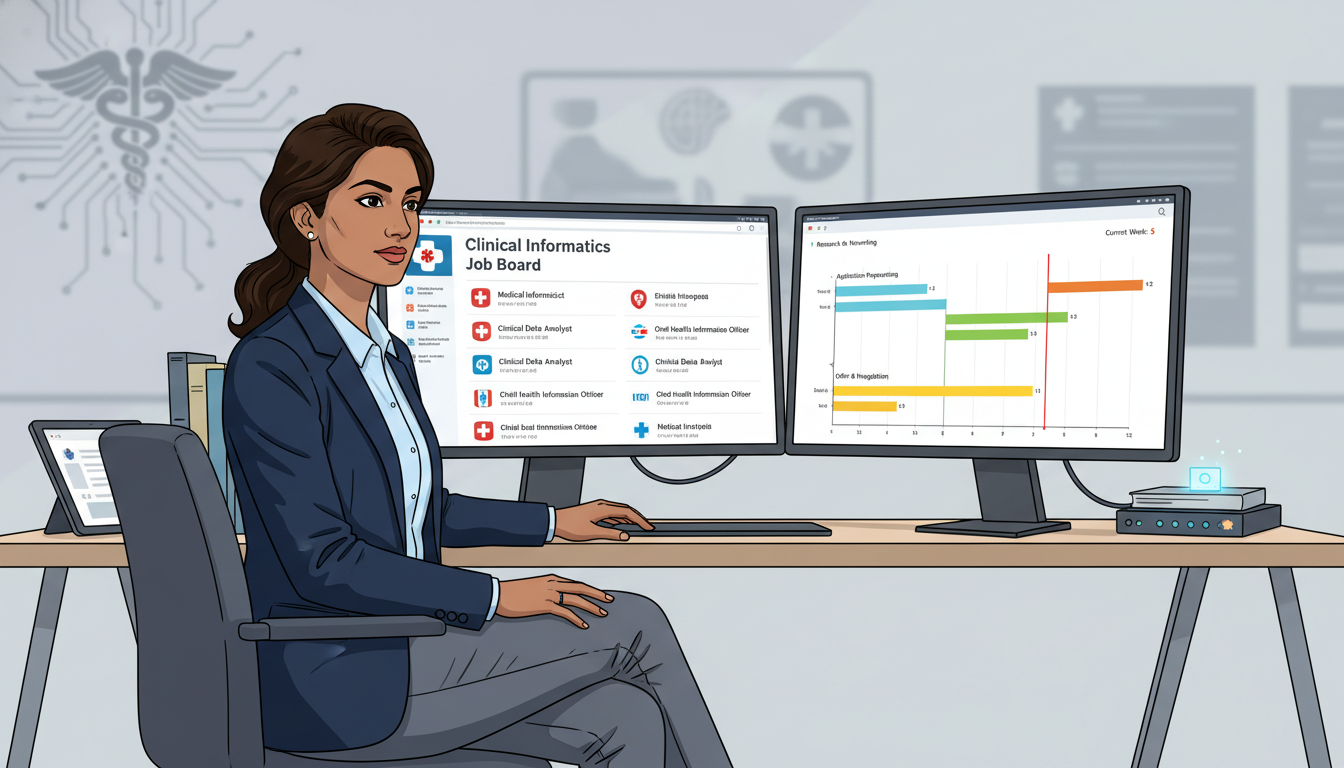
Begin watching job boards:
- AMIA Career Center
- HIMSS JobMine (and similar)
- Major hospital system job boards (search “informatics,” “CMIO,” “EHR,” “clinical informatics”)
- Health IT companies and digital health startups sites
3. 9–6 Months Before Target Start Date
Focus: Applications and early interviews
Actions:
Start applying to selected roles:
- Prioritize alignment with your desired FTE split and career goals.
- Customize cover letters to highlight:
- Your specific clinical background
- Your informatics skill set
- Past project outcomes and leadership experience
Engage selectively with recruiters:
- Respond to targeted outreach from recruiters familiar with health IT training and informatics.
- Share a clear one-page summary of your ideal role and constraints (location, salary band, clinical FTE).
Prepare for two types of interviews:
- Clinical interview (if role includes patient care)
- Standard attending physician interview topics: quality, safety, teamwork.
- Informatics interview
- EHR governance and change management
- Stakeholder engagement (nursing, allied health, IT)
- Approach to CDS design and evaluation
- Data literacy, dashboards, analytics
- Clinical interview (if role includes patient care)
4. 6–3 Months Before Target Start Date
Focus: Finalizing offers, negotiating, and logistics
Actions:
Evaluate offers not just by salary, but by:
- Clinical vs informatics time
- Title and influence (committee membership, governance structure)
- Support staff (analysts, project managers)
- Professional development opportunities (courses, conferences, board prep)
- Workload and expectations for nights/weekends/on-call for IT go-lives
Negotiate:
- Protected time for major projects
- Startup support for analytics or innovation work
- Pathways to advancement (clear criteria for promotion to leadership titles)
Confirm and start:
- Medical licensure in the new state (if applicable)
- Credentialing and privileging
- Access to necessary IT systems and training
Common Pitfalls in Job Search Timing for Clinical Informatics
Waiting too long to start
Many fellows and early attendings assume informatics jobs will be posted in a neat cycle like traditional clinical jobs. They start the attending job search 3–4 months before graduation and discover:- Fewer openings in their desired location
- Longer internal approval cycles
- Missed opportunities that were filled informally months earlier
Over-focusing on posted jobs
In a relationship-driven field like clinical informatics, a large portion of roles are:- Created around a known candidate
- Opened after conversations with leadership
- Never widely advertised Your timing should prioritize networking early, not just watching job boards later.
Undervaluing internal options
Some fellows ignore the possibility of staying on at their training institution. Often:- The easiest transition is from fellow to junior faculty or associate medical director in the same system.
- These transitions require early discussions (12–18 months out) so departments can plan budgets and FTE.
Not considering clinical role timing separately
You may need to:- Start a clinical attending position before a formal informatics title is available.
- Accept a role with initial lower informatics FTE and negotiate expansion over 12–24 months as projects grow.
Strategic Advice by Scenario
Scenario 1: Second-Year Clinical Informatics Fellow, Wanting Academic Job in Same City
- When to start job search: 12–15 months before graduation.
- Focus:
- Internal conversations with department and hospital leadership early.
- Build a case for a role that meets a departmental need (e.g., quality metrics, documentation, AI implementation).
- Risk if you wait: Role may be allocated to someone else; department may not have enough time to budget for your position.
Scenario 2: Early-Career Hospitalist with Strong Interest in Clinical Informatics, No Formal Fellowship
- When to start:
- Start portfolio building now; expect 6–12 months before you’re competitive for formal informatics roles.
- Once you have at least 1–2 substantial projects, begin search 9–12 months before desired transition.
- Focus:
- Join or create an EHR optimization project.
- Take on measurable informatics responsibility (order set redesign, note template standardization, CDS review).
- Longer-term move:
- Consider a clinical informatics fellowship or a defined internal training track if aiming for leadership roles.
Scenario 3: Mid-Career Specialist Aiming for Associate CMIO/CMIO Role
- When to start: 18–24 months before intended move.
- Focus:
- Strengthen leadership “capital” (chair committees, lead multi-site projects, participate in IT steering).
- Increase visibility at AMIA/HIMSS with presentations, workshops, or networking roles.
- Timing considerations:
- Senior roles often align with leadership changes or major strategic projects; you’ll need patience and flexibility.
FAQs: Job Search Timing in Clinical Informatics
1. When is the best time of year to look for clinical informatics jobs?
There isn’t a single “match-like” season. However, many health systems finalize budgets in late fall and early winter, then open new positions in Q1 and early Q2. Academic roles frequently target July 1 starts, so interviews may cluster in fall and winter. The safest strategy is to be actively searching year-round, with intensified efforts from late summer through spring for a following summer/fall start.
2. How early should I start looking if I’m in a clinical informatics fellowship?
Begin structured planning around 12–15 months before graduation, with active networking and early conversations. Start applying to roles around 9–12 months before your planned start date, and aim to have serious offers in hand by 3–6 months before graduation.
3. Is it possible to combine a new clinical job and an informatics role at the same time?
Yes, and it’s common. Many positions are advertised as mixed roles (e.g., 0.5 FTE clinical, 0.5 FTE informatics). Even if you’re hired primarily as a clinician, you can often negotiate informatics responsibilities during the hiring process or within the first year, especially if you demonstrate clear value and experience.
4. I’m already an attending with some informal informatics work. When should I consider a formal job search?
If you’re consistently doing informatics tasks without formal title or protected time, and you want a defined role, start planning a job search 9–12 months before you’d like a new structure. This could involve:
- Negotiating a formal internal title and FTE split, or
- Exploring external roles that recognize and compensate your informatics contribution.
By starting early, aligning your experience with market needs, and understanding organizational cycles, you can navigate the physician job market in clinical informatics far more strategically—and land a role that fits your long-term career goals.