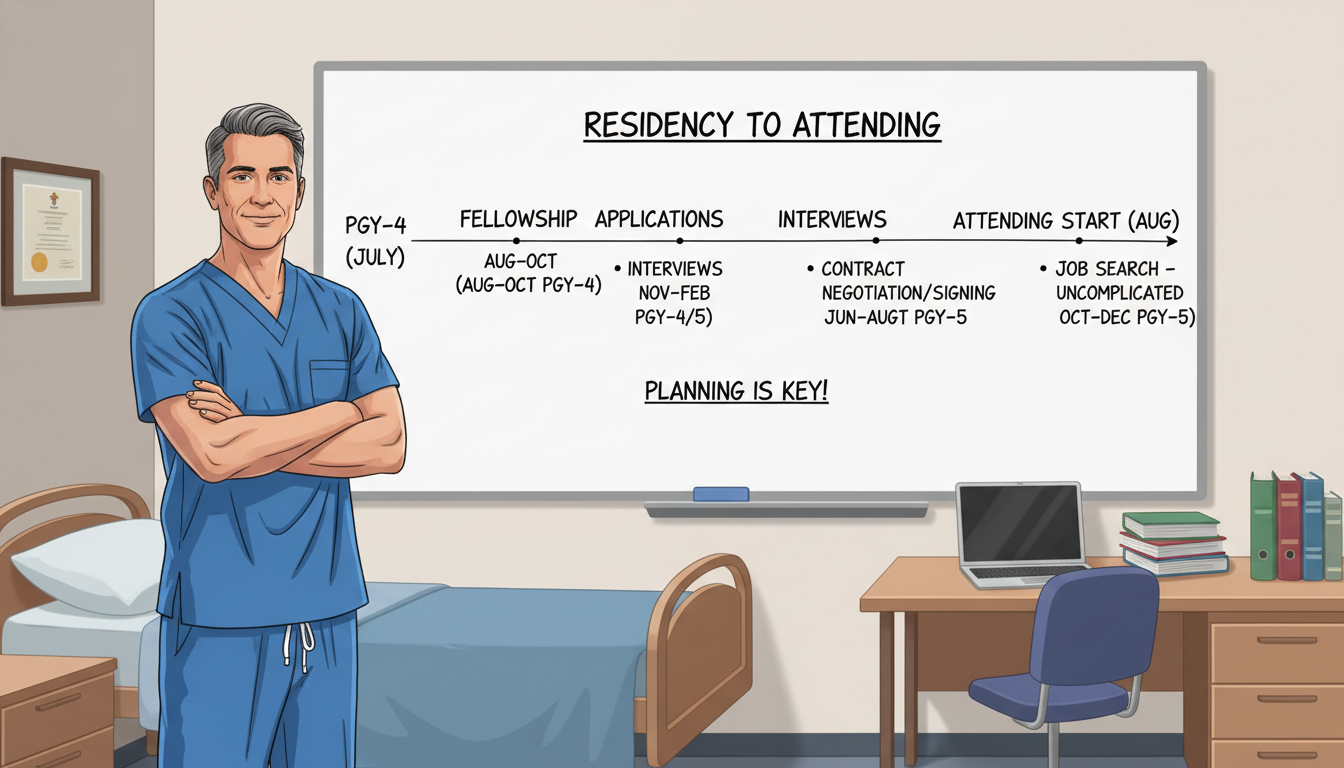
The transition from general surgery residency to your first attending role is one of the most consequential career moves you’ll make. The timing of your job search can significantly impact the number and quality of opportunities available, your negotiating leverage, and even your long-term career satisfaction. This guide walks you through exactly when and how to start your job search in general surgery—from early residency planning to signing your first attending contract.
Understanding the Timeline: When Should General Surgery Residents Start the Job Search?
The most common mistake residents make is either starting their job search too late (leading to limited options) or too early in an unfocused way (wasting time and energy). For most categorical general surgery residents planning to go directly into practice (without fellowship), the ideal window to seriously start your attending job search is:
- Early to mid–PGY-4: Initial planning, CV preparation, networking, and light outreach
- Mid–PGY-4 to early PGY-5: Active applications and interviews
- By mid–PGY-5: Aim to have a signed contract (or at least a firm offer)
However, this varies based on your path:
1. Going Straight into Practice After Residency
If you plan to enter the workforce as a general surgeon immediately after residency:
PGY-3 (late):
- Begin thinking about long-term goals (academic vs community, geographic preferences, scope of practice).
- Start building a network of mentors in your areas of interest.
PGY-4 (summer–fall):
- This is when you should start your job search in earnest.
- Update your CV, craft a basic cover email/letter, and start scanning the physician job market.
- Begin reaching out to mentors and potential employers.
PGY-4 (winter) – PGY-5 (early fall):
- Apply to positions regularly.
- Attend interviews (many community and regional hospitals recruit heavily during this period).
- Start narrowing down your priorities and deal-breakers.
PGY-5 (fall–winter):
- Aim to be in negotiation/final offer stage.
- Many employers want a signed contract at least 6–9 months before your start date to plan coverage, onboarding, and credentialing.
2. Pursuing Fellowship Before Attending Practice
If you’re planning a fellowship (e.g., surgical oncology, MIS, colorectal, trauma/critical care, vascular):
Residency job search = fellowship job search substitute
During residency, your main “job market” activity is the fellowship match. But you should still:- Maintain professional relationships.
- Keep a running list of regions or systems you might want to work in after fellowship.
Fellowship timeline for attending job search:
- Fellowship Year 1 (first 3–6 months): Clarify your post-fellowship goals (academic vs private, urban vs rural, subspecialized vs broad general surgery).
- Fellowship Year 1 (mid-late): Start your attending job search. For 1-year fellowships, you often need to move aggressively:
- Some high-demand academic or niche positions are recruited 12–18 months before the start date.
- Fellowship Year 2 (if applicable): You should be actively interviewing early and ideally signing by mid-year.
3. Special Considerations Based on Practice Type
The timing question—when to start job search—also depends on your target practice setting:
Academic positions (especially major university centers):
- Often recruit earlier and more deliberately.
- Some departments will start identifying candidates 18 months in advance, especially for niche roles.
Large health systems / employed groups:
- Common to post positions 9–12 months before anticipated start.
- Credentialing and onboarding are bureaucratic; they prefer long lead times.
Private practice groups / smaller hospitals:
- Sometimes recruit on shorter timelines—6–9 months or even less if they have sudden need.
- However, desirable, stable groups often plan ahead; early networking matters.
Rural/underserved areas:
- Often have ongoing recruitment; they will consider strong candidates as soon as they become available.
- These can sometimes accommodate later searches if you’ve delayed.

Year-by-Year Strategy: Building Toward the Surgery Residency Match and Beyond
Your success in the attending job market actually starts years earlier—during medical school and residency. That might sound daunting, but the good news is that much of it overlaps with what you’re already doing to become a strong surgeon.
Medical School and the Surgery Residency Match
Your surgery residency match shapes the training environment, case mix, and mentorship you receive—all of which influence your future job prospects.
Key long-term moves during medical school:
Choose programs with:
- Strong operative volume in bread-and-butter general surgery (hernia, biliary, colorectal, endoscopy, emergency general surgery).
- Clear fellowships or subspecialty exposure if you’re leaning that way.
- Graduates who successfully land jobs aligned with your goals (ask where recent chiefs have gone).
Start relationships with surgeons in:
- Locations you may want to return to.
- Practice models you might eventually seek (academic vs private).
These early relationships often become key networking nodes when you’re searching for a job as a chief or fellow.
PGY-1 to PGY-3: Laying the Foundation
While this phase is not about sending out CVs, it is about shaping your eventual competitiveness in the physician job market.
Focus on:
Clinical reputation:
- Consistently being prepared, reliable, and collegial.
- Faculty hire and recommend people they trust clinically and personally.
Skills portfolio:
- Seek out broad operative exposure, endoscopy training, and any niche skills aligned with your interests (e.g., laparoscopy, robotic surgery).
- Marketability as a new attending is tied to specific skills that are valuable locally.
Early career conversations:
- Tell trusted mentors where you think you might want to practice (region, environment).
- Ask about alumni in those settings; they can connect you later.
PGY-4: The Launch Point of Your Attending Job Search
This is where timing becomes critical.
Key tasks for PGY-4 if you’re going directly into practice:
Clarify Your Priorities (Early PGY-4)
Ask yourself:- What kind of call schedule can I realistically tolerate?
- How important is location vs practice type?
- Do I want a broad general surgery practice or a subspecialty-leaning role?
- Is teaching important to me?
- How much does compensation factor compared to lifestyle and mentorship?
Prepare Your Job-Search Materials (Early–Mid PGY-4)
- CV:
- 1–3 pages, clean formatting, updated publications, presentations, leadership roles.
- Cover email template:
- A concise paragraph introducing who you are, your training, your interests, and why you’re reaching out.
- References list:
- 3–4 faculty who know you well, ideally including a program director or department chair.
- CV:
Scan the Physician Job Market (Mid PGY-4)
- Use:
- Hospital system career pages
- Major physician job boards
- Specialty-specific resources via ACS, SAGES, etc.
- Recruiters (with selectivity; avoid signing exclusive contracts without clear benefit)
- Use:
Start Networking in a Targeted Way
- Attend national meetings (ACS Clinical Congress, subspecialty conferences).
- Schedule brief meetings with alumni or faculty in regions you’re considering.
- Let your program director know your preferences; they often get informal job inquiries before they’re widely posted.
PGY-5: Converting Opportunities Into Signed Contracts
During PGY-5, timing is about pacing interviews, offer evaluation, and negotiation.
Early PGY-5:
- You should be actively interviewing if you haven’t already.
- Keep communication clear with all potential employers about your timeline.
Mid PGY-5:
- Aim to be at the second-visit/contract negotiation stage.
- If you have no strong leads by this point, widen your geographic or practice-type preferences.
Late PGY-5:
- Focus on contract finalization, state licensure (if different from current state), and hospital credentialing.
- A late job search is still possible, especially in high-need regions, but your options may be narrower and leverage lower.
The Physician Job Market in General Surgery: What’s Driving Timing?
Understanding the physician job market for general surgeons helps you time your search and set realistic expectations.
Supply and Demand: A Mixed Picture
Nationally:
- General surgery remains in demand, especially in rural and community settings.
- Subspecialty-trained surgeons sometimes face more saturated markets in major metro academic centers.
Regionally:
- Urban and coastal academic hubs can be highly competitive, particularly for niche roles.
- Midwestern, Southern, and rural areas often have multiple openings and strong incentives.
This means:
- If you’re flexible with geography, you can often afford a slightly later search.
- If you’re targeting a very specific city, health system, or academic niche, you should start earlier and broadcast your interest widely.
Institutional Hiring Cycles
Different institutions follow different rhythms:
Academic centers often:
- Align hiring with academic and budgeting cycles (often making decisions late calendar year for the next academic year).
- Want to interview and identify candidates well before the fiscal year budgeting is finalized.
Community hospitals/large systems often:
- Post positions when a surgeon retires, relocates, or when service lines expand.
- May have rolling recruitment, but internal approval for new positions can take months—another reason they like early commitments.
How COVID and System Changes Have Shifted the Market
Workforce shortages and burnout have:
- Increased the number of openings in some regions.
- Led to more interest in sustainable call schedules and shared coverage.
Consolidation of practices into large systems:
- Means more “employed” models where surgeons are hospital employees.
- Often longer onboarding timelines, reinforcing the value of starting your job search early.

Practical Timeline: Month-by-Month Guide for Final Two Years
Below is a typical timing framework for a general surgery resident going directly into practice. Adjust by 6–12 months earlier if you are a fellow looking for your post-fellowship attending job.
PGY-4 (July–September)
- Reflect on:
- Preferred regions and practice models.
- Long-term goals (academic track vs high-volume community vs lifestyle-focused position).
- Update:
- CV and professional email signature.
- Online profiles (e.g., Doximity, LinkedIn if you use it professionally).
- Talk to:
- Program director, associate program director, and 1–2 trusted faculty about your goals.
PGY-4 (October–December)
- Start light outreach:
- Email alumni or contacts in target areas asking about the local job landscape.
- Ask faculty if they know of upcoming openings.
- Begin:
- Checking major job boards weekly.
- Collecting job descriptions that interest you (even if you don’t apply yet).
PGY-4 (January–March)
- Move from observation to action:
- Apply selectively to positions matching your core criteria.
- Respond to recruiter inquiries that are aligned with your goals.
- Goal:
- First interviews (virtual or in-person) by late PGY-4.
PGY-4 (April–June)
- Continue:
- Interviewing, often for community or regional jobs.
- Evaluate:
- Is your original geographic focus realistic?
- Do you need to expand or modify your search criteria?
PGY-5 (July–September)
- Intensify search if you haven’t identified strong leads:
- Broaden geography or consider different practice types.
- Follow up on earlier interviews or informal conversations.
- Keep:
- A spreadsheet of each opportunity (location, call burden, compensation, non-compete clauses, support, case mix).
PGY-5 (October–December)
- Aim to:
- Have at least one solid offer in hand.
- Negotiate contract terms (with help from a mentor and/or healthcare attorney).
- If no offers yet:
- Ask mentors to actively connect you with colleagues.
- Consider reaching out directly to hospitals or groups in your target regions; many needs are not advertised.
PGY-5 (January–Graduation)
- Finalize:
- Contract, relocation plans, licensure, and credentialing paperwork.
- Prepare:
- For the transition from resident to attending—from a clinical, administrative, and personal standpoint.
Common Timing Pitfalls—and How to Avoid Them
Even strong residents can stumble not from lack of ability, but from mismanaging job search timing. Here are frequent problems and how to stay ahead of them.
1. Starting the Job Search Too Late
Signs you’re running behind:
- You’re a mid-PGY-5 without any interviews or leads.
- You’re only applying to desirable big-city jobs with many applicants.
- You’ve been “meaning to” update your CV for months.
How to recover:
- Immediately loop in your program director and mentors.
- Relax one or two of your criteria (e.g., expand geographic radius, consider a slightly busier call schedule for first job).
- Be willing to:
- Take a solid but not “dream” job with the intent to move in a few years if necessary.
- Use this first job to gain experience, references, and negotiation leverage.
2. Overcommitting Too Early
On the other side, it’s possible to rush into accepting the first offer before you’ve seen the landscape.
Avoid:
- Signing a contract after your first interview unless:
- You’ve done due diligence.
- The offer truly aligns with your priorities.
Solutions:
- Ask for a reasonable time to consider an offer (often 1–3 weeks).
- Communicate transparently:
- “I am very interested in this position and would like to complete my remaining scheduled interviews before making a final decision. Can we set a decision date of [X]?”
3. Underestimating Credentialing and Licensure Timelines
Even if you accept a job early, you can still run into delays.
Typical timeframes:
- State medical license (new state): 3–6 months (sometimes longer).
- Hospital credentialing: 2–4 months.
- Insurance paneling: Variable, often 2–3 months after credentialing.
Implication:
- Signing a contract 9–12 months in advance is not overly cautious—it’s practical for many systems.
4. Ignoring the “Hidden” Job Market
Many positions are:
- Not advertised widely.
- Filled by word-of-mouth or through faculty networks.
Solution:
- Ask directly:
- “Do you know of any systems or groups that may be hiring in [Region X] over the next year?”
- Attend regional surgical society meetings where jobs are discussed informally.
- Let recruiters know your specific interests—but vet their offers carefully.
Actionable Strategies for a Well-Timed, Effective Job Search
To bring all of this together, here’s a concise strategy checklist you can follow.
Define Your Non-Negotiables and Flexibilities
Before the applications and emails begin:
Non-negotiables might include:
- Minimum OR volume or scope (e.g., must be able to do endoscopy, or must have block time).
- Maximum call frequency.
- Geographic constraints (e.g., spouse’s job, family support).
Flexibilities might include:
- Academic vs community.
- Compensation structure (salary vs RVU-based vs hybrid).
- Size of group or system.
Having clarity allows you to act quickly—without regret—when a good fit appears.
Use Mentors Intentionally
When to involve them:
- Early in PGY-4: Goal-setting and reality checks.
- Mid PGY-4 and beyond: Network introductions.
- PGY-5: Contract and offer review.
How to get the most from mentors:
- Be specific:
- “I’m looking for a general surgery job with a mix of elective and emergency general surgery in the Southeast, with reasonable call and some teaching opportunities.”
- Ask targeted questions:
- “How is this offer compared to what you’re seeing nationally?”
- “Would you join this group at my career stage?”
Be Professionally Visible
Even a modest professional presence can help:
- Present at regional/national meetings.
- Publish case reports or small series if opportunities arise.
- Maintain a professional email and voicemail; respond promptly to potential employers.
Schedule and Track Your Search
Treat your job search like any other major project:
- Maintain:
- A master document of positions explored, contacts, interview dates, and follow-ups.
- Block:
- Time on your calendar for applications and interview travel.
- Update:
- Your program leadership about major milestones; they can often accelerate behind-the-scenes advocacy once you’re a finalist.
FAQs: Job Search Timing in General Surgery
1. When should I start my job search if I’m a general surgery resident going straight into practice?
Begin planning and light outreach in early PGY-4, with active applications and interviews from mid-PGY-4 onward. Aim to have at least one strong offer and be in contract negotiations by mid–PGY-5 so that licensure and credentialing can proceed smoothly.
2. Does the timing change if I’m planning a fellowship first?
Yes. During residency, your focus is on the fellowship match, but you should still network and clarify long-term goals. During fellowship, especially 1-year programs, you should start your attending job search early in the fellowship year, often within the first 3–6 months, because many post-fellowship positions are identified 12–18 months in advance.
3. Is it ever “too early” to accept an attending job offer?
It can be. Accepting an offer very early—without exploring alternatives or fully understanding the practice—can limit your options and lead to regret. However, if you find a job that clearly matches your priorities, in a location you know well, through mentors you trust, accepting 9–12 months before your start date is common and appropriate.
4. What if I reach PGY-5 and still don’t have a job lined up?
You still have options, but you need to move deliberately. Inform your program director and mentors immediately, broaden your search (geography and/or practice type), and leverage networks and recruiters. Many community and rural hospitals need general surgeons and may be able to onboard you relatively quickly, though your bargaining power and selection may be more limited than with an earlier search.
Managing job search timing in general surgery requires forethought, honest self-assessment, and proactive use of your network. By understanding how the physician job market operates, starting your search at the right time, and pacing your decisions strategically, you can enter your first attending role with confidence—and set the stage for a satisfying surgical career.