
Understanding Job Search Timing for IMG Neurology Graduates
For an international medical graduate (IMG) in neurology, the timing of your job search can matter almost as much as your credentials. Neurology is a growing field with a favorable physician job market, but IMGs often face additional layers of complexity: visas, geography, institutional preferences, and tight training schedules.
This IMG residency guide focuses specifically on when to start job search activities and how to align them with your neurology residency, fellowship (if applicable), board exams, and visa milestones. Think of this as your timeline roadmap from PGY-2 through your first attending contract.
Why Timing Matters So Much for IMGs in Neurology
Several timing-sensitive factors affect an IMG pursuing a neuro match and later an attending job:
- Visa constraints (J-1 waiver, H-1B start dates, green card timelines)
- Hospital recruitment cycles (often 12–18 months before start date)
- Board eligibility and certification dates
- Subspecialty fellowship applications and decisions
- Geographic preferences and shortages (rural vs urban, academic vs community)
- Institutional IMGs hiring practices (some systems are more IMG- and visa-friendly than others)
Getting the calendar wrong can mean:
- Missing out on preferred locations or practice types
- Ending up in an emergency “gap year” with no position
- Rushed, poorly negotiated contracts
- Lost visa options or delayed immigration progression
The rest of this guide will walk month-by-month and year-by-year through a rational job search timeline tailored to international medical graduates in neurology.
Big-Picture Timeline: From Early Residency to First Attending Job
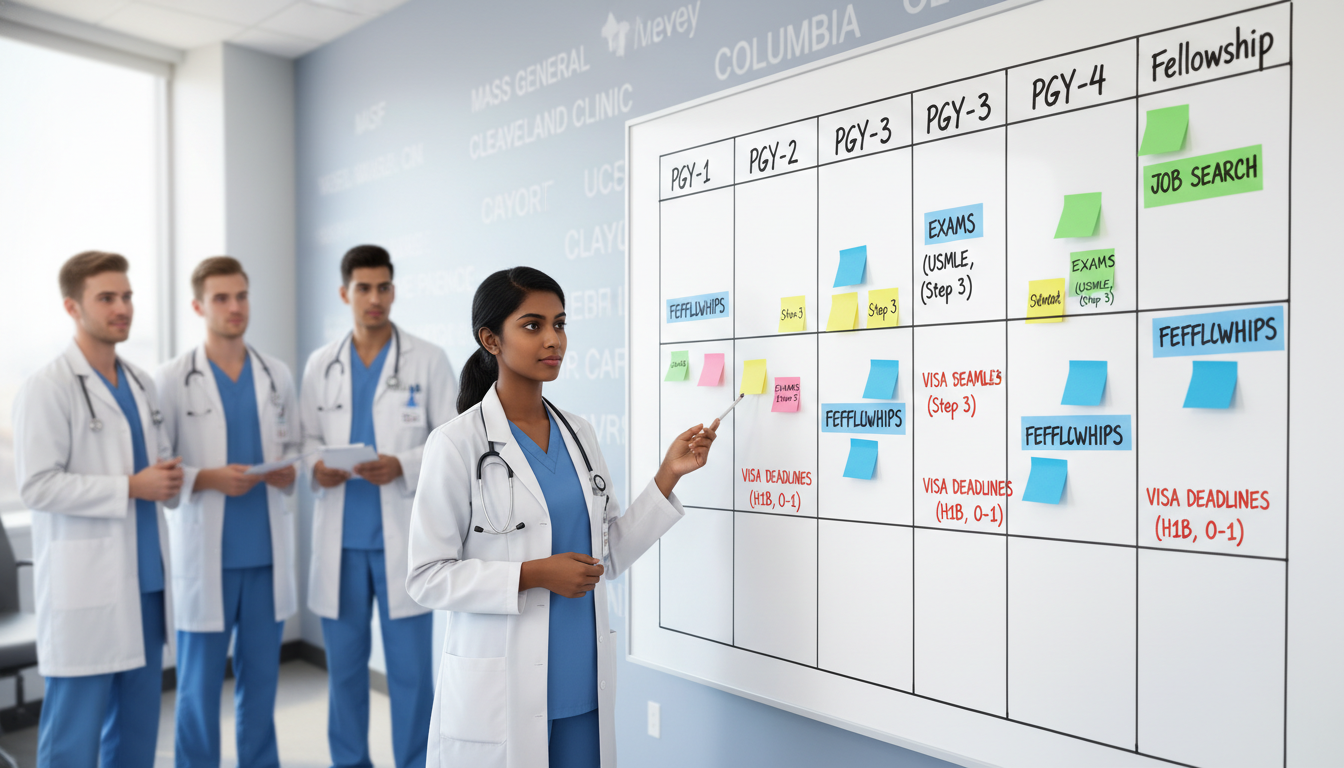
Before diving into details, here is the high-level timing framework many successful IMG neurologists follow. Assume a standard 4-year neurology residency (PGY-1 internship + PGY-2–4 neurology), with your first attending job starting July after graduation:
PGY-1 (Intern Year)
- Focus: Clinical performance, letters of recommendation, adapting to the U.S. system
- Job search tasks: Minimal; mainly career exploration and initial networking
PGY-2 (First Neurology Year)
- Focus: Building neurology foundation, exploring subspecialties
- Job search tasks: Decide if you will pursue fellowship; start learning about the neurology physician job market
PGY-3
- If pursuing fellowship: Fellowship applications and interviews
- If going straight to practice: Begin structured job market research late PGY-3
PGY-4
- If fellowship-bound: Clarify long-term goals (academic vs community, subspecialty needs)
- If entering workforce directly: This is your primary attending job search year
- 12–18 months before start date: Active applications and interviews
Fellowship Year(s)
- 6–18 months before your anticipated finishing date: Core attending job search window
- Many neurologists on visas must be especially proactive starting 12–18 months before completion
The most important rule: Start earlier than you think you need to, especially as an IMG with visa needs.
Year-by-Year: What to Do and When
PGY-1: Lay the Foundation, Don’t Rush the Job Search
As an IMG, PGY-1 is often overwhelming: new healthcare system, documentation, communication style, and sometimes a new culture and language environment. At this stage, job search timing is mostly about not getting ahead of yourself.
Key goals in PGY-1:
- Strong clinical performance and professionalism
- Build relationships with attendings
- Clarify interest in neurology subspecialties (stroke, epilepsy, neuromuscular, movement disorders, neurocritical care, behavioral neurology, etc.)
- Understand your visa category and long-term implications (J-1 vs H-1B)
Job-related tasks:
- Attend 1–2 neurology-related career talks, if offered by your program
- Create a master CV (you will update this for years)
- Set up and optimize LinkedIn and basic professional online presence
- Have an initial meeting with a GME office or institutional immigration lawyer to understand:
- J-1 waiver obligations and timelines (if J-1)
- H-1B possibilities and pathways
- Whether your institution hires IMGs as attendings and under what conditions
You don’t need to apply for jobs yet, but you should understand your constraints early. For example, J-1 neurology residents will eventually need a J-1 waiver job, often in a specific geographic or underserved area. That has major timing implications for the attending job search.
PGY-2: Decide on Fellowship vs Direct-to-Practice Path
PGY-2 is the first real “strategy” year for your long-term neurology career.
1. Clarify Whether You Will Do a Fellowship
By the end of PGY-2, you should have a strong idea whether you will:
- Pursue a neurology subspecialty fellowship (e.g., stroke, epilepsy, EMG/neuromuscular, movement disorders, neuroimmunology, neurocritical care, clinical neurophysiology, behavioral neurology), or
- Go directly into general neurology practice
This choice dramatically affects job search timing.
- If you plan a fellowship, your first serious job search for an attending role will start during fellowship, not residency.
- If you will not do fellowship, your primary attending job search will be during PGY-3 and PGY-4.
2. Start Understanding the Neurology Physician Job Market
Use PGY-2 to observe and gather information:
- Ask your seniors:
- When did you start applying for attending jobs?
- Did you feel rushed or comfortable?
- How did visa status impact your timeline?
- Attend neurology conferences (e.g., AAN) if possible and:
- Visit career booths
- Talk to recruiters
- Collect brochures about practice models (academic vs private vs employed, tele-neurology, hospitalist neurology)
- Browse major neurology job boards without applying:
- Look at position types (inpatient, outpatient, subspecialty mix)
- Note locations that are more open to IMGs
- Start learning employers’ typical requirements (board eligibility timing, visa readiness)
Actionable tip: Create a simple spreadsheet (or Notion/Excel file) titled “Neurology Career Notes” and start logging:
- Institutions you like
- Regions that appear IMG-friendly
- Subspecialty needs (for example, heavy demand for stroke or general neuro in many areas)
- Comments on visa statements in job postings (“J-1 and H-1B candidates welcome” vs “must be US citizen or green card holder”)
PGY-3: Fellowship Applications or Early Attending Job Exploration
Your PGY-3 timing hinges on whether you are applying for fellowship.
If You Are Fellowship-Bound
For many neurology subspecialties, formal fellowship applications happen during PGY-3:
- Research potential programs 6–9 months before their application deadlines
- Ask faculty in that subspecialty:
- Which fellowships are supportive of IMGs?
- Which institutions later hire their fellows as attendings?
- Clarify with each fellowship:
- Visa policy (J-1 vs H-1B sponsorship)
- Whether they typically help fellows find attending positions after graduation
Your attending job search is not active yet, but your fellowship choices directly influence:
- Where you might later work as an attending
- How strong your future job-market position will be
- Whether you will be board-eligible in a subspecialty with high demand (e.g., stroke, epilepsy, neurocritical care)
If You Will Go Straight to Practice After Residency
For those not pursuing fellowship, PGY-3 is your early research and light networking year for attending jobs:
6–18 Months Before PGY-4 Graduation (Late PGY-3):
- Start actively researching permanent job opportunities:
- Keep updating your spreadsheet with job leads
- Identify 10–15 target regions and practice types
- Clean and refine your CV and personal statement-like “career summary”
- Practice a brief career story:
- Who you are
- What type of neurology you want to practice
- What you bring as an IMG and neurologist (language skills, multicultural competence, flexible geographic preferences, willingness to work in underserved areas)
- Attend national or regional neurology meetings:
- Introduce yourself to recruiters at career fairs
- Ask direct questions:
- “When is the best time for me to apply for a 202X start date?”
- “Are you open to J-1/H-1B sponsorship for neurologists?”
- “Do you hire general neurologists straight out of residency?”
You likely will not sign a contract in PGY-3, but for IMGs, especially on J-1 visas, it’s very reasonable to start exploratory conversations 12–18 months before graduation.

PGY-4 and Fellowship Years: Your Primary Job Search Window
This is where job search timing becomes crucial. Whether you are finishing residency or fellowship, the standard neurology physician job market starts moving 12–18 months before your anticipated start date.
Ideal Timing for Most Neurology IMGs
- 18–14 months before start date: Light outreach, networking, and initial conversations
- 14–9 months before start date: Main application period and first-round interviews
- 9–6 months before start date: Second visits, contract negotiations, final decisions
- 6–3 months before start date: Credentialing, licensing, immigration paperwork, relocation planning
Because IMGs must account for visa processing and potential delays, start at the early end of this range (15–18 months if possible).
For Residents Entering Practice Directly After PGY-4
PGY-4 Timeline Example (July Graduation, J-1 or H-1B):
July–September (PGY-4 start; ~12 months before graduation):
- Finalize your CV and cover letter template
- Ask 2–3 attendings for job recommendation letters
- Start formally applying for jobs in desirable regions
- Notify your program director that you are actively job searching and discuss realistic options for your specific visa
September–December (10–7 months before graduation):
- Attend interviews (in-person or virtual)
- Narrow your preferences:
- Academic vs community practice
- Inpatient vs outpatient balance
- Call schedule, salary expectations, procedural opportunities (LPs, EEGs, EMG)
- Ask directly about:
- Visa sponsorship and J-1 waiver eligibility (if applicable)
- Start date flexibility (some can start off-cycle if needed)
January–March (6–4 months before graduation):
- Compare offers and carefully review contracts
- Engage an independent physician contract lawyer, ideally one familiar with IMGs and neurology
- Negotiate:
- Compensation and bonuses
- Non-compete clauses and geographic restrictions
- Call burden
- CME and relocation allowances
- Visa and green card support
March–May (4–2 months before graduation):
- Finalize and sign contract
- Begin state licensing and hospital credentialing if not already started
- Ensure visa paperwork is initiated early (especially J-1 waiver or H-1B)
May–July (2–0 months):
- Complete onboarding tasks
- Plan relocation and housing
- Finish neurology boards preparation if you have not yet taken them
This schedule is aggressive but realistic for IMGs who need adequate time for immigration steps.
For Fellows (Finishing Subspecialty Training)
For those doing a neurology fellowship, your main attending job search timing shifts into your fellowship year.
Assume a 1-year fellowship:
6 months before fellowship starts (late PGY-4):
- Clarify what kind of attending job you want post-fellowship
- Explore whether your fellowship institution might hire you as an attending afterwards
Fellowship Months 1–3 (12–9 months before fellowship end):
- Update subspecialty-focused CV (include fellowship procedures, skills, research)
- Start reaching out to both:
- Your home institution (for potential faculty or staff positions)
- External employers interested in your subspecialty
Months 3–6 (9–6 months before end):
- Apply broadly if you need geographic or visa flexibility
- Interview actively
- Discuss:
- Protected time for research or teaching (if you want academic neurology)
- The proportion of general vs subspecialty neurology in your practice
- For J-1 fellows: confirm that the position qualifies as a waiver job, if needed
Months 6–9 (6–3 months before end):
- Finalize offer selection
- Negotiate and sign
- Initiate licensing, credentialing, and immigration processes
Months 9–12 (3–0 months):
- Transition planning
- Decide on board exam timing (for both general neurology and subspecialty boards)
- Plan relocation
As an IMG neurology fellow, err on the earlier side: start serious job search activity 12–15 months before your desired attending start date.
Special Considerations: IMGs, Visas, and J-1 Waivers in Neurology
Many IMGs in neurology are on J-1 visas and must secure a J-1 waiver job after training, often in medically underserved regions. Others are on H-1B and have different constraints. These visa realities affect not only where but when to start your job search.
If You Are on a J-1 Visa
For a J-1 neurology resident or fellow, timing your job search involves aligning with:
- State Conrad-30 waiver timelines
- Other federal waiver programs (VA, HHS, etc.)
- Employer willingness to sponsor and navigate waivers
Timing Tips:
- Begin serious waiver job search 15–18 months before your training end date.
- Contact state health departments (Conrad-30 programs) early:
- Ask when they start accepting applications
- Clarify whether neurology is a preferred or neutral specialty
- When speaking with potential employers, ask:
- “Do you have experience with J-1 waivers for neurologists?”
- “How many J-1 waiver hires have you sponsored in the last 3–5 years?”
- Because waiver spots can be competitive and sometimes run out mid-cycle, early application provides a critical advantage.
If You Are on an H-1B Visa
H-1B carries different timing issues:
- Cap-exempt vs cap-subject employers
- Start dates (often tied to October 1 for cap-subject), though medical institutions are often cap-exempt
- Green card sponsorship plans
Timing Advice:
- Start exploring H-1B-friendly employers 12–15 months before your target start date.
- Confirm whether the employer:
- Is cap-exempt (most academic centers and certain hospital systems are)
- Will sponsor H-1B transfer or extension
- Will begin green card processing within the first 1–2 years of employment
Using the Physician Job Market to Your Advantage
Neurology is generally in high demand, particularly in:
- Community hospitals
- Smaller cities and rural regions
- Integrated health systems expanding outpatient neurology
As an IMG, you can use this favorable neurology physician job market to:
- Start searching early and be transparent about your visa needs
- Compare multiple offers—even in underserved locations—to avoid predatory contracts
- Negotiate for:
- Reasonable call schedules
- Support staff (e.g., NPs, PAs, scribes)
- CME and research opportunities, if desired
Practical Strategies to Stay on Track with Job Search Timing
1. Build a Simple Job Search Timeline Document
Create a one-page document with key dates:
- Residency/fellowship end date
- Board exam dates (planned)
- Visa deadlines (J-1 waiver applications, H-1B timelines)
- Planned job search milestones:
- Begin research
- First applications
- Interview windows
- Contract decision date
- Licensing and credentialing start
Refer to this monthly and update as things evolve.
2. Time-Block Job Search Tasks
During PGY-4 or fellowship, clinical duties can easily overwhelm you. Dedicate:
- 1–2 hours weekly for:
- Updating CV
- Sending emails to recruiters/employers
- Tracking job leads
- 1–2 half-days (when available) for interviews and site visits
3. Leverage Mentors and Recent Graduates
Ask specifically:
- “When did you start your job search?”
- “What would you do earlier if you could repeat the process?”
- “When would you recommend an IMG start job search to allow enough time for visa and credentialing?”
Recent IMG neurology graduates are the most realistic source of timing advice tailored to your visa category and training environment.
4. Coordinate Job Search with Board Exams
Board exam timing is another layer in your schedule:
- Many employers require board eligibility by start date and board certification within a few years.
- Plan your boards so that:
- You’re not taking them in the most intense part of your interview season
- You have exam results available by your expected start date if possible
Aligning exam preparation with job search requires early planning—another reason to map out your 12–18 month timeline.
FAQs: Job Search Timing for IMG Neurologists
1. When should I start my attending job search as an IMG in neurology?
For most IMGs, especially on visas, aim to start serious attending job search activities 12–18 months before your planned start date. That usually means:
- Late PGY-3 / early PGY-4 if going directly from residency to practice
- Early in your fellowship year if you are subspecializing
Starting at 15–18 months is safer if you require a J-1 waiver or complex immigration steps.
2. Is it too early to talk to recruiters or employers in PGY-2 or early PGY-3?
It’s rarely “too early” for informational conversations, as long as you’re transparent about your training timeline. In PGY-2 or early PGY-3, you can:
- Introduce yourself at conferences
- Ask about typical hiring timelines for neurologists
- Learn about visa policies and geographic needs
Just be clear that you’re exploring long-term options, not expecting immediate offers.
3. How does doing a fellowship change my job search timing?
Fellowship mainly shifts your primary job search into your fellowship year. You will:
- Apply for fellowship during PGY-3 (most subspecialties)
- Focus on attending job search during your fellowship, starting around:
- 12–15 months before your desired attending start if on a visa
- 9–12 months before if you have no immigration constraints
Still, consider fellowship institutions with strong records of hiring their fellows, as this can simplify your eventual job search and visa path.
4. As an IMG, should I prioritize signing a contract early, or waiting for the “perfect” job?
You must balance timing, visa realities, and job quality:
- Don’t wait so long that you face visa or licensing crises close to graduation.
- Avoid signing the first offer without comparison, especially if terms are unfavorable (excessive non-compete, unsustainable call load, unclear visa support).
A practical compromise: - Start early
- Aim to secure at least 2–3 serious offers for comparison
- Make a decision 6–9 months before your start date, leaving time for immigration and credentialing while still allowing some flexibility to refine your choice.
By mapping your training years against this timeline and being proactive—especially about visas—you can transform a chaotic, last-minute scramble into a structured, confident neurology job search. As an international medical graduate, you bring valuable skills and perspectives to the field; getting the timing right simply ensures you have the broadest set of options to practice the kind of neurology you envision for your career.