Understanding the Job Search Timeline for IMGs in Interventional Radiology
For an international medical graduate (IMG) in interventional radiology (IR), the question of when to start job search is almost as important as how to search. Interventional radiology is a small, highly specialized field with a complex training pathway and a rapidly evolving physician job market. As an IMG, you also navigate visa constraints, potential sponsorship needs, and sometimes a steeper learning curve in U.S. networking and contracts.
This IMG residency guide to job search timing is tailored specifically to:
- IMGs currently in or aiming for an interventional radiology residency or integrated IR/DR program
- Fellows in independent IR fellowships
- Early-career interventional radiologists planning their first attending job search in the U.S.
The overall principle:
Start earlier than you think, and align your timeline with your visa status, board eligibility, and desired practice type.
Big-Picture Timeline: From IR Training to Your First Attending Job
Before going into month-by-month details, it helps to understand the “macro” timeline most U.S.-trained interventional radiologists experience.
Typical Training Pathways for IR (U.S. context)
Integrated IR/DR Residency (5–6 years)
- PGY-1: Internship
- PGY-2 to PGY-5/6: Diagnostic radiology + IR
- Leads directly to IR/DR board eligibility
Independent IR Residency (Fellowship)
- DR residency (PGY-2 to PGY-5)
- 1–2 years of independent IR training (PGY-6/7)
As an IMG, your path may include:
- Preliminary / transitional year
- Diagnostic radiology residency
- IR integrated or independent residency
- Optional additional fellowship (e.g., neurointerventional, vascular)
The attending job search typically begins during your final IR training year (or earlier, if you have visa constraints or want competitive metropolitan positions).
Core Timing Principles
- Academic IR jobs: Often recruit 12–18 months before start date
- Large private practices and hospital-employed positions: Frequently recruit 9–12 months before start date
- Smaller private groups / community hospitals: Sometimes recruit 6–9 months before start date, occasionally even later if there is sudden need
As an IMG, add extra lead time (3–6 months) for:
- Visa sponsorship negotiations
- State licensing delays
- Credentialing and hospital privileging
Rule of thumb for IMGs in IR:
Begin actively exploring jobs 12–18 months before graduation, and aim to sign a contract 6–12 months before your intended start date.
Phase-by-Phase Job Search Roadmap for IMGs in IR
Phase 1: Early Residency (PGY-2 to PGY-3) – Laying the Foundation
Even though this article focuses on job search timing, preparation begins much earlier.
Goals in this phase:
- Clarify your long-term vision (academic vs private; U.S. vs abroad)
- Understand the IR job landscape
- Establish relationships and mentors who will later connect you with opportunities
Key Actions (Timing: 2–4 years before graduation)
Clarify your career direction
- Decide how much you value:
- Pure interventional vs substantial diagnostic mix
- Academic leadership, research, teaching
- High-volume procedures vs lifestyle balance
- Urban major academic centers vs community/regional hospitals
- As an IMG, factor in:
- Willingness to live in less competitive locations (which often sponsor visas more readily)
- Long-term immigration goals (green card vs staying on temporary visas)
- Decide how much you value:
Track the IR job market
- Follow:
- Society of Interventional Radiology (SIR) job board
- American College of Radiology (ACR) job listings
- Major recruitment firms specializing in radiology
- Observe:
- Where positions are clustered geographically
- Which jobs commonly offer J‑1 waiver / H‑1B support
- Typical expectations for case mix, call, RVUs, and compensation bands
- Follow:
Build relationships (critical for IMGs)
- Identify 2–3 mentors:
- 1 IR mentor in your department
- 1 program director or associate PD
- Possibly 1 outside mentor via SIR networking
- Attend:
- SIR Annual Scientific Meeting (especially as PGY-3 onward)
- Regional/national radiology meetings
- Use this time to:
- Present posters or talks
- Join committees, particularly SIR Resident, Fellow & Student (RFS) sections
- Identify 2–3 mentors:
Even though you are not yet applying, this early engagement will make you more competitive and speed up your search later.
Phase 2: Mid-Training (PGY-4 to PGY-5) – Positioning Yourself and Narrowing Options
By this stage, you’re closer to independent IR practice. This is the ideal time to start thinking concretely about the physician job market and where you may fit.
Goals in this phase:
- Decide on academic vs private vs hybrid practice preference
- Determine preferred geographic regions
- Understand your visa pathway and timeline for work authorization
Key Actions (Timing: 18–30 months before graduation)
Understand your visa and immigration timeline
- If you are on J-1:
- Clarify whether you will require a J-1 waiver job (e.g., Conrad 30, federal waiver programs)
- Waiver jobs have time-sensitive application cycles, usually fall to winter of your final year but require earlier contact
- If you are on H‑1B:
- Confirm maximum duration remaining
- Ask potential employers if they sponsor H‑1B transfers and green cards
- If applying for permanent residency (green card):
- Understand how job location and type may impact EB categories and processing times
- If you are on J-1:
Refine your target practice type
- Academic IR:
- Earlier recruitment
- Emphasis on research, teaching, and subspecialization
- May have more institutional support for visas but also more competition
- Hospital-employed IR or large private groups:
- Strong salaries, heavier clinical or diagnostic mix
- Often open to IMGs, but visa policies differ widely
- Pure outpatient / OBL-based IR:
- Focus on elective procedures (e.g., PAD, oncology, UFE, venous disease)
- Not all OBL owners sponsor visas; ask early
- Academic IR:
Begin targeted networking
- Approach mentors with specific questions:
- “I’m an IMG considering academic IR in the Northeast. When do those programs usually recruit?”
- “Which groups or departments are known to be IMG-friendly and open to H‑1B/J‑1 waiver candidates?”
- Attend SIR and explicitly schedule:
- One-on-one conversations with faculty whose practice type matches your goal
- Informal informational interviews (not job interviews yet, but they may lead to openings later)
- Approach mentors with specific questions:
Although you are still more than a year from your job start, mid-training is the prime time to map the market and line up potential contacts.
Phase 3: Final IR Year – Active Job Search and Interviews
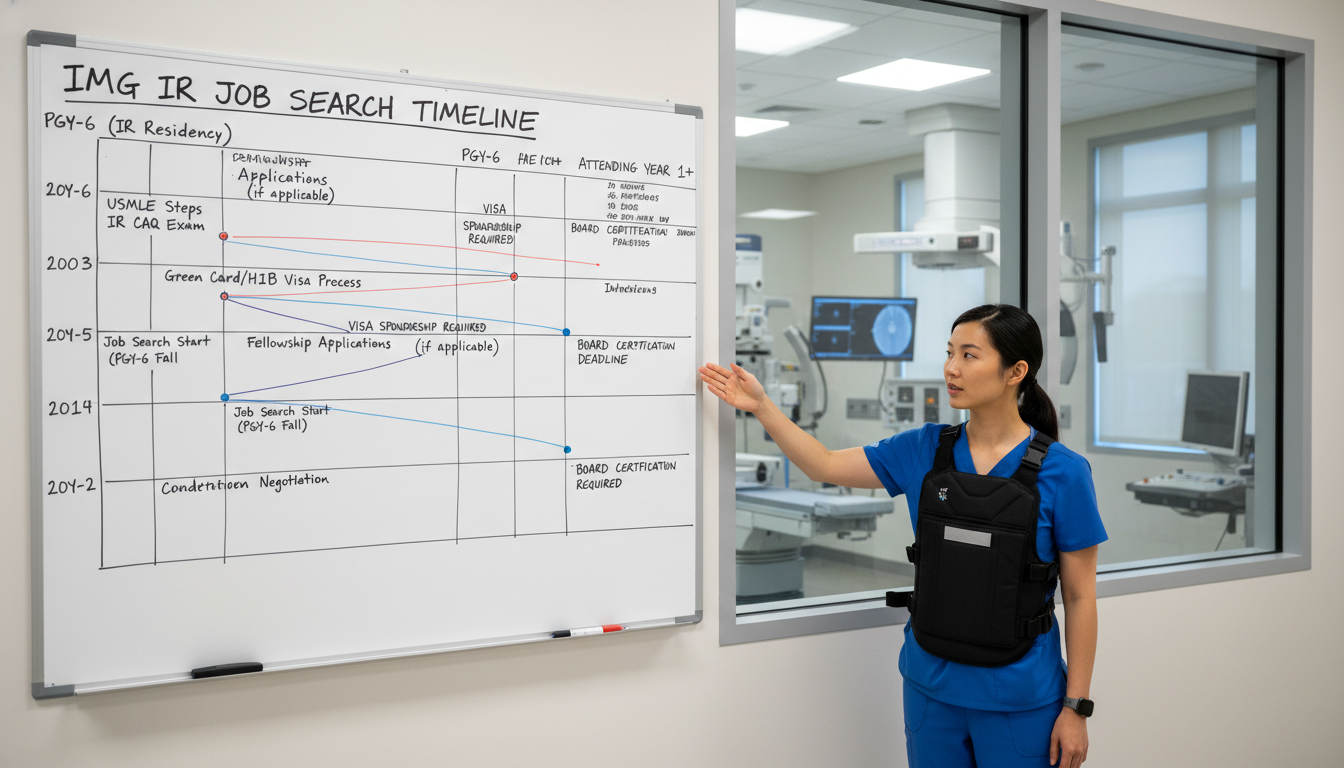
This is the most critical period in the IR match to attending job transition. For most IMGs, your final year in IR residency or fellowship is when the real job search begins in earnest.
Ideal Start: 12–18 Months Before Graduation
If your graduation is June 2027, think:
- July–December 2025: Exploration and first contacts
- January–June 2026: Applications, early interviews, especially for academic and J‑1 waiver positions
- July–December 2026: Main wave of interviews and contract negotiations
- By January–March 2027: Contract finalized, licensing and credentialing underway
The exact timing depends on job type…
Academic IR Positions – Earlier Timeline
Academic departments often:
- Predict needs earlier (retirements, service expansion)
- Have institution-based HR processes that move slowly
- Want to secure strong candidates a year or more in advance
Recommended timing if you are targeting academic IR:
- 18–24 months prior to start date:
- Inform mentors and program leadership: “I’m committed to academic IR and plan to start looking for positions this cycle.”
- Ask them:
- Which institutions are likely to have upcoming openings
- Whether they will support you with personal introductions
- 12–18 months prior:
- Start sending:
- Personalized emails to chiefs of IR and department chairs
- CV + 1-page cover letter describing your interests (e.g., IO, venous, women’s IR, education)
- Attend SIR and:
- Arrange advance meetings with faculty from your target institutions
- Start sending:
- 9–15 months prior:
- Formal interviews, on-site visits
- Initial offer letters and negotiation
As an IMG, raise visa questions early:
- “Does your institution sponsor H‑1B for faculty?”
- “Have you previously hired IR faculty on J‑1 waivers?”
You don’t need to lead with this in your first sentence, but it must be clarified before serious commitment.
Private Practice & Hospital-Employed IR – Main Wave at 9–12 Months
Community-based and private groups often recruit closer to the anticipated start date, but strong candidates (especially in IR) are often identified earlier.
Recommended timing if you’re targeting private/hybrid practice:
- 12–14 months prior to graduation:
- Begin active search:
- Register with 1–2 radiology-focused recruiters
- Set up job alerts on SIR, ACR, and other physician job boards
- Send targeted inquiries:
- Example: “I am an IMG IR fellow completing training in June 2027, board-eligible in IR/DR, seeking a clinically focused IR position with moderate DR component in the Midwest.”
- Begin active search:
- 9–12 months prior:
- Interviews and site visits
- Compare offers
- 6–9 months prior:
- Finalize contract, start licensing/credentialing
- For IMGs with visas, this window can be tight; earlier is safer
Special Case: J‑1 Waiver Jobs (Critical for Many IMGs)
If you are on a J‑1 visa, your attending job must often fulfill J‑1 waiver requirements (e.g., underserved area, full-time clinical, certain service commitments). These job types follow an even more rigid timeline:
- 12–18 months prior:
- Identify states with Conrad 30 programs you’re open to (each state has unique rules and deadlines)
- Shortlist states whose timelines align with your graduation date
- 9–12 months prior:
- Start applications to waiver-eligible positions
- Employers must file waiver applications as soon as the state program opens (some fill very fast)
- 6–9 months prior:
- Waiver approval
- H‑1B filing based on waiver
Because J‑1 waiver process is highly time-sensitive, start job search and employer conversations earlier than your U.S. citizen/green card peers—often 18–24 months before graduation.
Phase 4: After Accepting an Offer – Licensing, Credentialing, and Backup Plans
Once you’ve accepted an IR job, the work is not done. For IMGs, the post-offer timeline matters as much as the pre-offer timeline.
6–12 Months Before Start Date: Licensure and Credentialing
Plan backward from your start date:
- 6–12 months prior:
- Apply for state medical license where you’ll work
- Some states process quickly (6–8 weeks), others take many months
- IMGs may need extra documents: ECFMG certificate, primary source verifications, translations
- Start hospital credentialing and privileging:
- Background checks
- Procedure logs
- Letters of reference
- Apply for state medical license where you’ll work
- 3–6 months prior:
- Finalize contract addenda, benefits, malpractice coverage
- Confirm visa filings (H‑1B transfer, J‑1 waiver documentation)
- Prepare for gradation and relocation logistics
Starting your job search too late compresses all of this and risks delaying your first day of work, causing significant financial and visa-related stress.
Always Have a Plan B
Even with good timing, certain factors (visa delays, licensing issues, sudden program closures) can disrupt your initial plan.
Consider backup strategies:
- One-year academic or research position with visa support (bridge to a later job)
- Additional fellowship year (e.g., advanced IR, neurointerventional) if:
- Market in your preferred city is temporarily tight
- You need extra time for waiver or immigrant petition processing
- Wider geographic search including:
- Rural or smaller cities
- HPSA/MUA-designated areas more open to J‑1 waiver and IMGs
Starting early gives you enough runway to pivot if Plan A fails.

Practical Tips for Timing and Strategy as an IMG in IR
1. Use a Reverse-Engineered Timeline
Start from your desired first day as an attending and work backward:
- Start date: July 1, 2027
- Visa, license, credentialing completed: by May 2027
- Contract signed: by December 2026 – March 2027
- Interviews completed: by November 2026
- Applications and initial contact: starting January–June 2026
- Market exploration and mentor conversations: 2025
This backward planning helps you avoid the “sudden panic” many trainees feel in their final year.
2. Balance Breadth and Focus
The physician job market for IR is currently favorable, but:
- Certain regions (major coastal metro areas) remain competitive
- Visa sponsorship narrows your options
- Highly specialized academic niches (e.g., 100% IO) may be limited
To protect yourself:
- Have at least two geographic regions you’d genuinely consider
- Remain open to some diagnostic work if pure IR positions are scarce in your target area
3. Communicate Your Visa Needs Clearly—but Not Prematurely
During initial feeler conversations:
- Focus first on:
- Your skills
- Training pedigree
- Procedural strengths
- Clinical interests
- Then, early in the serious discussion (but not necessarily in your very first email), state:
- Your current visa status (e.g., “I am on a J‑1 visa and will need a waiver-position starting July 2027.”)
- Whether you’ve already had any initial visa consultations
This timing protects you from premature rejection while ensuring no time is wasted with employers who cannot accommodate your situation.
4. Leverage Your Unique Strengths as an IMG
As an international medical graduate, you often bring:
- Broad clinical experience from home country
- Multilingual skills and cultural competence
- High adaptability and resilience
Use these in your narrative during interviews:
- “Our patient population includes a large [X language]–speaking community; my background aligns well with this.”
- “I have prior exposure to resource-limited settings, which is useful for outreach and referring hospital relationships.”
These strengths can offset perceived visa-related complexity and make you more compelling as a candidate.
5. Stay Informed About Market Shifts
The IR labor market can change with:
- Expansion or contraction of outpatient IR/OBL models
- Hospital consolidation
- Regulatory or reimbursement changes
Stay updated via:
- SIR newsletters and economic updates
- ACR and RSNA workforce studies
- Talking to recent graduates about their search experiences
This allows you to adjust your timing (earlier vs later) and expectations accordingly.
Common Pitfalls in Job Search Timing for IMGs in IR
Starting the search too late (within 6 months of graduation)
- Leads to limited options, rushed decisions, and visa or licensing delays.
- Especially risky if you require a J‑1 waiver or H‑1B sponsorship.
Relying only on online job postings
- Many IR jobs—particularly academic and high-quality private groups—are filled through networking and word of mouth before public posting.
- As an IMG, you must be even more proactive about relationships.
Ignoring visa implications until after you like a job
- You can waste months on an opportunity that cannot sponsor your visa.
- Always clarify visa possibilities early enough to pivot if needed.
Being geographically inflexible
- If you insist on one highly competitive city as an IMG requiring sponsorship, you may face significant delays.
- Broaden your acceptable regions early in the process.
Underestimating licensing and credentialing time
- Some states and hospitals are slow; starting paperwork late can cost months of salary and jeopardize visa start dates.
Avoiding these pitfalls is all about starting early, planning backward, and keeping communication open.
FAQs: Job Search Timing for IMG Interventional Radiologists
1. When should I start my attending job search as an IMG in interventional radiology?
For most IMGs in IR, start serious job exploration 12–18 months before your planned start date.
If you require a J‑1 waiver or anticipate complicated visa processes, begin 18–24 months in advance. Academic positions and waiver jobs often demand the earliest timelines.
2. How does my visa status affect the timing of my job search?
Visa status is central:
J‑1:
- Must target waiver-eligible positions.
- Waiver programs (e.g., Conrad 30) have strict yearly cycles; jobs need to be lined up early so the employer can file as soon as the window opens.
- Start conversations 18–24 months before graduation.
H‑1B:
- You need employers willing to sponsor H‑1B and, ideally, a green card.
- You still want to begin 12–18 months prior to graduation so filing is on time.
Green card or U.S. citizen:
- More flexibility; starting 12 months before graduation is often sufficient, but earlier is still advantageous for academic or metropolitan positions.
3. Should I wait until after I pass my boards before looking for a job?
No. The IR job search typically overlaps with your board preparation. Most employers hire you as board-eligible, with the expectation that you’ll take (and pass) boards soon after starting. You should not delay job search timing until you are fully board-certified; doing so can leave you unemployed after training.
4. Is it realistic to find a job in a major city as an IMG in IR?
Yes, but it is more competitive and often tougher if you need visa sponsorship. To improve your chances:
- Start earlier (18 months before graduation).
- Build strong academic or clinical credentials.
- Use mentors to make direct introductions.
- Be open to hybrid roles (IR + DR) or starting in a slightly less central area and transitioning later.
If your goal is a specific large metropolitan area right out of training, you must be especially strategic and flexible, and your job search timing must allow for multiple application and negotiation cycles.
By aligning your job search timing with your training progression, visa needs, and practice goals, you can move from IR residency or fellowship into your first attending position with confidence. For IMGs in interventional radiology, early planning, proactive networking, and a clearly structured timeline are the keys to a smooth and successful transition into the physician job market.