
Understanding Job Search Timing as an IMG in Emergency Medicine
For an international medical graduate (IMG) in emergency medicine, timing your job search is not just about finding the right position—it’s about aligning three complex timelines:
- The EM residency timeline
- The physician job market cycle
- Your immigration and licensure milestones
If you mis-time any of these, you risk visa gaps, underemployment, or missed opportunities in competitive locations. This IMG residency guide focuses specifically on when to start job search planning, how it connects to the EM match and residency years, and how to approach the attending job search strategically.
This article assumes you are:
- An IMG (US-IMG or non-US-IMG)
- Planning or currently in an ACGME-accredited emergency medicine residency in the US
- Ultimately seeking a US attending job in EM (community, academic, or hybrid)
Big Picture: How the EM Job Market and Timeline Work
1. The typical EM job cycle
Emergency medicine hiring tends to follow an annual cycle tied to residency graduation:
- Peak recruitment:
- Starts: Late summer to early fall of your final year (PGY-3 or PGY-4 depending on program)
- Most offers made: Fall–early winter
- Ongoing hiring: Some groups hire year-round, especially high-need or rural locations
- Credentialing lag: 3–6 months (or more) from signed contract to first shift
From a practical standpoint, most graduating residents start their first attending jobs in July–September, though some start later if there are visa or licensing delays.
2. Why IMGs must think earlier and more strategically
As an international medical graduate, your job search timing must account for:
- Visa status and timelines (J-1, H-1B, O-1, green card)
- State medical licensure, which may have additional requirements for IMGs
- Employer willingness to sponsor visas or J-1 waivers
- Geographic limitations (e.g., J-1 waiver jobs often in underserved or rural areas)
Because these factors significantly narrow your options, you cannot afford a late or casual approach. The earlier you understand your constraints, the better you can position yourself in the physician job market.
Recommended Timeline: Year-by-Year from EM Match to Attending Job
This section lays out a structured timeline from pre-residency through your first EM attending job, specifically customized for IMGs in emergency medicine.
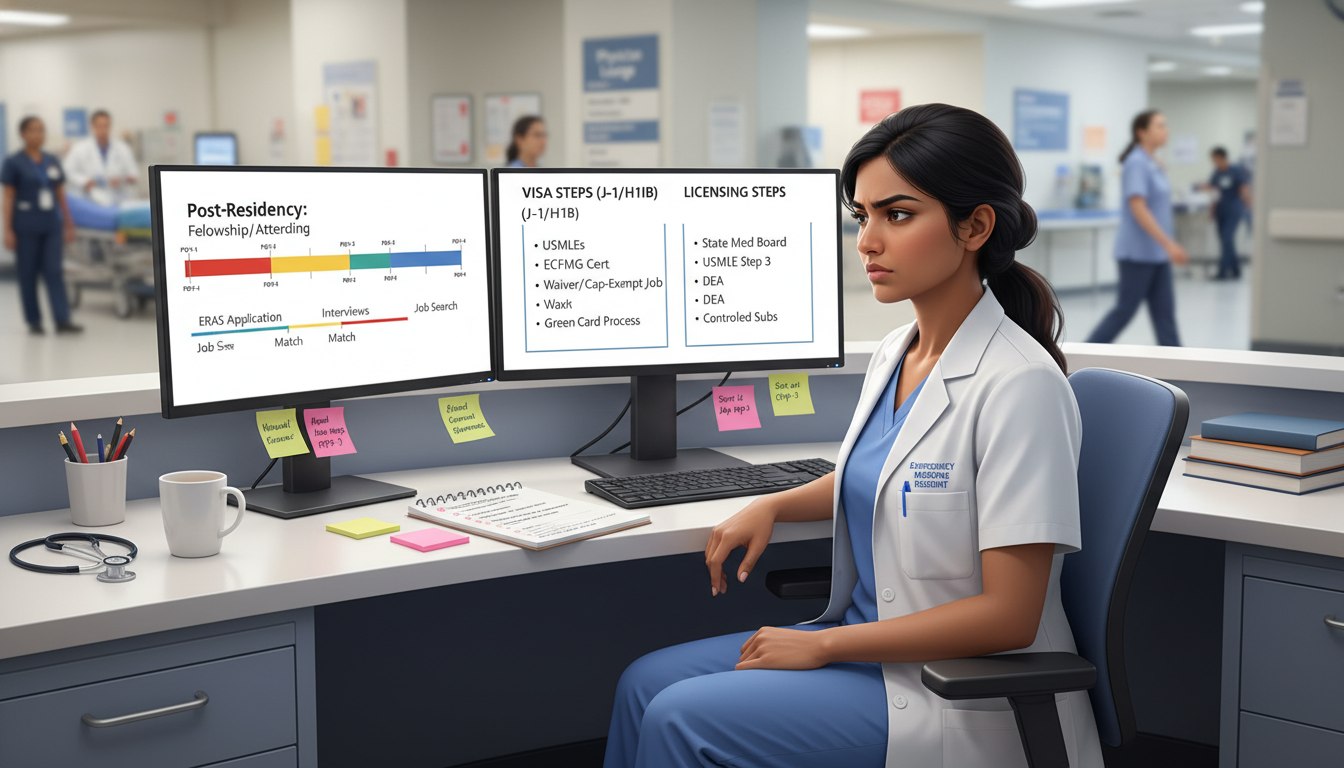
Pre-Residency / EM Match Phase (MS4 or Pre-Match Year)
Primary goal: Lay the foundation for a successful EM match AND a future job search.
Key actions:
Clarify ultimate immigration path early
- Are you aiming for:
- Long-term US practice with eventual permanent residency?
- Shorter-term US experience with likely return to home country?
- Discuss options with:
- An immigration attorney familiar with physician visas
- Mentors who are IMGs in emergency medicine
- Are you aiming for:
Match strategy with job market in mind
When planning your EM match list, consider:- Programs with strong track records of placing IMGs into US attending jobs
- Faculty with experience navigating visas and J-1 waivers
- States with friendlier IMG and visa environments (e.g., large underserved areas with many waiver positions)
Ask the right questions on interview day
Without over-emphasizing visas, you can ask:- “How many of your recent graduates are IMGs?”
- “Where have your IMG graduates practiced after residency?”
- “Are there program resources for visa or waiver guidance?”
Outcome to aim for: Matching at a program that is not only strong clinically but also experienced in moving IMGs into US attending EM jobs.
PGY-1: Orientation, Foundations, and Early Planning
Primary goal: Learn the system and clarify long-term constraints.
You don’t start active job applications now—but you do begin strategic planning.
Key actions:
Understand your visa and its end-date
- If you’re on a J-1:
- Know that you generally must do a J-1 waiver job or leave the US for 2 years, unless you obtain a waiver or different status
- Start learning what J-1 waiver EM jobs look like: rural, underserved, or high-need areas
- If you have H-1B or another status:
- Ask early about maximum duration and portability to an attending job
- If you’re on a J-1:
Seek an IMG-EM mentor
- An attending who is/was an IMG in emergency medicine is ideal
- Ask them:
- When did they start job searching?
- What would they do earlier in hindsight?
- Which states or employers are more IMG-friendly?
Early awareness of licensure requirements
- Review the state medical boards where you might want to practice:
- Some states have stricter rules for IMGs (e.g., more US GME years required, specific exam timelines)
- This matters because licensure timelines drive when to start job search in your final year.
- Review the state medical boards where you might want to practice:
Develop your EM profile
- Strong clinical performance and good evaluations
- Early involvement in:
- Quality improvement projects
- Research
- EM interest groups, committees, or resident councils
Outcome to aim for: By the end of PGY-1, you should know your visa constraints, preferred regions, and potential licensure obstacles—even if nothing is “final” yet.
PGY-2: Career Direction and Early Market Intelligence
Primary goal: Move from general awareness to a targeted plan for your attending job search.
This is the year most residents start asking “When to start job search?” Even though you’re not fully applying yet, as an IMG you must start information-gathering no later than mid-PGY-2.
Key actions:
Define your practice preferences
- Academic vs community vs hybrid
- Urban vs suburban vs rural
- Shift load (e.g., high-volume urban center versus moderate-volume community site)
- Willingness to work in J-1 waiver-eligible or very underserved areas
Research the EM job market
- Use job boards and recruiters to get a feel for:
- Regions with strong demand for EM physicians
- Employers that frequently mention J-1 waiver or visa sponsorship
- Speak with recent graduates from your program, especially IMGs:
- Where did they interview and match as attendings?
- Which employers were IMG- and visa-friendly?
- Use job boards and recruiters to get a feel for:
Narrow your state targets
- Identify 3–5 states where:
- You would realistically be willing to live and work
- The physician job market for EM is open or growing
- State medical license processing times match your graduation date
- Check if these states are common locations for J-1 waiver jobs if that applies to you.
- Identify 3–5 states where:
Attend early networking events
- EM conferences (ACEP, SAEM, AAEM, state ACEP chapters)
- Talk with booth representatives and ask:
- “How do you handle visas for IMGs?”
- “Do you recruit J-1 waiver candidates?”
- You’re not applying yet—but you’re planting seeds and understanding timelines.
Outcome to aim for: By the end of PGY-2, you should have a short list of target states and practice settings, understand who hires IMGs in EM, and know the likely timeline for state licenses in those areas.
PGY-3 (and PGY-4 for 4-year programs): Your Critical Job Search Year
This is the decisive period for your attending job search as an IMG in emergency medicine. Your timing and strategy during this year will determine whether you start work smoothly after residency—or face delays and gaps.
A. When to Start Job Search Activity
For a June graduation:
Very early planning:
- Start finalizing your CV and personal statement: April–June of the prior year (end of PGY-2 or PGY-3 for 4-year programs)
- Request letters of recommendation: late spring/summer
Active job search and applications:
- Ideal window to start applying: August–October of your final year
- For IMGs, especially with J-1 or H-1B needs, starting in August or even late July is safer than waiting until winter
Interviews and offers:
- Typically: September–December
- Many groups aim to finalize their new-hire class by late fall or early winter
If you are on a more restrictive visa or require a J-1 waiver, consider yourself on an early timeline—think July/August, not October.
B. How Visa Status Influences When to Start
- J-1 Visa Holders
If you’re J-1 sponsored for residency:
- You generally must:
- Either complete a J-1 waiver job in a designated shortage area, or
- Leave the US for 2 years (with some exceptions)
Timing implications:
- You need to target employers that:
- Are located in waiver-eligible areas
- Are experienced in filing the J-1 waiver application
- Application cycles for J-1 waivers may be tied to:
- State health department timelines
- Federal agency programs (e.g., Conrad 30)
Practical rule of thumb:
- Begin serious job search (outreach, applications) by July–August of your final year
- Be aware that:
- Some states open J-1 waiver applications on fixed dates (e.g., October 1)
- You and your employer must coordinate documents well in advance
- H-1B or Other Work Visas
If you’re on H-1B during residency:
- Many EM employer groups may be less experienced with H-1B than J-1 waiver
- However, H-1B is “dual intent” and can be attractive for long-term plans
Timing implications:
- Start networking and inquiry by early summer of your final year
- Start applications no later than August–September
- Employers will need time to:
- Assess whether they can handle H-1B
- Consult with their own immigration counsel
- File petitions before you complete residency
- Green Card Holders / US Citizens
If you are an IMG but hold a green card or US citizenship:
- You have more flexibility in timing
- However, the EM job market can still be locally tight in some desirable cities
Timing implications:
- You can generally start applying between September–November of your final year
- But if you want competitive academic posts in popular metros, start in August–September to be safe
C. Aligning State Licensure with Job Search
State medical licenses often take 3–6 months, and some states are slower.
General strategy:
By early PGY-3 (or PGY-4):
- Confirm which state(s) you are targeting
- Check processing times and requirements (e.g., notarized documents, translations, primary source verification)
When to start license application:
- Many residents begin their first license application around October–December of their final year
- If your target state is known to be slow or complex, consider starting earlier
- Some employers will help you file once you sign a contract
IMG-specific considerations:
- Ensure you have all ECFMG documents ready
- Be prepared for additional verification of foreign transcripts or training
Key point: A delayed state license can postpone your start date, even if you have a signed contract and an approved visa. This is why licensure planning and job search timing must be coordinated.
Practical Strategy: How to Execute a Timely Job Search as an IMG

1. Build a Month-by-Month Checklist for the Final 18 Months
Here is a simplified structure you can adapt:
18–15 months before graduation (early PGY-3 / mid PGY-3 for 4-year programs)
- Confirm visa path and immigration priorities
- Identify target regions and states
- Meet with program leadership to discuss your goals as an IMG
- Attend a national or state EM conference if possible
14–12 months before graduation
- Draft or update your CV (make it EM-specific and US-style)
- Prepare a template cover letter emphasizing:
- EM residency training
- Visa considerations (clearly but concisely)
- Clinical strengths and interests
- Ask 2–3 attendings for letters of recommendation
11–9 months before graduation (July–September)
- Begin active job search:
- Respond to recruiter emails selectively
- Directly email medical directors or group leadership at target sites
- Use program alumni networks
- For J-1 holders: prioritize waiver-eligible employers and clarify if they will sponsor
8–6 months before graduation (October–December)
- Attend onsite interviews and virtual interviews
- Compare offers and contract terms
- Start first state license application if not already initiated
- Confirm that the employer’s timeline aligns with your visa and graduation date
5–3 months before graduation (January–March)
- Finalize contract negotiations
- Work with employer and attorney on visa petitions or J-1 waiver submissions
- Confirm credentialing timeline with employer and hospital(s)
2–0 months before graduation (April–June)
- Complete onboarding requirements, immunizations, drug screening, background checks
- Monitor state license processing; provide any additional documents promptly
- Prepare for transition: housing, relocation, financial planning
2. Be Transparent but Strategic About Visa Status
When communicating with potential employers:
Mention visa status early, but not as the very first sentence:
- Example: “I am a PGY-3 emergency medicine resident at [Program]. I am seeking a full-time EM attending position starting August [Year]. I am currently on a J-1 visa and will require a J-1 waiver position upon graduation.”
This allows employers to:
- Quickly self-select in or out
- Avoid wasted time on both sides
- Connect you with their immigration resources early
3. Use Multiple Channels, Not Just Recruiters
While recruiters are common in the EM job market, as an IMG you should also:
Leverage program alumni who are IMGs
Write directly to:
- EM medical directors
- Chairpersons for academic departments
- CEOs or CMOs in smaller hospitals where leadership is more hands-on
Attend job fairs at EM conferences and ask specifically:
- “Do you sponsor visas for emergency physicians?”
- “Have you hired J-1 waiver candidates before?”
4. Consider Time-Bound vs. Opportunity-Bound Decisions
You might face a tension between:
- Best job fit (location, schedule, pay, academic opportunities)
- Best visa fit (waiver eligibility, employer experience with sponsorship, faster processing)
For many IMGs, the first attending job is primarily a visa and licensure solution, with the goal of moving to an ideal location later once immigration status stabilizes (e.g., after fulfilling a waiver obligation or progressing in green card processing).
Understanding this allows you to make pragmatic timing decisions instead of waiting too long for a “perfect” job that may never fully materialize.
Common Pitfalls in Job Search Timing for IMGs in EM
1. Waiting Too Long to Start
- IMGs on J-1 who start serious searching in January or February of their final year often:
- Find fewer available waiver jobs
- Face compressed visa and license timelines
- May need to delay start dates or accept less desirable posts
2. Ignoring State Licensing Timelines
- Applying for licensure too late can:
- Push your start date back by months
- Put visa timing at risk if start dates are tied to status activation
3. Underestimating Visa Complexity
- Assuming “the employer will handle it” without:
- Confirming they actually have prior experience with J-1 waiver or H-1B
- Reviewing realistic timelines with their immigration counsel
4. Missing Opportunities to Network Early
- Not talking to IMGs 1–2 classes ahead of you
- Skipping EM conferences where major EM groups recruit heavily
- Failing to share your long-term goals with residency leadership who might connect you to employer contacts
Putting It All Together: A Strategic Mindset for IMGs in EM
As an international medical graduate in emergency medicine, your attending job search must be deliberate, early, and coordinated with:
- The EM hiring cycle
- State licensing timelines
- Your specific visa path and long-term immigration goals
If you start planning by early PGY-2, begin active searching by mid-summer of your final year, and maintain clear communication with potential employers about your visa status, you will greatly improve your chances of stepping smoothly into your first attending role.
This timing discipline turns a stressful, uncertain process into a structured project you can manage—freeing your energy to focus on what truly matters: becoming an excellent emergency physician.
FAQs: Job Search Timing for IMGs in Emergency Medicine
1. When should an IMG in EM start their attending job search?
For most IMGs in emergency medicine, begin active job search efforts (applications and outreach) by August of your final residency year. If you’re on a J-1 visa, treat July–August as your target start window to allow enough time for J-1 waiver processes and credentialing. You should start planning and gathering information no later than mid-PGY-2.
2. Does being on a J-1 visa change when to start job search?
Yes. J-1 status significantly affects when to start job search and which employers you can target. Because J-1 waiver positions are limited and often tied to state-specific application cycles, you should start early:
- Learn waiver rules in PGY-2
- Begin serious job search by July–August of your final year
- Prioritize employers with a proven track record of J-1 waiver hires
3. If I have a green card, can I wait until late in my final year to look for jobs?
You have more flexibility than someone on a J-1 or H-1B, but waiting until late winter can still limit your choices—especially in competitive metros or academic centers. Starting your EM job search around September–November of your final year is usually ideal, even for green card holders and US citizens.
4. How does the EM job market affect my timing as an IMG?
The physician job market in emergency medicine can be regional and cyclical. Some urban centers are saturated, while many community and rural hospitals still have strong demand. As an IMG, you should:
- Use PGY-2 to understand which regions have more openings and visa support
- Time your applications to arrive during the main recruitment window (late summer to fall of your final year)
- Remain flexible about location, especially for your first job if a waiver or sponsorship is required
By aligning your job search timing with both the EM market cycle and your immigration constraints, you maximize your chances of moving smoothly from residency to a stable, satisfying attending role in emergency medicine.