
Understanding the Job Search Timeline for IMGs in General Surgery
For an international medical graduate (IMG) in general surgery, timing the job search is almost as critical as board scores were during the surgery residency match. The physician job market for general surgeons is strong overall, but the way you time your applications, networking, and contract negotiations can dramatically influence:
- The type of position you land (community vs academic vs private practice)
- Your geographic options
- Your starting salary and benefits
- Your ability to secure or maintain a visa
This IMG residency guide for the post‑residency physician job market is specifically tailored to international medical graduates in general surgery, focusing on when to start job search activities and how to pace them.
Below, we’ll walk through a structured, year‑by‑year and month‑by‑month job search timeline, with special attention to visa-dependent IMGs and general surgery career specifics.
Big Picture: How Early Should an IMG Start the Job Search?
For a categorical general surgery resident (5-year program), the job search doesn’t start in PGY‑5. It starts much earlier—mentally, strategically, and in terms of relationship-building.
Here’s a high‑level overview:
PGY‑1–2: Exploration and foundation
- Clarify career goals (community vs academic vs fellowship)
- Start early networking
- Build your CV with meaningful experiences
PGY‑3: Strategic positioning
- Decide on fellowship vs going straight into practice
- Identify geographic and visa constraints
- Begin informal discussions with mentors about opportunities
PGY‑4: Pre‑search and early moves
- Refine your target practice type and location
- Update CV and begin quietly monitoring the physician job market
- Attend meetings, talk to recruiters, and observe market trends
PGY‑5: Active application and negotiation (for those going directly into practice)
- 12–18 months before graduation: Start active search
- 6–12 months before graduation: Intensive interviewing and contract negotiation
- 3–6 months before graduation: Finalize contracts, start credentialing, plan relocation and immigration steps
If you are pursuing fellowship in general surgery subspecialties (e.g., MIS, surgical oncology, colorectal, trauma/critical care), you must overlay this with the fellowship application timeline. In that case, your attending job search typically begins during fellowship—again, 12–18 months before finishing fellowship.
Year-by-Year Timeline: From Early Residency to Attendinghood
PGY‑1 to Early PGY‑2: Laying the Groundwork
This is not the time to send out CVs, but it’s the ideal period to prepare for the future physician job market.
Key goals:
Clarify long‑term direction
- Academic vs community practice
- Interest in subspecialty vs broad general surgery
- Aggressive operative practice vs mixed clinical/administrative/teaching role
Learn the reality of the job market for general surgeons
- Many community hospitals are desperate for general surgeons.
- Academic positions are more competitive and slower to hire.
- Visa sponsorship varies widely by employer type and region.
Build your professional profile
- Participate in research if you foresee an academic career.
- Seek increasing autonomy in the OR and on call.
- Present at local or national surgical meetings.
Practical steps during PGY‑1–2:
- Join societies (ACS, specialty-specific groups).
- Keep a master CV updated at least annually.
- Develop relationships with faculty who may later serve as references or connect you with job openings.
At this stage, formal job search activity is premature, but strategic planning is not.
PGY‑3: Decision Points and Early Market Intelligence
PGY‑3 is a critical “pivot year” in a general surgery residency.
1. Decide: Fellowship vs Direct-to-Practice
The first major question impacting your job search timing:
- Will you apply for fellowship (e.g., surgical oncology, MIS, vascular, colorectal, trauma/critical care)?
- Or will you go straight into a general surgery attending role after PGY‑5?
This decision influences when, where, and how you search for jobs.
If choosing fellowship:
- Your attending job search will mainly occur during your final fellowship year.
- However, start understanding which subspecialties have better markets, including for visa-dependent IMGs.
If going directly into practice:
- You will begin formal job search activities early in PGY‑5, but your planning starts now.
2. Understand Your Visa and Immigration Timeline
For an international medical graduate, the visa factor heavily influences when to start job search.
J‑1 visa (most common for IMGs in residency):
- You will likely need a J‑1 waiver job after training, usually in a medically underserved or HPSA/MUA area.
- J‑1 waiver processes (Conrad 30, ARC, DRA, HHS, etc.) have strict deadlines and limited slots.
- This requires you to secure a qualifying job earlier than many US grads—often 12–18 months before completion if possible.
H‑1B visa:
- You may transition to H‑1B if your employer sponsors you.
- The timing interacts with H‑1B caps and filing windows (April filings, October start dates).
- Advance planning and legal counsel are crucial.
Permanent residency (green card):
- If you already have a green card, your timeline is more flexible.
- You can focus more on job fit and less on waiver or visa constraints.
Action items in PGY‑3:
- Meet with your institution’s GME office and an immigration attorney familiar with physician immigration.
- Map out:
- When you’ll complete training
- What type of visa you will need for your first job
- Whether you’re likely to need a J‑1 waiver position and in which states or regions
This immigration roadmap determines how early and how aggressively you must enter the surgery residency job market.
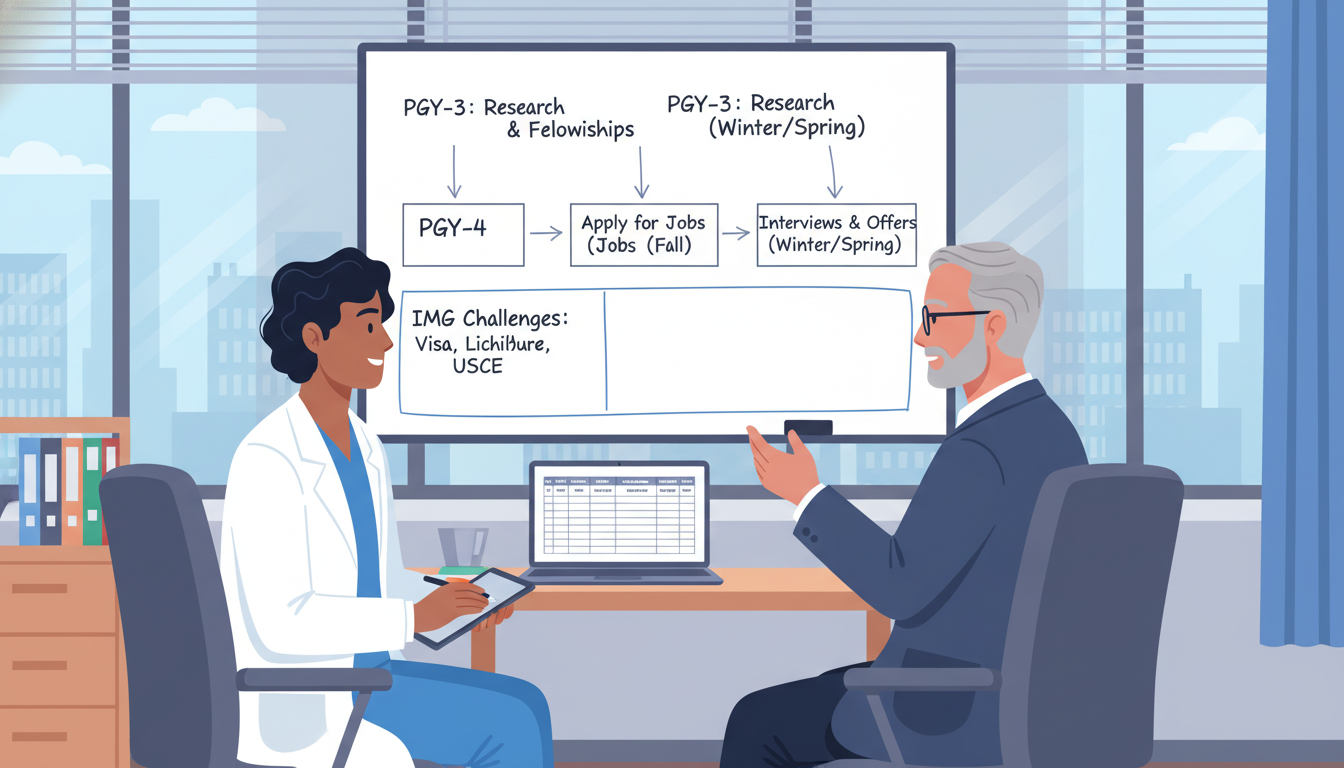
PGY‑4: Quiet Preparation and Strategic Positioning
PGY‑4 is where job search timing starts to become concrete.
1. Clarify Your Ideal Practice Profile
By this stage, you should be able to define:
Type of practice:
- Academic general surgery
- Community hospital employed
- Private practice (independent or multi-specialty group)
- Hybrid models (community-academic affiliates)
Scope of practice:
- Bread-and-butter general surgery
- Heavy endoscopy
- Rural broad-scope practice (including some orthopedics, OB emergencies in certain regions)
- Subspecialty-heavy practice (e.g., mostly colorectal or bariatric within a general framework)
Geography:
- Regions or states open to you vs off-limits
- Willingness to consider rural or underserved areas (critical for J‑1 waiver)
2. Start Monitoring the Physician Job Market
You’re not actively applying yet, but you should be watching.
Set up job alerts on:
- Major job boards (e.g., JAMA, NEJM CareerCenter)
- Specialty-specific sites (ACS, subspecialty societies)
- J‑1 waiver job listing platforms (if applicable)
Pay attention to:
- Which regions are consistently hiring general surgeons
- Compensation ranges (base salary, RVU bonuses, call pay)
- How often jobs mention visa sponsorship or explicitly welcome IMGs
3. Start Soft Networking
The timing of networking is early by design—it takes months to build genuine connections.
- Attend regional and national conferences (ACS Clinical Congress, subspecialty meetings).
- Introduce yourself to:
- Faculty from other institutions
- Surgeons in your home country who now practice in your target region
- Potential mentors who have recently navigated the job market as IMGs
You might casually mention your future availability (“I’ll be graduating in 2 years and I’m very interested in community general surgery in the Midwest”) without formally asking for a job yet.
PGY‑5: Active Job Search and Negotiation (Direct to Practice)
For residents going straight from a general surgery residency to an attending position, PGY‑5 is mission-critical.
When to Start the Formal Job Search in PGY‑5
Ideal window to start actively applying:
12–18 months before your anticipated completion date- Example:
If you finish residency on June 30, 2027, begin active searching and sending CVs between January and June 2026.
- Example:
Why so early, especially for IMGs?
- Time to:
- Identify visa-sponsoring or J‑1 waiver–eligible employers
- Complete interviews (often multiple rounds)
- Negotiate contract terms
- Start credentialing and licensing (which can take 4–9 months)
- Allow for delays in immigration processing
- Time to:
US grads may sometimes secure positions 6–9 months before graduation; IMGs, particularly on J‑1 visas, should not rely on that timeline.
Step-by-Step PGY‑5 Timeline
12–18 months before graduation
Finalize your CV, including:
- Surgical case logs (summarized, not raw)
- Research and presentations
- Leadership roles
- Visa status clearly noted
Draft a generic but polished cover letter that you can customize.
Start contacting recruiters and employers:
- Hospital HR or physician recruitment departments
- Group practices with posted openings
- Institutions your mentors directly know
If seeking J‑1 waiver positions:
- Identify your target states and review their Conrad 30 timelines (when they accept applications; some fill quickly each year).
- Target hospitals in HPSA/MUA areas early.
9–12 months before graduation
Conduct first-round interviews:
- Virtual video interviews
- Initial phone screening with recruiters or department chiefs
Refine your target list based on:
- Quality of interactions
- Job description vs your goals
- Visa feasibility
Begin state medical license applications in states you are serious about (many programs allow this once you are PGY‑4 or PGY‑5 with a letter from your program director).
6–9 months before graduation
Schedule on-site interviews at top-choice locations.
Start comparing offers:
- Compensation and incentive structure
- Call schedule and OR block time
- Support staff and equipment
- Mentorship and new-surgeon onboarding/support
- Visa support and legal fees coverage
This is also the primary contract negotiation window:
- Seek legal review from a physician contract attorney.
- Clarify non-compete clauses, tail coverage, relocation assistance, and signing bonuses.
3–6 months before graduation
Finalize and sign your employment contract.
Ensure your employer initiates:
- Credentialing with the hospital and payer enrollment
- Visa filing (H‑1B petitions, J‑1 waiver documentation, etc.)
- Support with state license finalization if still pending
Plan relocation and start discussing:
- Start date (often 1–3 months after residency completion)
- Orientation schedule
- Initial call responsibilities
For many IMGs, this tight but well-paced sequence is what allows a seamless transition from resident to attending without unnecessary gaps in employment or visa status.

Fellowship Pathway: Adjusting the Timeline
If you plan to pursue a fellowship after general surgery residency, your attending job search timing shifts.
1. Residency to Fellowship
- Fellowship applications in general surgery subspecialties usually occur in PGY‑3–4 (depending on specialty).
- At this stage, your focus is on matching into fellowship, not your first attending job.
2. Fellowship to First Attending Position
Most general surgery fellows should begin their attending job search on a similar timeline:
12–18 months before fellowship completion, start:
- Updating your CV with fellowship skills and case volume.
- Identifying positions that explicitly seek your subspecialty.
- Re-examining visa needs (you may be on a new J‑1 or H‑1B for fellowship).
For J‑1 fellows:
- You may again need a J‑1 waiver position, even if you previously completed one after residency. Clarify your specific situation with an immigration attorney.
- States sometimes differentiate between residency and fellowship J‑1 waivers.
3. Market Realities for Subspecialists
Keep in mind:
- Some fellowships increase your market value (e.g., MIS/bariatric, colorectal, trauma/critical care in some regions).
- Others are highly region-specific or academic-heavy, requiring more targeted job searching and longer lead time.
- As an IMG, always verify visa sponsorship early with potential employers; some smaller private groups may want a subspecialist but are unfamiliar with visa processes.
IMG-Specific Factors That Change Job Search Timing
1. Visa Constraints and Waiver Timelines
Visa status is the single biggest differentiator between IMGs and US graduates in terms of timing.
- You must align:
- Job search timeline
- Immigration filing windows
- State-level J‑1 waiver deadlines
- Hospital credentialing and licensing
This means you cannot safely delay your job search to “see what comes up later.” An early, structured timeline is essential.
2. Geographic Flexibility
General surgeons are in demand, but:
- Visa-friendly jobs may cluster in:
- Rural or semi-rural areas
- Underserved communities
- Community hospitals with long-standing IMG hiring
If your geographic preferences are very narrow, start your search even earlier (18–24 months before completion) to maximize your options.
3. Reference Letters and Mentor Availability
Because you may be searching earlier than some peers, ensure your:
- Program director and key faculty are prepared to provide strong references early in PGY‑5 (or late PGY‑4 if you’re very proactive).
- Mentors in your specialty know your timeline and can alert you to unadvertised opportunities, especially in IMG-friendly institutions.
Practical Tips: How to Execute a Well-Timed Search
Tip 1: Build a “Job Search Calendar”
Create a month-by-month roadmap starting 18–24 months before your graduation (or fellowship completion):
- Mark:
- State license application deadlines
- J‑1 waiver state program opening dates (if applicable)
- Planned conference dates for networking
- Target months for initial outreach, interviews, and contract signing
Treat this calendar like you treat your call schedule—non‑optional and central to your planning.
Tip 2: Balance Job Search with Clinical Demands
PGY‑4–5 and fellowship years are intense. To avoid burnout:
- Dedicate 1–2 hours per week consistently to the job search instead of occasional, frantic bursts.
- Use “lighter” rotations or research blocks to schedule most interviews and site visits.
- Get administrative support where possible—some programs have career offices or coordinators who can help.
Tip 3: Use Recruiters Strategically (Not Passively)
Recruiters can be valuable, especially for IMGs needing visa support, but:
- Don’t rely solely on them. Many of the best academic or niche jobs never go through recruiters.
- Be very clear with them about:
- Visa needs and timeline
- Practice type and geography preferences
- Ask directly: “How familiar is this employer with J‑1/H‑1B sponsorship? Have they successfully sponsored before?”
Tip 4: Track Every Contact and Application
Maintain a simple spreadsheet:
- Employer name and location
- Type of practice (academic, community, private)
- Contact person and date of initial contact
- Visa willingness (Y/N/unclear)
- Interview status and notes
- Offer details and deadlines
This helps you manage multiple opportunities at different stages without missing key follow-ups.
Tip 5: Time Negotiations Before Everything Fills Up
Recognize that:
- Many hospitals finalize their next year’s staffing by late winter or early spring for July starts.
- Some J‑1 waiver slots in attractive states fill in the first weeks of their application window.
- If you delay negotiations, you may face:
- Fewer open positions
- Less leverage to negotiate
- More time pressure on visa processes
Aim to have serious offers in hand 6–9 months before graduation and final contracts by 3–6 months prior, especially if you depend on a visa.
Frequently Asked Questions (FAQ)
1. As an IMG in general surgery, when should I start looking for my first attending job?
For IMGs finishing general surgery residency and going straight into practice, plan to start active job search 12–18 months before your graduation date. If you are on a J‑1 visa and will require a waiver, lean toward the earlier side of that range, especially if you want a specific region or type of practice.
If you are completing a fellowship, shift that timeline to 12–18 months before fellowship completion, not residency completion.
2. How does being on a J‑1 visa change the timing of my job search?
A J‑1 visa typically accelerates your job search timeline:
- You must secure an offer from a qualifying J‑1 waiver employer early enough to:
- Prepare the waiver application
- Submit it during the state’s limited annual application period
- Complete USCIS processing and hospital credentialing
This often means beginning to contact potential employers 18 months before completion and aiming to have an offer well in hand 9–12 months before you finish training.
3. Can I wait until after I pass my boards to start my job search?
No. For most IMGs in general surgery, waiting until after board exams (often after finishing residency) is too late. The job search, immigration process, and credentialing are lengthy. You should begin your search while still in training, well before your final year ends. Many employers will hire board-eligible surgeons, with the expectation you’ll become board-certified within a defined period.
4. What if I’m undecided between fellowship and going straight into practice—how does that affect my timing?
If you’re uncertain, use PGY‑3 and early PGY‑4 to clarify your goals. Applying to fellowship and applying for attending jobs simultaneously can complicate your message to employers and create timing conflicts. Ideally, decide on fellowship vs direct practice by mid-PGY‑3 for most pathways, so:
- If you choose fellowship, you focus on fellowship applications first and postpone attending job search until your fellowship.
- If you choose direct practice, you begin prepping your job search plan by late PGY‑4 and move into active searching early in PGY‑5.
By approaching your job search with a structured, forward-looking timeline tailored to your status as an international medical graduate in general surgery, you significantly increase your odds of landing a position that matches your clinical interests, supports your visa needs, and sets you up for long-term success as an attending surgeon.