
Understanding Job Search Timing as an IMG in Med-Peds
For an international medical graduate pursuing Medicine-Pediatrics, job search timing is not just a planning detail—it is a strategic decision that can determine visa security, income stability, and long-term career satisfaction. Unlike some US graduates, IMGs must coordinate the medicine pediatrics match, board eligibility, and immigration requirements with the physician job market and institutional hiring cycles.
This IMG residency guide focuses on when to start job search efforts and how to pace each phase, specifically for Med-Peds residents and fellows who trained or matched in the United States. We will also consider those still outside the US who are aiming for Med-Peds training and want to think ahead.
Key themes you’ll see throughout:
- Start earlier than you think, especially as an IMG
- Work backward from your graduation/visa deadlines
- Adjust timing if you’re planning subspecialty fellowship or non-clinical paths
- Balance flexibility (to secure a job) with strategy (to get the right job)
The Big Picture: Timeline Overview for IMGs in Med-Peds
For most US-based Med-Peds residents, serious job planning begins 18–24 months before graduation, with intensive searching and interviewing in the 9–15 month window. For IMGs, that range often needs to shift earlier due to visa and licensing constraints.
A typical Medicine-Pediatrics residency is 4 years. Here’s a high-level timeline:
PGY-1 (Intern Year)
- Focus: Clinical adjustment, US health system, networking foundation
- Job search: Not active yet, but start understanding the attending job search process from seniors
PGY-2 (Second Year)
- 24–30 months before graduation
- Clarify career goals: hospitalist vs primary care vs hybrid, academic vs community
- Identify geographic and visa-related constraints (e.g., need for H-1B, J-1 waiver)
- Start informal outreach to mentors and program leadership
PGY-3 (Third Year)
- 12–24 months before graduation: Core exploration and early applications
- Attend job fairs, national conferences (e.g., ACP, AAP, MPPDA-related events)
- Begin early applications in your preferred regions, especially underserved or rural areas open to IMGs
- For fellowship interest: coordinate with fellowship applications so job search doesn’t conflict
PGY-4 (Final Year)
- 6–18 months before graduation: Interviews, offers, and contract negotiations
- Aim to sign by 6–9 months before graduation as an IMG to allow time for licensing, credentialing, and visa processing
- Solidify relocation plans, credentialing packets, and board exam scheduling
If you are planning a med peds residency but still abroad, you should still think about timing early. Understanding when you will likely graduate, your visa options, and common job search windows will help you design rotations, electives, and networking with your target job market in mind.
Month-by-Month: A Detailed Timeline for IMGs in Med-Peds
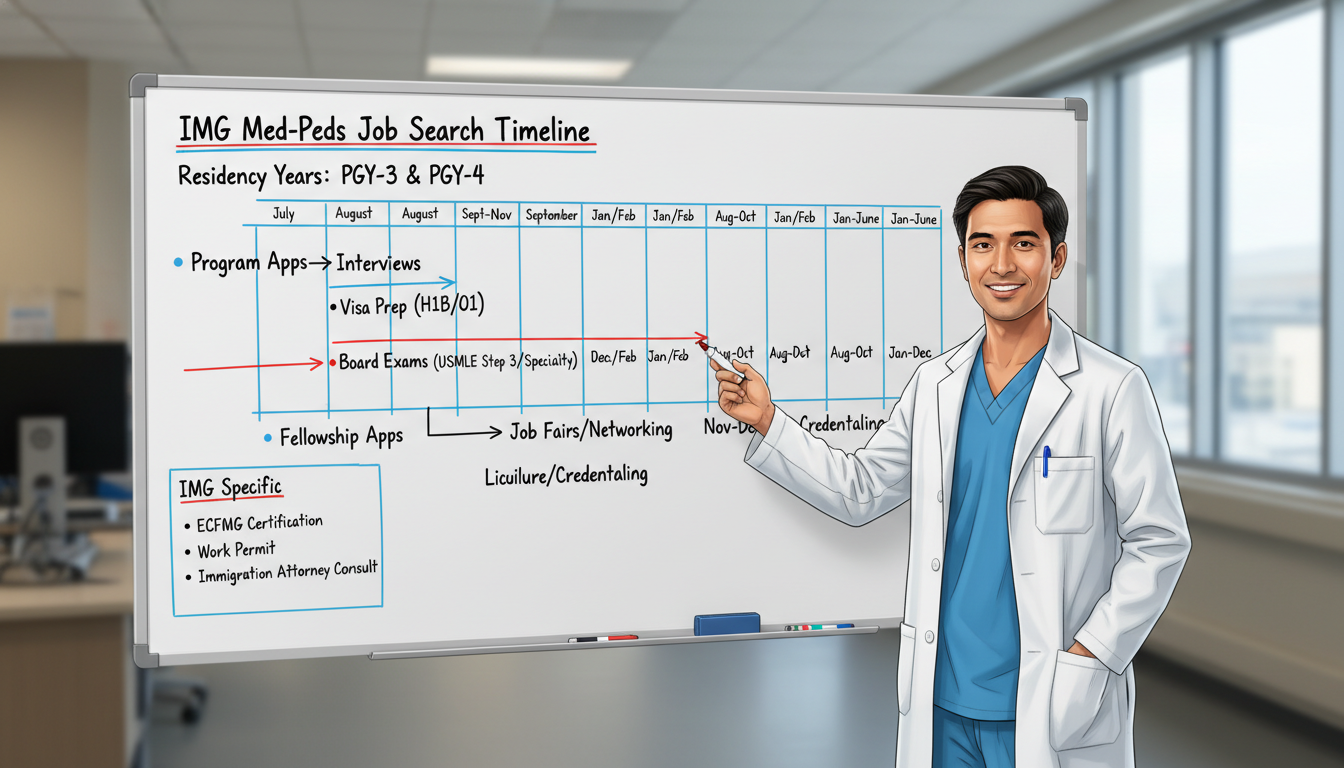
PGY-1: Laying the Foundation (36–48 Months Before Graduation)
Main priority: Adjust, perform well clinically, and build relationships.
Develop core relationships
- Identify mentors in internal medicine, pediatrics, and Med-Peds leadership.
- Share early that you are an international medical graduate interested in long-term US practice; mentors can begin thinking about opportunities for you.
Learn the US physician job market
- Ask senior Med-Peds residents about their attending job search experience:
- When did they start?
- What kind of positions are available for Med-Peds?
- Any IMGs in prior classes—how did they handle visas?
- Ask senior Med-Peds residents about their attending job search experience:
Clarify your long-term goals
- Do you want to practice full-spectrum Med-Peds (caring for both adults and children) or ultimately narrow to adult-only or peds-only practice?
- Are you interested in:
- Med-Peds hospitalist roles
- Academic Med-Peds (teaching and research)
- Outpatient primary care
- Combined complex care, transitional care, or specialty tracks (e.g., Med-Peds with a focus in cardiology, infectious disease, etc.)
These early decisions influence where and when you start searching; for example, academic roles may recruit earlier and require a deeper CV.
Actionable steps in PGY-1
- Join national organizations:
- American Academy of Pediatrics (AAP)
- American College of Physicians (ACP)
- Medicine-Pediatrics Program Directors Association (MPPDA) – often has Med-Peds specific career resources.
- Attend at least one national or regional meeting (virtual or in person) to observe how employers recruit and what positions are available for Med-Peds.
- Keep an updated CV and document teaching, QI projects, and leadership—these become crucial during your attending job search.
PGY-2: Strategic Planning and Early Exploration (24–36 Months Before Graduation)
This is when you should intentionally decide when to start job search activities in earnest.
Clarify your post-residency path
- Pure clinical Med-Peds practice
- Most common route: outpatient primary care, mixed inpatient/outpatient, or hospitalist roles.
- Subspecialty fellowship (adult, pediatric, or combined)
- If pursuing fellowship, your initial job search may be delayed until fellowship, but many IMGs still:
- Track job market trends early
- Build relationships in potential hiring departments
- If pursuing fellowship, your initial job search may be delayed until fellowship, but many IMGs still:
- Non-clinical or mixed roles
- E.g., public health, industry, clinical research, or administrative medicine
- These fields often recruit on different timelines; networking often matters more than mass applications.
For IMGs, PGY-2 is critical for visa strategy
- If on a J-1 visa, you must anticipate the need for a J-1 waiver job after residency:
- Typically in a Health Professional Shortage Area (HPSA) or medically underserved location.
- Many such employers recruit earlier and are very open to IMG Med-Peds physicians because of workforce needs.
- If on an H-1B visa, confirm:
- Whether your residency program is cap-exempt
- Whether you will need a cap-subject H-1B later (most private practices and some hospitals)
- Application periods and deadlines tied to USCIS timelines.
Actionable steps in PGY-2
- Meet with:
- Program director or Med-Peds chief to discuss your career interest and visa limitations.
- Institutional GME office or immigration attorney to clarify realistic timelines.
- Start building a short list of target states/regions, considering:
- Licensure processing times (some states take 3–6+ months)
- J-1 waiver or H-1B sponsorship friendliness
- Need for Med-Peds physicians (rural vs urban, academic vs community).
- Begin soft outreach:
- Email Med-Peds faculty or alumni in your desired regions:
- Introduce yourself
- Ask about their practice and whether they anticipate hiring in 1–2 years
- Save all helpful contacts in a spreadsheet with notes on timing and fit.
- Email Med-Peds faculty or alumni in your desired regions:
PGY-3: Core Job Search Phase (12–24 Months Before Graduation)
For most IMGs and most Med-Peds positions, the real job search starts here.
12–18 Months Before Graduation: Active Exploration and Early Applications
This is your main job search launch window.
Update all documents
- CV tailored for attending roles
- Short personal statement or cover letter template
- Updated list of references (preferably at least one Med-Peds faculty and one chief of service).
Start applying to positions
- Use multiple channels:
- Hospital/health system career pages
- National job boards (NEJM, AAP, ACP, PracticeLink, etc.)
- Recruiters familiar with Med-Peds and IMGs
- Direct outreach to practice groups
- Use multiple channels:
Be transparent about your visa and timeline
- Employers must know you are an IMG and what visa support you need.
- Earlier conversations are better; it saves both you and the employer time.
Attend conferences with a career focus
- Many conferences include job fairs with recruiters and department chairs.
- Bring printed CVs and a concise “elevator pitch”:
- “I am a Med-Peds resident at [Program], graduating in [Month, Year], interested in [type of practice] in [geographic area], and I require [J-1 waiver/H-1B sponsorship].”
9–12 Months Before Graduation: Interviews and Narrowing Options
Schedule and attend interviews
- Try to cluster interviews geographically to minimize travel costs.
- Use vacation or elective blocks; coordinate with your chief residents early.
Evaluate jobs systematically
Build a comparison spreadsheet including:- Practice type: outpatient, inpatient, mixed
- Patient mix: percentage adults vs pediatric, complexity, call schedule
- Compensation model: base salary, RVU bonus, signing bonus, relocation
- Visa support: J-1 waiver/H-1B details and past experience with IMGs
- Long-term growth: partnership track, academic titles, leadership opportunities
Request draft contracts from serious contenders
- Review with:
- A health-care employment attorney (ideal)
- Trusted mentor who has negotiated contracts
- Your program leadership, especially if they’ve helped prior Med-Peds IMGs.
- Review with:
PGY-4: Securing and Finalizing Your Position (0–12 Months Before Graduation)

9–12 Months Before Graduation: Aim to Sign as an IMG
For international medical graduates, a conservative and safer timeline is:
Target: Signed contract by 9–12 months before graduation
- Allows ample time for:
- State medical licensure
- Hospital credentialing and payer enrollment
- Visa sponsorship paperwork
- Allows ample time for:
Negotiate thoughtfully but efficiently
- Don’t rush blindly, but also avoid long delays that threaten visa timing.
- Key negotiable points:
- Start date (may need flexibility for visa approval)
- Call schedule and clinical load
- Sign-on bonus, relocation, loan repayment
- Any protected time for teaching or research (if academic).
6–9 Months Before Graduation: Paperwork and Backup Planning
Licensure
- If not already done, immediately apply for your state license; some states may require multiple attempts for verifications from abroad.
- Start early if your training or medical school was outside the US.
Credentialing and privileging
- Submit full credentialing packet ASAP: training letters, board eligibility letters, immunization records, malpractice history.
- Respond quickly to any requests from the hospital’s medical staff office.
Visa process
- J-1 waiver:
- Confirm your state’s or federal waiver program deadlines and slots.
- Coordinate among employer, immigration lawyer, and ECFMG.
- H-1B:
- Ensure employer understands cap-exempt vs cap-subject issues.
- Provide all documentation (USMLE scores, diplomas, licenses) promptly.
- J-1 waiver:
Backup/contingency plan
- As an IMG, always have a Plan B:
- A second signed contract in a different region is usually not practical, but you can:
- Keep at least one or two serious leads warm
- Maintain open communication with recruiters in case visa issues disrupt plans.
- A second signed contract in a different region is usually not practical, but you can:
- As an IMG, always have a Plan B:
0–6 Months Before Graduation: Transitioning and Onboarding
Finalize logistics:
- Housing in the new location
- Schooling for children/spouse job search if applicable
- Moving timelines that align with contract start date and visa issuance.
Prepare professionally:
- Schedule your internal medicine and pediatrics boards based on your job start date and employer expectations.
- Review clinical topics relevant to your new role (adult hospitalist vs outpatient pediatrics vs combined Med-Peds, etc.).
Clarify expectations with your employer:
- Orientation dates
- EMR training
- Initial productivity expectations during your first year as an attending.
Special Scenarios: How Timing Changes
If You’re Pursuing Fellowship After Med-Peds
For Med-Peds residents planning fellowship (e.g., cardiology, pulmonary, infectious disease, or pediatric subspecialties), the primary job search shifts to the fellowship period. Still:
- Start understanding the physician job market for your future subspecialty early in fellowship.
- If you’re an IMG on J-1, remember that the J-1 waiver job typically must be your first job after completing all training, including fellowship. This compresses the job search timeline at the end of fellowship, so begin at least 18–24 months before fellowship completion.
If You Trained Abroad and Aim to Enter a US Med-Peds Residency
Your first “job search” is actually the medicine pediatrics match. For this:
- Start planning 2–3 years before you want to start residency:
- USMLE completion
- US clinical experience (observerships, externships)
- Strong Med-Peds-focused letters of recommendation.
Though your focus is on matching, still think ahead:
- Familiarize yourself with US job landscapes that are traditionally friendlier to IMGs—often rural or underserved areas.
- Use this knowledge later in residency when you begin your attending job search.
If You’re Considering Non-Clinical or Mixed Clinical/Non-Clinical Careers
Non-clinical positions (e.g., industry, public health, global health NGOs, policy roles) often follow less predictable timelines:
- Start networking at least 18–24 months before you hope to transition.
- Attend specialized conferences, certificate programs, and courses and seek mentors in those spaces.
- As an IMG on a clinical visa, verify that your visa type allows non-clinical work or mixed roles; many do not without careful structuring.
Practical Tips to Optimize Your Job Search Timing as an IMG in Med-Peds
Always work backward from your constraints
- Graduation date, visa timelines, and state licensure processing are the three main anchors that determine when to start job search planning.
Use your Med-Peds identity as a strength
- Many hospitals and community health systems like Med-Peds physicians because they can flex between adult and pediatric needs.
- Emphasize your versatility in both internal medicine and pediatrics, plus any global health or multilingual skills.
Communicate proactively with program leadership
- Your program director and Med-Peds faculty often know local and regional opportunities before they’re advertised.
- Ask them explicitly:
- “Given that I’m an international medical graduate with [visa type], when do you recommend I begin my attending job search?”
- “Do you know of prior grads in my situation and how early they started?”
Don’t underestimate administrative delays
- Licensure, credentialing, and visa processing can each take months of back-and-forth.
- Build in slack time: assume everything will take 30–50% longer than optimal.
Balance “right job” vs “right now job”
- As an IMG, especially on a J-1 waiver, you may need to accept a geographically suboptimal but visa-secure first job.
- Treat it as a stepping stone; after you complete waiver obligations or secure permanent residency, you can reposition geographically or toward your dream practice.
Keep your search organized
- Use a spreadsheet or project management tool to track:
- Positions applied to
- Contact persons
- Interview dates
- Contract details
- Visa discussions and deadlines
- This helps avoid missing key dates and lets you notice patterns in how the job market responds to your profile.
- Use a spreadsheet or project management tool to track:
FAQ: Job Search Timing for IMGs in Medicine-Pediatrics
1. When should an IMG in Med-Peds start their attending job search?
Most IMGs should begin serious exploration 18–24 months before graduation and start submitting applications 12–18 months before finishing residency. Because of visa and licensure needs, aim to have a signed contract 9–12 months before graduation.
2. How does being an IMG on a J-1 visa affect job search timing?
If you are on a J-1 visa, you usually must secure a J-1 waiver job in an underserved area after training. Many states and federal waiver programs open and close on fixed annual timelines and have limited slots, so:
- Start identifying potential waiver jobs 18–24 months before completion of training.
- Coordinate with an immigration attorney and your employer as early as possible to avoid missing waiver deadlines.
3. Does pursuing a med peds residency fellowship change when to start job search?
Yes. If you go from Med-Peds residency into fellowship, your attending job search typically happens near the end of fellowship. However, you should still:
- Monitor the physician job market for your future subspecialty early in fellowship.
- As an IMG, start exploring post-fellowship jobs 18–24 months before fellowship completion, especially if a waiver or H-1B sponsorship is involved.
4. What if I don’t have a contract signed 6 months before graduation—is that a problem?
It can be, especially for IMGs. Many states, hospitals, and visa processes require several months. If you are <6 months from graduation without a signed job, you should:
- Broaden your geographic and practice-type preferences.
- Proactively contact recruiters and consider underserved or rural regions more open to IMGs.
- Involve your program director and GME office immediately to help identify leads and troubleshoot timing or visa issues.
This IMG residency guide is meant to help you see the entire arc—from early residency to contract signing—so you can approach the attending job search systematically. With deliberate timing, proactive communication, and a clear understanding of your visa and licensure constraints, you can navigate the Med-Peds job market confidently and transition smoothly into your first attending role in the United States.