
Understanding the Big Picture: Why Timing Matters So Much for IMGs in Pathology
For an international medical graduate (IMG) in pathology, timing your job search is almost as important as your CV. The pathology job market is cyclical, influenced by fellowship timelines, academic hiring cycles, and regional workforce needs. Add to that the unique challenges for IMGs—visa sponsorship, program directors’ references, and often fewer networking opportunities—and you can see why starting too late (or unfocused) can be costly.
This IMG residency guide focuses specifically on the timing of your pathology job search, from PGY‑1 through your final fellowship year and beyond. The main goal is to help you avoid the two most common mistakes:
- Starting the job search far too late (and being forced into a suboptimal position or extra/unplanned fellowship)
- Starting early but in an unfocused way (wasting time, missing key relationship-building opportunities, and signaling uncertainty)
You’ll learn:
- How the pathology match and fellowship timelines influence when to start your job search
- The differences between academic vs. private practice timing
- How visa and IMG status change your strategy
- What to do in each year of residency and fellowship so you’re never “behind”
- How to adjust if you’re late, unmatched, or doing multiple fellowships
Throughout, think of this as a job search timing roadmap—not fixed rules, but evidence-informed ranges tailored for IMGs in pathology.
The Pathology Job Market Cycle: What IMGs Need to Know
Before deciding when to start your job search, you need to understand how the physician job market for pathology actually works.
1. When Positions Are Typically Posted
Pathology hiring is less standardized than residency or fellowship, but there are patterns:
Academic positions
- Most commonly posted 6–12 months before the desired start date
- Many are timed around the July 1 academic year, though not all
- Committees may take months to screen, interview, and approve offers
Private practice / community hospital groups
- Jobs may open when someone retires, leaves, or volume increases
- Some positions are posted 9–12 months in advance, but small groups sometimes post only 3–6 months before a desired start date
- Informal recruitment often happens quietly through networking and word-of-mouth long before ads appear
Because pathology is relatively small and subspecialized, word travels quickly in the community. Many jobs, especially desirable ones in good locations, never make it to public postings or are filled early using internal networks.
2. The Role of Fellowships in Timing
Most new pathologists complete at least one fellowship, and many do two. That changes when to start job hunting:
If you are doing one fellowship:
- Job search usually peaks during the first half of your fellowship year
- You’re generally aiming to sign a contract 6–12 months before starting work as an attending
If you’re doing two fellowships:
- Some start searching late in the first fellowship year (targeting start date after the second fellowship)
- Others wait until the early second fellowship year
- For IMGs with visas, earlier is often safer to allow time for sponsorship processing
3. Extra Timing Complexity for IMGs
As an international medical graduate, your job search timing is shaped by:
- Visa status (J‑1, H‑1B, O‑1, green card, citizen)
- Need for waiver positions (e.g., J‑1 waiver constraints, although these are more typical in primary care than pathology)
- State licensure timing (primary source verification abroad can be slow)
- Requirement for strong U.S. references (PD, AP/CP faculty, fellowship directors)
Because of these, IMGs should aim for the earlier end of the usual job search window and plan extra lead time for administrative steps.
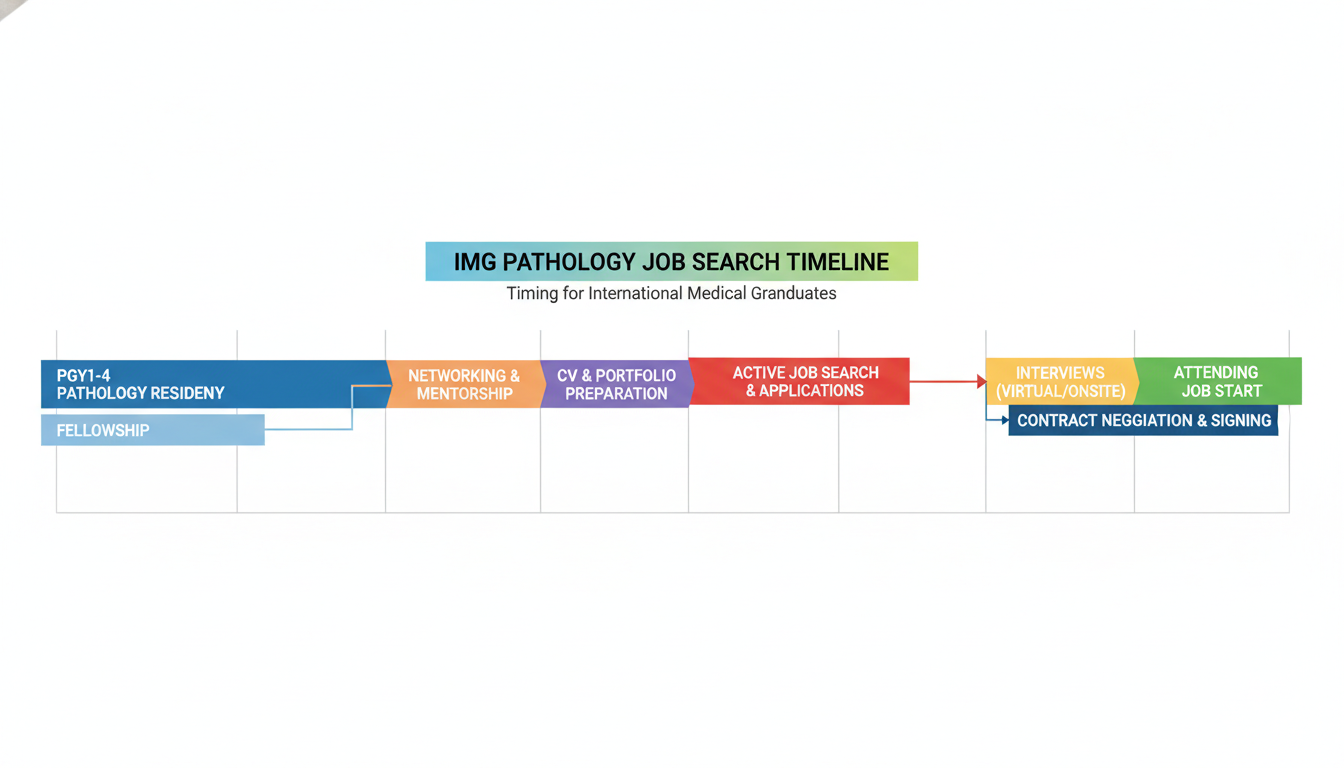
Year-by-Year Timeline: From Residency to Your First Attending Job
The most practical way to understand when to start your job search is to look at what you should be doing each year. This section assumes a typical AP/CP residency followed by at least one fellowship.
PGY‑1: Laying Foundations (Not Yet Job Searching)
Primary focus: Learn pathology, adapt to the system, and start building relationships.
Even though your attending job is far away:
- Do not actively search or apply for attending jobs.
- Do start thinking about your pathology career direction:
- Academic vs. community/private practice
- Possible subspecialties (e.g., hematopathology, cytopathology, GI, derm, molecular, transfusion medicine)
- Key tasks for PGY‑1 IMGs:
- Build strong relationships with faculty who may later be references.
- Understand visa implications early: meet with a GME or immigration advisor.
- Keep an updated CV with rotations, presentations, and small projects.
- Join professional societies (CAP, USCAP, ASCP, and subspecialty societies).
Timing takeaway: PGY‑1 is about foundation, not job search.
PGY‑2: Clarifying Career Direction and Fellowship Strategy
Primary focus: Decide on subspecialties and fellowship pathways that will shape your future job search.
During PGY‑2:
- Fellowship decisions:
- Many competitive pathology fellowships recruit 18–24 months in advance.
- By mid‑PGY‑2, you should be actively applying for at least your first fellowship.
- Career planning tasks:
- Discuss your long-term goals with a program director or mentor:
- “I’m an international medical graduate interested in academic GI pathology.”
- “I’d like a community practice with a mix of AP/CP and maybe a subspecialty focus.”
- Begin exploring the pathology residency job market informally:
- Ask senior residents/fellows where they matched for jobs.
- Learn which subspecialties are in demand in your preferred region.
- Discuss your long-term goals with a program director or mentor:
For IMGs, this is when you must start thinking about visa-compatible careers:
- If you are on a J‑1, note that most pathology positions are not traditional J‑1 waiver jobs—but many academic centers sponsor H‑1B or O‑1.
- If you already have a green card or citizenship, you have more geographic and practice-type flexibility.
Timing takeaway: PGY‑2 is about mapping your trajectory and securing fellowships, not yet submitting attending job applications.
PGY‑3: Early Exploration of the Physician Job Market
Primary focus: Understand the real physician job market for pathologists and position yourself for a strong fellowship-to-job transition.
You’re still not actively applying for attending jobs, but you are getting closer to the pathology residency finish line.
Tasks in PGY‑3:
Refine career target
- Decide whether you are leaning toward:
- Academic subspecialty pathologist
- Community practice with subspecialty interest
- Hybrid model (e.g., community setting with teaching responsibilities)
- Decide whether you are leaning toward:
Network deliberately
- Attend national meetings (USCAP, CAP, ASCP, subspecialty meetings).
- Introduce yourself to faculty from institutions where you might want to work.
- Ask them general questions about:
- How they hired their last new pathologist
- Whether they anticipate openings in the next few years
- Keep conversations exploratory, not pushy.
Understand hiring timelines
- Ask senior fellows:
- “When did you start applying for jobs?”
- “How long did it take from first contact to offer?”
- Note differences between:
- Academic centers (often longer timelines, more formal committees)
- Private groups (potentially faster but more variable)
- Ask senior fellows:
Timing takeaway: PGY‑3 is about market reconnaissance, not formal applications.
PGY‑4 (Final Residency Year): Planning the Transition to Fellowship and Beyond
Primary focus: Prepare materials, clarify geography and practice preferences, and build a timeline for when you’ll begin active job searching during fellowship.
Key tasks:
Finalize fellowship(s):
- Confirm your position(s), start and end dates.
- If doing multiple fellowships, understand how they affect your attending start date.
Start “pre-job-search” preparation:
- Create a polished CV and template cover letter.
- Draft a short professional bio and update your LinkedIn profile.
- Ask senior residents/fellows for examples of successful job application emails.
Visa and licensure planning:
- If you’re an IMG on a visa:
- Meet with your GME office and possibly an immigration lawyer.
- Clarify what kind of sponsorship you will need from a future employer.
- Begin reading about state medical licensure requirements in regions you’re considering:
- Some states take many months to process applications, especially with foreign medical school verification.
- If you’re an IMG on a visa:
At this stage, you generally do not start applying for attending jobs yet. Your focus is to make sure that on day one of fellowship, you can pivot to job search quickly and efficiently when the time comes.
Timing takeaway: PGY‑4 is prep time. You build tools and clarity so that your fellowship year job search is smooth, not rushed.

Fellowship Year(s): When to Start the Actual Job Search
This is where timing becomes critical. Most IMGs in pathology land their first attending job during fellowship, not residency. Your specific window depends on how many fellowships you’re doing and your visa situation.
One Fellowship (Most Common Scenario)
Assume you finish residency in June, start fellowship July 1, and want to begin your first attending job the following July.
Ideal Job Search Timeline for One Fellowship
June–August (early fellowship)
- Finalize your job search criteria:
- Academic vs. private vs. hybrid
- Geographic preferences (and deal-breakers)
- Practice size and desired case mix
- Update CV with new roles, recent presentations, and projects.
- Ask your fellowship director and key mentors if they’ll be willing to serve as references.
- Finalize your job search criteria:
August–October
- Start actively scanning job postings:
- CAP, USCAP, PathologyOutlines, NEJM Career Center, major hospital job boards
- Begin sending a small number of targeted applications:
- Academic jobs often open early and can take months to finalize.
- Large hospital systems may also start early.
- Have informational conversations with places that may anticipate openings.
- Start actively scanning job postings:
October–February (peak search period)
- For most IMGs in a one-year fellowship, this is the core hiring window:
- Apply broadly to positions that fit your criteria.
- Be prepared for interviews (virtual and/or in-person).
- Respond quickly to inquiries; pathology searches can move fast when a group is eager.
- Many attendings sign contracts between November and March.
- For most IMGs in a one-year fellowship, this is the core hiring window:
March–June
- If still searching:
- Expand geographic range or practice type.
- Lean on your program director and fellowship faculty to connect you to contacts.
- Some last-minute openings appear due to retirements, relocations, or failed contracts.
- If still searching:
For IMGs, you should aim to start definitively by August–September of your fellowship at the latest. Starting in October or later is not necessarily too late, but earlier gives you a much deeper pool of options and more secure visa planning.
Two Fellowships: Staggered Search Strategy
If you are doing two fellowships (for example, Surgical Pathology then Hematopathology), your timing choices are:
- Begin job search during the first fellowship year, targeting a start date after the second fellowship.
- Wait and begin search early in the second fellowship year.
Option 1: Early Start in First Fellowship Year
Benefits:
- More time to find the right job.
- Better for visa-sensitive IMGs who need early commitment and paperwork.
- Attractive for employers who can plan ahead for a known start date.
Risks:
- Institutions might hesitate if your start date is more than a year away.
- Your subspecialty identity may still be forming, especially if the second fellowship defines your niche.
How to do it:
- Start light exploration and a few applications around winter of your first fellowship year, once your second fellowship is confirmed.
- Clearly state in communications:
“I will complete a second fellowship in [subspecialty] ending in June [year], and I am seeking positions with a start date of July [year].”
Option 2: Standard Start in Second Fellowship Year
More common approach:
- Treat the second fellowship year like the single fellowship scenario:
- Start active search around August–September of the second fellowship.
- Peak applications/interviews October–February.
- This approach works well if:
- Visa issues are manageable.
- You want time to refine your subspecialty and build a stronger CV.
For IMGs, especially with complex visas, a hybrid approach is often ideal:
- Start informal networking and a few early conversations in the first fellowship year.
- Launch a full job search early in the second fellowship year.
Academic vs Private Practice: How Timing Differs
Your preferred practice setting strongly influences when to start job searching.
Academic Pathology Positions
- Longer preparation and hiring cycles
- Search committees convene, review, interview, then negotiate.
- 6–12 months from application to contract is not unusual.
- More structured pay scales but more complex approval pathways
- Department, hospital, and university approvals may each add time.
Timing advice for IMGs targeting academic positions:
- Begin actively applying very early in fellowship:
- Often by August–September for a following July start.
- Be prepared for:
- Multiple interview rounds.
- Seminars or job talks.
- Longer wait times for final decisions.
Because academic departments often sponsor H‑1B or O‑1 visas, reaching them early is crucial so immigration steps don’t delay your start.
Private Practice / Community Hospital Groups
- Generally less formal but highly variable.
- Some advertise positions 9–12 months in advance; others only when urgently needed, just 3–6 months before start.
- Decision-making often faster, especially in small or medium groups.
Timing advice for IMGs targeting private practice:
- Start active search in the usual fellowship window (August–September onward), but:
- Expect some positions to appear later in the year.
- For IMGs with strict visa constraints:
- Try to secure a contract by early spring (March–April) to allow for visa processing.
- Be very clear with potential employers about timelines and visa steps.
Special Considerations for IMGs: Visas, Licensing, and Backup Plans
For an international medical graduate in pathology, job search timing is tightly connected to legal and administrative timelines.
Visa-Related Timing
Common scenarios:
J‑1 visa during residency/fellowship
- Pathology does not have as many J‑1 waiver options as primary care, so:
- Many IMGs transition to H‑1B or O‑1 for attending roles.
- Start job search early enough to:
- Identify institutions capable and willing to sponsor.
- Complete immigration paperwork without delaying your start.
- Pathology does not have as many J‑1 waiver options as primary care, so:
H‑1B during training
- Transition to a new H‑1B employer also takes time.
- Some employers are inexperienced with H‑1B for pathologists; earlier conversation is key.
Green card or citizenship
- Greater flexibility; timing concerns are more about market and contract cycles than immigration.
Actionable tip:
Start a visa planning meeting 12–18 months before your desired attending start date (often late residency or very early fellowship). Work backward from known USCIS timelines so your job search launch aligns with what is realistically needed.
State Licensing
Many employers require you to either:
- Already have a state license at the time of hire, or
- Be well along in the process.
For IMGs, foreign medical school verification can add months. You should:
- Identify 1–3 target states early in your fellowship.
- Begin at least one licensure application 6–12 months before your anticipated job start.
- Ask senior IMGs which states processed their licenses faster or slower.
What If You Start Job Search Late?
If you realize in February–March of your final fellowship year that you haven’t started:
- Inform your program/fellowship director immediately
- Ask them to reach out to their network.
- Broaden your criteria
- Consider:
- Smaller cities or rural settings
- Different practice types
- Multi-hospital systems
- Consider:
- Actively monitor job boards and send direct inquiries
- Short, targeted emails to department chairs or group leaders can uncover unadvertised needs.
- Consider a second fellowship or research year—strategically
- Not just to “delay” but to meaningfully enhance your marketability:
- Example: Adding a high-demand subspecialty like hematopathology, cytopathology, or molecular.
- Not just to “delay” but to meaningfully enhance your marketability:
Practical Checklist: When to Start Job Search (At a Glance)
For quick reference, here’s a summary timeline for when to start job search as an IMG in pathology aiming for your first attending job:
PGY‑1–2:
- No job search yet; build foundations, choose subspecialty interests, plan fellowship(s).
PGY‑3–4:
- Market reconnaissance only; prepare CV, clarify preferred practice type and geography.
Single fellowship year:
- June–August: Prepare materials, finalize goals, talk to mentors.
- August–October: Begin active job search, especially for academic roles.
- October–February: Peak applications and interviews; aim to sign offer.
- March–June: Close gaps if still searching, expand radius, use program contacts.
Two fellowship years:
- First fellowship: Light networking and a few early discussions once second fellowship confirmed.
- Second fellowship: Follow the single fellowship timeline.
For IMGs with visas:
- Start serious planning 12–18 months before desired attending start date.
- Start active job applications on the earlier side of the recommended windows.
This structure helps ensure that your pathology match (for residency and fellowship) and your attending job search are synchronized, so you move smoothly from training to practice without gaps or last-minute panic.
FAQs: Job Search Timing for IMGs in Pathology
1. When should I, as an IMG, officially start my attending job search in pathology?
If you’re doing a single fellowship, you should generally start active job searching between August and October of your fellowship year, targeting a start date the following July. As an international medical graduate, it’s safer to be toward the earlier side of that range, especially if visa sponsorship is needed.
2. How does being an IMG change my timing compared to U.S. graduates?
As an IMG, you must factor in visa and licensure lead times, which means:
- Start planning (not applying) 12–18 months before your desired attending start date.
- Start applying early in your fellowship year, so there’s enough time for employers to process sponsorship and for you to complete state licensure. In practice, this often means you can’t afford to wait until late winter or spring to begin your search.
3. Is it a problem if I haven’t decided between academic and private practice by fellowship start?
Not necessarily, but you should aim to narrow your focus within the first 2–3 months of fellowship. Academic jobs often recruit earlier and have slower hiring cycles; if you decide late that you want academia, you may miss that year’s hiring wave. A useful strategy is to start early with academic applications while also keeping an eye on private practice positions as they appear throughout the year.
4. What if I don’t secure a job by the end of fellowship?
You still have options, but you must act quickly and strategically:
- Ask your program or fellowship director to intensively leverage their network.
- Broaden your search geographically and by practice type.
- Watch for late openings (retirements, unexpected departures).
- Consider a second fellowship that genuinely strengthens your profile in a high-demand subspecialty. Use that second year to start the job search much earlier, following the timing principles in this guide.
By understanding the natural cycles of the physician job market in pathology—and by starting your planning early—you can transform a stressful, uncertain process into a structured path toward your first attending position. As an international medical graduate, your timing must be intentional, but with a well-organized strategy, you can position yourself competitively and confidently for the next phase of your career.