
Understanding the Big Picture: Why Timing Matters for IMGs in PM&R
For an international medical graduate planning a future in Physical Medicine & Rehabilitation (PM&R), timing your job search is almost as important as your training itself. The physiatry job market is currently favorable, but the process is slower and more complex for IMGs because of visas, licensing, and institutional policies. A well-planned timeline can mean the difference between:
- Having several strong offers vs. scrambling for whatever is left
- Practicing in your preferred region vs. settling for a location you never considered
- Seamlessly transitioning from residency/fellowship to attending practice vs. months of unpaid waiting
Unlike some other fields, PM&R residency and fellowship graduates often have multiple paths:
- Outpatient musculoskeletal and sports
- Inpatient rehabilitation (stroke, TBI, SCI, general rehab)
- Interventional pain and spine
- Academic vs. community practice
- Subacute and post-acute care systems
- Niche practice areas (cancer rehab, pediatrics, EMG/neuromuscular, amputee care, spasticity, etc.)
Each path has its own recruitment cycle, risk tolerance for visas, and timeline expectations. Understanding this early helps you plan your IMG residency guide to the attending job market effectively.
This article focuses on job search timing for the international medical graduate in PM&R—when to start, what to do at each stage, how visas affect timing, and how to avoid common pitfalls in the physiatry match to your first attending position.
Core Timeline: When to Start Job Search as an IMG in PM&R
The “Goldilocks” Window: 12–18 Months Before Graduation
For most U.S.-based PM&R residents and fellows, the ideal time for an attending job search is 12–18 months before your anticipated completion date.
For an IMG, especially with a visa, lean toward the early side: 15–24 months.
Why so early?
- Employers need time for credentialing, licensing, and hospital privileges
- Visa petitions (H‑1B, O‑1, sometimes J‑1 waiver process) can take several months
- Academic and large hospital systems move slower, often 3–9 months from initial contact to signed contract
- Competitive metro areas and desirable practice types may be filled early
A helpful structure is:
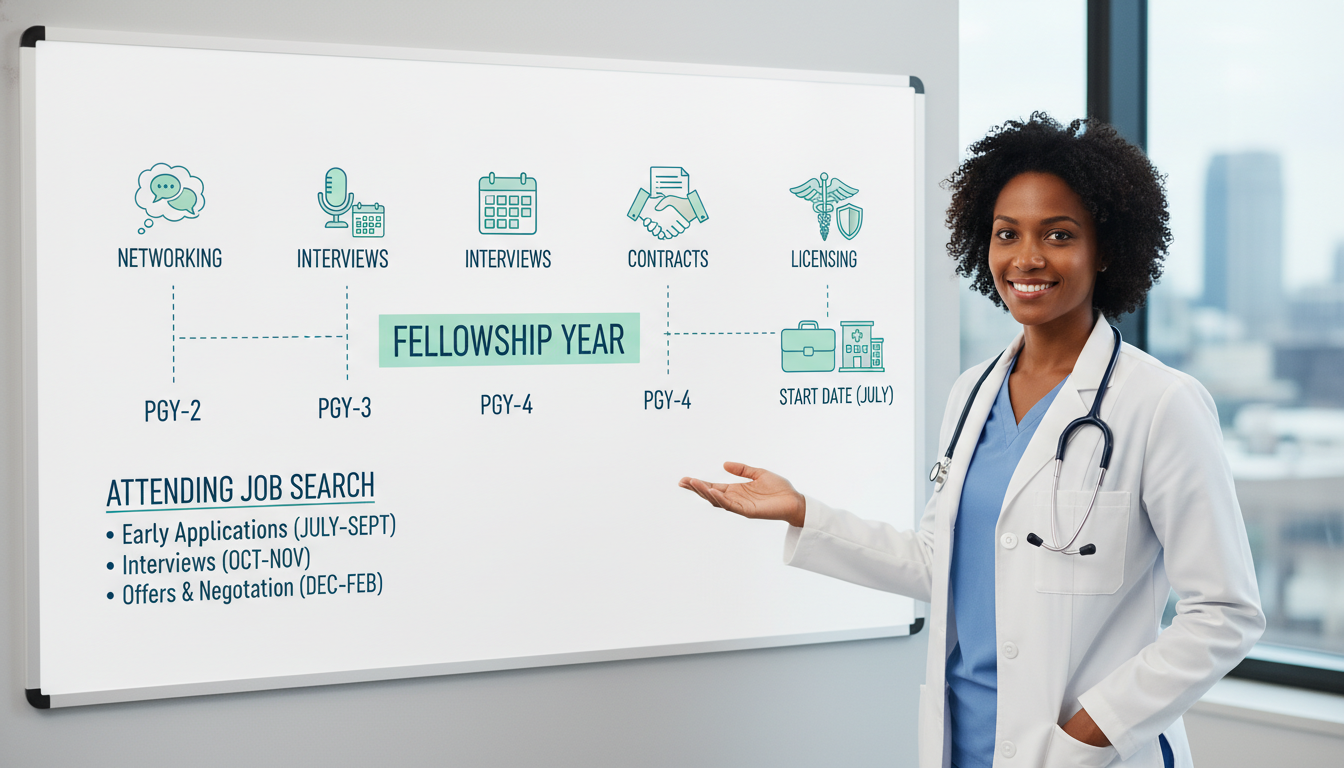
- PGY-2 to early PGY-3 (or Fellowship Year −2): Exploration and long-term planning
- PGY-3 to early PGY-4 (or Fellowship Year −1.5 to −1): Serious networking, CV polishing, narrowing preferences
- Mid PGY-4 / Mid-fellowship (≈ 12–18 months before completion): Active applications and interviews
- 6–12 months before completion: Contract negotiation and finalizing your role
- 3–6 months before start date: Licensing, credentialing, and relocation tasks
Let’s break it down more concretely.
Approximate Timeline by Training Year
PM&R Residency (Categorical or Advanced) – No Fellowship Planned
Assume a 3-year PM&R residency (PGY-2 to PGY-4) and no additional fellowship:
PGY-2 (first PM&R year)
- Focus: Orientation to the specialty, skill-building, understanding the field
- Job search tasks:
- Attend national PM&R meetings (e.g., AAPM&R, AAP) to observe the physician job market
- Talk to faculty about common career paths and “IMG-friendly” regions
- Clarify your visa status and long-term options (H‑1B, J‑1 waiver, O‑1)
- Begin a simple “wish list” of practice settings and locations
PGY-3 (middle PM&R year)
- Focus: Clarifying your ideal practice type and location
- Job search tasks:
- If you are not doing fellowship, start light networking 18–24 months before completion
- Update CV, create a basic professional email signature, refresh your LinkedIn/digital presence
- Reach out to alumni, mentors, and prior IMGs to understand realistic options with your visa
- Identify states where you may want to obtain licensure early (some take 4–9 months)
Early PGY-4 (≈ 12–18 months before graduation) – Active search begins
- Send your first serious inquiries and job applications
- Start interviews (in-person or virtual); late fall to spring is typically busy
- Consider timing around national PM&R meetings for in-person networking
Late PGY-4 (≈ 6–12 months before graduation)
- Aim to sign your contract in this window
- Begin state licensure applications (if not already started)
- Confirm visa sponsorship and deadlines with employer’s legal team
PM&R Residents Planning Fellowship (e.g., Pain, Sports, Neurorehab)
If you are doing fellowship after residency:
- Your attending job search timeline shifts by one year, but the process is the same.
- Begin serious attending job search 12–18 months before fellowship completion, not residency completion.
- During late residency and early fellowship, maintain light networking and explore geographic preferences.
Fellowship Year – Critical Timing Points
For many PM&R specialties (pain, sports, neurorehab, SCI, TBI, pediatrics):
- 12–18 months before fellowship completion (often late PGY-4 or early fellowship year):
- Start reaching out to practices and academic centers in your target locations.
- 6–12 months before completion:
- Complete interviews, negotiate contracts, and lock in your start date.
If you are an IMG with a J‑1 visa and need a waiver job, your job search may need to begin even earlier (see visa-specific section below).
Visa Status and Its Impact on Job Search Timing
For any international medical graduate, job search timing is tightly linked to visa strategy. You must plan your attending job search in parallel with your immigration plan.
Common Visa Situations for IMGs in PM&R
- H‑1B during residency/fellowship
- J‑1 during training, needing a J‑1 waiver job
- Transitioning from J‑1 to H‑1B (or O‑1)
- Permanent residency (green card) already obtained
Each scenario changes when to start job search and how selective you can be.
If You Are on an H‑1B During Training
You may:
- Continue H‑1B with a new employer (H‑1B transfer)
- Possibly pursue a green card with a sponsoring employer
Timing implications:
- Employers familiar with H‑1B transfers may be more flexible but still need months of lead time.
- Aim to have a signed contract 8–12 months before your anticipated start date to allow for:
- Petition filing and approval
- Licensing and credentialing
Recommended actions:
- 18–24 months before graduation: Confirm with your GME office and immigration lawyer what is required to transfer your H‑1B (cap-exempt vs. cap-subject status).
- Target larger health systems and academic centers that routinely sponsor H‑1B.
If You Are on a J‑1 and Need a Waiver Job
This is the most time-sensitive scenario and the one that demands the earliest job search.
Key elements:
- You must secure a job that qualifies for a J‑1 waiver (often in underserved or rural areas, or via federal programs like Conrad 30, VA, or HHS).
- Each state has its own Conrad 30 timeline, eligibility, and competitiveness.
- Many J‑1 waiver jobs fill early, especially in more desirable states.
Timing implications:
- Start job search 18–24 months before completion of your final year of training, focusing on waiver-eligible positions.
- Research each target state’s Conrad 30 program at least 1–2 cycles ahead to understand application windows.
Example:
- You finish fellowship in June 2027.
- You should understand state Conrad 30 rules by mid-2025 and start job search by mid-2025 to early 2026.
- This lets you apply as soon as the state opens its next waiver cycle, giving you the best chance of securing a slot.
If You Have or Expect a Green Card
If you already have permanent residency (or anticipate getting it during training):
- You still benefit from starting job search 12–18 months before completion.
- However, you can be more flexible regarding:
- Location (cities and academic centers often less willing to handle visas become accessible)
- Practice type and employer size
You can afford to start closer to the 12-month mark instead of 18–24 months, though early exploration is still wise.
Month‑by‑Month Roadmap: From Exploration to Signed Contract
The question “when to start job search” often masks a deeper issue: what exactly should you be doing at each stage? Here is a practical month-by-month style roadmap for a typical IMG PM&R resident or fellow.
18–24 Months Before Graduation: Exploration & Positioning
Focus: Gather information, clarify goals, and position yourself.
Tasks:
- Reflect on your ideal first job:
- Inpatient vs. outpatient vs. mixed
- Academic vs. community vs. private practice
- Interventional vs. non-interventional
- Review the physician job market for PM&R:
- Explore job boards: AAPM&R, AAP, specialty societies, large health systems
- Ask seniors and alumni where they work and job satisfaction levels
- Visa planning:
- Meet with your program’s international office and/or immigration attorney
- Clarify if you need a J‑1 waiver, H‑1B transfer, or other pathway
- Career branding:
- Update your CV (publications, QI projects, teaching, leadership)
- Clean up your online presence (LinkedIn, Doximity, etc.)
- Begin light networking:
- Introduce yourself to faculty who practice in settings similar to your dream job
- Attend national/regional PM&R conferences and participate in resident/fellow career events
12–18 Months Before Graduation: Active Career Search Begins
Focus: Narrowing targets and initiating contact.
Tasks:
- Define 3–5 target regions and 2–3 practice types you will pursue seriously.
- Start reaching out directly to:
- Department chairs, service line directors, and practice owners
- Alumni from your program, especially IMGs in similar visa situations
- Craft tailored emails:
- Express your training background, visa status, and what type of role you’re seeking
- Attach updated CV and a short paragraph about your interests (e.g., spasticity, MSK, EMG, SCI)
- Monitor PM&R-specific job boards regularly:
- AAPM&R Physiatrist Job Board
- AAP career center
- Subspecialty societies for pain, sports, neurorehab, pediatrics, etc.
- Schedule your first informational calls and exploratory interviews.
For IMGs:
- If you are J‑1, identify waiver-eligible states and employers early. Many practices in rural or underserved areas actively recruit J‑1 candidates and appreciate early contact.
9–12 Months Before Graduation: Interviews & Competitive Positioning
Focus: Convert leads to formal interviews and offers.
Tasks:
- Attend formal interviews (virtual and in-person).
- Ask targeted questions about:
- Visa sponsorship history (“How many IMGs or visa holders have you sponsored in the last 5 years?”)
- Practice structure (patient mix, call schedule, autonomy)
- Support for procedures you’re trained in (e.g., ultrasound, injections, EMG, interventional spine).
- Keep organized notes (spreadsheet) tracking:
- Location, compensation, call schedule, visa support, culture, and timeline.
- Clarify expected contracting timelines:
- Some employers want to sign you 9–12 months early; others may move slower, but as an IMG you should favor groups with timely decisions.
This is also the window when many residents in your class will begin to receive early offers—do not wait passively if you haven’t started.
6–9 Months Before Graduation: Contract Negotiation & Decision Phase
Focus: Finalize your destination and negotiate terms.
Tasks:
- Narrow your choices to 1–3 serious options.
- Request formal offer letters and contracts.
- Consider professional contract review (healthcare attorney, or advisors experienced with PM&R).
- Key elements to review:
- Base salary, bonus structure, productivity expectations (wRVUs)
- Non-compete clauses and geographic restriction
- Call expectations, weekend coverage, inpatient vs. outpatient balance
- Protected time for procedures, EMG, research, or teaching (if academic)
- Immigration clauses: H‑1B sponsorship details, J‑1 waiver responsibilities, green card sponsorship
- Aim to sign a contract at least 6 months before start date—earlier if you are on J‑1 or need complex immigration work.
3–6 Months Before Start Date: Licensing, Credentialing, and Transition
Focus: Paperwork and smooth transition.
Tasks:
- Finalize state medical license (start this even earlier in some states).
- Complete hospital credentialing and payer enrollment (Medicare, Medicaid, major insurers).
- Confirm visa petition filings and approvals with the employer’s legal team.
- Plan relocation, housing, and any family logistics.
- Prepare clinically for your role (review core PM&R topics relevant to your job focus).

Special Considerations for IMGs in the PM&R Job Market
Academic vs. Community Jobs: Different Clocks
Academic positions (university, major teaching hospitals):
- Often advertise 12–24 months in advance
- Committees and HR processes slow things down
- Good for early planners, especially IMGs needing strong institutional visa support
Community hospitals / large multispecialty groups:
- Moderate timeline; start search 9–18 months ahead
- More likely to hire based on local service need and referral growth
Private practices (especially interventional pain, MSK, sports):
- Some hire late, closer to your graduation (6–12 months), but many top groups secure fellows early
- As an IMG with visa needs, you should still aim to engage them 12–18 months ahead; not all will be comfortable with immigration processes.
Geographic Realities for IMGs in PM&R
The physician job market for PM&R is generally favorable nationwide, but:
- Metro areas and coastal cities:
- More competition, more U.S. grads and fellowship-trained applicants
- Sometimes less willing to handle complex visas
- Midwest, South, and rural areas:
- Often more open to IMGs and J‑1 waivers
- Good opportunities in inpatient rehab facilities, hospital-based PM&R, and general outpatient physiatry
If you have strict geographic limitations (e.g., spouse’s job, children’s school, extended family), you must:
- Start earlier (18–24 months)
- Be flexible about practice model (academic vs. community; inpatient vs. outpatient)
- Be transparent about your visa needs
How Fellowship Choice Affects Job Search Timing
In PM&R, fellowship direction shapes your attending job search:
Interventional pain/spine:
- Highly sought after; jobs often open year-round
- Many practices plan hires 12–18 months in advance
- Visa sponsorship is common in larger groups but variable in private clinics
Sports/MSK:
- Mix of academic, community, and private practice opportunities
- Jobs may be less standardized; networking is critical
SCI, TBI, Neurorehab, General Inpatient:
- Strong demand in rehab hospitals and health systems
- Particularly good for IMGs seeking visa-friendly employers
- Many J‑1 waiver positions are inpatient-heavy
Pediatrics, EMG/neuromuscular, cancer rehab:
- More niche, somewhat fewer positions
- Start earlier (18–24 months) to locate your best fit
Remember: your attending job search should focus on employers who actually need your specific skill set and are comfortable with your visa status.
Transitioning from Training to Your First Attending Job: Practical Advice
How Early is Too Early?
- Starting exploration and networking at 24 months is never too early.
- Actively applying more than 24–30 months before completion might be premature unless:
- You are in a very specialized niche
- You are targeting a specific academic department you already know well
How Late is Too Late?
For an IMG with visa needs:
- Starting your first serious job inquiries later than 9–12 months before completion is risky.
- For J‑1 waiver positions, starting late can mean:
- Fewer waiver slots remaining in your desired states
- Rushed decisions or being forced into locations/practices that are less ideal
When to Start Job Search vs. When to Start Job
Applicants often confuse “when to start job search” with “when to start job.” For IMGs in PM&R:
- Start job search: 12–24 months before completion (earlier if J‑1 waiver).
- Start job: usually 1–2 months after finishing residency/fellowship (to allow relocation, exam, paperwork), although some begin immediately.
If an employer expects you to start very quickly without time for board exams or relocation, consider whether that aligns with your long-term well-being.
Planning Multiple Timelines Simultaneously
As an IMG physiatrist, you are often juggling:
- ABPMR board exam timing
- Visa transitions
- State licensing
- Relocation
- Family responsibilities
Create a single master calendar with:
- Application windows (J‑1 waiver, H‑1B filings)
- Intended board exam dates
- Residency/fellowship milestones
- Job search milestones (CV ready, first outreach, interviews, contract target date)
This integrated timeline will keep you from missing critical deadlines.
FAQs: Job Search Timing for IMGs in PM&R
1. When should I start my attending job search as an IMG in PM&R?
For most international medical graduates in PM&R, start serious exploration and networking 18–24 months before completing residency or fellowship, and begin active applications and interviews 12–18 months before completion. If you are on a J‑1 visa and need a waiver, lean heavily toward the early side (18–24 months) to maximize your options.
2. How does my visa type change the timing of my job search?
- H‑1B: Start 12–18 months ahead; ensure the employer is experienced with H‑1B transfers and plan for 6–12 months for petitions, licensing, and credentialing.
- J‑1 (waiver needed): Start 18–24 months ahead; research Conrad 30 and federal waiver options early and target waiver-eligible positions.
- Green card holders: You have more flexibility and can safely start closer to 12–18 months ahead, though early networking still helps.
3. I’m planning a fellowship after PM&R residency. Do I start my job search now or during fellowship?
Your attending job search timeline is anchored to when you will finish all training. If you are doing a fellowship, begin attending job planning 12–18 months before fellowship completion, not residency completion. However, use your final year of residency to clarify interests, identify target regions, and strengthen your CV so you’re ready to search aggressively as soon as fellowship begins.
4. Can I wait until after I pass my boards to start my attending job search?
Waiting until after boards is usually too late, especially for IMGs. Most employers in PM&R are comfortable hiring board-eligible candidates and expect to sign contracts 6–12 months before your start date. Plan your job search first, while scheduling your board exam based on your training completion and the exam calendar. Board certification is important, but employers do not require you to have already passed before offering a position.
By understanding the timing expectations of the PM&R physician job market and aligning them with your visa and training timeline, you can approach your attending job search as a deliberate, strategic process—not a last-minute scramble. As an international medical graduate, starting early, planning carefully, and targeting visa-friendly employers are your greatest advantages in building the physiatry career you want.