
Understanding Job Search Timing for IMGs in Psychiatry
As an international medical graduate (IMG) in psychiatry, timing your job search is almost as important as your clinical skills. The transition from psychiatry residency or fellowship to your first attending job is shaped by credentialing timelines, visa constraints, licensing, and the realities of the physician job market.
This IMG residency guide–style article focuses on when to start job search planning, how early to sign, and how to avoid both rushing and waiting too long. While the core principles are similar across specialties, psychiatry residency graduates—especially IMGs—face some unique timing considerations due to high demand, telepsychiatry growth, and visa dependency.
Below, we’ll walk through a practical, month-by-month framework, with specific advice tailored to IMGs in psychiatry aiming for a strong psych match with their first attending role.
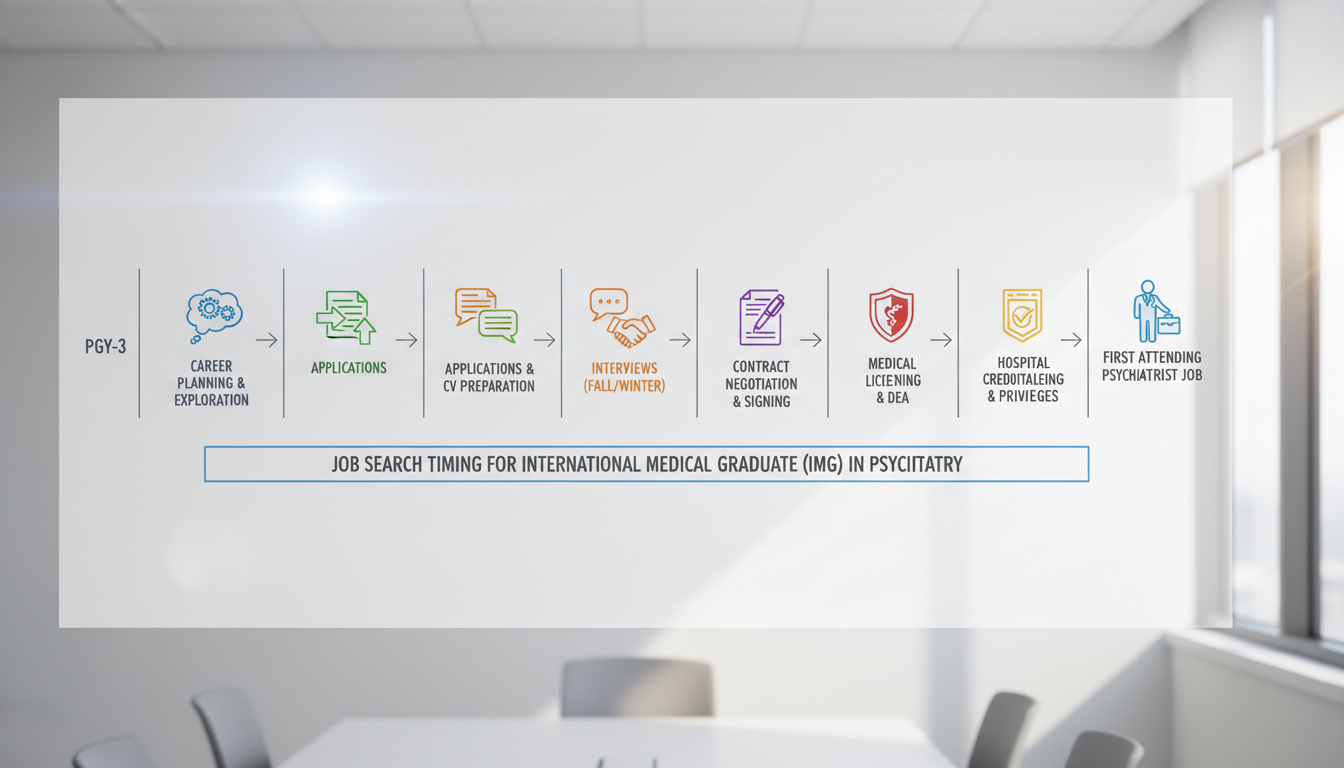
Big-Picture Timeline: When Should an IMG Psychiatrist Start Their Job Search?
For most psychiatry residents (PGY‑4) or fellows in their final year:
- Ideal window to start structured job search:
12–18 months before graduation - Typical time to sign your first attending contract:
6–12 months before graduation - Usual time required for licensing & credentialing:
4–9 months from signed offer (can be shorter or longer) - If you’re on a visa (e.g., J‑1 or H‑1B):
Start at least 12–18 months before graduation; earlier if you are targeting specific locations (e.g., waiver positions).
Why this early?
- Licensing + Credentialing Lag:
- State medical license: often 3–6 months.
- DEA, hospital privileges, payer enrollment: an additional 2–4+ months.
- Visa Steps for IMGs:
- J‑1 waiver job search and state/federal waiver processes (if applicable) must align with strict deadlines.
- Negotiation and Fit:
- Quality positions—good teams, reasonable productivity expectations, visa support—are competitive. You need time to compare and negotiate.
A good mental rule for an IMG psychiatrist:
Start serious planning 18 months before graduation and active applications 12–15 months before. Try to sign by 6–9 months before graduation.
A Month-by-Month Timeline: From PGY‑3 to First Attending Job
This section assumes a standard 4‑year adult psychiatry residency, with graduation in June of Year 4. Adjust slightly if you’re in a 3‑year or 5‑year track, child/adolescent fellowship, or another subspecialty.
PGY‑3: Laying the Groundwork (18–12 Months Before Graduation)
Timeframe: July–December, one year before your PGY‑4 year begins.
1. Clarify Career Goals and Constraints (18–15 months prior)
Key questions to answer early:
- Visa status
- Are you on J‑1, H‑1B, or another status?
- Do you need a J‑1 waiver position after residency or fellowship?
- Are you open to medically underserved or rural areas if needed for a waiver?
- Clinical interests
- Do you prefer inpatient, outpatient, C/L psychiatry, emergency psychiatry, integrated care, or telepsychiatry?
- Are you planning a fellowship (e.g., Child & Adolescent, Addiction, Forensics, Geriatric, C/L)?
- Geographic priorities
- Specific states or cities?
- Proximity to family or community?
- States with easier licensing or more waiver-friendly policies?
- Lifestyle and financial goals
- Target salary range?
- Loan repayment or Public Service Loan Forgiveness (PSLF) considerations?
- Desired call schedule and workload?
Action steps:
- Create a one-page “career priorities” document.
- Discuss with a trusted attending, mentor, or program director who understands IMG pathways.
- Check state medical board websites for licensing timelines and requirements in 2–3 likely states.
2. Understand the Physician Job Market in Psychiatry (18–12 months prior)
Psychiatry is currently a high-demand specialty. For IMGs, this can be an advantage—many regions struggle to recruit psychiatrists, and employers are often open to visa sponsorship.
However, demand varies by:
- Location: Rural and underserved areas often have more flexibility and higher incentives.
- Practice type: Community mental health centers, CMHCs, FQHCs, correctional psychiatry, and inpatient units may hire earlier and more aggressively.
- Subspecialty: Child & Adolescent psychiatry and Addiction psychiatry are particularly sought after.
Use this period to:
- Attend career talks (local hospital systems, professional societies).
- Talk to recent graduates from your program about their attending job search experiences: when they started, how long it took, what they would have done differently.
- Browse major job boards and recruiter emails for pattern recognition, not yet to apply:
- Common salary ranges
- Typical benefits (CME, relocation, sign-on)
- Frequency of visa sponsorship
Early PGY‑4: Start Active Applications (12–9 Months Before Graduation)
Timeframe: July–September of your PGY‑4 year (or equivalent final year).
This is when your IMG residency guide planning turns into real action.
1. Finalize Your CV and References
- Update your CV with:
- All psychiatry rotations and leadership roles
- Research, QI projects, poster presentations
- Special skills (languages, psychotherapy modalities, telepsychiatry experience)
- Prepare a brief professional summary (2–3 sentences) highlighting:
- Your training background
- Clinical interests (e.g., community psychiatry, mood disorders, child psychiatry)
- Visa status and availability date
- Identify 3–4 references:
- At least 2 core psychiatry attendings
- Program Director or Associate Program Director
- Fellowship director if applicable
Ask references early if they are comfortable supporting you and whether they are familiar with IMGs and visa dynamics.
2. Start Sending Applications (12–10 Months Before Graduation)
By this time, you should:
- Start reaching out to:
- Hospital systems in your desired regions
- Community mental health centers
- Academic centers that hire clinician-educators
- Telepsychiatry companies (if allowed by your visa and aligned with your goals)
- Use multiple channels:
- Direct applications on hospital or health system websites
- Professional job boards (APA, state psychiatric societies)
- Physician recruiters (both in-house and external)
- Networking through alumni and attendings
For IMGs on J‑1 visas:
- Prioritize J‑1 waiver-eligible positions and communicate openly:
- “I am a J‑1 visa holder seeking a waiver-eligible psychiatry position starting [month year].”
- Research state-specific J‑1 waiver timelines (Conrad 30, state health departments) and federal options (e.g., VA, HHS) if applicable.
- Some states accept applications as early as October; others have later windows.
3. Begin Interviews (11–9 Months Before Graduation)
Psychiatry employers often respond quickly once they see a strong CV. As an IMG, you may find:
- Interest is high in less saturated regions (Midwest, South, rural areas, and underserved urban settings).
- Academic centers may have slower processes but more structured interview days.
Plan to:
- Schedule interviews around lighter rotations if possible.
- Prepare for common psychiatry-specific questions:
- Managing high-risk patients
- Comfort with different patient populations (SUD, psychosis, mood disorders)
- Approaches to collaborative care with primary care, social work, and psychology
- Anticipate visa and sponsorship questions; be ready to explain:
- Your current status
- Required steps (e.g., J‑1 waiver, H‑1B transfer)
- Timing needs
Mid PGY‑4: Comparing Offers and Negotiating (9–6 Months Before Graduation)
Timeframe: October–December of your final year.
This is often the decision-making period. Many IMGs in psychiatry will receive multiple offers. Timing here is about avoiding signing too late, but also not rushing into a poor fit.
1. When Offers Arrive: How Fast Should You Decide?
Most employers will give you:
- 1–3 weeks to respond to a formal offer (sometimes longer if you request more time reasonably).
As an IMG psychiatrist, consider:
- If the job is J‑1 waiver–dependent: You may need to move more quickly to secure your waiver slot.
- If you’re already on H‑1B: You might have a bit more flexibility but still need time for transfer and credentialing.
Healthy approach:
- Try to have multiple interviews completed by mid-fall.
- Aim to have at least 2–3 serious offers to compare—especially if salary, call, or visa support differ significantly.
- Communicate honestly if you need more time:
- “I am very interested in this role and am currently interviewing at a few sites to ensure a good long-term fit. Could I have an additional week to finalize my decision?”
2. Key Contract and Timing Issues to Examine
Specific to psychiatry:
- Clinical load & productivity
- Outpatient: how many patients per day? Typical no-show rates? Support staff?
- Inpatient: average census and acuity? Shared call?
- Are there RVU targets? What happens if you don’t meet them?
- Support for IMGs
- Clear experience with J‑1 waivers or H‑1B visas?
- In-house immigration attorney or external counsel?
- Timing expectations spelled out (e.g., “We will file your petition by X date”)?
- Program structure and safety
- Access to multidisciplinary teams (social work, psychology, nursing, security)?
- Clear policies for managing violent or high-risk patients?
Timing details to clarify:
- When do they want you to start (month/year)?
- How long do they estimate for licensure, credentialing, and visa approval?
- Can they accommodate telepsychiatry or part-time bridge work if licensing or visas are delayed?
3. Target Signing Window: 9–6 Months Before Graduation
For most IMGs in psychiatry, a recommended target is:
- Sign your primary contract by December–February before your June graduation.
This allows:
- Enough time for:
- State medical license application
- DEA and controlled substance registration
- Hospital privileges and insurance credentialing
- Visa filing and approval
- Ability to make relocation plans, board exam prep, and transition planning with less stress.

Late PGY‑4: From Signing to Start Date (6 Months Before Graduation to First Day)
Once you sign, your focus shifts from when to start job search to how to manage the transition efficiently.
1. Licensing and Credentialing
Immediately after contract signing:
- Start your state license application if not already in progress.
- Request official medical school transcripts and ECFMG verification (often a bottleneck for IMGs).
- Arrange for USMLE/board score verification and reference letters as required by the board.
- Coordinate with the employer’s credentialing team:
- Hospital privileges
- Insurance paneling (especially important for outpatient psychiatry)
- DEA registration (often needs an active state license first)
Timing notes:
- States vary widely; IMGs often see:
- “Fast” states: license in 2–3 months.
- “Slow” states: 4–6+ months, especially if primary source verification is complex.
- Factor in time differences and international document retrieval from your home country or medical school.
2. Visa Processing for IMGs
For J‑1 visa holders:
- If you secured a J‑1 waiver job:
- Work closely with the employer and immigration counsel on:
- State waiver application (if Conrad 30 or similar)
- USCIS petition filing (e.g., H‑1B)
- Strict deadlines may apply; missing a window can delay your start date or force backup plans.
- Work closely with the employer and immigration counsel on:
For H‑1B or other statuses:
- Confirm:
- When the employer will file the H‑1B transfer or new petition.
- Whether premium processing will be used (often recommended to reduce uncertainty).
- Any bridge strategies if there’s a gap between training end and start of the new job.
As an IMG psychiatry graduate, do not leave visa discussions vague. Your attending job search should be anchored in clear timelines for each step.
3. Preparing Clinically and Financially
In the months before graduation:
- Clarify:
- Onboarding schedule
- Orientation and initial supervision
- Expected patient load ramp-up (gradual vs. immediate full panel)
- Plan your financial transition:
- Budget for 1–3 months without full income if licensing or credentialing delays occur.
- Confirm relocation assistance and timing of sign-on bonuses.
- Schedule your board exam (ABPN) around:
- Onboarding demands
- Personal bandwidth
- Visa and licensing milestones
Special Situations: Fellows, Late Starters, and Career Shifters
IMGs in Psychiatry Fellowships
If you are completing a fellowship (e.g., Child & Adolescent, Addiction, Forensics):
- Start job search around the beginning of fellowship (12–18 months before you finish the fellowship).
- Employers may highly value your subspecialty, and some positions may be created around your expertise.
- Confirm whether your attending role is:
- 100% subspecialty (e.g., all Child & Adolescent), or
- A mix of general and subspecialty psychiatry.
If You Started Your Job Search Late (e.g., 4–6 Months Before Graduation)
Some IMGs find themselves behind schedule. If that’s you:
- Intensify your search:
- Apply more broadly, including underserved and rural areas.
- Leverage recruiters who can move quickly.
- Be transparent about timing:
- Employers may adjust start dates or expedite credentialing if they are motivated to hire you.
- Consider interim roles (if legally feasible):
- Short-term locums after license approval
- Telepsychiatry roles (within immigration and licensing limits)
- Stay practical about expectations:
- First job doesn’t have to be your forever job; IMG psychiatrists often find it easier to change jobs after a year or two in the U.S. system.
Transitioning or Changing Clinical Focus
If you’re pivoting (e.g., from heavy inpatient to outpatient, or from academia to community):
- Aim to start your job search earlier than usual (18 months prior) to find the right fit.
- Highlight transferable skills: managing complex cases, team leadership, teaching, etc.
- Seek employers who demonstrate understanding of your background and can offer mentoring as a new attending in your new environment.
Practical Tips to Optimize Timing as an IMG Psychiatrist
To close, here are condensed, actionable strategies related to timing:
Anchor everything around your graduation date.
Work backwards:- Start job search: 18–12 months before
- Sign: 9–6 months before
- License/visa/credentialing: begin immediately after signing
Use a timeline spreadsheet.
Include:- Application dates
- Interview dates
- Offer receipt and response deadlines
- Licensing and visa milestones
- Credentialing completion target
Front-load your licensing prep.
Even before you sign a job, compile:- Medical school documents
- ECFMG certificate details
- Exam scores
- Contact info for references and past supervisors
Communicate clearly and early about visas.
Employers are more likely to work with you if they understand your needs up front and see you as organized and realistic.Resist pressure to sign too early without due diligence.
High demand in psychiatry means you often have options. Unless you’re facing strict J‑1 waiver deadlines, take the time to confirm that:- Clinical load is safe and reasonable.
- Support systems exist (teams, supervision, security).
- The organization has a track record with IMGs.
Stay flexible but have a default plan.
For example:- Primary plan: J‑1 waiver inpatient job in State A.
- Backup: Community mental health outpatient position in State B.
- Contingency: Telepsychiatry or academic role if visas or licenses delay start.
FAQs: Job Search Timing for IMG Psychiatrists
1. When should an international medical graduate in psychiatry start their job search?
Most IMG psychiatry residents should start serious planning about 18 months before graduation and begin active applications 12–15 months before their end date. This gives enough time for interviews, contract review, licensing, credentialing, and (for many IMGs) visa processes such as J‑1 waivers or H‑1B filings.
2. Is the timing different for IMGs versus U.S. graduates in psychiatry?
The core timeline is similar, but IMGs often need extra buffer for:
- International document verification (for licensing boards)
- Visa-related steps (J‑1 waivers, H‑1B transfers, etc.) Because of this, many IMGs benefit from starting on the earlier side of the 12–18 month window and ensuring visa discussions are front and center during interviews.
3. Can I wait until after I pass my boards to start my job search?
Waiting for boards is usually not advisable. The physician job market for psychiatrists expects residents and fellows to secure positions before graduation. Most employers are comfortable hiring you contingent on:
- Completion of residency/fellowship
- Board eligibility (and eventual certification) Start your attending job search well before boards; you can schedule the exam around your transition.
4. What if my visa or license is delayed and I can’t start on time?
Delays do happen. To reduce risk:
- Build buffer time into your intended start date.
- Maintain close communication with your employer’s HR and credentialing teams.
- Ask if they allow adjusted start dates, temporary non-clinical work, or delayed ramp-up if needed. For IMGs, it’s also wise to have a backup plan (alternative states, roles, or employers) if a specific J‑1 waiver or license route falls through.
By understanding and actively managing the timing of your job search, you can move from psychiatry residency or fellowship to your first attending role with more confidence and control. For an IMG psychiatrist, early planning, clear communication about visas, and an organized approach to licensing and credentialing are the keys to a smoother transition into the U.S. physician job market.