
Understanding Job Search Timing as an IMG
For an international medical graduate, job search timing is as critical as your clinical skills. The U.S. physician job market follows certain cycles, and your visa status, specialty, and training pathway all influence when you should start looking.
This IMG residency guide focuses on the job search after residency or fellowship, but the planning really starts years earlier. Many IMGs underestimate how early they need to begin thinking about their attending job search—especially if they will need visa sponsorship (H‑1B, J‑1 waiver, or O‑1). Poor timing can limit your options, force you into last‑minute compromises, or even create gaps in employment that complicate immigration and credentialing.
This article will walk you through:
- The typical timeline for the attending job search for IMGs
- Special considerations for visa‑requiring physicians
- Specialty‑specific timing patterns
- How to sequence exams, licensure, credentialing, and interviews
- Practical strategies and checkpoints from PGY‑1 through your final year
Throughout, the emphasis is on actionable timing strategies tailored for international medical graduates.
The Big Picture: When to Start Your Job Search
General rule of thumb
For most U.S. graduates, the attending job search begins about 12–18 months before graduation. For an international medical graduate—especially on a visa—18–24 months before graduation is safer.
Think of your job search as a multi‑phase project:
- Exploration & Positioning (PGY‑1 to early PGY‑2)
- Early Job Market Engagement (late PGY‑2 to early PGY‑3)
- Active Applications & Interviews (mid PGY‑3 to graduation)
- Finalization, Credentialing & Onboarding (last 6–9 months)
For fellowships, shift everything slightly earlier: start your attending job search during your first fellowship year, especially in 1‑year programs.
Why IMGs need to start earlier
As an international medical graduate, you face additional timing pressures:
- Visa sponsorship limitations
- Not all employers sponsor H‑1B, J‑1 waivers, or O‑1 visas. Finding those who do takes time.
- J‑1 waiver process deadlines
- Many states have strict annual cycles, and waiver slots can fill early in the fiscal year.
- Immigration processing times
- USCIS processing can be slow unless premium processing is used (and not all employers want to pay).
- Licensure and credentialing delays
- Primary source verification for international schools can take months.
- State‑specific requirements
- Some states need additional documents (e.g., translations, school transcripts, internship certificates) that can be slow to obtain from abroad.
In a competitive physician job market, U.S. graduates may have more flexibility; IMGs often need to demonstrate readiness earlier, with clear visa and licensure plans.
Year‑by‑Year Timeline: From PGY‑1 to Attending
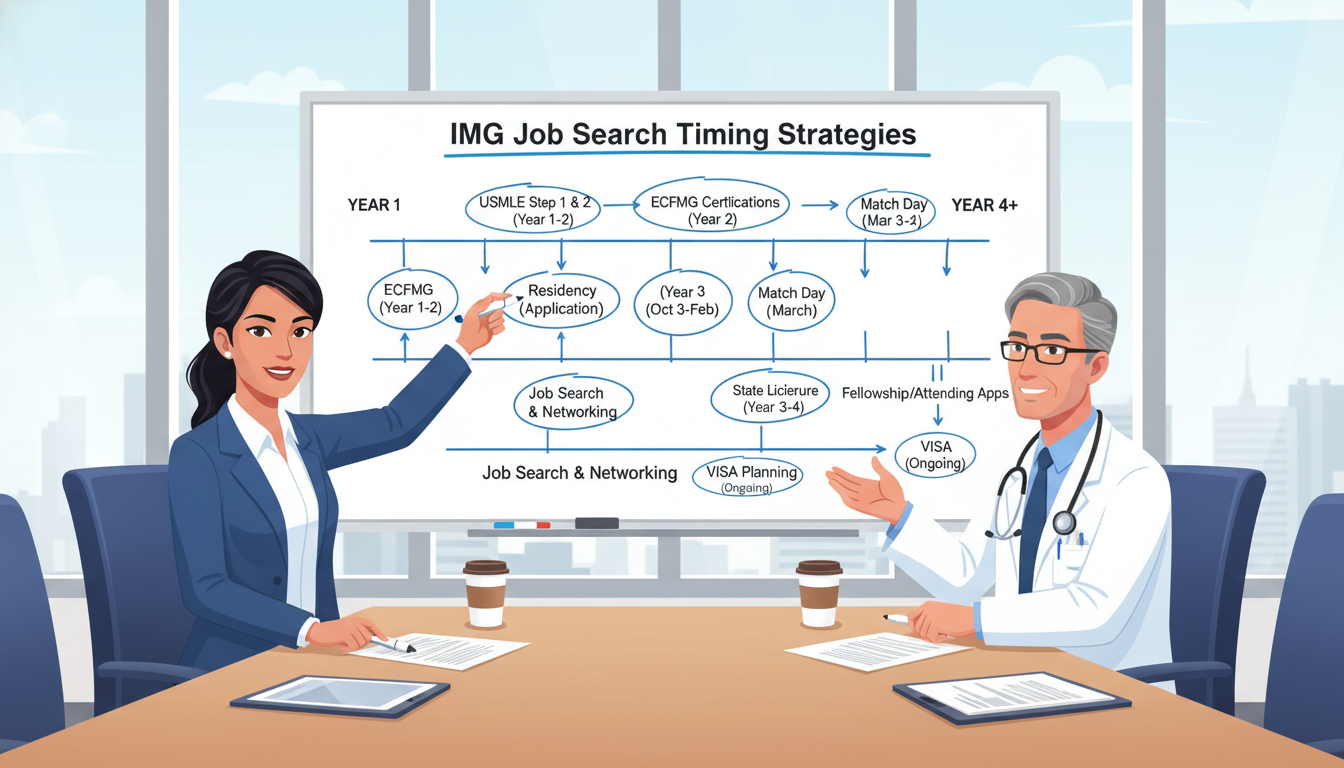
This section gives you a structured timeline so you know precisely when to start job search activities and what to focus on at each stage.
PGY‑1: Laying the Foundation (Exploration Phase)
Primary goals:
- Adjust to U.S. clinical environment
- Build a strong performance record and relationships
- Start understanding your post‑residency options
Key timing tasks:
Clarify your long‑term visa strategy (first 6–12 months)
- Are you on J‑1, H‑1B, or another status?
- If J‑1, do you intend to pursue:
- A J‑1 waiver job (Conrad 30/state waiver, federal waiver program, etc.)
- Home country return (2‑year requirement) then re‑entry
- If H‑1B, what are your options to transfer to another H‑1B employer after residency?
Identify likely practice types and geographic preferences
- Academic vs. community vs. hybrid
- Urban, suburban, or rural
- Willingness to work in medically underserved or rural areas (often necessary for J‑1 waivers)
Start tracking credentialing documents
- Keep a secure digital folder with:
- Medical school diploma and transcript (with certified translations)
- Internship/house officer certificates
- ECFMG certificate
- USMLE/COMLEX score reports
- Doing this early prevents last‑minute scrambling when employers request documents.
- Keep a secure digital folder with:
Build relationships and reputation
- Ask attendings about their own job search experiences and the timing they used.
- Identify mentors who are familiar with IMG‑specific challenges and visa issues.
Outcome of PGY‑1:
You understand your immigration constraints, likely practice pathway, and you’ve begun collecting documents and mentors. No need for active job applications yet, but awareness and planning have started.
PGY‑2: Positioning Yourself (Preparation & Early Market Awareness)
Primary goals:
- Clarify career direction and target job types
- Prepare for licensure and board eligibility
- Start low‑intensity market scanning
Key timing tasks:
Choose target states early (first half of PGY‑2)
- Research 3–5 states where you’re willing to work. Consider:
- Visa friendliness (are they known to hire IMGs? Conrad 30 history?)
- State medical board processing times
- Cost of living and family considerations
- For J‑1s, carefully review Conrad 30 programs and deadlines in those states.
- Research 3–5 states where you’re willing to work. Consider:
Start state medical license research (mid PGY‑2)
- Identify:
- Minimum PGY requirements (some need 3 years, some less for IMGs)
- Documentation requirements for international graduates
- Typical processing timelines (4–6 months is common; some are longer)
- You don’t apply yet, but you create a schedule:
- For most IMGs, submit state license applications 9–12 months before graduation.
- Identify:
Begin informal job market exploration (all year)
- Periodically check job boards (e.g., NEJM CareerCenter, PracticeLink, company and hospital sites).
- Note which employers:
- Explicitly mention “J‑1/H‑1B visa sponsorship available”
- Have a history of hiring IMGs
- Join specialty societies and attend meetings if possible; networking can reveal visa‑friendly employers.
Discuss future letters of recommendation (late PGY‑2)
- Tell key attendings: “I’ll be applying for jobs starting next year. Would you be comfortable writing a strong letter when the time comes?”
- This early notice improves the depth and quality of letters later.
Outcome of PGY‑2:
You know which states and job types you’ll target, have a licensure timeline, and are starting to understand which employers are open to IMGs with visa needs.
PGY‑3 (or Final Residency Year): Active Job Search & Interviews
For a 3‑year residency (e.g., Internal Medicine, Pediatrics, Family Medicine), PGY‑3 is the critical timing year. In longer residencies, treat your penultimate year like PGY‑3.
Primary goals:
- Launch an organized, proactive attending job search
- Secure interviews 9–12 months before graduation
- Lock in an offer at least 4–6 months before your end date (earlier for J‑1 waiver jobs)
Month‑by‑month framework (adjust for your program’s start/end month):
12–18 Months Before Graduation (early PGY‑3)
Finalize your CV and cover letter templates
- Emphasize: clinical volume, procedures, quality improvement projects, teaching experience, and any leadership.
- Mention visa status clearly (e.g., “Currently in J‑1 visa status; seeking J‑1 waiver sponsorship starting July 202X.”)
Start reaching out to contacts and mentors
- Ask: “Given my interest in X specialty and Y location, which employers would you recommend?”
- Request introductions via email to potential employers or department chairs.
Begin targeted job applications
- Especially important for:
- J‑1 waiver‑seeking IMGs (Conrad 30 and federal waiver programs can fill quickly)
- IMGs in competitive specialties (e.g., some subspecialties in urban academic centers)
- For J‑1s, many state waiver programs start accepting applications as early as October of your final year.
- Especially important for:
9–12 Months Before Graduation (mid PGY‑3)
This is the core of your attending job search.
Volume of applications:
- Depending on your specialty and visa needs, you may need to apply to 15–40 positions to secure multiple offers.
- More applications are often needed for:
- Hospitalist/primary care positions in highly desired cities that rarely sponsor visas
- Competitive subspecialties (e.g., cardiology in major metros)
Interview season:
- Plan for interviews to cluster over 2–4 months.
- Use vacation days and elective time strategically for travel.
- Conduct virtual interviews when available, but prioritize on‑site visits for top choices.
Parallel tasks:
- Start state medical license applications in your top 1–2 states during this period (earlier if the state is known for long processing times).
- Ensure all references are ready and responsive.
6–9 Months Before Graduation (late PGY‑3)
Offers and contract negotiation
- By this point, you should ideally have at least one serious offer—and more if possible.
- Discuss: salary, bonuses, call schedule, non‑compete clauses, partnership tracks, and scholarly time (if academic).
- For IMGs, confirm visa sponsorship details in writing:
- Type of visa (H‑1B, J‑1 waiver program, O‑1)
- Who pays legal and filing fees
- Timeline and key deadlines
Lock in your position
- For J‑1 waiver positions, timing is more rigid:
- Many states require job offers and contracts to be in place before waiver applications are submitted.
- Aim to sign a contract at least 9–12 months before your July start date.
- For J‑1 waiver positions, timing is more rigid:
Begin hospital credentialing (in collaboration with employer)
- Hospital credentialing can take 3–6 months, especially for IMGs with multiple international training experiences.
Final 3–6 Months Before Graduation
Focus shifts from searching to onboarding
- Track: state license approval, DEA registration, hospital privileges, insurance credentialing.
- Confirm your start date and schedule orientation.
Keep a backup plan in mind
- If any delays threaten your start, discuss temporary solutions with your employer (e.g., moonlighting, delayed start, bridging visas where possible with an immigration attorney).
Outcome of PGY‑3:
Your attending job search is complete or nearly complete; your main work now is ensuring licensure, visa, and credentialing are finalized.
Fellowship Years: An Accelerated Timeline
If you’re completing a fellowship, your attending job search timing shifts earlier:
1‑year fellowships (e.g., many subspecialty add‑on programs)
- Start your job search before fellowship begins or immediately at the start.
- Many fellows secure jobs by 6–9 months before fellowship completion.
2–3 year fellowships (e.g., Cardiology, GI, Hem/Onc)
- Begin job search activities in the first half of your final year.
- If there are few jobs in your subspecialty or you require visa sponsorship, start even earlier.
Tip: For competitive fellowships and subspecialties, network and express interest to potential employers during conference meetings, presentations, and rotations long before formal applications.
Visa‑Specific Timing Strategies for IMGs
Visa planning often drives job search timing more than any other factor for international medical graduates.

J‑1 Visa Holders: Timing Around Waivers
If you’re on a J‑1 visa for residency or fellowship, you typically face a 2‑year home country return requirement, unless you get a waiver.
Key timing principles:
Start exploring J‑1 waiver options 18–24 months before graduation.
- Federal programs (e.g., VA, HHS, ARC, DRA) and Conrad 30 differ in rules and timelines.
- Some require a signed contract and proof of recruitment before waiver submission.
Know when your target states open their Conrad 30 cycles.
- Many cycles open between October–January.
- Some states fill all 30 slots within weeks; others remain open longer.
- To be competitive, you often need:
- A signed employment contract
- Clear practice site information (often in underserved areas)
- Employer letter and supporting documents ready as soon as the cycle opens.
Backward plan from waiver deadlines.
- If your state accepts applications in October, your job search for a waiver‑eligible position often needs to begin by early in your final year (or earlier for tough markets).
- This means applications and interviews may need to start before your U.S. co‑residents are even thinking about their job search.
Coordinate with an immigration attorney early.
- Even if the employer has its own counsel, having your own advisor can help you align timelines and avoid mistakes that delay the process.
H‑1B Visa Holders: Transfer Timing
For IMGs in H‑1B status during residency or fellowship:
Understand cap‑exempt vs cap‑subject status.
- Training programs affiliated with universities or non‑profits are usually cap‑exempt.
- Private practice or non‑affiliated hospitals are often cap‑subject.
- This influences when you can start the new H‑1B and whether you need to go through the April lottery.
Start discussions with potential employers at least 9–12 months before graduation.
- Clarify:
- Whether they are cap‑exempt or cap‑subject
- Who will manage the transfer process
- Whether premium processing will be used (important for start date certainty)
- Clarify:
Align job start dates with H‑1B processing windows.
- Cap‑subject H‑1Bs have strict filing windows and start dates (often October 1), which may not perfectly match your July graduation.
- Plan early to prevent gaps in status or employment.
O‑1 and Other Pathways
Some IMGs qualify for O‑1 (extraordinary ability) visas, especially in academic or research‑heavy subspecialties.
- Start O‑1 evaluation 12–18 months in advance.
- You must assemble substantial evidence (publications, national/international recognition, awards, etc.), which takes time.
- Job offers and contracts must be aligned with O‑1 petition timing.
Specialty‑Specific Timing and the Physician Job Market
Not all specialties follow the same timing patterns in the physician job market. Your strategy should align with how your specialty typically recruits.
Primary Care and Hospital Medicine
Market characteristics:
- High demand, especially in underserved and rural areas
- Many employers willing to consider IMGs and visa sponsorship
Timing implications:
- You can often secure an offer 9–12 months before graduation without extreme competition.
- For J‑1 waivers in primary care or hospital medicine, more waiver‑eligible jobs are available, but you still need to be early for popular states.
Procedural Subspecialties (e.g., Cardiology, GI, Interventional Radiology)
Market characteristics:
- Fewer available positions
- Academic position timelines may be earlier
- Some private groups plan hires years in advance
Timing implications:
- Begin networking and informal conversations in your second fellowship year (or mid‑training for 3‑year programs).
- Formal job applications may need to start 12–18 months before fellowship completion.
- Visa‑requiring IMGs should be particularly proactive and flexible geographically.
Academic vs. Community Positions
Academic jobs may:
- Have more structured hiring cycles aligned with fiscal years
- Require additional steps (search committees, multiple interviews, formal faculty approval)
- Expect evidence of research, teaching, and scholarly output—build this early in training
Community jobs may:
- Hire on a rolling basis, with quicker decision processes
- Be more open, in some regions, to J‑1 waiver or H‑1B options
- Adjust start dates more flexibly to accommodate visas/credentialing
For academic jobs, start serious conversations 12–18 months before your intended start date; for community jobs, 9–12 months is often enough, though IMGs on visas should lean earlier.
Practical Strategies and Common Pitfalls for IMGs
Actionable Strategies
- Create a Job Search Timeline Document
Include:
- Target job start date
- Backward milestones:
- Contract signed by:
- Last interview date:
- First interview date:
- First application submissions:
- State license application submitted by:
- J‑1 waiver or H‑1B paperwork start date:
Review this timeline with a mentor and an immigration attorney.
- Use a Tracking Spreadsheet
Track every application with columns for:
- Employer, contact person, location
- Practice type, visa willingness
- Date applied, response, interview dates
- Offer details (salary, call, benefits, visa terms)
- Status (pending, declined, offer received, contract signed)
- Signal Your Visa Status Early but Strategically
In cover letters or brief emails:
- Be transparent but concise:
- “As an international medical graduate currently training on a J‑1 visa, I am seeking a position that can support a J‑1 waiver.”
- This saves time; non‑sponsoring employers often self‑select out early.
- Reserve Time for Interviews
- Anticipate a 2–3‑month period where interviews cluster.
- Coordinate with your program to use vacation or conference time.
- For away or virtual interviews, group them geographically to reduce travel.
- Reassess Progress Mid‑Search
- If you have few or no interviews 3 months after starting applications, adjust:
- Broaden your geographic range.
- Target more rural/underserved areas.
- Refine your CV and cover letter with feedback from mentors.
- Increase the number of applications.
Common Timing Mistakes for IMGs
- Starting job search at the same time as U.S. grads despite visa needs
- Result: Fewer options, rushed contracts, difficulty finding J‑1 waiver slots.
- Waiting too long to apply for state licensure
- Result: License not ready by start date—employer may delay your start, or in rare cases withdraw the offer.
- Underestimating J‑1 waiver competitive timelines
- Especially problematic in states that fill all 30 slots quickly.
- Starting late can completely eliminate options in your preferred states.
- Ignoring immigration counsel until late
- Visa issues discovered late in the process can derail job offers or delay start dates.
- Early legal review of your strategy is essential.
- Not having a backup geographic plan
- Only considering one city or state increases the risk of timing failure.
- For your first attending job, it’s often better to be flexible on location, then reposition later after green card progress.
FAQs: Job Search Timing for International Medical Graduates
1. When should an IMG start their attending job search?
For most IMGs, especially those needing visa sponsorship, the safest window is to start planning and light exploration 18–24 months before graduation, and active applications 12–18 months before graduation. Those on J‑1 visas seeking waivers in competitive states may even need to start earlier to align with state waiver cycles.
2. How does being on a J‑1 visa affect when I should start looking for jobs?
J‑1 status introduces rigid requirements and deadlines. You must find an employer willing to sponsor a waiver and complete the waiver process—often through Conrad 30 or federal programs—on a schedule that doesn’t always match typical job searches. To avoid missing waiver slots, you should begin exploring J‑1 waiver‑friendly positions and learning state timelines at least 18 months before graduation, and secure a signed contract as early as possible in your final year.
3. Can I wait until the last 6 months of residency to start my job search?
It’s strongly discouraged for IMGs, especially on visas. By the last 6 months, you should ideally be focusing on licensure, credentialing, and immigration paperwork, not just starting the search. Waiting that long can leave you with very limited options, force you to accept suboptimal offers, or cause gaps in status or employment.
4. How does the physician job market affect timing for IMGs?
The physician job market is generally favorable for many specialties, but competition and visa restrictions create bottlenecks for international medical graduates. In high‑demand rural and underserved areas, positions remain open longer and are more likely to sponsor visas, allowing some flexibility. In popular cities and competitive subspecialties, jobs may be filled early and may not offer sponsorship, pushing IMGs to start earlier, target wider geographies, and use more strategic networking.
A well‑timed job search is one of the most powerful advantages you can give yourself as an international medical graduate. By starting early, understanding visa‑driven deadlines, and aligning your efforts with the realities of the physician job market, you can move from residency to your first attending role with far more control, confidence, and options.