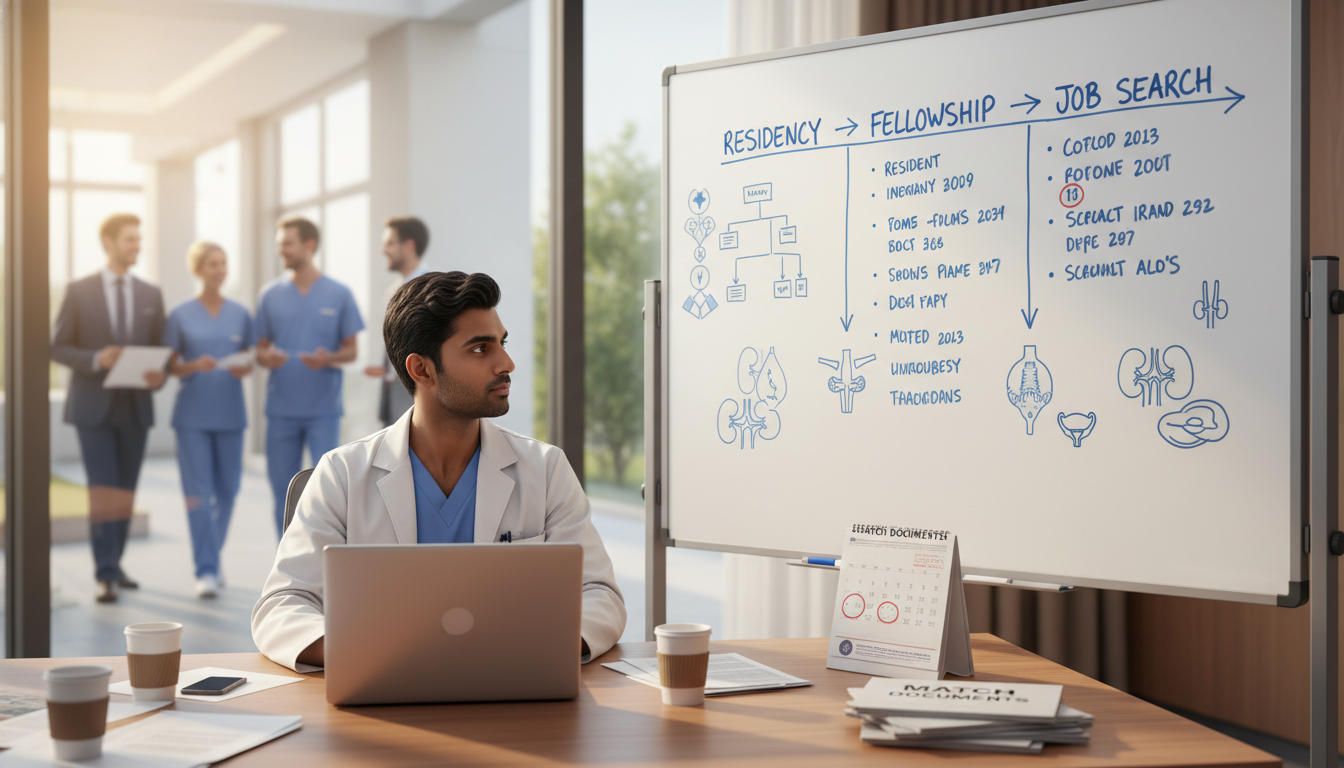
Why Job Search Timing Matters So Much for IMG Urologists
For an international medical graduate in urology, when you start your job search can be just as important as how you search. Urology is a small, competitive field with a relatively tight physician job market. Positions—especially in desirable locations and academic centers—are often filled more than a year in advance.
As an IMG, your visa status, training path, and networking opportunities add extra layers of complexity. Poor timing can mean:
- Missing the urology match to competitive fellowships or positions
- Losing out on ideal practice settings
- Scrambling for any job rather than choosing the right one
- Visa gaps and employment interruptions
This IMG residency guide–style article focuses specifically on job search timing for:
- IMGs applying to urology residency in the US or Canada
- Current IMG urology residents planning for fellowship and first attending job
- IMGs finishing training and entering the attending job search
You’ll find a year‑by‑year, and in some sections month‑by‑month, breakdown of what to do and when so that timing becomes a strategic advantage, not a liability.
Understanding the Urology Job Pipeline for IMGs
Before diving into specific timelines, it helps to understand the overall “pipeline” from IMG to practicing urologist and how timing plays into each stage.
Typical IMG Urology Pathways
Pre‑Residency Stage (IMG outside the US/Canada or just arrived)
- Taking USMLE/COMLEX
- Clinical electives or observerships
- Research positions
- Applying to urology residency or sometimes general surgery → urology
Residency Stage (Urology Residency, 5–6 years total)
- PGY‑1: Mostly general surgery or transitional year
- PGY‑2–PGY‑5/6: Core urology training
- Optional research year at some programs
Post‑Residency Options
- Fellowship (e.g., endourology, oncology, pediatrics, female pelvic medicine, reconstructive, infertility)
- Directly into Attending Practice (community or hospital‑employed, sometimes academics)
Why Timing is Unforgiving in Urology
Several specialties allow late job searches; urology generally does not. Reasons include:
- Small specialty – Fewer programs and jobs; hiring is often completed early.
- Heavy use of informal networks – Chairs and program directors often fill positions through contacts months before jobs are officially posted.
- Visa complexities for IMGs – J‑1 waivers, H‑1B caps, and processing times can easily take 6–12 months.
- Fellowship bottlenecks – Many academic jobs expect fellowship training; missing the urology match for fellowships pushes everything back a year.
For an IMG, you aren’t just asking:
“When should I start my job search?”
You are really asking:
“How do I start the right search early enough to get a visa, a good fit, and long‑term stability?”
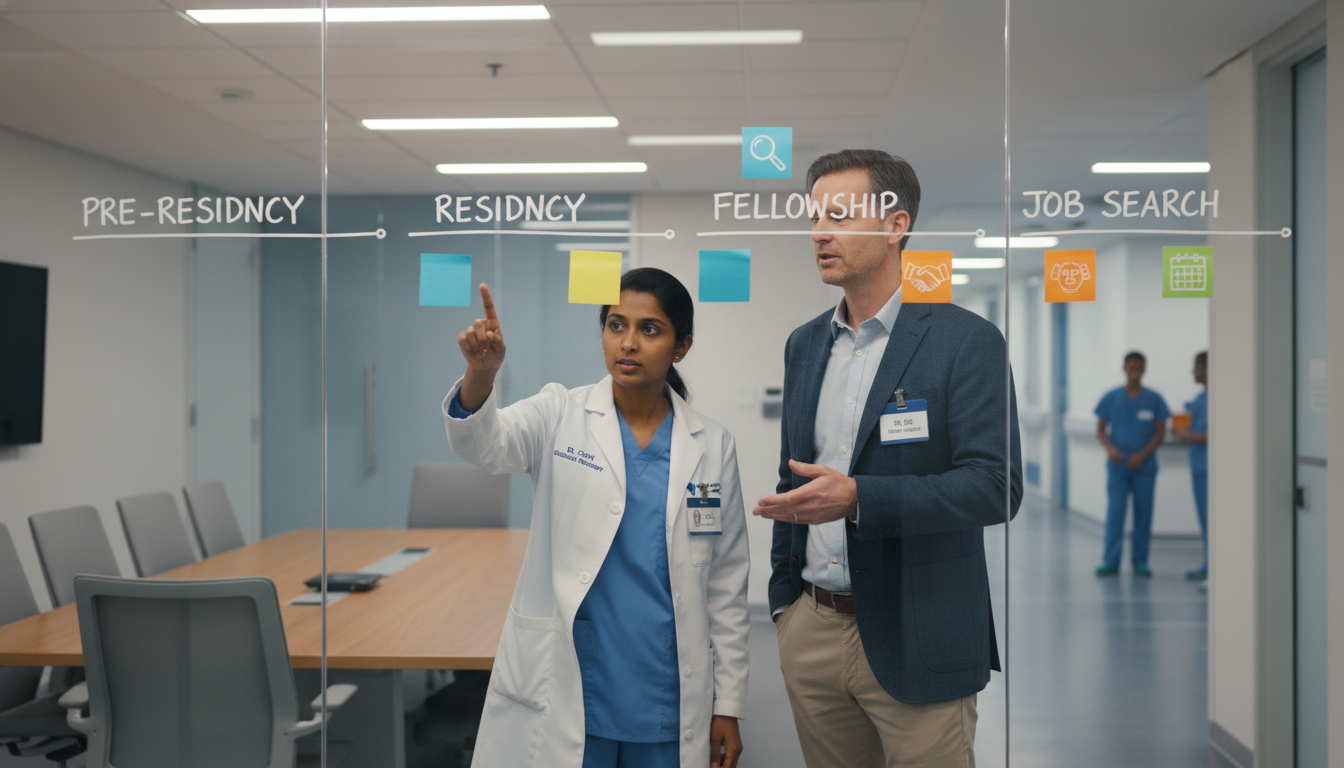
Timing Your Search: From Pre‑Residency Through Urology Match
This section focuses on IMGs who are not yet in urology residency but are planning ahead. Even before you match, understanding timing sets you up for a smoother transition to job market realities.
Pre‑Residency (IMG Still Abroad or in a Preliminary Role)
At this stage, “job search” really means positioning yourself for future residency and eventual employment:
24–36 Months Before Residency Start (while finishing medical school or early post‑grad):
- Focus on:
- USMLE Step 1/2 CK scores
- English proficiency (IELTS/TOEFL if needed)
- Building relationships for letters of recommendation, ideally with urologists
- Think long‑term:
- Start learning about US visa categories (J‑1 vs H‑1B) early; this will matter later in the attending job search.
- Research which regions have higher needs for urologists (often rural or underserved states).
12–18 Months Before Urology Match (while applying)
- Start behaving like someone who will need a job in 6–8 years:
- Track regions where you might eventually want to practice (or where you are open to J‑1 waiver options if you go that route).
- Look for urology programs with:
- A history of supporting IMGs
- Strong career placement
- Faculty who are active in national organizations (AUA, SUO), because they will be important for your network.
Why This Early Planning Matters Later
Even though you are far from the attending job market, early decisions affect:
- Where you are likely to do a J‑1 waiver (if applicable)
- How easy it will be to find mentors who know the physician job market
- Whether your program is connected to strong fellowship opportunities
Think of this as Phase 1 of your attending job search: you are choosing the ecosystem that will shape your later opportunities.
Residency Years: The Most Critical Window for Job Search Timing
For an international medical graduate in urology, residency is where job search timing truly becomes make‑or‑break. You must plan for both fellowship and attending options simultaneously, because they are tightly linked in urology.
PGY‑1 (Intern Year): Laying the Groundwork
- Primary focus: learning US hospital culture, excelling clinically, and proving reliability.
- Job search timing tasks:
- Attend at least one departmental or regional career talk if available.
- Start tracking your case logs and academic activities—this will later go straight onto your CV.
- Have an early conversation with:
- Program Director (PD)
- A trusted urology faculty mentor
about your long‑term goals (academic vs community, fellowship interests, and visa status).
Key timing insight:
By the end of PGY‑1, you should know if you are probably aiming for fellowship or going directly into practice. This will shape your PGY‑2 and PGY‑3 strategy.
PGY‑2–PGY‑3: Fellowship vs Direct Job – Decide Early
These years are the core of your urology training. They’re also when critical timing decisions should be made.
If You Are Aiming for Fellowship (Very Common in Urology)
- Fellowship applications often open in PGY‑3, sometimes earlier, depending on subspecialty and whether they use the SUO/AUA match or an institutional process.
- Job Search Timing Impact:
- Your attending job search will effectively start during fellowship (~2 years before your first job).
- But you must begin fellowship planning by early PGY‑2:
- Research subspecialties and application cycles (urologic oncology, pediatrics, endourology, FPMRS, reconstructive, andrology, etc.).
- Start academic projects and seek mentors in your area of interest.
If You Might Go Directly Into Practice (No Fellowship)
For IMGs, this is often influenced by visa and financial considerations.
- By mid‑PGY‑2 at the latest, start talking with:
- Your PD about how recent graduates have found jobs
- Institutional legal/visa office about:
- Your current visa type (J‑1 vs H‑1B)
- When you would need to start planning for J‑1 waiver/H‑1B sponsorship
- Goal: Be ready to begin an attending job search no later than 18–24 months before graduation.
PGY‑4–PGY‑5 (and PGY‑6 if applicable): Precise Job Search Calendar
At this stage, timing becomes more granular.
Timeline if You Are Applying for Fellowship
PGY‑3 → PGY‑4 (Fellowship Application Year):
- 18–24 months before residency graduation:
- Finalize subspecialty choice.
- Request letters of recommendation.
- Prepare fellowship CV and personal statement.
- Apply as early as the cycle opens; urology fellowships are small and competitive.
PGY‑4 → PGY‑5 (Fellowship Interview and Match):
- Once matched to fellowship:
- Calculate your fellowship start date.
- Start thinking backward:
- If fellowship is 1 year → your job search for attending jobs starts at the very beginning of fellowship (or even a few months before)
- If fellowship is 2 years → attending job search usually starts during the first half of the second year
Timeline if You Are Going Straight to an Attending Job
This is where timing is most critical for an IMG.
24 Months Before Graduation:
- Begin exploring the physician job market:
- Attend national meetings (AUA, subspecialty sections).
- Visit the career center booths—talk to recruiters and employers.
- Start compiling a list of:
- Geographical preferences
- Practice settings: academic, large hospital system, multi‑specialty group, private practice
- Deal‑breakers: call burden, visa support, teaching vs no teaching
18 Months Before Graduation:
Begin active job search:
- Update your CV and create a basic cover letter template.
- Reach out directly to:
- Program alumni
- Former faculty
- Regional hospitals in areas you’d consider
- Register with a few urology‑specific recruiters or large physician job boards (without over‑committing to any one firm).
For J‑1 visa holders:
- Begin exploring J‑1 waiver opportunities:
- State Conrad‑30 program timelines
- Federal waiver programs (VA, HHS, etc.)
- These processes are time‑sensitive and can fill early.
- Begin exploring J‑1 waiver opportunities:
12–15 Months Before Graduation:
- Aim to have multiple interviews scheduled.
- Ideally, you want verbal or written offers by 9–12 months before graduation, so visa and credentialing can start without rushing.
9–12 Months Before Graduation:
- For most IMGs, this is the latest safe time to accept a job if visa processing is required.
- Start:
- Contract review (get a physician‑contract lawyer if possible)
- Credentialing and state license applications (these may take several months)
- Visa petition preparations (H‑1B or J‑1 waiver paperwork)
If you are still without an offer at 6 months before graduation, you are behind schedule, and your options may become:
- Expanding geographic preferences
- Considering less competitive markets (rural, underserved)
- Leveraging every personal and faculty contact you have

Fellowship Years: When to Start Your Attending Job Search
Many IMGs will pursue fellowship after urology residency. In that case, your attending job search shifts into the fellowship phase—but it does not shift later. If anything, it starts earlier than many expect.
One‑Year Fellowship (e.g., Endourology, Many Onc/Uro Onc Programs)
For a 1‑year fellowship starting in July:
July–September (Months 1–3):
- Update your CV immediately with:
- “Urologic Oncology Fellow, Institution X, July 20XX–June 20XY”
- Any new publications or projects underway
- Clarify with your fellowship director:
- Whether they anticipate openings in their own or affiliated system
- Which regions/institutions they can connect you with
- Update your CV immediately with:
August–November (Months 2–5):
This is typically the prime time to begin attending job search:- Reach out to:
- Faculty across your network
- Academic centers in your subspecialty interest
- Community/hospital systems that might need your niche skills
- Attend national or subspecialty meetings that occur during this period; schedule on‑site or informal interviews.
- Reach out to:
By December–January (Months 6–7):
- Aim to have:
- Several interviews completed
- At least one strong lead that looks likely to become an offer
- For IMGs on visas: this is the point to ensure any sponsoring employer understands visa deadlines.
- Aim to have:
February–April (Months 8–10):
- Try to sign a contract no later than 3–4 months before fellowship completion, earlier if visa work is needed.
Two‑Year Fellowship
For a 2‑year fellowship, timing is spread out but the “search early” principle still applies.
- Fellowship Year 1:
- Focus on building clinical and academic profile.
- Start the exploratory phase late in Year 1:
- Identify what type of job (academic vs community with academic affiliation vs pure private) fits you best.
- Fellowship Year 2:
- Months 1–4 of Year 2: Begin active search:
- Update CV and cover letters.
- Contact potential employers.
- Leverage your fellowship director’s contacts aggressively—this is a major asset in the urology job market.
- Months 5–8 of Year 2:
- Go through interviews and narrow options.
- Negotiate contract, especially important if tracking for academic promotion.
- Months 8–10 of Year 2:
- Finalize and sign contracts, ensuring adequate time for visa and licensure.
- Months 1–4 of Year 2: Begin active search:
Practical Strategies to Optimize Job Search Timing as an IMG
Knowing when to start is only half the battle. These strategies help you actually use that time wisely.
Build a Long‑Term Network Early
Because the urology residency and urology match ecosystem is small and relational, informal recommendations often move faster than public job postings.
- Start networking at:
- AUA annual meetings
- Sectional meetings (Northeastern, Southeastern, Western, etc.)
- Subspecialty meetings (SUO, Endourology Society, SPU, SMSNA, etc.)
- Aim to:
- Present posters or podium talks, even if small projects
- Introduce yourself to leaders in your area of interest
- Stay in touch periodically (email updates every 6–12 months)
Why this matters for timing:
When you start your attending job search, a warm email from someone who already knows your work can quickly turn into an interview—long before a job ever appears on a website.
Use Time‑Bound Milestones
Instead of thinking “I’ll look for jobs late in residency,” convert that into specific milestones:
“By January of my PGY‑4 year, I will:
- Have an updated CV
- Know if I’m applying for fellowship and in which subspecialty
- Have spoken with at least 2 alumni about how they found their jobs.”
“By September of my fellowship year, I will:
- Have contacted at least 10 institutions about job possibilities
- Scheduled preliminary conversations or visits for interested employers.”
Write these into a simple calendar or planner and review them every 3 months.
Coordinate with Visa Timelines
As an international medical graduate, visa realities strongly influence when to start job search and which employers are realistic.
J‑1 Visa Holders:
- Must complete a waiver (often in underserved areas) before moving to other jobs or permanent residency pathways.
- Many states have early Conrad‑30 deadlines and limited slots:
- Some states fill within weeks of opening
- Others remain open longer, but you should still plan early
- Practical advice:
- Begin researching Conrad‑30 states 18–24 months before training completion.
- Target jobs in states that not only need urologists but historically approve waivers.
- Ask potential employers early: “Have you previously sponsored J‑1 waivers for urologists?”
H‑1B Visa Holders:
- Have to navigate caps (for some employers) and start dates.
- Non‑cap‑exempt institutions (many private practices or non‑academic hospitals) may only be able to start you on October 1.
- If you train at a cap‑exempt institution, transitioning to a cap‑subject one needs early planning.
- Start exploring employer’s H‑1B experience at least 12–18 months before you want to start working.
Balance “Casting a Wide Net” with Focus
Starting early sometimes leads candidates to apply to too many jobs haphazardly. To keep your search efficient:
Early in the exploratory phase, define:
- Primary goal (academic vs strong community practice, research‑heavy vs clinical)
- Geographic tolerance (where you definitely won’t live, where you’re flexible, where you’d love to be)
- Visa must‑haves (sponsorship type, J‑1 waiver readiness, etc.)
Use these to quickly triage opportunities:
- Respond promptly to jobs that fit 2–3 of your main criteria.
- Politely decline or deprioritize those that clearly won’t work for your long‑term goals.
When to Start Job Search: Summary Timelines by Phase
To tie this IMG residency guide together, here is a consolidated view.
If You Are Pre‑Residency (IMG Planning to Enter Urology)
- Job search timing focus: Prepare for competitiveness and future employability.
- Recommended actions:
- Learn about the physician job market in urology while you study for exams.
- Target residency programs that place graduates well and support IMGs.
If You Are a Urology Resident (No Fellowship Planned)
- Optimal time to start active attending job search:
18–24 months before residency graduation. - Latest safe time assuming visa needs:
9–12 months before graduation.
If You Are a Urology Resident (Fellowship Planned)
- Fellowship applications: Typically in PGY‑3 or early PGY‑4 (varies).
- Attending job search:
- For 1‑year fellowship: Start during months 2–4 of fellowship.
- For 2‑year fellowship: Start early in the second year.
If You Are in Fellowship Now
- Ideal time to start attending job search:
- Once you’re clinically settled and have a clear sense of your niche—usually 3–6 months into fellowship, depending on duration.
If You Are Late and Behind Schedule
- Expand geographic range, especially toward:
- Smaller cities
- Rural and underserved regions
- Lean heavily on:
- Alumni networks
- PD and fellowship director contacts
- Be realistic about:
- Compromises on salary, call, or setting in your first job, knowing you can reposition later once your visa situation and US experience are solid.
FAQs: Job Search Timing for IMG Urologists
1. As an IMG urology resident, when should I start my first attending job search?
Most IMGs in urology should begin active attending job search 18–24 months before finishing their final training step (residency or fellowship). If visa sponsorship is needed, aiming for 18–24 months provides the safest margin for interviews, contract negotiation, credentialing, state licensing, and visa processing.
2. If I’m planning a urology fellowship, do I still need to think about attending jobs during residency?
Yes. While your actual attending job search will happen during fellowship, your fellowship choice strongly shapes your eventual job market. During residency (particularly PGY‑2 and PGY‑3), you should time your activities—research, mentoring, networking—so you can match into a fellowship that aligns with your desired future practice (academic, oncologic, reconstructive, pediatric, etc.).
3. How does being an IMG change the ideal timing compared to US graduates?
As an international medical graduate, you face additional constraints:
- Visa sponsorship (J‑1 waiver or H‑1B)
- Limited employer experience with visa processes in some regions
- Sometimes fewer local connections
Because of these, IMGs should generally start earlier than US graduates—often several months earlier, and almost never later. Where a US graduate might be safe waiting until 9–12 months before graduation, an IMG should ideally be deep into the process by that point, not just starting.
4. Should I use recruiters, or rely mainly on networking and job boards?
Use a combination, but time each wisely:
- Networking (faculty, mentors, alumni, meetings): Start as early as PGY‑2 and continue throughout career. This is the most powerful tool in a small field like urology.
- Job boards and hospital system career sites: Begin using them in the exploratory phase 18–24 months before finishing.
- Recruiters: They can be helpful, especially for community and rural positions, but:
- Don’t rely on just one.
- Clarify visa support early.
- Understand that the very best academic positions are often filled through direct networking, not recruiters.
Used together and on time, these approaches give you the broadest exposure to the physician job market and the best chance of landing a position that matches your skills, visa needs, and long‑term career goals.