
Understanding the Job Search Timeline for IMGs in Vascular Surgery
For an international medical graduate (IMG) in vascular surgery, timing your job search is as important as building your CV. Vascular surgery is a small, highly specialized field with a relatively tight physician job market and long lead times for hiring—especially in academic centers and large hospital-employed groups. On top of this, IMGs face additional steps: visas, licensing, and sometimes geographic limitations.
This IMG residency guide will walk you through when to start job search activities during an integrated vascular program or traditional fellowship, how far in advance different settings hire, and how to align your training milestones, visa planning, and career goals with the real-world vascular surgery job market.
Section 1: Overview of the Vascular Surgery Physician Job Market
The physician job market in vascular surgery has some distinct features that directly influence when and how you should begin your attending job search.
1.1 A Small Specialty With Limited Positions
Vascular surgery is a relatively small specialty compared to internal medicine or general surgery. This means:
- Fewer total attending positions posted each year
- Many jobs are filled quietly through networking and word-of-mouth
- Academic and high-demand urban positions can be highly competitive
- Regional and community-based jobs may be more available but sometimes less visible online
Because of the small size of the specialty, earlier, targeted networking is more important than simply responding to online postings late in your final year.
1.2 Hiring Lead Times in Vascular Surgery
In vascular surgery, the hiring lead time (from first conversation to signed contract) is often 6–18 months:
- Academic centers often start recruiting 12–24 months ahead
- Large health systems and hospital-employed groups commonly recruit 9–18 months ahead
- Private practices and smaller community hospitals may recruit 6–12 months ahead, sometimes even shorter if there is an urgent need
For an IMG targeting a specific geographic region or a particular practice type, this long lead time means you cannot wait until the last months of training to begin your attending job search.
1.3 Why Timing Matters More for IMGs
As an international medical graduate, your timeline must also accommodate:
- Visa needs (H-1B vs J-1 waiver vs O-1, etc.)
- State medical licensure timing
- Board eligibility and hospital credentialing
- Potential employer hesitations about immigration processes
These factors make the “when to start job search” question especially critical. A domestic candidate might be able to sign a contract 4–6 months before graduation; an IMG often needs the process started 12–18 months in advance to comfortably navigate visas and logistics.
Section 2: Year-by-Year Timeline – Integrated Vascular and Fellowship Pathways
The optimal job search timing depends on your training route: integrated vascular program (0+5) vs general surgery + vascular fellowship (5+2). Below is a generalized timeline; you can adapt it to your program length and local realities.
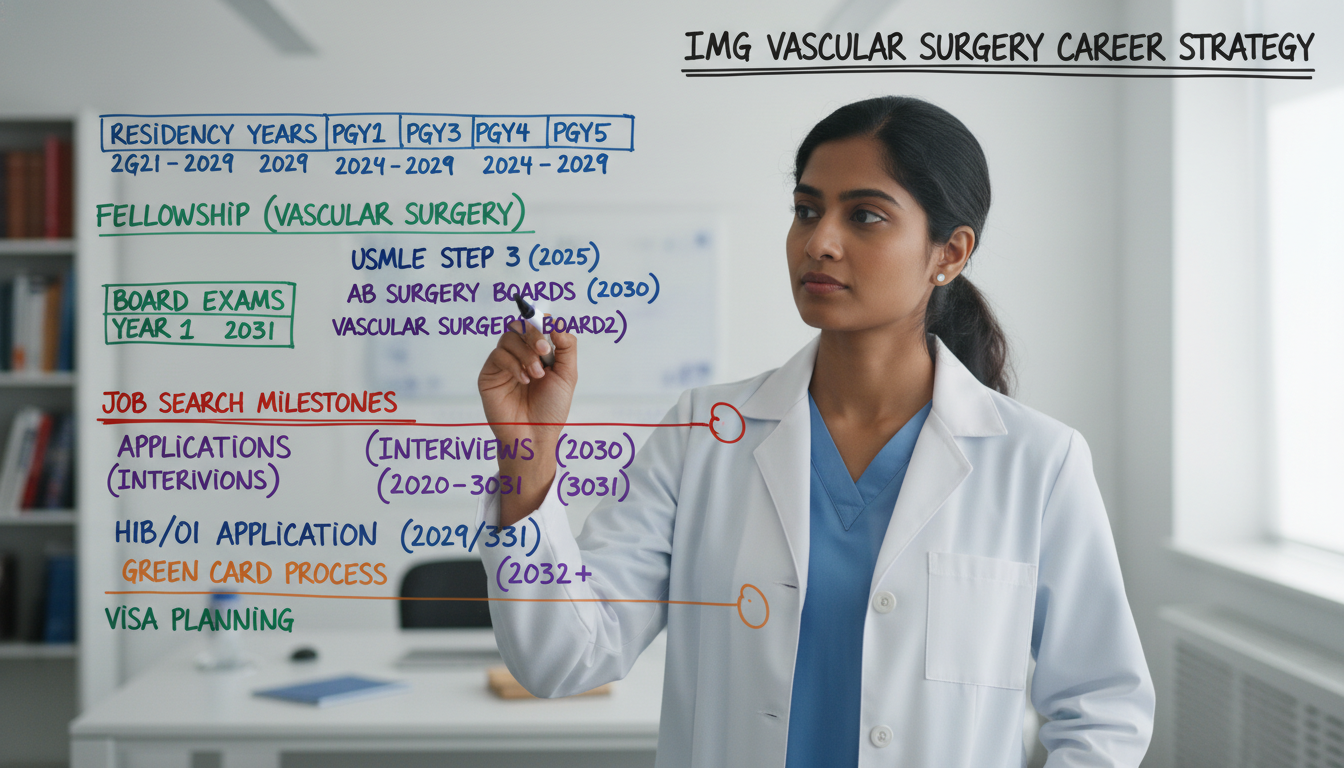
2.1 Early Training: Foundations, Not Formal Job Search
Integrated Vascular PGY-1 to PGY-3
Traditional Path: General Surgery PGY-1 to PGY-3
Focus: Skill-building, research, and reputation—not active job hunting yet.
Key actions:
- Build strong clinical performance and relationships with attendings.
- Get involved in vascular research projects and quality improvement.
- Present at local/regional vascular meetings, if possible.
- Begin to clarify your long-term preferences:
- Academic vs community
- Geographic regions
- Interest in specific niches (endovascular, open complex aortic, limb salvage, dialysis access, etc.)
You’re too early for a formal job search, but you’re not too early to network and develop mentors who might later open doors.
2.2 Mid-Training: Strategic Positioning and Visibility
Integrated Vascular PGY-4
Fellowship-Track: General Surgery PGY-4–5 / Early Vascular Fellowship
Focus: Establish your academic and professional profile and start visibility in the field.
Key actions:
- Present at national meetings (SVS, regional vascular societies).
- Publish case series, reviews, or original research in vascular topics.
- Let trusted mentors know your long-term career interests (“I’m IMG, interested in academic vascular in the Midwest”).
- Learn from upper-level residents/fellows about their job search experiences and timelines.
You are still early to formally apply for positions, but this is when early word-of-mouth opportunities may surface. Some programs know 2–3 years out when they’ll need a new vascular surgeon.
2.3 The Critical Job Search Window
Integrated Vascular PGY-5–6 (final 2 years)
Vascular Fellowship Year 1–2 (final 2 years of training)
This is when timing becomes crucial.
Ideal Start Time for Formal Job Search
For most IMGs in vascular surgery:
- Start serious job search activities 18–24 months before graduation.
- Begin informal conversations and networking 24–30 months before graduation.
Why this early?
- Academic jobs may be posted 18–24 months ahead, and decisions take time.
- Visa-dependent positions need extra planning, institutional approvals, and legal review.
- If initial prospects don’t work out, you still have time to pivot.
Example: Integrated Vascular Resident Timeline
Assume a 0+5 integrated vascular program ending June 2028:
- July 2026 (start of PGY-4)
- Clarify career goals, start talking with mentors about job search strategy.
- January–June 2027 (PGY-4 to early PGY-5)
- Attend conferences, quietly signal to contacts that you’ll be on the job market for July 2028.
- July–December 2027 (PGY-5)
- Begin actively searching for jobs, sending CVs, and contacting division chiefs.
- Discuss visa options formally with your GME office and potential employers.
- January–June 2028 (PGY-5 final months)
- Interview, negotiate contracts, finalize job and begin credentialing.
- Many IMGs in this situation aim to sign a contract 6–12 months pre-graduation.
Example: Vascular Fellowship Timeline (5+2)
Fellowship ends June 2027:
- Early Fellowship Year 1 (July–December 2025)
- Begin exploring regions and practice types; update mentors on your goals.
- Mid Fellowship Year 1 (January–June 2026, ~12–18 months before graduation)
- Start the active job search—especially for academic jobs, J-1 waiver positions, or competitive metropolitan areas.
- Fellowship Year 2 (July 2026–June 2027)
- Prioritize interviews and contract negotiations in the first half of the year if possible.
- Aim to finalize your contract by December–February for a June finish.
Section 3: Matching Job Search Timing to Practice Type and Visa Status
The “best” time to start looking depends not just on your graduation date, but on where and how you want to practice and which visa you hold.
3.1 Academic Vascular Surgery Positions
Academic positions—particularly at large university hospitals or major training centers—tend to:
- Recruit earlier (often 12–24 months ahead)
- Have multi-step hiring processes:
- Division-level interviews
- Department chair interviews
- Dean/administration approvals
- Legal/contract review
For an IMG seeking an academic vascular surgery position:
- Start networking ~24 months before graduation.
- Start formal applications and CV submissions 18–24 months before graduation.
- Expect interviews and decisions to unfold slowly; be prepared for multiple visits and presentations (grand rounds, job talk, etc.).
If you are on a J-1 visa, confirm early whether the institution:
- Accepts J-1 waiver candidates
- Has previous experience hiring J-1 waiver vascular surgeons
- Is in a location where state Conrad 30 or federal waiver options are realistic
3.2 Hospital-Employed or Large Health System Jobs
Hospital-employed positions and large multi-specialty groups often:
- Post jobs 9–18 months in advance
- Work with recruitment firms
- Have some internal flexibility for visa sponsorship
IMG considerations:
- Start looking 12–18 months before graduation.
- Do not wait for perfect job postings—also send targeted cold emails with your CV to vascular surgery chiefs in regions of interest.
- Clarify upfront:
- H-1B vs J-1 waiver support
- Timeline for credentialing and onboarding
- Expectations for call, OR time, and endovascular access
3.3 Private Practice and Smaller Community Hospitals
These employers may:
- Start recruiting later, sometimes just 6–12 months ahead
- Be less familiar with immigration processes
- Be more flexible about job description but less structured about timeline
For IMGs, this can be challenging:
- Some practices may prefer US citizens/green card holders due to immigration complexity.
- Others may be open but inexperienced with H-1B or J-1 waiver paperwork.
Strategy:
- Begin exploring and contacting such practices 12–18 months before graduation, even if they are not currently advertising.
- Educate them (briefly and professionally) on visa processes and reassure them that your GME office or an immigration attorney can help.
- Have a “backup plan” with more immigration-savvy employers, especially if you are on a J-1 visa and need a waiver.
Section 4: Visa and Licensing Timelines That Affect Job Search
For an international medical graduate, job search timing is tightly linked to visa strategy and licensing.
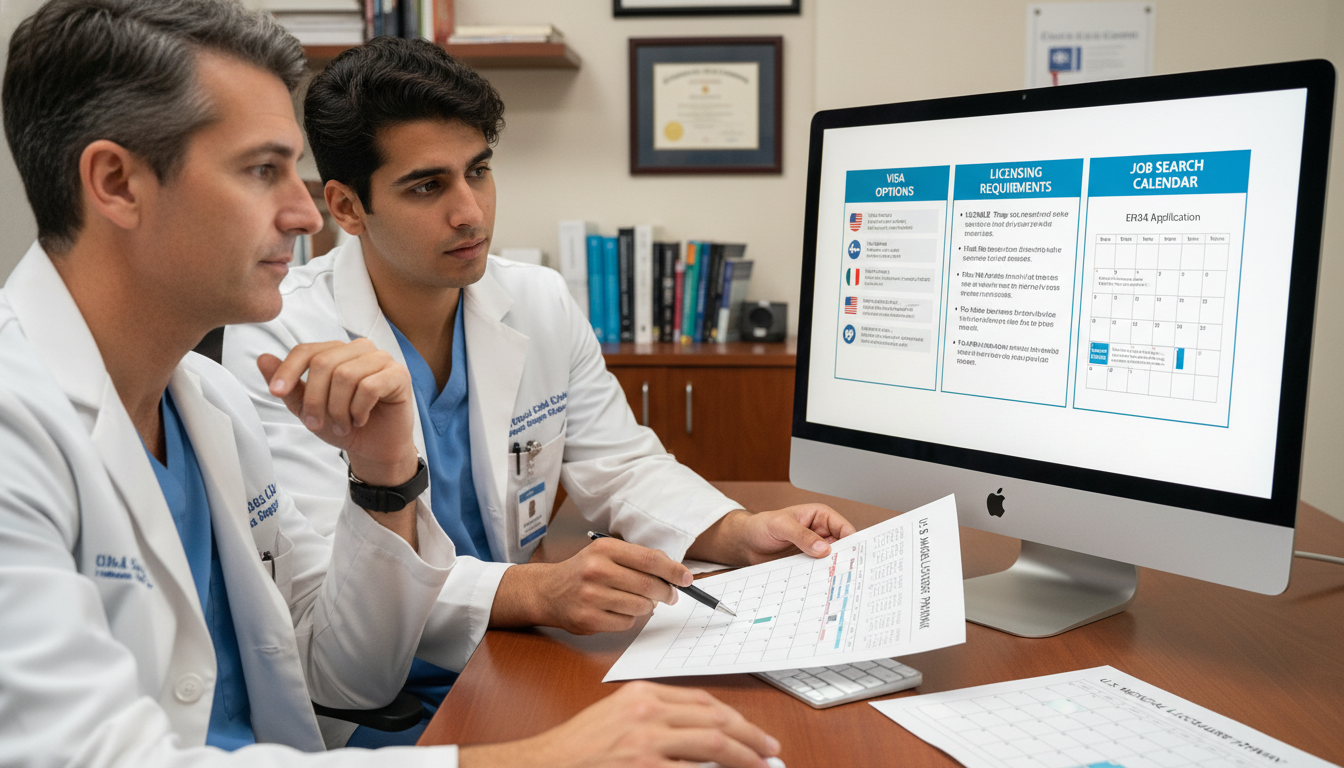
4.1 H-1B vs J-1: When to Plan
H-1B (Temporary Worker)
- Often preferred by IMGs intending long-term work and possible green card sponsorship.
- Cap-exempt if working for academic institutions or non-profit hospitals affiliated with universities.
- For cap-subject employers (some private or non-academic institutions), H-1B filing windows are fixed (lottery in March, start October 1).
Timing implications:
- Clarify 1–2 years before graduation whether your target employer is cap-exempt or cap-subject.
- If cap-subject, your job offer usually must be finalized by early winter so H-1B can be filed for the March lottery.
J-1 (Exchange Visitor) and J-1 Waivers
- Many IMGs do residency/fellowship on J-1 visas.
- To remain in the US without leaving for 2 years, you often must secure a J-1 waiver job in a qualifying area.
Timing implications:
- J-1 waiver positions are competitive and regionally limited.
- For vascular surgery, the number of employers able and willing to offer waiver positions can be relatively small.
- Begin serious J-1 waiver job search 18–24 months before graduation.
- Understand state Conrad 30 timelines; some states open applications on fixed dates each year and fill quickly.
4.2 State Medical Licensure and Credentialing
Licensure and hospital credentialing can take 3–9 months, sometimes longer for IMGs.
To avoid delays:
- Start state licensing as soon as your job location is confirmed—ideally 9–12 months before your start date.
- If you’re applying broadly, consider:
- Starting licensure in 1–2 strategically important states early (where many vascular positions exist or where you’d like to live).
- Asking potential employers if they will help expedite or cover costs.
Hiring institutions may hesitate to commit if they believe licensure or visa obstacles could delay your start; beginning these processes early shows professionalism and reduces perceived risk.
Section 5: Practical Strategies and Examples for IMGs in Vascular Surgery
5.1 Build a Timeline Backward From Your Graduation Date
Create a personalized calendar starting from your projected graduation date and moving backward:
- T = 0: Finish residency/fellowship (e.g., June 30, 2027)
- T – 12 months: Target date to have signed a contract (June 2026)
- T – 18 months: Start intensive job search (December 2025)
- T – 24 months: Begin structured networking and informal job conversations (June 2025)
Adjust this based on:
- Academic vs community target
- Visa type
- Personal geographic constraints
5.2 Use Conferences and Meetings Strategically
SVS and regional vascular society meetings are powerful for early contact:
- At least 2 years before graduation, attend and:
- Introduce yourself to division chiefs and program directors.
- Express your likely timeframe: “I’m currently a PGY-4 in an integrated vascular program, IMG, graduating in 2027, and I’m very interested in academic positions in the Northeast.”
- Follow up with emails and your CV within 1–2 weeks.
- The goal is to be on their radar when positions open.
5.3 Early Communication With Program Leadership
Your program director and senior faculty are often your best advocates:
- Inform them of your visa status and geographic preferences 18–24 months before graduation.
- Ask explicitly:
- “When do vascular surgery attendings in our field usually sign contracts?”
- “Are there institutions or groups you recommend I contact now?”
- Many jobs are never widely posted; faculty may know of upcoming retirements, expansion plans, or unannounced positions where your name could be suggested.
5.4 Handling Multiple Offers and Timing Conflicts
Because you may start your job search early, you might face:
- Early offers with short decision deadlines
- Delays from your top-choice institutions still interviewing
Strategies:
- Ask for reasonable time to decide (2–4 weeks is common), explaining your need to complete ongoing interviews.
- Do not ghost employers; communicate clearly and professionally.
- If a top-choice employer is moving slowly, inform them (politely) that you have another offer with a decision timeline, and ask if they can accelerate their process.
As an IMG, you must also factor in immigration realities. Securing a solid, visa-supportive job early is often safer than waiting indefinitely for a “perfect” opportunity that may not materialize.
Section 6: Common Pitfalls and How to Avoid Them
6.1 Starting the Job Search Too Late
A frequent mistake for IMGs in vascular surgery is waiting until the last 6–9 months of training to actively look for jobs. Consequences can include:
- Limited choice of positions, especially in desired cities or institutions
- Lost opportunities for J-1 waivers or H-1B filing cycles
- Rushed contract negotiations with little leverage
Avoid this by anchoring your job search start to your graduation date, not to your seniority level alone. A practical rule for IMGs in vascular surgery:
Assume you need 18–24 months of runway from first serious search activities to your first job start date.
6.2 Ignoring Visa Feasibility in Early Conversations
Some candidates invest time in pursuing positions only to learn late that:
- The employer cannot sponsor H-1B visa
- The position is not eligible or suitable for a J-1 waiver
- The hospital has no experience with IMG hiring
Address visa issues early but tactfully in the conversation. For example:
- In early emails: “As an IMG currently on a J-1 visa, I am seeking positions that can support a J-1 waiver.”
- During first phone call: Ask if they have previously sponsored H-1B or J-1 waiver physicians and whether they anticipate any barriers.
6.3 Underestimating the Role of Networking
Relying only on online job boards in a small specialty like vascular surgery can significantly limit your opportunities. Some of the best positions for IMGs—especially those open to visa sponsorship—are found via:
- Program director recommendations
- Co-fellow introductions
- National meeting conversations
- Research or clinical collaborations
Make networking part of your job search timeline, not an afterthought.
FAQs: Job Search Timing for IMG Vascular Surgeons
1. When should I start my attending job search as an IMG in a vascular surgery integrated program?
For an IMG in a 0+5 integrated vascular program, begin structured networking and early inquiries 24 months before graduation, and start actively applying and interviewing 18–24 months before graduation. Aim to have a signed contract 6–12 months before your training end date, especially if you need visa sponsorship or a J-1 waiver.
2. Does job search timing differ for academic vs community vascular surgery jobs?
Yes. Academic jobs often plan farther ahead, recruiting 12–24 months before the start date, with slower, multi-step approval processes. Community and hospital-employed positions may recruit closer to 9–18 months ahead, and some private practices even later. As an IMG, it is safer to follow the earlier academic-style timeline, even if you are open to community positions.
3. How does being on a J-1 visa change when I should start looking for a job?
If you are on a J-1 visa, you’ll need a J-1 waiver job to stay in the U.S. without returning home for 2 years. These positions are limited, regionally specific, and can be competitive. Start actively seeking J-1 waiver-compatible jobs 18–24 months before graduation, and learn the timelines for Conrad 30 and other waiver programs in your preferred states.
4. What if I don’t have any offers 6 months before my vascular surgery graduation?
If you are within 6 months of graduation without a signed offer:
- Immediately expand your geographic flexibility and practice type preferences.
- Use all available networks: program directors, faculty, co-fellows, national society job boards.
- Consider temporary options (e.g., an additional year of fellowship, research position, or locums in regions where licensing/visa allow) while you continue your search.
- Work closely with an immigration attorney to explore all possible visa strategies.
Being proactive and starting early significantly reduces the chance of this scenario, which is why timing your job search well is crucial for every international medical graduate in vascular surgery.