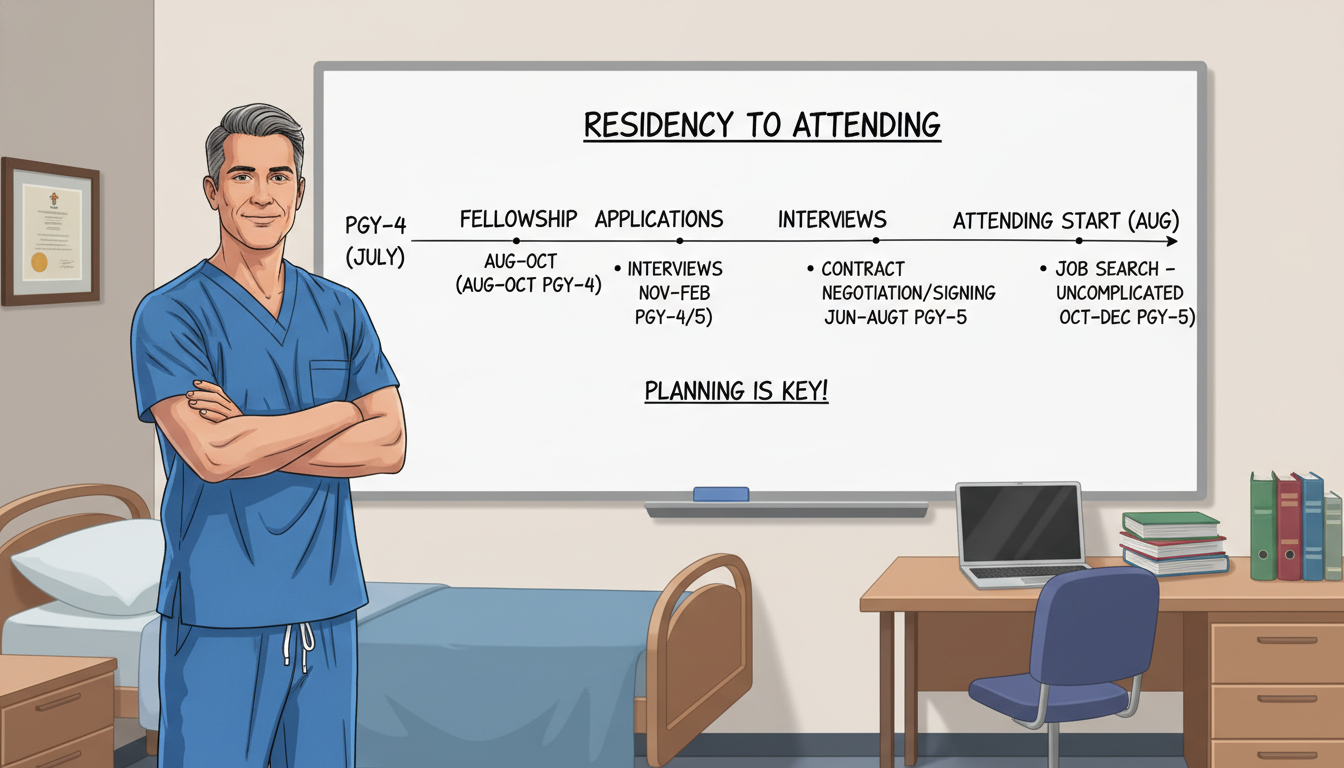
Understanding the Unique Timing Challenges in Interventional Radiology
Interventional radiology (IR) is one of the most competitive and rapidly evolving fields in medicine, and its job market follows its own rules. Compared with many other specialties, timing your job search in interventional radiology residency is more complex and often earlier, especially if you want a position in a desirable geographic area or a highly procedural practice.
Several factors make the timing of an IR job search distinct:
- Relatively small specialty: Fewer positions overall mean earlier recruiting cycles.
- Fast-evolving practice models: From traditional private practice to 100% IR, OBL/ASC-based practices, and academic hybrids, the timing and structure of offers can vary widely.
- High demand but uneven distribution: Some regions are saturated while others struggle to recruit.
- Training pathway complexity: Integrated, independent, and ESIR pathways lead to slightly different job search timelines.
Before diving into month-by-month guidance, it helps to frame your job search as a process that unfolds across three major phases of training:
- Early residency (PGY-2 to PGY-3 for integrated; PGY-3 to PGY-4 for independent candidates)
- Mid- to late-residency (PGY-4 to early PGY-5, and early fellowship time)
- Final year (last 12–18 months before graduation)
The single most important principle:
In interventional radiology, it is usually safer to begin serious job exploration 18–24 months before graduation, and to aim for a signed contract 9–12 months before finishing training.
The rest of this guide details how to do that strategically.
How Early Is “Early Enough”? A Timeline from R3 to Fellowship Completion
The key question for many residents is: when to start job search in IR so that you are neither too late (limited options) nor too early (locking into a job before you understand your preferences and skills). The ideal timing differs slightly by pathway but follows similar patterns.
General Rule of Thumb
- Exploration and networking: Start 24–30 months before graduation
- Active searching and interviewing: Start 18–24 months before graduation
- Signing a contract: Target 9–12 months before graduation
(Earlier if you are geographically restricted or aiming for highly competitive urban/academic markets)
Below is a more detailed timeline tailored to IR trainees.
24–30 Months Before Graduation: Laying the Foundation
For many integrated IR residents, this corresponds roughly to early-mid PGY-4. For independent IR residents, it may be late DR residency / early IR fellowship.
Primary goals in this phase:
Clarify your clinical identity:
- Do you want 100% IR, or are you comfortable with a mixed DR/IR job?
- Are you more clinically oriented (IR clinic, longitudinal care) or primarily procedural?
- Do you see yourself in an academic, private practice, or hybrid model?
Define priority constraints:
- Geographic restrictions (partner’s job, family, schools)
- Visa status and immigration timeline
- Need for certain case mix (PAD, interventional oncology, trauma, women’s health, venous disease, neuro, etc.)
Begin low-stakes networking:
- Attend national meetings (e.g., SIR Annual Scientific Meeting, regional SIR meetings).
- Introduce yourself to IR attendings who are well-connected; ask them about the physician job market in IR and how they found their positions.
- Join IR interest and job forums (SIR Connect, specialty Slack/WhatsApp groups, IR job boards).
Actions to take:
- Draft a first version of your CV.
- Create a running list of:
- Regions where you would consider working
- Practice types of interest (academic, hospital-employed, private group, OBL/ASC-based)
- “Non-negotiables” vs “nice-to-haves”
You are not yet actively applying, but you are building the groundwork so that when the IR match timeline ends and your plans are clear, you can move quickly.
18–24 Months Before Graduation: Transition from Exploration to Active Search
This is the key transition period. For many IR trainees, this aligns with late PGY-4 to early PGY-5 (integrated) or the first half of independent IR fellowship.
By this time you should:
- Have a clearer vision of your strengths and interests (e.g., complex oncology, PAD, trauma/ED coverage, dialysis access, venous disease, women’s health interventions).
- Understand the IR job landscape where you want to live:
- Are positions primarily mixed DR/IR?
- Is there support for IR clinic and longitudinal patient care?
- Are there established OBLs or opportunities to build one?
This is when you should begin serious, structured job exploration.
What “Active Exploration” Looks Like
Refine your CV and online presence
- Update your CV with:
- Case logs and areas of high volume
- Research, presentations, leadership, committee roles
- Certifications and visas
- Clean up your online footprint (LinkedIn, any professional profiles).
- Update your CV with:
Begin reaching out to potential employers
- Academic departments in your target region
- Large private practice groups with IR positions
- Hospital-employed IR service lines
- Independent IR practices and OBLs
Use meetings and conferences strategically
- At SIR or other major meetings, attend:
- Career fair or job boards
- “Practice development” or career-oriented sessions
- Ask mentors to introduce you to:
- Department chairs
- Practice leaders
- Recent graduates in your desired region
- At SIR or other major meetings, attend:
Talk with recent graduates
- They have the most up-to-date view of the IR job market.
- Ask them:
- When did they start their job search?
- How many interviews did they attend?
- What surprised them most about contract negotiations or call obligations?
At this stage, you may not sign anything yet, but it is not unusual—especially in smaller markets or visa-dependent situations—for interviews and early informal offers to begin.

12–18 Months Before Graduation: The Critical Window
This is the core attending job search phase for most interventional radiology residency graduates. For many, this corresponds to late PGY-5 to early PGY-6 (integrated) or mid IR fellowship year.
By 12–18 months before finishing training, you should:
- Be actively applying to positions.
- Have multiple interviews scheduled, especially if:
- You are geographically restricted.
- You need a visa.
- You want 100% IR or a very specific niche (e.g., heavy interventional oncology, robust PAD practice).
Realistically, most IR residents who want competitive urban/academic positions need to be fully engaged in their job search no later than this point.
Activities in This Period
Formal applications and screening calls
- Respond to posted jobs on:
- SIR job board
- Major physician job boards (e.g., NEJM Career Center, PracticeLink)
- Hospital system and academic websites
- Proactively email:
- Department chairs
- Section chiefs
- Practice managers
- Engage cautiously with recruiters:
- Some are very helpful, especially for community/hospital-employed roles.
- Maintain control of where your CV is sent.
- Respond to posted jobs on:
On-site and virtual interviews
- Plan for multiple visits if you are serious about a position:
- First visit: broad overview, meet the team.
- Second visit: deeper dive into call, case mix, financials, and local living.
- Prepare targeted questions:
- What percentage of time is IR vs DR?
- What is a typical day? Typical call schedule?
- Who controls referrals and what is the growth potential for IR?
- Plan for multiple visits if you are serious about a position:
Clarify expectations about practice structure
- Academic:
- Protected research time?
- Teaching responsibilities?
- Promotion criteria?
- Private practice / hospital-employed:
- Partnership track details?
- RVU expectations and thresholds?
- Support for clinic, advanced practice providers, and marketing?
- Academic:
By the end of this window, many IR residents will have at least one serious offer in hand.
9–12 Months Before Graduation: Negotiation and Commitment
This is the period when you should aim to sign your attending job contract, unless you are in a highly flexible situation or targeting less competitive rural markets.
Why this timeline matters:
- Your future group or department needs lead time to:
- Get hospital privileges approved.
- Plan call coverage and scheduling.
- Market your arrival to referring clinicians.
- You need time to:
- Secure state licensure.
- Complete credentialing and payer enrollment.
- Plan relocation, housing, and family logistics.
Key steps:
Request detailed written offers
- Don’t rely on verbal commitments.
- Ask for:
- Full compensation breakdown (base, bonus, call pay, partnership or equity potential).
- Detailed expectations (hours, call, IR vs DR mix).
- Non-compete language and geographic restrictions.
- Malpractice coverage (claims vs occurrence; tail coverage responsibilities).
Seek expert review
- Have your contract reviewed by:
- An attorney experienced in physician contracts.
- A trusted mentor who understands IR practice economics.
- Pay special attention to:
- Call responsibilities.
- Buy-in to equipment or OBL ownership.
- How new IR procedures or service lines will be supported.
- Have your contract reviewed by:
Finalize your choice
- Consider:
- Fit with colleagues and culture.
- Realistic growth potential for the IR service.
- Long-term implications for your career (academic track vs entrepreneurial path vs lifestyle focus).
- Consider:
Signing 9–12 months before graduation gives you stability while keeping a buffer for unexpected delays in licensure or credentialing.
How the Broader Physician Job Market Affects IR Job Search Timing
The overall physician job market cycles and economic environment can significantly alter the optimal timing of your attending job search. Interventional radiology is generally in high demand, but local and national conditions still matter.
Macro Trends That Influence IR Job Search Timing
Hospital budgets and procedure volumes
- Economic downturns or reimbursement cuts can:
- Slow hiring at academic centers.
- Delay expansion of IR service lines.
- High procedure volume and strong margins (e.g., PAD, oncology embolization) often drive earlier hiring in growth-oriented systems.
- Economic downturns or reimbursement cuts can:
Shifts in care settings (hospital vs OBL/ASC)
- As more IR services move to office-based labs (OBLs) or ASCs, job opportunities may:
- Increase in entrepreneurial practices.
- Require broader skill sets in practice management and marketing.
- The job search timing for OBL-based practices may be more flexible than for large hospital systems.
- As more IR services move to office-based labs (OBLs) or ASCs, job opportunities may:
Geographic maldistribution
- High-demand rural and mid-market regions:
- Often recruit earlier and are more aggressive with incentives.
- Saturated urban hubs:
- May offer fewer high-quality positions or more mixed DR/IR roles.
- Require starting your IR job search earlier to secure the best options.
- High-demand rural and mid-market regions:
Visa and immigration policy
- If you are on J-1 or H-1B status:
- Begin planning even earlier (up to 30+ months before graduation).
- Coordinate with legal counsel and potential employers regarding waiver or sponsorship requirements.
- Expect fewer positions that can accommodate complex visa needs in smaller practices.
- If you are on J-1 or H-1B status:
Practical Implications for Your Timeline
If the market is tight or uncertain:
- Start exploring early and avoid delaying your search hoping something “perfect” will appear late.
- Be flexible with geography, practice type, or IR/DR mix.
If the market is strong in your preferred area:
- You may have more leverage during negotiation.
- Still, don’t delay; well-positioned jobs attract multiple strong applicants.

Practical Strategies to Optimize Your IR Job Search Timing
Beyond knowing the calendar, you also need a strategy. These practical steps help align timing with your career goals.
1. Map Your Training Path to a Timeline
Because IR training pathways differ, explicitly map your path to specific dates. For example:
Integrated IR resident (PGY-1 to PGY-6):
- PGY-4 start: Begin exploration and networking.
- PGY-5 start: Begin active applications, attend interviews.
- Mid-PGY-5 to early PGY-6: Negotiate and sign.
Independent IR resident (after DR):
- Late DR residency (final year): Begin exploration, especially if you already know geography.
- Early IR fellowship: Active applications and interviews.
- Mid-fellowship: Negotiate and sign.
Make this timeline explicit on your calendar, with monthly checkpoints.
2. Align Your Case Mix and Skills with Your Target Job Type
Your skill set at graduation influences which jobs will be a good fit and how early you’ll get serious interest:
Want an oncology-heavy or advanced embolization focus?
- Seek high-volume experience and document your logs.
- Highlight this in your CV; these skills can be a selling point that accelerates offers.
Targeting a PAD-focused or venous disease practice?
- Track volume of peripheral interventions and complex venous work.
- Develop comfort with clinic-based longitudinal care.
More open to general IR across multiple domains?
- Emphasize your versatility—this is highly attractive in many community practices.
The more clearly you can describe your skill set and preferences early in the process, the more efficiently you can filter positions and avoid late-stage mismatches.
3. Be Honest About Geographic Constraints Early
If you require a specific city or region (e.g., spouse’s job, family support), your timeline needs to be earlier and more deliberate:
- Identify all large health systems, academic centers, and IR groups in that region.
- Reach out even if they aren’t advertising a job yet; many IR needs are not posted but are known internally.
- Ask your mentors to introduce you to any IRs they know in that region.
In constrained markets, informal networking and persistence started 18–24 months before graduation can uncover opportunities that never appear on formal job boards.
4. Build in Time for Second Looks and Due Diligence
Rushing to sign because you started too late can lead to:
- Underestimating call burden.
- Misjudging support staff quality.
- Overlooking non-compete implications.
- Missing early warning signs about referral patterns or internal politics.
Starting early lets you:
Do a second site visit focusing on daily workflow:
- Who does consults?
- How is post-procedural follow-up handled?
- How often are you pulled into non-IR duties?
Talk with junior partners or recent hires:
- Are they satisfied?
- Did the position match what they were promised?
5. Plan for the “Gap” Between Signing and Starting
Once you sign 9–12 months before graduation, use that time intentionally:
- Complete any extra training or electives that align with your new job’s needs (e.g., more PAD, more IO).
- If clinic will be a major part of your role, seek out more clinic experience during fellowship.
- Maintain regular contact with future partners or department leadership:
- Get updated on equipment purchases, new hires, or service line changes.
- Clarify your planned start date and onboarding schedule.
Common Timing Pitfalls in IR Job Searches (and How to Avoid Them)
Waiting until the last 6–9 months to start looking seriously
- Risk: Limited options, compromising on IR/DR mix or geography, rushed decisions.
- Fix: Begin structured searching at least 18 months before graduation.
Overcommitting too early without clarity
- Risk: Signing a job 2+ years before finishing training, then later realizing your interests or life circumstances changed.
- Fix: Use the early years for exploration; reserve binding commitments for the 9–12 month window unless your situation heavily favors locking in early (e.g., J-1 waiver in a limited market).
Ignoring market signals from recent grads
- Risk: Assuming “there will always be plenty of IR jobs” in your target city, when in reality the local market is saturated or skewed toward mixed DR/IR only.
- Fix: Actively seek input from fellows and new attendings who graduated in the last 3–5 years.
Underestimating visa or licensure timelines
- Risk: Delays that push back your start date or cause offers to be rescinded.
- Fix: Start earlier (24–30 months out), get legal advice, and favor employers experienced with your visa type.
Not treating the attending job search as a skill to learn
- Risk: Accepting the first “good enough” offer without negotiating or investigating deeper aspects of the role.
- Fix: Read about physician contracting; attend SIR career sessions; ask mentors to role-play negotiations with you.
FAQs: Job Search Timing in Interventional Radiology
1. When should I start my attending job search during interventional radiology residency?
Most IR trainees should start active job exploration 18–24 months before graduation, with the goal of signing a contract 9–12 months before finishing. Begin informal networking and self-assessment even earlier (around 24–30 months before graduation). If you have geographic restrictions or visa needs, start toward the earlier end of these ranges.
2. Is the IR job market strong enough that I can wait until late fellowship to look?
In many regions, there is strong demand for IR, but it is not uniform. Highly desirable urban areas and top academic programs can be very competitive, and jobs that are 100% IR with robust clinic support are often limited. To maximize your options and avoid rushing, treat the IR job market seriously and start your search no later than 18 months before graduation, even if you are confident you’ll find something.
3. How does my desire for 100% IR vs mixed DR/IR affect the timing?
If you are targeting a true 100% IR, clinic-heavy, or subspecialized practice, you should start earlier and cast a wider net. These positions:
- Are still a minority in many regions.
- Often recruit selectively and may not be widely advertised. Mixed DR/IR roles are more common in many communities and may be somewhat easier to secure, but you still benefit from starting your search 18–24 months before graduation to find groups where the mix aligns with your expectations.
4. I’m on a visa (J-1 or H-1B). How early should I start?
Visa-dependent trainees should typically begin planning and informal outreach up to 24–30 months before graduation, and start active applications at least 18–24 months out. J-1 waivers and H-1B sponsorship add complexity, and not all practices are equipped or willing to navigate this. Early conversations with potential employers and an immigration-focused attorney are crucial to avoid last-minute problems.
Timing your job search in interventional radiology residency is as much a strategic process as choosing the right training path. By understanding the broader physician job market, mapping your timeline to your specific IR training pathway, and starting early enough to explore and negotiate thoughtfully, you give yourself the best chance of landing an attending role that fits both your professional goals and your life outside the angiography suite.