
Understanding the Unique Position of MD Graduates in Preliminary Medicine
A preliminary medicine (prelim IM) year sits at a very specific—and sometimes confusing—intersection in medical training. As an MD graduate from an allopathic medical school headed into (or already in) a preliminary medicine year, you are simultaneously:
- Finishing core medical training as a physician
- Preparing to move into an advanced residency (e.g., neurology, anesthesiology, radiology, PM&R, etc.)
- Potentially considering backup plans in case your advanced position falls through
- Needing to understand the physician job market earlier than many of your categorical colleagues
Because of this, timing your job search—or more accurately, timing your career search strategy—requires clarity on your goals and the structure of your training path.
For most MD graduates in a prelim IM position, the primary trajectory is:
- MD graduate →
- Match into a preliminary medicine year (or transitional year) →
- Start an advanced residency categorical position the following year
In this default path, you do not typically search for “attending” jobs immediately after your prelim medicine year, because you’ll still be in residency training for your advanced specialty.
However, there are several important exceptions and contingencies:
- You did not match into an advanced position and are using a preliminary medicine year as a bridge.
- You are considering re-applying to categorical internal medicine while keeping your options open.
- You are an international graduate who secured a prelim spot and are reassessing long-term plans.
- Personal circumstances (family, location, finances, burnout) may push you to consider non‑traditional pathways or temporary work.
This article walks through when to start job search activities at each stage of training, how the allopathic medical school match structure impacts your timing, and what a strategic timeline looks like for an MD graduate in preliminary medicine.
Mapping the Training Timeline: Where the Job Search Fits
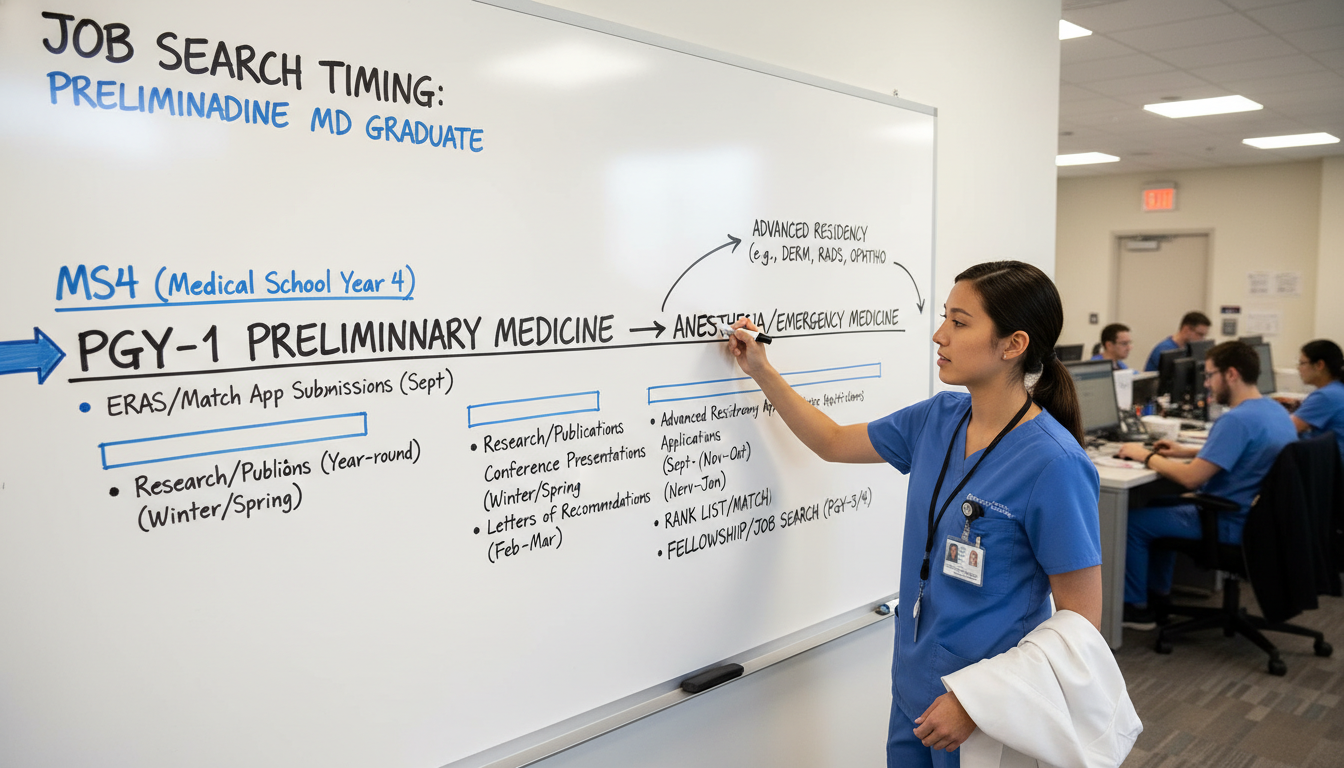
Before deciding when to search for a job, you need a realistic map of your training timeline and milestones. For an MD graduate in a preliminary medicine year, the typical structure is:
MS4 (Final Year of Medical School)
- Apply through ERAS and NRMP
- Interview for both preliminary medicine and advanced positions
- Allopathic medical school match results in:
- Prelim IM + Advanced position, or
- Prelim IM only, or
- No match (SOAP or re-application pathway)
PGY-1: Preliminary Medicine Year
- 12 months of internal medicine rotations, mostly inpatient
- Can be at a different institution than your advanced program
- Usually no continuity clinic; limited long‑term patient follow‑up
After PGY-1 Prelim
- If you have an advanced spot: move into PGY-2 in advanced residency
- If no advanced spot: options include
- Re-apply ERAS for categorical IM or another specialty
- Seek another prelim/transitional year (less common)
- Explore non‑residency roles (research, industry, etc.)
- Very rarely, pursue limited clinical roles if licensure/state rules allow
Because the attending job search usually starts 12–18 months before finishing your final residency or fellowship, prelim IM physicians are typically years away from a true “attending job market” search.
However, there are three parallel “job searches” you must manage strategically:
Residency Advancement Search
- Applying to advanced or categorical positions
- Timeline is tightly linked to ERAS and NRMP calendars
Short-Term or Contingency Employment Search
- Research, teaching, non‑clinical, or temporary clinical work
- Becomes relevant if your training path changes or is delayed
Long-Range Career and Attending Job Market Planning
- Understanding where you want to practice long term
- Positioning yourself for an efficient attending job search later on
When to Start Planning vs. When to Start Actively Searching
1. During MS4: Setting Up Your Path (0–2 Years Before Any Job Search)
During your final year of medical school, your main focus is the allopathic medical school match, not the physician job market. Still, decisions you make here shape your future job search timing.
Key actions:
Clarify your ultimate specialty goal.
Are you using a preliminary medicine year as a staging area for:- Neurology, radiology, anesthesiology, PM&R, dermatology, etc.?
Or as a plan B while re-applying to categorical internal medicine?
- Neurology, radiology, anesthesiology, PM&R, dermatology, etc.?
Understand your training length.
Example:- Prelim IM (1 year) + Neurology (3 years) = 4 total years of residency
- Prelim IM (1 year) + Anesthesiology (3 years) = 4 years
- Categorical IM (3 years) + possible fellowship (2–3 years) = 5–6 years
This determines when you’ll enter the attending job market.
Begin long-term geographic thinking.
You don’t need to start an attending job search, but you should start asking:- Where do I realistically want to live long-term?
- Are there family, partner, cost-of-living, or visa considerations?
- What states am I most likely to seek licensure in later?
These reflections shape your future strategy but do not yet require applications.
2. Early Prelim IM (July–November): Clarify Your Training Trajectory
During the first half of your preliminary medicine year, your schedule is heavy, but this is a critical time to:
- Verify your advanced residency start date (if already matched)
- If you do not have an advanced position, determine:
- Will you re‑enter the match this cycle?
- Will you aim for categorical internal medicine?
- Are you open to non‑traditional or non‑clinical paths?
Active job search?
- For most prelim IM MD graduates: No attending job search yet.
- Your “job search” is essentially:
- Applying for advanced or categorical residency programs through ERAS
- Networking with faculty about letters, mentorship, and backup plans
Practical steps:
Update your CV with:
- Medical school accomplishments
- Early residency rotations
- Any quality improvement or research projects you’re starting
Meet with your program director (PD) by September–October:
- Clarify your performance status and strengths
- Discuss your specialty goals and whether they see you as a strong candidate
- Ask direct questions:
- “If I reapply for categorical IM, do you think I am competitive?”
- “Can you provide a letter or help advocate on my behalf?”
For those without secured advanced positions:
- Start ERAS preparations no later than September
- Request letters of recommendation early from key attendings
- Treat this as a residency search, not an attending job search
3. Mid to Late Prelim IM (December–June): Parallel Tracks and Contingency Planning
By mid‑year, your path usually falls into one of three categories:
- You already matched to an advanced position (e.g., PGY-2 radiology)
- You are actively reapplying to the match (categorical IM or new specialty)
- You are uncertain or did not secure a spot and are exploring other options
Each scenario has its own timing for job search activities.
Scenario A: You Have a Secured Advanced Position
If your allopathic medical school match (or subsequent SOAP or off-cycle match) gave you both a prelim IM and an advanced position, your job search over the next few years is strictly training-focused, not employment-focused.
Attending job search timing:
Typically begins 12–18 months before completing your final residency/fellowship.
Example:- Prelim IM 2025–2026
- Advanced neurology 2026–2029
- Start attending job search around mid‑2027 to early 2028
What you should do during prelim year:
- Learn medicine well—these skills translate strongly to almost every specialty
- Start informal networking and mentorship:
- Ask advanced program leadership about common job paths for graduates
- Attend grand rounds, journal clubs, and specialty conferences if feasible
- Keep your CV updated and save documentation of your responsibilities, research, and QI projects—this will later support your attending job applications
In this scenario, no active attending job applications should be underway during the prelim IM year.
Scenario B: You Are Reapplying for Residency
If you’re using your prelim IM year to re-enter the allopathic medical school match (for a categorical IM position or a different specialty), your main “job search” is another residency search, not a true attending search.
Timing considerations:
- ERAS opens for applicants typically in June–September
- Applications are submitted in September
- Interviews run roughly October–January
- Rank lists due and Match Day in late winter/early spring
What to do during prelim IM:
July–September: Application preparation
- Update personal statement based on your prelim experiences
- Clarify your narrative: why internal medicine (if switching to categorical IM) or why the new specialty
- Gather letters from prelim year attendings, your PD, and possibly medical school mentors
October–January: Interviews
- Managing interviews while on busy inpatient rotations requires early communication with your chief residents and scheduling office
- Plan elective blocks or lighter rotations during peak interview season, if possible
Post-Match Contingency Planning:
- If you match categorical IM or another specialty: job search is “solved” for now; you move on to training.
- If you do not match:
- Participate in SOAP if eligible
- Explore off-cycle positions
- Consider non‑residency positions or a research year while re-strategizing
Does this involve the attending job market?
Usually, no. You are still a trainee-focused applicant.
However, this is when you should start learning about the broader physician job market—salaries, geographic trends, shortage areas—because it will inform both your specialty and location choices.
Scenario C: You Did Not Secure a Continued Residency Path
This is the scenario where questions like “when to start job search?” become more complex.
If, despite efforts, you did not secure an advanced or categorical position and are nearing the end of your prelim IM year:
- You may need to explore:
- Research positions
- Non‑clinical or quasi‑clinical roles (clinical research coordinator, medical writing, industry roles, consulting)
- Limited clinical work (rare and state-dependent) such as:
- Hospitalist or general practitioner roles in rural or underserved areas (usually for IMGs with specific visas or state allowances)
- Some states permit practice with only one year of residency under a restricted license—but these are uncommon and often not recommended as a long-term plan
When to start job search in this scenario:
Start by January–February of your prelim IM year if:
- You have low confidence about matching again
- You want to avoid a post-residency employment gap
Types of searches to launch:
- Research roles:
- Email PIs at your current or nearby institutions by January
- Highlight your clinical experience and interest in bridging to future training
- Non‑clinical roles:
- Look at medical communications, health-tech startups, quality improvement teams
- Update your LinkedIn and CV for non‑clinical audiences by February
- State-dependent clinical options:
- Research state licensure boards’ rules by December–January
- Speak to your PD and GME office before committing to any path—this may have long-term implications for board certification and career trajectory
- Research roles:
In this uncommon but important situation, your job search timing is driven by:
- Your expected end date (June 30)
- Visa status (if applicable)
- Financial buffer and personal commitments

Looking Ahead: Timing the Attending Job Search After Advanced Training
Assuming you proceed along the more common pathway—prelim IM followed by an advanced residency—your true attending job search begins in the final phase of residency or fellowship.
Here’s how to time it effectively.
1. Understand the Standard Attending Job Search Window
For most U.S. specialties, including those entered after a preliminary medicine year, the ideal window to start your attending job search is:
- 12–18 months before graduation for competitive, urban, or academic positions
- 6–12 months before graduation for many community or rural positions
Because you are an MD graduate entering the physician job market in a specific specialty (e.g., neurology, anesthesia, radiology), your timing may adjust slightly:
- Highly competitive subspecialties (e.g., some procedural fields, certain academic niches):
- Lean toward 18 months out
- Generalist or high-demand specialties:
- 9–12 months is often adequate
2. What “Start of Job Search” Actually Means
When people ask “when to start job search?” they often imagine sending out applications. In practice, the attending job search progresses in phases:
Phase 1: Exploration and Preparation (18–24 Months Before Graduation)
- Clarify:
- Desired practice setting (academic vs. community, private vs. hospital-employed)
- Geographic preferences and deal-breakers
- Long-term career goals (clinical focus, leadership, teaching, research)
- Update:
- CV to reflect current training, research, presentations
- Generic but strong cover letter templates
- Start:
- Talking to recent graduates from your program about their job search timelines
- Reviewing salary and contract norms (using MGMA data, specialty societies, etc.)
Phase 2: Active Search (12–18 Months Before Graduation)
- Send inquiries and applications to:
- Hospital systems
- Large medical groups
- Academic centers
- Physician recruiters (selectively)
- Attend:
- Specialty conferences where employers often recruit
- Begin:
- Initial phone/video screening interviews
Phase 3: On-site Interviews and Contract Negotiation (6–12 Months Before Graduation)
- Travel for second-round interviews
- Evaluate:
- Compensation, benefits, call structure, RVU expectations
- Mentorship, support, and culture fit
- Negotiate:
- Salary, sign-on bonus, relocation support, loan repayment
- Start date and any ramp-up protections
For you as a prelim IM MD graduate, the important connection is:
Your attending job search timing is anchored to the end of your final residency/fellowship—not the end of your preliminary medicine year.
How the Physician Job Market Shapes Your Strategy
The physician job market is dynamic and varies by:
- Specialty
- Region (rural vs. urban, coasts vs. Midwest/South)
- Practice type (academic, private, hospital-employed)
Even as a prelim IM trainee, understanding broad market trends will help you later:
- Internal medicine hospitalists are in high demand, especially in community and rural hospitals.
- Certain outpatient-focused IM roles may be more saturated in desirable metro areas.
- Many advanced specialties (e.g., anesthesiology, radiology) are experiencing robust demand in community and private practices, with increasing options for remote or hybrid work in some fields.
Why this matters now (during prelim):
- If you are considering pivoting to categorical internal medicine, knowing that hospitalist jobs are abundant can help you envision a secure attending future—after completing full IM training.
- If you are still undecided about your ultimate specialty path, learning where the market is strong (and weak) can inform your re‑application strategy.
Actionable steps during prelim:
- Talk to hospitalists, subspecialists, and advanced trainees about:
- Their experience with the job market
- When they began their attending job search
- Which resources they found most useful (recruiters, specialty job boards, conference networking)
- Join your intended specialty’s national organization as a resident or student member—this often grants access to:
- Job boards
- Salary surveys
- Career webinars focused on the attending job market
Practical Timeline Summary for MD Graduates in Preliminary Medicine
To bring it all together, here is a high-level timeline keyed to a typical prelim IM year for an MD graduate, assuming graduation is June and prelim runs July–June.
MS4 (Before Prelim IM)
- Focus: Match strategy (prelim + advanced vs. categorical)
- Job search: None in attending sense
- Actions:
- Clarify specialty path
- Begin long-term geographic and lifestyle planning
Prelim IM: July–November
- Focus: Clinical performance, confirming long-range training path
- If already matched to advanced program:
- No job search yet; stay focused on learning and basic networking
- If reapplying:
- Prepare ERAS, request letters, submit applications in fall
- If uncertain or unmatched:
- Start contingency thinking by early autumn
Prelim IM: December–June
- With advanced position secured:
- Continue clinical development
- Begin light specialty networking; attend conferences if feasible
- Reapplying to match:
- Interview and SOAP as needed
- Make a backup plan in case of non-match
- No future residency secured:
- By January–February: Start non-residency or research job search if needed
- Explore any state-dependent clinical options with extreme caution and mentorship
Advanced Residency/Fellowship (Post-Prelim)
- 24–18 Months Before Graduation:
- Begin career visioning
- Research the physician job market in your specialty and target regions
- 18–12 Months Before Graduation:
- Start the attending job search:
- Update CV/cover letters
- Send initial applications
- Network at conferences
- Start the attending job search:
- 12–6 Months Before Graduation:
- Conduct on-site interviews
- Negotiate and sign contracts
- Final 6 Months:
- Finalize licensure and credentialing
- Prepare for transition to attending life
Frequently Asked Questions (FAQ)
1. As an MD graduate in a preliminary medicine year, should I be applying for attending jobs during PGY-1?
Almost never. A preliminary medicine year alone does not qualify you for board certification in internal medicine or most subspecialties. The overwhelming majority of physicians pursue additional residency training (categorical or advanced residency, often followed by fellowship) before entering the attending job market. Your PGY-1 “job search” should be focused on securing or transitioning into the right residency path.
2. I matched into a prelim IM year but not an advanced spot. When should I start my next application cycle?
Begin preparing your ERAS application by early summer before starting your prelim year (if you already know you’ll need to reapply) or by July–August at the latest. Request letters from early rotations in your prelim program and aim to submit ERAS as early as possible in September. Your focus is on residency applications, not attending jobs, during this period.
3. Can I work as a hospitalist or attending after only a preliminary medicine year?
In most cases, no. Standard U.S. practice expects completion of a full categorical internal medicine residency (3 years) before working as a hospitalist or outpatient internist, and board certification is the norm. A few states have historical or restricted pathways allowing limited practice after one year of postgraduate training, but these are uncommon, tightly regulated, and generally not recommended as a long-term plan. Always discuss with your PD, state licensing board, and mentors before considering such a path.
4. When is the best time to start my attending job search once I’m in my final specialty training?
For most specialties, including those that use a preliminary medicine year, begin actively searching 12–18 months before your anticipated completion date. That means:
- Start researching markets and updating your CV 18–24 months out
- Begin sending applications and talking to employers around 12–18 months out
- Plan on site visits and contract negotiations 6–12 months before graduation
This window gives you enough time to explore options thoroughly, negotiate effectively, and align start dates with licensure and credentialing.
By understanding how your preliminary medicine year fits into the broader training and physician job market landscape, you can time your efforts strategically—focusing on residency advancement now, while laying the groundwork for a successful and well-timed attending job search later.