
Understanding the Job Search Landscape for Med-Peds Graduates
Medicine-Pediatrics (Med-Peds) graduates occupy a unique place in the physician job market. You can work as an internist, a pediatrician, or a combined Med-Peds physician; you can lean toward inpatient, outpatient, or a mix; and you’re attractive to employers who need flexibility. That versatility is a major strength—but it also complicates the timing and strategy of your job search.
As an MD graduate residency–bound or nearing completion of training at an allopathic medical school match program, you’re likely asking:
- When should I start my job search?
- How does timing differ for hospitalist vs. outpatient positions?
- How do I balance the medicine pediatrics match timeline, board exams, and contract deadlines?
- How does the current physician job market affect me as a Med-Peds graduate?
This guide walks through a practical timeline from early residency through the first attending job search, tailored specifically to Med-Peds physicians.
Big Picture: When to Start Your Job Search as a Med-Peds Resident
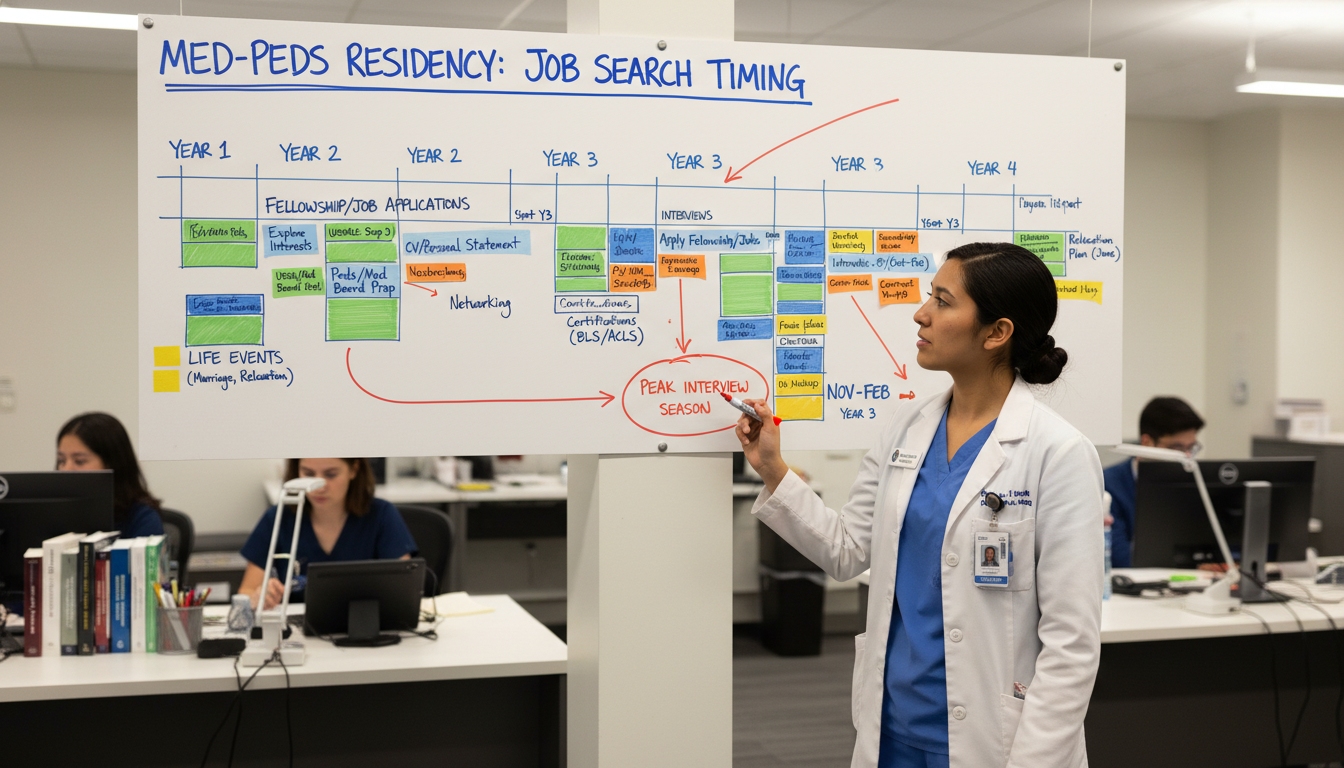
The most important concept: your job search starts much earlier than applying. For Med-Peds residents, a realistic framework is:
- PGY-1–2: Exploration and positioning
- PGY-3: Clarifying direction and beginning to network
- Early PGY-4: Active search, site visits, and interviews
- Mid–Late PGY-4: Contract negotiation and finalizing plans
Many MD graduate residency programs in Med-Peds see residents signing contracts 6–12 months before graduation. In competitive regions or highly specific roles, that can stretch to 12–18 months. For more flexible hospitalist roles or underserved areas, you may find jobs closer to graduation.
Key Timing Principles
Define your career direction by early PGY-3.
Your timeline depends on what you’re seeking:- Combined Med-Peds outpatient primary care
- Adult or pediatric hospitalist roles
- Academic Med-Peds positions
- Fellowship (e.g., cardiology, PICU, ID, etc.)
- Hybrid roles (urgent care, med-peds hospitalist/outpatient mix, etc.)
Start active job searching 9–12 months before graduation.
This is the sweet spot for most Med-Peds residents:- Employers have defined positions for the upcoming year.
- You’ll have enough experience and references.
- Licensing, credentialing, and privileging can take 3–9 months.
In tight geographic markets, start earlier.
If you must be in a specific city or region (due to family, partner job, or personal preference), begin informal networking as early as late PGY-2/early PGY-3.Allow extra time for academic positions.
University-affiliated or research-heavy roles often have longer hiring and HR processes. Starting 12–18 months in advance is reasonable.
Year-by-Year Timeline: From Med-Peds Residency to First Job
PGY-1: Orientation, Exploration, and Foundation
You’re not formally in the attending job search yet, but what you do now will matter later.
Priorities in PGY-1:
Explore practice types
- Pay attention to what energizes you: adult wards vs. NICU/PICU vs. clinic.
- Note whether you enjoy continuity clinic, complex chronic disease management, or acute inpatient care.
Build professional relationships
- Introduce yourself to Med-Peds faculty and program leadership.
- Show up prepared and engaged—these are your future references and advocates.
- Ask attendings informally how they approached their own medicine pediatrics match-to-job transition.
Lay groundwork for your CV
- Participate in QI projects, small research opportunities, or teaching activities.
- Keep a running list of accomplishments, presentations, and committee roles.
Start understanding the physician job market
- Talk to PGY-3/4s and recent graduates:
“When did you start your attending job search?”
“What surprised you about the Med-Peds job market?” - Begin to learn which local systems hire Med-Peds and how they use them.
- Talk to PGY-3/4s and recent graduates:
There’s no pressure yet to find or apply for jobs. Focus on clarity and competence.
PGY-2: Clarifying Direction and Early Networking
PGY-2 is the bridge year: you’re far enough along to understand your strengths and interests but still early enough to adjust your path.
Key tasks in PGY-2:
Clarify your preferred clinical focus
Ask yourself:- Do I see myself doing more inpatient or outpatient work?
- Do I plan to maintain full-scope Med-Peds, or lean toward internal medicine or pediatrics only?
- Am I interested in academic medicine, community practice, or hospital-employed positions?
- Am I considering a fellowship?
This matters because job search timing differs:
- Fellowship-bound residents: Your focus is on ERAS and the fellowship match first; your attending job search comes later.
- Direct-to-practice residents: Your job search will effectively begin in late PGY-2/early PGY-3 with exploration and networking.
Start informational conversations (not interviews yet)
- Schedule brief chats with:
- Med-Peds faculty in outpatient and inpatient roles
- Recent alumni in your target cities
- Hospitalist and primary care leaders at your institution
Ask:
- “If you were me—Med-Peds PGY-2—when would you start your job search?”
- “In your system, when do Med-Peds residents typically sign contracts?”
- “Are Med-Peds physicians used as generalists, hospitalists, or primarily in clinic?”
- Schedule brief chats with:
Attend career talks and workshops
Many programs or national organizations (like the National Med-Peds Residents’ Association) offer:- Sessions on contracts and compensation
- Panels with recent graduates
- Discussions on job search timing for MD graduate residency programs
Identify any geographic or lifestyle constraints
- If you must be near a partner’s training program or family, timing will be tighter and more strategic.
- Start mapping potential health systems in those regions that employ Med-Peds physicians.
At this stage, you’re gathering data and building the network that will be vital when you actively start your attending job search.
PGY-3: Defining Your Path and Initiating the Search
PGY-3 is the decision year for most Med-Peds residents planning to enter practice after residency.
1. Decide on your main pathway by mid-PGY-3
By around mid-PGY-3, you should have a working answer to:
- Fellowship vs. direct practice
- Location flexibility (open nationwide vs. specific region/city)
- Practice style:
- Combined Med-Peds primary care
- Adult or pediatric hospitalist
- Hybrid roles (e.g., 50% adult hospitalist / 50% Med-Peds primary care)
- Academic vs. purely clinical
This clarity will directly shape when to start your job search and which employers to target.
2. Begin light, targeted outreach (6–15 months before graduation)
For a typical 4-year Med-Peds residency:
- Graduation: June of PGY-4
- Start light outreach: as early as summer–fall of PGY-3 (9–18 months before graduation)
Light outreach includes:
- Emailing Med-Peds alumni in your areas of interest
- Letting trusted attendings know your rough plan:
“I’m a PGY-3 Med-Peds resident, likely looking for a combined adult+peds outpatient position in the Midwest starting next July.” - Attending regional or national meetings with a Med-Peds track and visiting employer booths.
You’re not necessarily signing contracts yet. Instead, you’re:
- Learning which systems hire Med-Peds
- Understanding how they structure positions and call
- Finding out when they typically start recruitment
3. Draft your CV and basic cover letter
By late PGY-3:
- Prepare an updated CV, including:
- Education and training (MD, allopathic medical school match program, Med-Peds residency)
- Licensing exams (USMLE/COMLEX details, if helpful)
- Clinical experience
- Scholarly work, teaching, leadership
- Draft a generic cover letter that can be tailored to:
- Community vs. academic jobs
- Inpatient vs. outpatient
This allows you to move quickly when you see a position that fits.
4. Fellowship applicants: Adjust your timeline
If you’re applying to fellowship:
- Job search timing shifts later—your immediate “job” is your fellowship.
- Still, it’s wise to:
- Understand the physician job market for your eventual specialty
- Meet mentors in your subspecialty who can advise on future timing
- Know that many subspecialists start searching for attending jobs during their final fellowship year, again 9–12 months before completion.
PGY-4: Active Job Search, Interviews, and Contracting
PGY-4 is when your attending job search enters its active phase.
1. When to start actively applying: 9–12 months before graduation
For most Med-Peds residents:
- Start active applications: July–October of PGY-4
- This is particularly true if:
- You are geographically limited
- You want a specific type of hybrid Med-Peds position
- You’re aiming for academic Med-Peds roles
You may find postings and opportunities earlier—especially in high-need or rural markets—but the major wave of recruitment usually happens during this window.
2. Account for licensing and credentialing delays
Your job start date depends on:
- State medical license (can take 2–6 months, sometimes more)
- Hospital privileging and payer enrollment (3–6+ months)
- Background checks, HR paperwork, and credentialing
Because these processes are slow, many employers prefer signing Med-Peds residents 6–9 months before start date to ensure everything is in place.
That’s a key reason when to start job search is earlier than you might assume.
3. Interview scheduling and site visits
Interviews typically occur 3–9 months before graduation:
- Virtual screens may come first (especially for larger systems).
- On-site interviews and site visits are critical for:
- Understanding culture
- Seeing how Med-Peds physicians are used in the system
- Assessing workload, support staff, and call structure
Plan these around:
- Busy inpatient rotations
- Board exam study windows
- Personal life events (weddings, moves, etc.)
Most programs are very familiar with this stage of an MD graduate residency, especially for Med-Peds residents, and will help with scheduling.
4. Evaluating offers and negotiating contracts
Once you receive offers, consider:
- Clinical mix:
- Adult vs. pediatric patients
- Inpatient vs. outpatient vs. urgent care
- Continuity clinic opportunities
- Compensation and benefits:
- Base salary, productivity bonuses (wRVUs)
- Loan repayment, sign-on bonuses
- CME funds, relocation support
- Non-clinical expectations:
- Teaching, QI, committee work, research
- Support:
- Call backup, subspecialty availability, mentoring
Timing point:
Contract deadlines may be 30–60 days after offer. Keep in mind:
- It’s reasonable to ask for more time if you’re waiting for another interview.
- Many residents will have competing offers; plan your interview schedule strategically.

Med-Peds–Specific Considerations in Job Search Timing
1. Flexibility vs. Niche: How It Affects Timing
As a Med-Peds physician you bring dual-board eligibility and adaptability. This shapes your timing:
If you’re flexible (e.g., willing to work as adult hospitalist, pediatric hospitalist, or primary care in multiple states):
- You may have more job options overall.
- You can often secure good roles even if you start later (6–9 months before graduation).
If you want a narrow niche (e.g., integrated Med-Peds primary care with robust complex care support in a specific city):
- Positions may be limited.
- Start exploratory networking earlier (late PGY-2 or early PGY-3).
- Let local Med-Peds groups know you’re interested so they can plan ahead if someone is considering retirement or expansion.
2. Academic Med-Peds vs. Community Practice
Academic employers often have:
- Longer approvals for position creation
- Multi-layered HR and faculty appointment processes
- Earlier recruitment cycles (sometimes 12–18 months in advance)
If you want an academic Med-Peds primary care or teaching hospitalist role:
- Start networking with division chiefs and program directors by early PGY-3.
- Ask directly, “For Med-Peds faculty positions, when do you typically start hiring for July starts?”
Community and private practices may:
- Post positions later
- Move more quickly from interview to offer
- Be flexible on start dates
3. Telehealth, Hospitalist, and Hybrid Roles
The evolving physician job market has expanded:
- Telemedicine opportunities (especially adult primary care, chronic disease management)
- Hybrid inpatient/outpatient Med-Peds roles
- Positions that flex between departments based on volume
These can benefit Med-Peds physicians, but timing is variable:
- Some hospitalist roles recruit year-round with quick hiring.
- Others follow an annual staffing review cycle.
Ask recruiters: “What’s your typical timeline from application to start date for hospitalists/primary care in your system?”
Strategic Tips for a Strong, Well-Timed Job Search
1. Reverse-Engineer from Your Graduation Date
Start by marking:
- Graduation date
- Desired start date (often July–September)
- Board exam study windows
- Big personal events (wedding, move, family changes)
Then count backwards:
- 12 months before start: Begin active search and applications.
- 9 months before start: Core interview period for many positions.
- 6 months before start: Aim to have a signed contract; begin licensing and credentialing.
- 3 months before start: Finalize move logistics, onboarding, and schedules.
2. Use Your Program as a Resource
Your Med-Peds program director and faculty have seen multiple cohorts navigate the medicine pediatrics match and job transition:
- Ask, “When did last year’s residents sign contracts?”
- Request contact info for alumni in your target region or role.
- Ask for feedback on your CV and job search timeline.
3. Consider Backup Plans and Flexibility
Even with good timing, the physician job market can shift locally:
- Have Plan A, B, and C:
- A: Ideal job ( location, role, scope )
- B: Slightly less ideal but acceptable (different practice type or city)
- C: Short-term hospitalist or locums work while you wait for the right permanent job
The Med-Peds background typically makes you attractive for hospitalist coverage and bridge positions.
4. Don’t Ignore Financial and Lifestyle Timing
Many MD graduates underestimate how long it takes for first attending paycheck to arrive:
- From graduation to first paycheck can be 2–4 months or more.
- Plan for:
- Moving costs
- Potential gap between residency pay and attending income
- Loan repayment grace/forbearance strategy during transition
A well-timed job search reduces this gap and avoids scrambling for stopgap income solutions.
FAQs on Job Search Timing for Med-Peds MD Graduates
1. When should I start my job search as a Med-Peds resident?
Most Med-Peds residents should begin active job searching 9–12 months before their planned start date (usually graduation). That means:
- Light exploration and networking: late PGY-2 to early PGY-3
- Active applications and interviews: PGY-4 (or final training year), starting about July–October
- Contract signing: ideally 6–9 months before start, to allow for licensing and credentialing
If you’re geographically restricted or targeting a very specific Med-Peds niche, start informal outreach even earlier.
2. Does the timing differ for hospitalist vs. outpatient Med-Peds jobs?
Yes, somewhat:
Hospitalist positions (adult or pediatric) may:
- Hire throughout the year
- Have faster turnaround from interview to offer
- Be more flexible with start dates and sometimes accept shorter lead time
Outpatient Med-Peds primary care or hybrid roles:
- Often recruit on an annual cycle
- May require more time to align panel growth and clinic space
- Benefit from you starting the search earlier (9–12+ months)
In both cases, the safest approach is to start your attending job search early in your final residency year.
3. How does fellowship affect job search timing for Med-Peds graduates?
If you pursue fellowship, your first attending job search generally shifts to your final fellowship year, not residency:
- Start your search 9–12 months before fellowship completion.
- Use early fellowship years to:
- Clarify whether you’ll practice primarily adult, pediatric, or dual populations.
- Understand job market trends in your chosen subspecialty.
- Build relationships with potential employers and mentors.
Your Med-Peds background is often a plus, especially for fields involving transitions of care or chronic disease management from childhood to adulthood.
4. What if I miss the “ideal” window and start my search late?
If you start later than planned (e.g., 4–6 months before graduation):
- Focus initially on:
- Hospitalist roles (which may have more flexible timing)
- Underserved or high-need areas that recruit aggressively
- Be open to:
- Short-term contracts or locums to bridge a gap
- Adjusting your start date to align with licensing and credentialing
Many Med-Peds graduates still secure good positions even with a compressed timeline. Your dual training and broad skillset are attractive in much of the physician job market; you may just have fewer geographic or niche options immediately available.
By understanding the timelines that govern the MD graduate residency transition into practice—particularly in Medicine-Pediatrics—you can plan a deliberate, low-stress, and strategic job search. Begin with exploration in your early residency years, move into active searching 9–12 months before graduation, and adapt your strategy to your practice goals and geographic needs.