
Understanding the Job Search Timeline in Addiction Medicine
For a US citizen IMG in addiction medicine, the single most important job search decision is when to start. The physician job market is different from other industries: hiring cycles are slow, contracts are complex, and roles in addiction treatment are evolving rapidly. As an American studying abroad, you’re already navigating licensing, visas (if applicable during training), and perception issues; you do not want to add last-minute job panic on top of that.
Most addiction medicine attending job searches should start 9–12 months before your intended start date. For many physicians, that means:
- If finishing residency then an addiction medicine fellowship → start job search early in fellowship year
- If transitioning directly from residency to practice with a high addiction medicine focus → start in the final year of residency
- If already practicing and considering a change → plan 6–12 months ahead for a smooth transition
The right timing gives you better choice of geography, practice type, mentorship, and compensation—especially crucial for a US citizen IMG building a sustainable career in a competitive and evolving physician job market.
In this guide, we’ll walk through:
- A month-by-month timeline from late residency through fellowship and into your first attending job
- How the US citizen IMG label impacts timing and strategy
- Specific considerations for those with and without an addiction medicine fellowship
- How to align job search timing with board exams, licensing, and relocation
- Practical tips to stay organized and avoid common timing mistakes
Big Picture: How Addiction Medicine Hiring Works
Addiction medicine is a growing field, but it doesn’t yet have the same highly formalized hiring patterns as, say, cardiology or orthopedics. However, there are still predictable cycles that should guide your timeline.
1. Typical Hiring Cycles in Addiction Medicine
Addiction medicine positions are offered across a wide range of settings:
- Academic medical centers and teaching hospitals
- Large health systems and integrated delivery networks
- Community-based addiction treatment centers
- Federally Qualified Health Centers (FQHCs)
- VA and state hospitals
- Residential and outpatient rehab programs
- Telehealth or hybrid models focused on substance use disorders
Patterns you’ll see:
Academic and hospital-based jobs
- Often recruit on a fixed annual cycle
- Like to have positions filled 6–12 months before start date
- Align hiring with budget years and academic calendars (July/August starts)
Community, FQHC, and rehab programs
- More variable, may hire 3–9 months ahead
- Sometimes need urgent coverage (e.g., unexpected turnover)
- Still prefer candidates who can start with full licensure and DEA in place
Telehealth and outpatient SUD programs
- Some hire continuously
- Start dates may be more flexible
- Credentialing can still take 2–4 months even when “quick”
Given these patterns, waiting until March or April of your graduation year to start an attending job search is risky—especially if you care about location or specific practice characteristics.
2. Why US Citizen IMGs Need to Be Extra Strategic
Being a US citizen IMG (an American studying abroad) does bring some advantages in the addiction medicine job market:
- You do not require visa sponsorship as an attending
- Employers don’t have to navigate H‑1B caps or J‑1 waivers
- You can be more geographically flexible without immigration constraints
However, there are real-world considerations:
- Some employers still show subtle preference for US graduates
- Credentialing and privileging committees may take longer to verify foreign medical education
- A few state medical boards process foreign-trained graduates more slowly, creating licensing delays
All of this makes early and proactive planning essential. You want your US citizenship to be a clear advantage, not overshadowed by paperwork or timing issues.
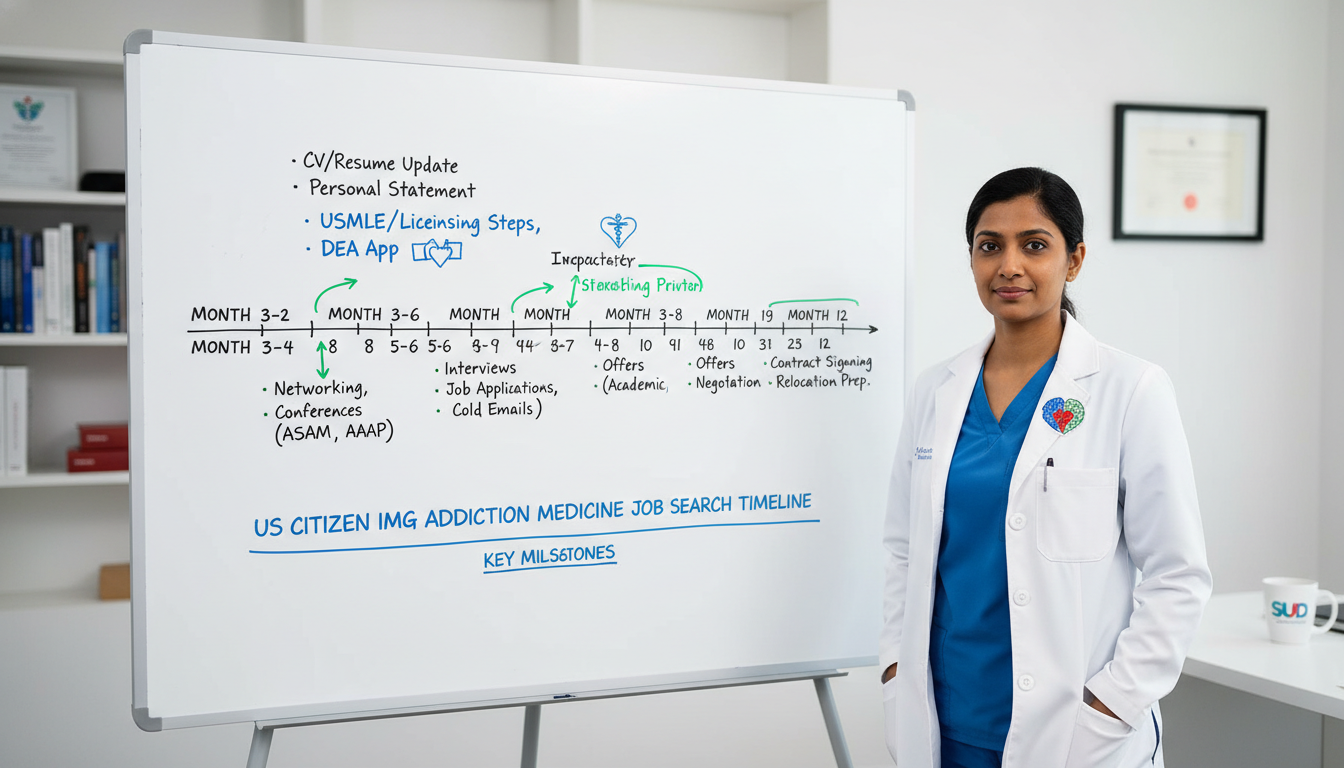
Month-by-Month Timeline: From Late Residency to First Addiction Medicine Job
This section assumes the most common path for a US citizen IMG: core residency (often internal medicine, family medicine, psychiatry, or pediatrics) followed by an addiction medicine fellowship, then an attending job. If you are skipping fellowship, there is a dedicated section later.
A. PGY-3 (or Final Residency Year) – 18–24 Months Before First Attending Job
Even during residency, timing decisions affect your future job market options.
Key tasks:
Clarify Your Career Path
- Decide: Will you pursue an addiction medicine fellowship or go directly into practice with a strong SUD focus?
- Consider your long-term goals:
- Academic vs community practice
- Leadership or program development ambitions
- Interest in research or public policy
Apply to Addiction Medicine Fellowship (if not already)
- Most fellowships want your applications about 1 year before fellowship start.
- As a US citizen IMG, make your addiction medicine interest obvious:
- Addiction electives or rotations
- Quality improvement projects or research related to substance use
- Conference posters or presentations (ASAM, AAAP, etc.)
Start Building a Niche Profile
- Join ASAM or other addiction societies
- Attend at least one addiction medicine conference before fellowship
- Seek mentorship from any addiction-trained faculty at your residency or medical school
At this stage, you’re not applying to attending jobs yet. You’re laying the foundation that will later make you a more competitive candidate in the physician job market.
B. Addiction Medicine Fellowship – The Prime Job Search Window
Most addiction medicine fellowships are one year long. This creates a tight timeline: you need to apply for attending jobs during the same year you’re learning advanced clinical skills.
We’ll assume a July–June fellowship year. Adjust the months if your program starts off-cycle.
1. July–September (12–9 Months Before Target Start Date)
Primary focus: self-assessment, groundwork, and early networking.
Tasks:
Define what you want from your first job
- Type of practice: academic, hybrid, community, telehealth, correctional health, etc.
- Patient mix: OUD, AUD, polysubstance, co-occurring psychiatric conditions, pregnant patients with SUD, adolescents, etc.
- Procedural scope: inpatient consults, outpatient MAT clinics, integrated primary care, bridge programs, etc.
Research the geography question
- Where do you want to live for the next 3–5 years?
- Consider:
- State licensing requirements for IMGs
- Proximity to family/support system
- Presence of strong addiction treatment networks
Update your CV and online professional presence
- Highlight:
- Addiction rotations, QI projects, naloxone initiatives
- Any advocacy or community outreach related to substance use
- Presentations, posters, or publications in addiction medicine
- Highlight:
Start light networking
- Let mentors know you’ll be job searching this year
- Join addiction medicine listservs or conversation groups
- Attend institutional or regional addiction-related meetings
You don’t need to send out applications yet, but you should know your preferences and have materials ready.
2. October–December (9–6 Months Before Start Date)
This is often the ideal window to begin active job applications in addiction medicine.
Why this timing works:
- Many large systems finalize next year’s staffing needs in the fall
- Academic centers often begin serious recruiting now
- You are far enough into fellowship to describe your skill set confidently, but still early enough to compare offers and negotiate
Actions:
Begin Applying to Jobs
- Target 5–10 positions initially, across:
- Academic addiction medicine divisions
- Health systems with robust MAT programs
- FQHCs with integrated addiction services
- Established rehab organizations with medical leadership roles
- Target 5–10 positions initially, across:
Leverage Your US Citizen IMG Identity Positively
- In cover letters, briefly frame your background:
- Trained abroad → diverse perspectives and adaptability
- US citizen → no visa hassle, long-term stability
- Emphasize any cross-cultural or multilingual skills, which are highly relevant to addiction care.
- In cover letters, briefly frame your background:
Engage Heavily with Mentors
- Ask: “Where do you see unmet addiction medicine workforce needs?”
- Request warm introductions to program directors, clinic leaders, or department chairs in your target regions.
Prepare for Interviews
- Develop a clear narrative:
- Why addiction medicine?
- What do you bring as a US citizen IMG?
- What type of program do you want to help build or improve?
- Be ready with examples:
- Starting or improving buprenorphine programs
- Implementing screening, brief intervention, and referral to treatment (SBIRT)
- Leading a QI project to reduce discharge against medical advice among patients with SUD
- Develop a clear narrative:
3. January–March (6–3 Months Before Start Date)
By now, you should be actively interviewing and moving toward serious offers.
Goals for this phase:
- Complete most first-round and many second-round interviews
- Narrow your top choices
- Start preliminary contract discussions
Key considerations:
Licensing & Credentialing Timing
- Ensure you have:
- Your state medical license underway or completed
- A DEA number (or a clear plan to obtain one)
- Any X-waiver-related training (note that regulations are evolving, but employers still care about your comfort with MOUD prescribing and training)
- For US citizen IMGs, anticipate that some state boards may:
- Request additional documentation of your foreign medical school
- Take longer to process verification
- This is why many addiction medicine fellows begin state license applications 6–9 months before their planned start date.
- Ensure you have:
Evaluating Offers When you receive offers, look beyond salary:
- Job structure
- Inpatient vs outpatient time
- Protected teaching or administrative time
- Call expectations (especially in hospital-based detox or consult services)
- Career development
- Opportunities to build or lead programs
- CME and conference funding (important to maintain addiction medicine expertise)
- Support for addiction medicine practice
- Availability of behavioral health staff, social workers, case managers
- Institutional attitudes toward MOUD and harm reduction
- Job structure
Timing Red Flag:
- If it’s March and you do not yet have interviews scheduled, it’s time to:
- Expand your geographic radius
- Consider community-based or hybrid roles while you build your longer-term academic or leadership path
- Leverage telehealth and multi-site organizations that may hire later in the cycle
- If it’s March and you do not yet have interviews scheduled, it’s time to:
4. April–June (3–0 Months Before Start Date)
This is the consolidation phase before you transition into your first attending role.
What should be done by now:
- You have signed a contract or are very close to finalizing it
- Your medical license and DEA applications are well advanced
- You’ve discussed a clear start date, ideally 1–2 months after fellowship completion to allow for move/transition (if relocating)
Tasks:
Close Out the Job Search
- Politely withdraw from positions you’re no longer considering
- Maintain good relationships; addiction medicine is a small world
Finalize Logistics
- Relocation plans
- Housing and schools (if relevant)
- CME and onboarding requirements (EMR training, credentialing packets)
Prepare Clinically and Professionally
- Clarify your initial role:
- Will you start as “junior faculty”?
- Are you expected to grow a new clinic or join an established one?
- Confirm:
- Supervision expectations
- Quality metrics that will apply to your work
- Opportunities to teach, if desired
- Clarify your initial role:

If You Skip Fellowship: Direct Entry into Addiction-Focused Practice
Not every US citizen IMG in addiction medicine will complete a formal addiction medicine fellowship. Some will:
- Enter primary care or psychiatry jobs with heavy SUD focus
- Work in FQHCs, community clinics, or rehab facilities that support on-the-job training and certification
- Later consider an addiction medicine fellowship or practice pathway certification
Timing Differences for Non-Fellowship Paths
If you plan to start working immediately after residency without fellowship:
- Begin attending job search around September–November of your final residency year
- Emphasize your addiction-related training from residency:
- Rotations in detox units, addiction clinics, or consult services
- Suboxone waiver training (or MOUD-related training)
- QI projects, overdose prevention initiatives, or hospital guidelines work
Because you won’t have the “signal” of fellowship training, timing matters even more—you may need more interviews to find a program that values your interest in addiction medicine and is willing to support ongoing training.
Strategic Job Search Considerations for US Citizen IMGs
Beyond the calendar, there are some timing-sensitive strategic decisions that are especially relevant to US citizen IMGs in the addiction medicine physician job market.
1. Aligning Job Search with Board Exams
Your timeline should consider:
- Primary specialty board exams (e.g., ABIM, ABFM, ABPN)
- Addiction medicine subspecialty boards (if pursuing fellowship + boards)
Implications:
- Avoid scheduling high-stakes interviews close to exam dates.
- Some employers may ask about your plan for board certification:
- Be prepared to discuss when you will sit (or have sat) for exams
- If you’re awaiting results, clarify expected timelines
2. State Licensing Bottlenecks for IMGs
Because your medical degree is from abroad, start state medical licensing early—ideally 9–12 months before your intended start date if you’re moving to a new state.
Practical steps:
- Identify target state(s) by the first quarter of fellowship
- Review each state’s specific policies for international medical graduates
- Gather:
- Original medical school diploma and transcripts
- English translations if needed
- Proof of ECFMG certification and USMLE scores
If you apply to jobs in multiple states, discuss with mentors which single state to prioritize first based on where offers seem more likely to materialize.
3. When to Start Job Search if You’re Unsure About Location
Many US citizen IMGs have multiple potential “home bases” (e.g., former home state, where family now lives, where residency/fellowship were completed). If you’re not sure where to settle:
- Start broadly in October–December:
- Apply to a mix of regions and practice types
- Use early interviews as learning experiences about what you value
- By January, narrow to your top 1–2 regions, both to avoid licensing chaos and to focus your energy.
4. Telehealth and Hybrid Roles: Timing Flexibility
Telehealth addiction medicine roles are sometimes more flexible about start dates and may hire closer to your availability (e.g., 2–4 months out).
These can be useful if:
- You have not secured a traditional attending job by March/April
- You’d like to piece together part-time roles while building a long-term plan
However, even for telehealth, credentialing takes time. Don’t assume you can start within a week or two of signing a contract; allow at least 6–10 weeks.
Common Timing Mistakes and How to Avoid Them
Mistake 1: Waiting Until Spring of Graduation Year to Start
Consequence:
- Limited geographic and practice options
- Higher risk of “taking whatever is available” rather than what fits your goals
Prevention:
- Mark your calendar: begin serious job search 9–12 months before intended start date.
Mistake 2: Underestimating Licensing Delays for IMGs
Consequence:
- Needing to push back start dates
- Employers reconsidering your hire if delays are long
Prevention:
- Start state licensing early, particularly if your target state is known to move slowly
- Keep meticulous records of all documents and send everything in promptly.
Mistake 3: Over-Focusing on One Dream Job Too Early
Consequence:
- If the role falls through, you’re left with few backup options late in the cycle
Prevention:
- Always have multiple active applications until you have a signed contract.
- Use early offers as leverage for better negotiation and to clarify your priorities.
Mistake 4: Ignoring Substance Abuse Training Fit
Addiction medicine is more than just prescribing buprenorphine. Rushing into job acceptance without understanding the substance abuse training culture of a workplace can harm your growth.
Prevention:
- Ask in interviews:
- How are new attendings supported in complex SUD cases?
- Are there opportunities for ongoing addiction-specific CME?
- What is the clinic’s approach to harm reduction, MAT access, and co-occurring mental health disorders?
The right timing allows you to be selective about fit, not just salary.
Putting It All Together: A Sample Timeline
Here’s a concrete example for a US citizen IMG finishing an addiction medicine fellowship in June 2027 and wanting to start as an attending in August 2027:
July–September 2026
- Define career goals and geography
- Update CV and LinkedIn/profile
- Begin state license application if moving to a new state
October–December 2026
- Start applying broadly to addiction medicine attending jobs
- Attend at least one conference; network actively
- Complete 3–6 interviews
January–March 2027
- Second-round interviews and site visits
- Negotiate and finalize offer by March if possible
- Confirm license and DEA application progress
April–June 2027
- Sign contract and complete credentialing paperwork
- Plan relocation, if needed
- Finish fellowship strong, ensuring robust experience across SUD treatment modalities
August 2027
- Begin attending job ready, credentialed, and aligned with your long-term goals.
FAQs: Job Search Timing for US Citizen IMG in Addiction Medicine
1. When should I start my job search if I’m completing an addiction medicine fellowship?
If you’re finishing fellowship in June, start serious job applications between October and December of your fellowship year—about 6–9 months before your planned attending start date. Begin groundwork (career planning, CV updates, license applications) even earlier, around July–September.
2. Does being a US citizen IMG change the timing of my job search?
The broad timeline is similar to US grads, but as a US citizen IMG you should:
- Start state licensing applications earlier to account for potential extra verification steps
- Be proactive in networking and highlighting your strengths, since some employers may be less familiar with foreign medical training pathways
- Use your US citizenship and lack of visa requirements as a selling point when discussing start dates and long-term engagement.
3. What if I’m not doing an addiction medicine fellowship—when do I start my job search?
If you’re going straight from residency into an addiction-focused job:
- Begin your attending job search around September–November of your final residency year.
- Use the extra time to identify employers that value strong addiction skills even without a formal addiction medicine fellowship and emphasize your substance abuse training during residency.
4. How early is “too early” to start my attending job search?
Starting more than 12–15 months before your intended start may be premature for many employers; their staffing and budget planning may not be finalized. The sweet spot is generally 9–12 months ahead, with flexibility for slower state licensing states or academic centers with longer lead times.
By planning deliberately and starting early, a US citizen IMG can navigate the physician job market in addiction medicine from a position of strength. Align your job search timing with licensing, board exams, and personal goals, and you’ll be far better positioned to secure an attending role that supports both your clinical passions and long-term career growth.