
Understanding the Transition: From Anesthesia Match to Attending Job Search
You’ve made it through the allopathic medical school match, survived your anesthesiology residency, and perhaps a fellowship is on the horizon—or already underway. Now you’re staring down the next major transition: your first attending job.
For an MD graduate in anesthesiology, job search timing is as important as the job search itself. Start too early and you may waste time or commit before you know your true preferences. Start too late and you risk limited options, geographic constraints, or a rushed decision with a long-term impact on your lifestyle and career trajectory.
This article walks through:
- The typical U.S. anesthesiology training timeline and how hiring cycles align with it
- When to start planning, networking, interviewing, and signing a contract
- How timing differs for fellowship vs. going straight into practice
- How the physician job market for anesthesiologists shapes timing decisions
- Common pitfalls and practical strategies to stay ahead
All with a specific focus on MD graduates from allopathic medical schools targeting or completing an anesthesiology residency.
Big-Picture Timeline: When Should an Anesthesiology MD Graduate Start the Job Search?
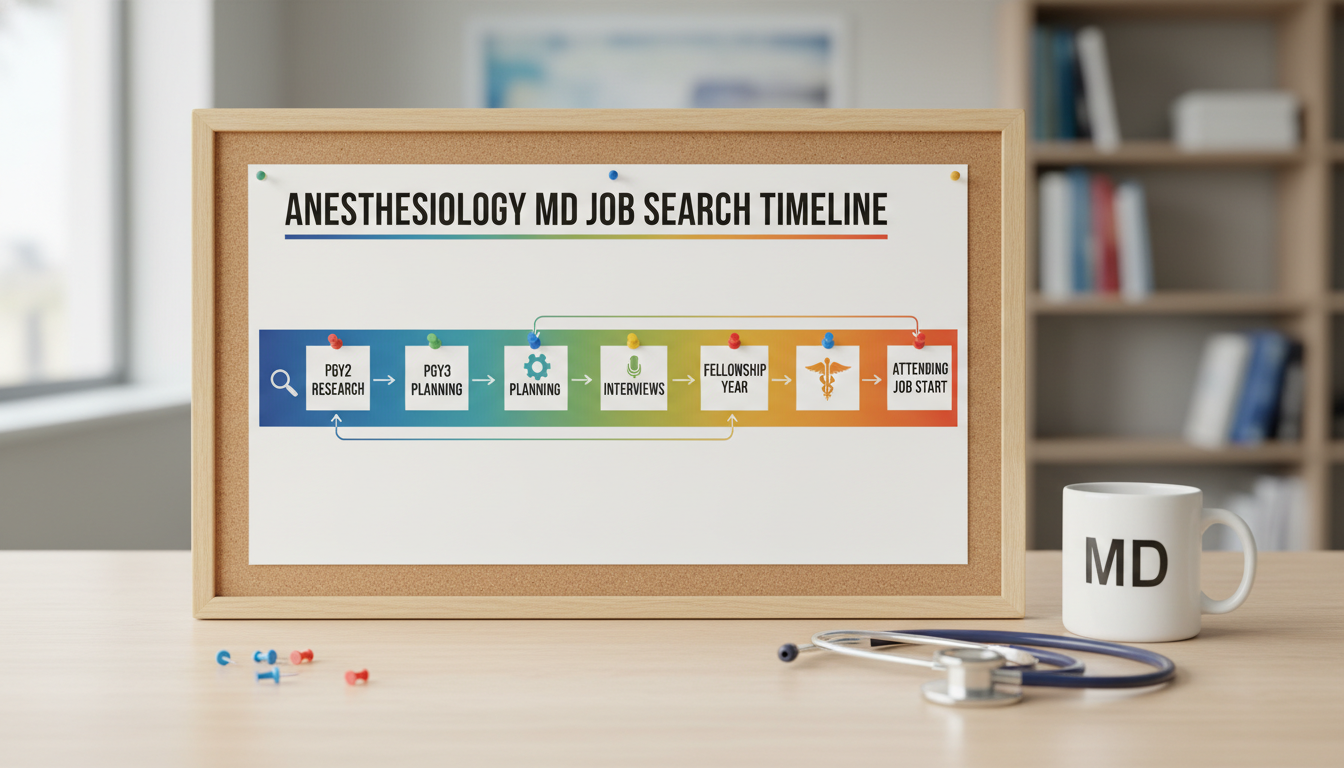
Think of the attending job search as a 12–18 month runway process rather than a single event. The most critical months fall in your final year of training, but the groundwork should begin earlier.
Typical Training Path and Key Milestones
For a standard anesthesiology path (no research years):
- MS4 (Allopathic Medical School Match): You match into an anesthesiology residency (categorical or advanced + prelim).
- PGY-1: Internship year (preliminary medicine/surgery or transitional year).
- PGY-2 to PGY-4: Clinical anesthesiology years.
- PGY-4: Chief resident year for some; fellowship decision; initial job market exposure.
- PGY-5+ (Optional): Fellowship (e.g., cardiac, critical care, pain, peds, regional).
The typical first attending job will begin July or August after you complete residency or fellowship.
High-Level Job Search Timing Guide
Below is a generalized timeline for an MD graduate in anesthesiology targeting their first job:
If going straight into practice (no fellowship)
- Late PGY-2 / Early PGY-3 (18–24 months before start date)
- Begin exploring career paths (academic vs. private practice vs. hybrid).
- Informal networking and light market research.
- Mid to Late PGY-3 (12–18 months before start date)
- Clarify geographic preferences and practice settings.
- Draft CV and basic cover letter.
- Attend regional or national meetings with job search in mind.
- Early PGY-4 (9–12 months before start date)
- Start actively searching and applying.
- Respond to recruiter outreach.
- Begin virtual and in-person interviews.
- Mid PGY-4 (6–9 months before start date)
- Narrow down options.
- Second-look visits and contract review.
- Negotiate salary, schedule, and call.
- Late PGY-4 (3–6 months before start date)
- Finalize and sign employment contract (sometimes earlier).
- Start credentialing and licensing processes if not already started.
If pursuing a 1-year fellowship (e.g., critical care, cardiac, pain)
Shift most of this timeline forward by one year, with the job search focusing on the late fellowship year:
- Early Fellowship (10–12 months before start date): Begin active search.
- Mid Fellowship (6–9 months before): Interviews and negotiations.
- Late Fellowship (3–6 months before): Contract finalization and onboarding steps.
Phase 1: Early Planning and Market Awareness (PGY-2 to Early PGY-3)
You do not need to send out applications in PGY-2, but you should start thinking strategically about your career and timing.
Understand the Physician Job Market in Anesthesiology
The physician job market for anesthesiologists is generally strong, but it is highly regional and sensitive to:
- Presence of large anesthesia groups/corporate management groups
- Local competition from CRNAs and AAs
- Academic vs. community hospital density
- State-level malpracticelaws and reimbursement patterns
- Urban vs. suburban vs. rural settings
In some urban academic markets, you may need to be more assertive and start networking a bit earlier. In many community and smaller metro areas, positions are posted and filled on a rolling basis through the year.
Actionable step (PGY-2 to early PGY-3):
Spend a few hours per month:
- Browsing job boards (ASA, specialty societies, hospital websites).
- Talking to recent graduates from your program about their job search timing.
- Asking attendings how the anesthesia job market looks in different regions.
This early exploration helps avoid surprises later and clarifies how competitive your target locations may be.
Clarify Your Career Direction
Before timing your search, you need to answer a few core questions:
Do I want to do a fellowship?
- If yes, the fellowship match timeline becomes your main focus early, and the attending job search will primarily be during fellowship.
- If no, your job search will start earlier, during senior residency.
What type of practice attracts me?
- Academic center with research or teaching
- Private practice group (traditional partnership track or W-2 employee)
- Hospital-employed anesthesia group
- Hybrid academic-private models
- Locums tenens work initially (often for flexibility or loan repayment)
Any strong geographic constraints?
- Family considerations, partner’s job, childcare, or aging parents
- Visa issues (for IMGs—less relevant to many U.S. MD graduates but still important if applicable)
- Preference for urban vs. regional vs. rural living
If you can answer these questions by early PGY-3, you’ll be in a much better position to time and target your job search.
Building a Foundation: CV and References
You don’t need a polished CV in PGY-2, but you should:
- Keep an ongoing list of experiences: presentations, QI projects, teaching roles, leadership.
- Identify 2–3 potential references (program director, key faculty, fellowship director if applicable).
By early PGY-3, assemble a professional CV so that, when recruiter emails start arriving, you’re not scrambling.
Example:
A PGY-3 anesthesiology resident planning to skip fellowship and stay in the same state might:
- Ask their program director during a semi-annual evaluation:
“I’m thinking about going straight into practice—when do your residents typically start the job search?” - Reach out to two graduated chiefs who stayed in-state and ask:
“When did you start applying and how long did credentialing/licensing take?”
This gives concrete local timing information that generic advice cannot fully capture.
Phase 2: Active Job Search and Applications (Late PGY-3 to Early PGY-4)
This is when the clock really starts ticking. For many MD graduates in anesthesiology residency, 9–12 months before your anticipated start date is the sweet spot for serious job search activity.
When to Start Sending Applications
For a July 1 start date as an attending:
- Best window to start actively applying:
- September to December of your PGY-4 year (or fellowship year).
- That typically corresponds to roughly 9–12 months before you start.
Why 9–12 months?
- Groups and hospitals often budget and plan staffing about a year ahead.
- This allows enough time for:
- Multiple interviews
- Negotiation and contract revisions
- State licensure (if new state)
- Hospital credentialing and payer enrollment
- It gives you some buffer if your first options don’t work out.
In less competitive or high-demand markets (many community hospitals, certain regions), you can sometimes start a bit later (6–9 months out) and still find ample opportunities. However, for popular metro areas or coveted academic jobs, earlier is safer.
Networking and Visibility
During this active phase, timing also encompasses when you show up where decision-makers are:
National meetings:
- ASA Annual Meeting is a prime networking venue. If it falls during your PGY-4 or fellowship year (or even late PGY-3), treat it partly as a job fair.
- Many groups and departments host receptions or booths; introduce yourself, collect cards, and follow up by email afterward.
Program and departmental connections:
- Let trusted faculty know you’re starting your job search and what you’re looking for.
- Many jobs are never widely posted; they’re filled through referrals and informal networks.
Actionable email example to a faculty mentor:
“Dr. Smith,
I’m starting to look for positions for after I graduate next June. I’m interested in a community setting within 2–3 hours of [City], with a reasonable mix of general OR and regional anesthesia and a manageable call schedule. If you hear of any openings that might fit, I’d really appreciate if you could connect me.”
That one email, timed correctly in early PGY-4, can uncover opportunities you would never see on public job sites.
Responding to Recruiters: When and How
Once you enter PGY-3 or PGY-4, recruiter emails and calls accelerate. Many residents ask: “When should I start taking them seriously?”
- Early PGY-3: It’s fine to respond and say,
“Thanks, I’m still early in residency and have not finalized my plans. Please keep me on your list for next year.” - Late PGY-3 / Early PGY-4: Start to selectively engage. Request written job descriptions and ask to schedule conversations closer to your target timeline (e.g., at 9–12 months before start date).
Avoid signing anything or verbally committing far earlier than you’re ready, particularly before you’ve:
- Clarified fellowship vs. no fellowship
- Assessed multiple job options
- Understood local compensation benchmarks

Phase 3: Interviews, Offers, and Contract Timing (Mid to Late Final Year)
Once your applications are out, the timing puzzle shifts to managing interviews, offers, and contract deadlines.
Ideal Window for Interviews
For a PGY-4 resident finishing in June:
- Prime interview window:
- October to February of your final year.
During this period, you should aim for:
- First round interviews (virtual or in-person) between October and January.
- Second-look visits or more detailed site visits between December and March.
Earlier interviews (September) are not uncommon, especially in high-need areas, but many programs finalize their position numbers and funding in the fall, hence the bulk of interviews in winter.
How Quickly Do You Need to Decide?
Different employers have different expectations:
- Some private practice groups move quickly and may ask for a decision within two weeks of an offer.
- Academic centers may give longer timelines—but their hiring processes can also be slower, with multiple committee approvals.
You can, and often should, ask for reasonable extensions to align timelines if you are still waiting on other interviews.
Example script:
“Thank you for the generous offer. I’m very interested in your group, and I want to make a thoughtful decision. I have a previously scheduled interview with another institution next month. Would it be possible to have until [date] to provide a final answer?”
In most cases, a 2–4 week extension is considered reasonable.
When Is the Right Time to Sign a Contract?
For most anesthesiology MD graduates:
- Common target: Sign contract 4–9 months before your start date.
- Earlier signing (9–12+ months): Reasonable if:
- You are highly confident about the job fit and location.
- The group is in a competitive market and expects early commitments.
- You’ve already compared multiple offers.
Signing too early (more than a year before start date) can be problematic if your circumstances change:
- Personal: partner’s job, family issues, new opportunities
- Professional: unexpected fellowship interest, leadership opportunity, or change in academic passions
Try to avoid pressure to sign a contract before you’ve seen at least a couple of other options, unless you are absolutely certain it’s your long-term home.
Leave Time for Licensing and Credentialing
Another reason to avoid last-minute contracts: administrative timelines.
Typical approximate timelines:
- State medical license (new state): 2–6 months, depending on state.
- Hospital credentialing: 60–120 days.
- Payer enrollment (if needed): Additional weeks to months.
If you sign a contract only 2–3 months before your start date in a new state, you may face delays in:
- Receiving your full salary
- Being able to bill for services
- Starting independent clinical work on time
For this reason, the safe zone for contract signing is usually at least 4–6 months before you start.
Special Situations and How They Affect Job Search Timing
Not every MD graduate in anesthesiology follows a standard path. Certain situations significantly alter the ideal timing of your attending job search.
1. Doing a Fellowship (Critical Care, Cardiac, Pain, etc.)
If you pursue a fellowship:
- Treat your fellowship year as a compressed version of your PGY-4 job search timeline.
- Begin serious job exploration within the first 3–4 months of fellowship.
- Aim to have a signed contract by midway to two-thirds through your fellowship (e.g., by January–March if you finish in June).
Because fellowship years are busy and short, procrastinating can leave you scrambling in the final months.
2. Staying at Your Training Institution
If your home institution wants to keep you, your job search timing changes:
- These conversations often start earlier, sometimes in late PGY-3 or early PGY-4.
- You may be offered a position informally well before positions are publicly advertised.
Even if you strongly prefer staying, do some external exploration:
- Obtain at least a rough sense of market compensation and call/schedule norms.
- This helps you negotiate fairly and ensures you’re not significantly undervaluing yourself.
3. Planning a Geographic Move to a New Region
If you’re moving to a region where you have fewer personal or professional connections:
- Consider starting your active search on the earlier side (10–12 months before).
- Schedule exploratory visits to learn about neighborhoods, schools, and commute patterns.
The less familiar you are with a location, the more time you need to avoid a rushed or misinformed decision.
4. Short-Term Locums Before a Permanent Job
Some anesthesiology graduates use locum tenens positions initially for:
- Flexibility
- Debt repayment
- Geographic exploration
If that’s your plan:
- Start talking to locums agencies 6–9 months before graduation.
- Plan state licensure accordingly, especially if you’ll be working in multiple states.
- Decide when you will transition to a permanent role and back-time your permanent job search from that future date.
Practical Checklists and Common Pitfalls
Month-by-Month Guide (Example for Resident Finishing June 2027)
July–December 2025 (mid PGY-3)
- Reflect on fellowship vs. straight to practice.
- Start rough geographic and practice-type preferences.
- Update your CV.
January–June 2026 (late PGY-3)
- Decide on fellowship applications or confirm you’re going straight into practice.
- Attend ASA or major regional meetings with networking mindset.
July–September 2026 (early PGY-4)
- Refine your CV and draft a standard email introduction.
- Notify mentors that you’re starting your job search.
- Begin responding more seriously to recruiter inquiries.
October 2026–February 2027 (main job search window)
- Apply broadly to preferred regions and practice types.
- Schedule and complete first-round and second-round interviews.
- Compare offers; begin contract review with a lawyer if needed.
March–April 2027
- Finalize negotiations and sign a contract.
- Start state license applications (if new state) and hospital credentialing.
May–June 2027
- Complete onboarding paperwork, orientation planning, and relocation details.
- Focus on a smooth transition from resident to attending.
Common Timing Mistakes to Avoid
Waiting until the last 3–4 months of residency/fellowship to start looking seriously.
- Leads to fewer choices, limited negotiating power, and administrative delays.
Signing the first offer you receive without comparison.
- Especially risky in private practice or corporate environments. You may lock into a schedule or compensation structure that’s suboptimal for years.
Underestimating licensing and credentialing timelines.
- Particularly when changing states, this can cause income gaps or delayed start dates.
Letting fellowship decisions drag too long.
- If unsure about fellowship, set a personal deadline (e.g., early PGY-3) to decide, because this heavily affects your attending job search timing.
Not thinking ahead about lifestyle implications.
- A job with great pay but brutal call or commute can be unsustainable; you need enough time to identify these issues during the search—not after you start.
FAQs: Job Search Timing for MD Graduate in Anesthesiology
1. I’m an MD graduate in anesthesiology residency. When should I seriously start my job search if I’m not doing a fellowship?
For most residents going straight into practice, aim to start serious job search activities 9–12 months before your planned start date. That usually means early PGY-4 for a June graduation. You can lay groundwork and explore options earlier in PGY-3, but active applications and interviews typically cluster during that 9–12 month window.
2. If I’m doing a fellowship, when should I start looking for attending jobs?
Your timeframe compresses. Begin active searching within the first quarter of your fellowship year—around 9–12 months before starting your attending role. Because fellowship is only one year, don’t wait until the final few months; aim to interview and sign by the midpoint to later half of the fellowship.
3. How early is too early to sign an anesthesiology attending contract?
Signing more than 12–15 months before your start date can be risky unless you’re completely sure about the job, location, and career path (including fellowship decisions). A common and safe window is to sign 4–9 months before you start, which balances adequate time for licensing and credentialing with flexibility in case your plans or personal situation evolve.
4. When should I start my attending job search if I know I want to stay at my current institution?
If you hope to stay where you trained, initiate conversations earlier than you would for external jobs—often late PGY-3 or early PGY-4. Let leadership know your interest and ask about projected openings and timelines. Still, consider at least informally exploring external options so you understand your market value and keep leverage in discussions.
By approaching your anesthesiology job search as a gradual, time-sensitive process—rather than a last-minute scramble—you position yourself to choose a role that fits your clinical interests, lifestyle goals, and long-term plans. Strategic timing, informed by an understanding of the anesthesia job market and your own priorities, is one of the most powerful tools you have as you move from resident or fellow to attending.