
Finding your way from a Caribbean medical school residency pathway to a stable surgical career can feel especially uncertain when you’re in a preliminary surgery year rather than a categorical spot. For Caribbean IMGs, timing your job search—both for PGY-2+ training positions and future attending roles—can make the difference between progressing smoothly and scrambling under pressure.
This guide focuses on job search timing for Caribbean IMG preliminary surgery residents, with practical, month‑by‑month advice, timelines, and strategies tailored to your situation.
Understanding Your Realistic Options After a Preliminary Surgery Year
Before planning when to search, you need clarity on what you’re actually searching for. A prelim surgery residency year is not the same as a guaranteed pipeline to a categorical surgery position.
1. Possible Paths After a Preliminary Surgery Year
As a Caribbean IMG in a preliminary surgery year, you typically face four main pathways:
- Transition to a categorical general surgery position
- Either at your current institution (internal transfer)
- Or at another program (open PGY-2 or PGY-1 categorical position)
- Switch to another specialty at the PGY-1 or PGY-2 level
- Popular options: anesthesia, radiology, PM&R, internal medicine, family medicine, emergency medicine, neurology
- Extend training with a non-ACGME or research year
- Surgical research fellowships
- Surgical ICU / trauma research positions
- Quality improvement or outcomes research roles
- Non-training physician work (usually limited for IMGs)
- Clinical jobs that do not require board eligibility (e.g., some telemedicine or locum roles, often restricted by visa and licensure)
- These are usually not ideal as long-term options and may jeopardize board certification pathways
For most Caribbean IMG prelims, your primary objective should be:
Secure a categorical training position that leads to board eligibility—ideally in surgery, but possibly in another suitable specialty.
Your job search timing should be built around this priority.
The Unique Challenges for Caribbean IMG Prelim Surgery Residents
Understanding the constraints you face will help you front‑load your efforts and avoid dangerous delays.
1. Structural Disadvantages
As a Caribbean IMG:
- You may not have the same home institution network as U.S. MD students.
- Some programs are hesitant to convert prelims (especially IMGs) to categorical due to:
- Limited positions
- Historical preference for U.S. graduates
- Perceived visa complexity
But there are counterbalancing strengths:
- If you came through the SGU residency match or a similar Caribbean medical school residency pipeline, programs already know your institution and its track record.
- You often have strong clinical adaptability and work ethic, which matter a lot in surgery.
2. Visa and Licensing Issues
Visa status has major timing implications:
- J-1 visa: Your timeline revolves around staying in ACGME-accredited training.
- H-1B visa: Fewer programs sponsor this, and timing for transfers is tighter and more complex.
- Green card / U.S. citizen: Your timing is more flexible, but delays still have consequences for board eligibility and CV continuity.
Whatever your situation, you must know:
- Your visa type
- When it expires
- What’s needed to transfer or extend
This should be clarified within the first 1–2 months of your prelim year with your GME office and possibly an immigration attorney if needed.
Month-by-Month Timeline: When to Start Each Type of Job Search
This is the core of your strategy. Think of your prelim year as running on two parallel timelines:
- In-year opportunities (spot openings, internal transfers)
- Future-year opportunities (Match and off-cycle categorical positions)
Below is a typical July–June prelim year timeline for a Caribbean IMG in preliminary surgery, with emphasis on timing.
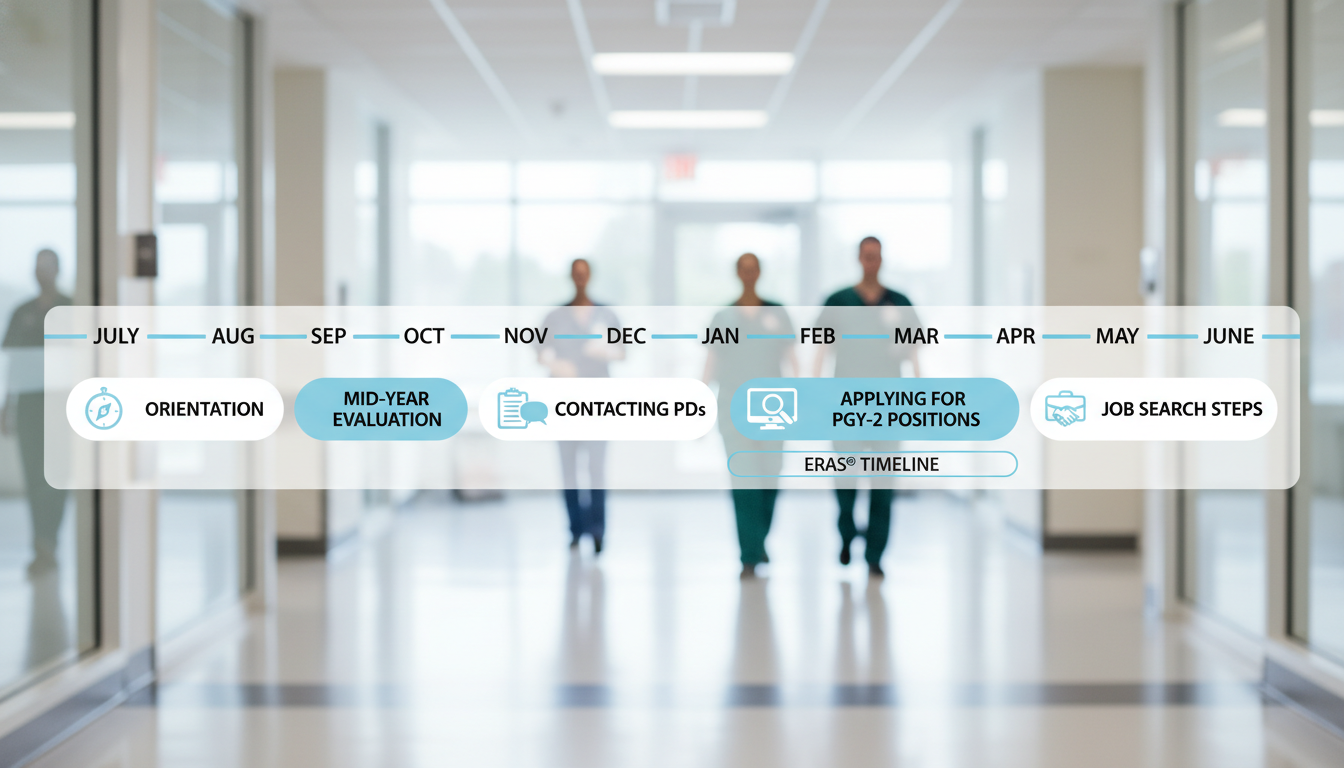
July–August: Orientation, Reality Check, and Early Planning
Goals:
- Establish your reputation
- Understand your program’s internal opportunities
- Map out your strategy and deadlines
Key actions:
Meet with your program director (PD) early
- Target: by end of August
- Ask directly:
- “Is there any realistic possibility of conversion from prelim to categorical here?”
- “Historically, how often have prelims transitioned at this program?”
- Get a sense of:
- PD’s impression of your potential
- Known or likely upcoming categorical openings
Clarify institutional pathways
- Some programs have:
- Known attrition spots (due to residents leaving for research, other specialties, or performance issues)
- Anticipated expansions (new hospital sites, service growth)
- Ask: “If a categorical spot opens, how are prelims considered for it?”
- Some programs have:
Start building a performance portfolio
- Keep a log of positive feedback from attendings
- Save any compliments in emails, or ask attendings if they’d be willing to support you later
- Begin noting cases, responsibilities, and teaching activities
Mindset: You are already in your job search. Surgeons and PDs are forming impressions that will influence your letters and internal transfer chances.
September–October: Preparing for In-House and External Options
Goals:
- Strengthen your internal candidacy
- Quietly prepare external applications
Key actions:
Double down on performance
- Be highly reliable on call
- Complete notes, orders, and follow-up promptly
- Be the first to volunteer for cases and tough assignments
- Treat this as a year-long in-person interview
Secure early mentors
- Identify 2–3 surgical faculty who:
- Have some influence
- Know you from rotations/call
- Ask for:
- Regular informal feedback
- Guidance on pursuing categorical positions
- Identify 2–3 surgical faculty who:
Update application materials
- By mid-October, you should:
- Update your CV
- Draft a new personal statement focused on:
- What you’ve learned in your prelim year
- Why you’re committed to surgery (or another chosen specialty, if pivoting)
- Prepare a concise email template to inquire about open PGY-2 or categorical positions
- By mid-October, you should:
Why now? Many spontaneous PGY-2 positions open October–March due to attrition. You need to be ready to email your materials within 24 hours when these are posted.
November–January: Aggressive Search for Open PGY-2 and Categorical Spots
This is the highest-yield period to move from prelim surgery residency to categorical training.
Goals:
- Spot and apply to every relevant opening
- Position yourself for internal consideration
- Decide whether you’ll re-enter the Match
Key actions:
Monitor job boards consistently (at least weekly):
- ACGME public list of “open positions”
- AMA’s FREIDA database (check “program updates”)
- APDS (Association of Program Directors in Surgery) listserv postings (via faculty or coordinator)
- Specialty societies’ job boards (trauma, critical care, etc. for future fellowship‑minded residents)
Email programs promptly when you see openings
- Ideal response time: within 24–48 hours of posting
- Attach:
- Updated CV
- Personal statement
- USMLE/COMLEX score reports
- At least 2–3 letters (if available; more can follow later)
- State clearly:
- That you are a Caribbean IMG in a preliminary surgery year
- Your current program and visa status
- Your availability to start (usually July; occasionally immediate off-cycle)
Have a candid mid-year meeting with your PD (December–January)
- Ask honestly:
- “Do you see me as competitive for a categorical spot here if one opens?”
- “Would you support my external applications with a strong letter?”
- If the answer is lukewarm or negative, double down on external search and possibly other specialties.
- Ask honestly:
Decide on the Match vs. off-cycle approach
- If pursuing surgery categorical through the Match:
- You should be preparing ERAS materials by December–January for the next cycle.
- If you’re targeting open PGY-2 spots only:
- You may bypass the Match, but this is risky if not many positions appear.
- Many Caribbean IMG prelims wisely pursue both:
- Apply to open PGY-2 surgery positions
- Also enter the Match for surgery or alternative specialties
- If pursuing surgery categorical through the Match:
February–April: Critical Decision Window and Backup Planning
By this point, you need clarity about your likely path. Time is short.
Goals:
- Secure at least one viable next step (categorical spot, second prelim year with clear purpose, alternate specialty, or research fellowship)
- Avoid finishing the year with no training lined up
Key actions:
Reassess progress by early February
- Do you have:
- Any interviews for PGY-2 or categorical surgery roles?
- Strong interest from your own PD regarding internal conversion?
- If not, consider:
- Expanding your specialty targets (e.g., internal medicine, family medicine)
- Intensifying search for research or non-ACGME clinical fellowships
- Do you have:
Intensify networking
- Ask mentors:
- “Do you know any PDs who might be looking for a hardworking prelim who wants to continue in surgery or a related field?”
- Request direct email introductions when possible
- Attend regional surgical meetings if feasible
- Even short, local or virtual meetings can generate contacts
- Ask mentors:
Apply to research fellowships or transitional positions
- Especially if:
- You’re waiting on next-cycle Match
- You fail to secure a categorical spot for the immediate next July
- These can:
- Keep you in an academic environment
- Strengthen your profile with publications and projects
- Especially if:
If you matched into another specialty (via the Match)
- Start planning your transition
- Ask your current PD for:
- Rotation adjustments if needed
- Time off for orientation at the new program
- This may mean leaving surgery, but preserves your ability to practice medicine and enter the physician job market as a board-eligible attending later.
May–June: Finalizing Next Steps and Preparing for Transition
By late spring, you should have a concrete plan for post-June.
Goals:
- Confirm your next position
- Avoid gaps in training
- Collect strong letters and document your prelim year achievements
Key actions:
Lock in paperwork
- For a new training program:
- Complete all onboarding requirements early (licensing, credentialing, visa documents)
- For research or fellowship roles:
- Confirm salary, responsibilities, and future publication opportunities
- For a new training program:
Secure end-of-year letters
- Ask:
- PD
- At least 2–3 surgical attendings who know you well
- Request that letters:
- Comment on growth over the year
- Highlight your work ethic, reliability, and technical ability
- Explicitly address that you “would be an asset as a categorical resident”
- Ask:
Maintain performance until the last day
- Future employers and programs may still contact your PD after you leave
- A strong finish prevents last-minute negative impressions
When to Start Thinking About Attending Job Search and the Physician Job Market
As a preliminary surgery resident, it might feel premature to think about being an attending. However, understanding the physician job market and when to start job search as an attending will inform your training decisions now.

1. Why Long-Term Planning Matters Now
Not all paths from a prelim year lead to the same job market reality:
- Board-eligible general surgeon:
- Strong demand in community hospitals and smaller cities
- Leverage in negotiating schedule and call distribution
- Another specialty (e.g., internal medicine, anesthesia, EM):
- Also strong market in many regions
- Different lifestyle and call patterns
- No board eligibility / incomplete training:
- Severely limited options
- Often low-paying, unstable, or geographically restricted positions
So your current decision about how aggressively to pursue categorical surgery vs. pivoting to another residency will shape your attending job search years later.
2. General Attending Job Search Timeline (Once in Categorical Training)
Assuming you secure a categorical position (surgery or another specialty):
- 2–3 years before completion:
- Start understanding your specialty’s physician job market:
- Geographic demand
- Typical salaries
- Academic vs. community practice differences
- Start understanding your specialty’s physician job market:
- 12–18 months before graduation:
- This is typically when to start job search in earnest:
- Update CV
- Attend job fairs (e.g., ACS Clinical Congress for surgeons)
- Contact recruiters and employer groups
- This is typically when to start job search in earnest:
- 6–9 months before graduation:
- Aim to have a signed employment contract by this point
- Especially important if you need:
- Visa sponsorship
- A specific location (family, spouse, etc.)
For a Caribbean IMG, especially with visa needs, starting earlier (18–24 months before graduation) is prudent.
Caribbean-Specific Strategies to Maximize Your Options
As a Caribbean IMG from schools like SGU, AUC, Ross, etc., you can leverage certain strengths and must anticipate some biases.
1. Use Your School’s Alumni Network
Many Caribbean medical school graduates are now:
- Faculty at U.S. programs
- Practicing surgeons or attendings in other specialties
- Program directors or APDs (especially in IM, FM, EM)
Actionable steps:
- Join your school’s alumni database and LinkedIn groups
- Reach out with:
- A brief intro (name, school, prelim year details)
- A specific ask: “I’m a prelim surgery resident seeking a categorical spot or research year—would you be open to a 10-minute call for advice?”
- If you’re from SGU, emphasize the SGU residency match brand:
- Programs familiar with SGU often have alumni on faculty or in leadership
2. Build a “Resilience Narrative” in Your Applications
Programs know prelim years are tough, especially for IMGs. Your application should convey:
- You chose surgery (or your new field) intentionally
- You handled the challenges of a demanding prelim year
- You developed concrete skills:
- Managing busy call
- Handling surgical emergencies
- Communicating with multidisciplinary teams
Frame your prelim year not as “I failed to get categorical,” but as:
“I earned a rigorous surgical prelim year where I proved my reliability and commitment, and now I’m eager to bring that experience into a categorical training environment.”
3. Be Strategic About Alternate Specialties
If surgery categorical isn’t working out, consider fields where your prelim surgery experience is an asset:
- Anesthesia: Comfortable in OR setting, airway familiarity
- Emergency medicine: Acute care skills, trauma exposure
- Critical care (via internal medicine or anesthesia): ICU rotations from prelim year
- Internal medicine or family medicine: Depth of inpatient exposure
Apply early to these if you pivot, not only as a last resort in May–June.
Putting It All Together: A Sample Strategy Timeline
Here is a condensed strategy for a Caribbean IMG in a preliminary surgery year:
July–August
- Clarify internal conversion chances with PD
- Understand visa/contract details
- Identify 2–3 attending mentors
September–October
- Update CV and personal statement
- Start monitoring open positions
- Build a strong reputation in the program
November–January
- Aggressively apply to PGY-2 or categorical surgery positions
- Have a formal mid-year PD meeting
- Decide whether to re-enter the Match (surgery or alternative specialties)
February–April
- Reassess: If no categorical options, expand to:
- Alternate specialties
- Research or non-ACGME surgical fellowships
- Intensify networking through faculty and alumni
- Accept realistic opportunities, not just ideal ones
- Reassess: If no categorical options, expand to:
May–June
- Finalize next position
- Obtain strong end-of-year letters
- Avoid any performance decline in the final months
Your primary goal: Do not finish your prelim year without a defined, active, and realistic next training step.
FAQ: Job Search Timing for Caribbean IMG in Preliminary Surgery
1. When should I start looking for categorical surgery positions during my prelim year?
You should begin serious preparation by September–October and active applications by November. Keep monitoring and applying through April, as spots can open late due to attrition. Have your CV, personal statement, and letters ready early so you can respond quickly when positions appear.
2. Should I re-enter the Match while I’m still searching for open PGY-2 surgery spots?
For most Caribbean IMG prelims, yes, it’s wise to consider both options. Use the Match to target:
- Categorical surgery positions (if realistic)
- Alternate specialties (e.g., IM, FM, EM, anesthesia) as a backup
At the same time, pursue off-cycle PGY-2 surgery openings. This dual strategy helps avoid ending the year without any training option.
3. If I switch to another specialty, will my prelim surgery year still help my future attending job search?
Yes. Many employers value:
- Your exposure to acute care
- High-intensity work environment experience
- Strong procedural and team-based skills
A prelim surgery year often strengthens your application for other fields and can be a positive differentiating factor when you later enter the physician job market as an attending—provided you complete a full categorical residency afterward.
4. When should I start my attending job search once I’m in a categorical program?
For most specialties:
- Begin researching the physician job market 2–3 years before graduation
- Start actively applying and interviewing 12–18 months before finishing training
- Aim to have a signed contract 6–9 months before graduation
As a Caribbean IMG, especially if you need visa sponsorship, you may want to start contacting employers on the earlier side of this range (up to 18–24 months before completion).
Navigating a preliminary surgery year as a Caribbean IMG requires early planning, constant situational awareness, and strategic flexibility. By understanding when to start each phase of your job search, maintaining strong performance, and leveraging your networks, you can turn a precarious prelim year into a stepping stone toward a stable, rewarding career in surgery or another specialty.