
Understanding the Job Search Landscape for Caribbean IMGs in Pediatrics-Psychiatry
Caribbean international medical graduates (IMGs) who match into Pediatrics-Psychiatry—or into a triple board program in Pediatrics/Psychiatry/Child & Adolescent Psychiatry—often feel they must “catch up” to U.S. graduates in planning their careers. That pressure is real, especially when you’re balancing clinical demands, visa issues, and uncertainty about the U.S. physician job market.
The most powerful way to regain control is to understand timing: when to start your job search, how the cycle works in peds psych and triple board, and how being a Caribbean IMG shapes your strategy.
This guide is written specifically for Caribbean IMGs in Pediatrics-Psychiatry and triple board programs who are approaching the post-residency and job market phase. It will walk you through:
- When and how to start exploring options
- How timing differs by practice type (academic vs community vs hybrid)
- Visa- and Caribbean-specific considerations
- How to coordinate your SGU residency match or other Caribbean med school background with a smart timeline
- Practical steps in every PGY year so you don’t miss key windows
Big Picture: How the Physician Job Market Works in Peds-Psych
The U.S. physician job market for pediatric-psychiatry and triple board–trained physicians is currently favorable. Child and adolescent mental health needs are high, pediatric primary care is overloaded, and systems are hungry for clinicians who can bridge both.
However, the structure of the market is fragmented:
- Academic centers (university hospitals, children’s hospitals):
- Often recruit earlier (up to 12–18 months before start date)
- Slower institutional hiring processes (multiple committees, HR delays)
- More structured start dates aligned with academic years (July 1 is common, but not universal)
- Large health systems / multispecialty groups:
- Recruit 6–12 months before start date
- More standardized contracts, often multiple locations
- Smaller community hospitals, FQHCs, private practices:
- May hire closer to need (3–9 months out)
- Sometimes willing to be flexible if they really need a peds-psych specialist
For Caribbean IMGs, job market realities also include:
- Visa sponsorship limitations (if not a permanent resident or citizen)
- Extra scrutiny of training background, especially when coming from a Caribbean medical school residency or as an SGU graduate
- A need to demonstrate clear, stable career goals and commitment to underserved populations
The key takeaway: you cannot afford a late start. Most Caribbean IMGs in Pediatrics-Psychiatry or triple board should treat job search planning as a two-year process before finishing training.
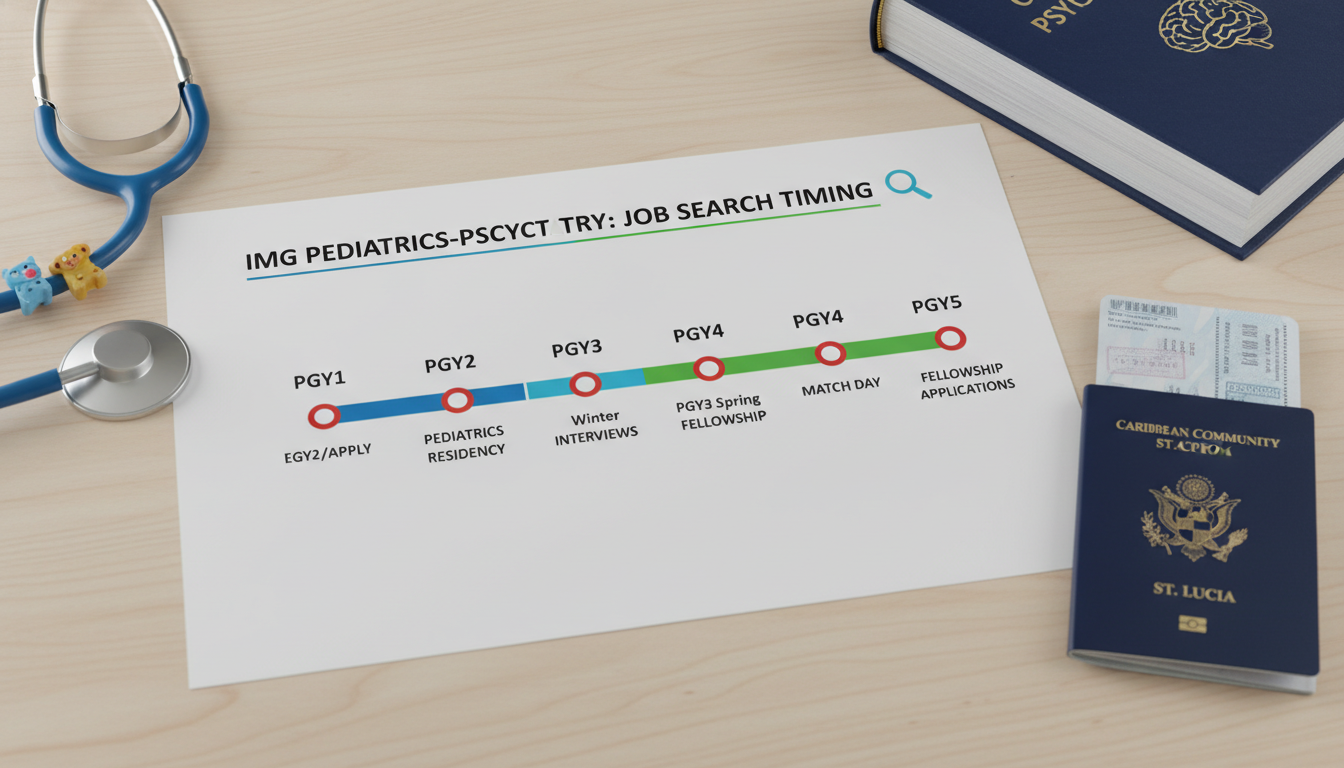
Year-by-Year Timeline: When to Start the Job Search
Below is a structured, realistic timeline for a Caribbean IMG in Pediatrics-Psychiatry or triple board training. Adjust the exact PGY years based on your program’s length (e.g., 5-year triple board vs separate pediatrics and psychiatry residencies).
PGY1: Foundation and Long-Range Planning (Not a Formal Job Search Yet)
Primary focus: Learn, adjust to the system, and observe.
Goals:
- Understand your program’s structure and where graduates go:
- Ask program leadership:
- “Where have recent graduates taken jobs?”
- “What proportion go into academic vs community practice?”
- “Any employers particularly interested in triple board–trained or peds psych physicians?”
- Ask program leadership:
- Clarify your long-term interests:
- More pediatric inpatient vs outpatient?
- More psychiatry (especially child/adolescent) vs general pediatrics?
- Interests in research, teaching, or administrative roles?
- Quietly research the physician job market:
- Subscribe to job boards focused on peds psych, child psychiatry, and pediatrics.
- Follow major systems and children’s hospitals on LinkedIn or email lists.
- If you are on a visa:
- Learn common pathways: J-1 waiver, H-1B, O-1 possibilities.
- Begin understanding underserved/shortage area requirements for potential J-1 waiver jobs.
Timing takeaway for PGY1:
You’re not yet “on the market,” but you are absorbing information. Your main question is not “where do I apply?” but “what kind of job will I want?”
PGY2: Clarifying Direction and Building a CV That Sells
Primary focus: Position yourself for the roles that will be hiring you in 2–3 years.
Goals:
- Identify one or two likely career paths, for example:
- Academic child psychiatry with continuity general pediatrics clinic
- Community-based integrated care (peds clinic with mental health services)
- Hospital-based consult-liaison role (peds floors + psych consults)
- Begin to shape your CV:
- Present at least one poster or talk at a regional or national meeting (AAP, AACAP, APA, etc.).
- Seek out quality improvement (QI) or research projects that align with peds psych integration.
- Build relationships:
- Identify 2–3 faculty mentors in pediatrics and 2–3 in psychiatry.
- Tell them your tentative plans: “I’m a Caribbean IMG in triple board, and I’m leaning toward [X] type of practice after graduation. I’d value advice on how your department views candidates for those roles.”
If your training path is:
- Triple board (5 years):
- PGY2 = still early, but this is the time to think:
“Do I want to lean more into psych or peds, or truly 50/50?”
- PGY2 = still early, but this is the time to think:
- Pediatrics residency then Child & Adolescent Psychiatry fellowship:
- PGY2 peds = think ahead to CAP match, which will strongly shape your later job options.
- Understand whether your eventual job will be more peds-heavy, psych-heavy, or integrated.
Timing takeaway for PGY2:
No official applications yet, but you’re actively shaping your future marketability and starting to define your destination.
PGY3: The “Soft Launch” of Your Job Search
This is where timing becomes critical—especially for Caribbean IMGs.
Primary focus: Start informal job search activities and gather market intelligence.
Key actions between 18–24 months before graduation:
Honest needs assessment
- Clarify geographic constraints:
- Tied to a specific state for family/visa reasons?
- Open to rural or underserved areas (especially relevant for J-1 waivers)?
- Define your minimums:
- Academic title necessary?
- Salary range expectations?
- Required mix of pediatrics vs psychiatry?
- Clarify geographic constraints:
Talk to recent graduates
- Reach out to alumni of your program, especially other Caribbean IMGs:
- Where did they land?
- When did they start their job search?
- What surprised them about contracts or visas?
- Ask specifically:
- “Looking back, when do you think is the ideal time to start a serious job search?”
- Reach out to alumni of your program, especially other Caribbean IMGs:
Start semi-formal networking
- Attend conferences and introduce yourself to potential employers.
- Example script:
- “I’m a PGY3 triple board resident at [Program], originally from a Caribbean medical school. I’m early in my job planning, likely looking for a combined peds-psych role in [year]. Does your institution have positions for this background, and when do you usually start recruiting?”
Explore with low-commitment conversations
- Respond to a limited number of recruiter emails, but primarily to gather information:
- “For peds-psych or triple board physicians, when do you typically begin recruitment for a July start date?”
- Keep a spreadsheet of:
- Interest areas
- Typical start dates
- Willingness to sponsor visas
- Salary ranges
- Respond to a limited number of recruiter emails, but primarily to gather information:
Timing takeaway for PGY3:
You are not yet signing contracts, but you are clearly on the runway. You should have a structured sense of when to start job search in your target market and how early employers start talking to candidates.

PGY4–5: Active Job Search Phase (Applications, Interviews, and Contracts)
Your exact PGY year will vary depending on whether you’re in a triple board program or separate pediatrics and psychiatry residencies. The principles are similar.
When to Start Applying: General Rules
For most Caribbean IMGs in Pediatrics-Psychiatry:
- Academic jobs: Apply 12–18 months before your intended start date.
- Large health systems / children’s hospitals: Apply 9–12 months before start date.
- Community or private practice jobs: Apply 6–9 months before start date.
Because you are a Caribbean IMG—and potentially on a visa—it is safer to be toward the earlier end of each range.
Example Timelines
If graduating June 2027 (PGY5 in triple board):
- Start targeted applications to academic centers: Jan–Jun 2026
- Major health systems: Spring–Fall 2026
- Community practices: Summer–Fall 2026
- Aim to sign a contract by Dec 2026–Feb 2027
If finishing child psychiatry fellowship June 2026 (after peds):
- Academic applications: Jan–Jun 2025
- Health systems: Summer–Fall 2025
- Community: Late 2025–early 2026
Starting later compresses your choices and may force you into less ideal roles, especially if you need visa sponsorship.
Steps in the Active Job Search Phase
Finalize Your Professional Story
- Craft a 2–3 sentence narrative that explains:
- Your Caribbean medical school background
- Your combined peds-psych expertise
- What type of job you’re seeking
- Example:
- “I’m a triple board resident trained at [U.S. program], originally from [Caribbean medical school]. I’m looking for a position where I can integrate pediatric primary care and child psychiatry, ideally in a system committed to underserved youth and collaborative care.”
- Craft a 2–3 sentence narrative that explains:
Update Documents
- CV tailored to highlight:
- Dual/tri-specialty training
- Any work with integrated care, autism, trauma, or chronic illness
- Teaching and quality improvement projects
- Concise, targeted cover letters that:
- Name the specific role or type of practice
- Establish your IMG and visa status briefly but clearly (when relevant)
- A one-page career goals statement (optional but often valuable for academic roles)
- CV tailored to highlight:
Proactively Address Visa Issues (If Applicable)
- Clarify your exact status:
- J-1, H-1B, or other
- Consult with:
- Your institution’s GME office
- An immigration attorney if needed
- When you speak with potential employers:
- Ask early: “Does your institution sponsor [H-1B/J-1 waiver] for pediatric-psychiatry or triple board positions?”
- Target:
- Systems experienced with IMGs
- States with active J-1 waiver programs and documented need for child mental health services
- Clarify your exact status:
Interviews and Site Visits
- Expect your first interviews:
- Academics: 12–15 months before start
- Others: 6–12 months before start
- For each interview, prepare:
- How you will balance pediatrics vs psychiatry in your schedule
- Your expectations for call, outpatient vs inpatient, and age ranges
- Questions about mentorship, promotion, and protected time (especially for academic or hybrid roles)
- Expect your first interviews:
Contract Negotiation
- Consider hiring a physician contract lawyer experienced with IMGs.
- Pay close attention to:
- Non-compete clauses (critical if you are tied to a region)
- Work RVU vs salary vs hybrid compensation
- Protected time for admin, teaching, or research
- Tail coverage for malpractice if you leave
Special Considerations for Caribbean IMGs and SGU Graduates
Your Caribbean medical school background—whether SGU or another school—shapes your job search, but it does not define or limit you if you strategize well.
Leveraging an SGU Residency Match or Other Caribbean Pathway
If you came through an SGU residency match or another Caribbean medical school residency pathway:
- Use your story:
- Emphasize resilience, adaptability, and your deliberate choice to pursue a high-need, dual-discipline field.
- Highlight that you:
- Already navigated competitive gateways: USMLE, match, residency/fellowship.
- Have a track record in U.S. clinical environments.
Specific strategies:
- Include an “About My Training Path” paragraph on your website/LinkedIn or in a teaching portfolio, explaining:
- Caribbean medical school → competitive match → peds psych/triple board
- Why this background makes you well-suited to work with diverse, underserved populations.
Combatting Assumptions in the Physician Job Market
Some recruiters or institutions may have limited familiarity with Caribbean-trained physicians. Prepare to:
- Speak confidently about the quality of your training:
- “My triple board program at [institution] is ACGME-accredited and has placed graduates at [X, Y, Z major employers].”
- Offer references from:
- Well-known faculty in pediatrics and psychiatry
- Department chairs or program directors who can vouch for your clinical excellence
Your timing advantage:
- Because you know you may face extra scrutiny, starting your job search earlier gives you:
- Time to correct misconceptions
- Multiple options on the table before committing
Balancing Pediatrics vs Psychiatry in Your Job Search
Peds-psych and triple board training allow a remarkable range of configurations. To time your job search properly, you must decide:
- Do you want a peds-heavy role (with psychiatry consults)?
- A psych-heavy role (with pediatric medical oversight)?
- A truly integrated practice?
How Timing Differs by Desired Role
Academic Triple Board Positions
- Often rare and highly customized.
- These posts may be designed around you once you’re known to the department.
- Start exploring and hinting at interest 18–24 months before graduation with your own institution and regional academic centers.
Child & Adolescent Psychiatry–Focused Roles
- The demand is extremely high.
- Many positions are open year-round and filled quickly.
- Start your search at 12+ months and be ready to move quickly when a strong match appears.
Peds Primary Care with Integrated Behavioral Health
- More common in large systems and FQHCs.
- Often hire closer to need, but the best-designed integrated roles (with protected time and support) may appear earlier.
- Begin targeted search around 9–12 months before start date.
When to Start Job Search vs When to Intensify It
A helpful way to think about timing:
- Exploration Phase:
- Begins: late PGY2 / early PGY3
- Activities: learning the market, talking to mentors and alumni, understanding visa paths, identifying target regions.
- Positioning Phase:
- PGY3 – early PGY4 (or equivalent): choosing focus areas, building CV, increasing visibility through conferences and publications.
- Active Applications Phase:
- 9–18 months before graduation depending on role type, emphasis on early applications for academics and visa sponsorship needs.
- Negotiation and Finalization Phase:
- 3–9 months before graduation: negotiate contracts, complete credentialing and licensing, finalize relocation plans.
If you ever feel uncertain about when to start job search efforts, assume you should start earlier, especially as a Caribbean IMG in a niche field like Pediatrics-Psychiatry or triple board.
Practical Tips and Common Pitfalls
Practical Tips
- Use a simple tracking spreadsheet:
- Columns: Institution, Type (academic/community), Location, Visa-friendly (Y/N), Contact person, Date first contact, Date interviewed, Status, Notes.
- Schedule “career check-ins”:
- Once every 6 months from PGY2 onward with one trusted mentor in pediatrics and one in psychiatry.
- Practice a concise explanation of your background:
- So you’re not caught off guard by questions about Caribbean training.
- Align your electives with your likely job path:
- If aiming at integrated care roles, take extra rotations in collaborative care clinics, developmental peds, or psych consult services.
- Prepare for virtual interviews early:
- Test your setup, lighting, and professional background.
Common Pitfalls for Caribbean IMGs in Peds-Psych
Starting too late
- Waiting until 4–6 months before graduation leaves poor leverage, fewer visa-sponsoring options, and rushed decisions.
Not clarifying visa requirements early
- Discovering at the offer stage that an employer cannot sponsor your visa is devastating and avoidable.
Over-focusing on location at the expense of role fit
- Being too rigid about geography can backfire, particularly with J-1 waivers or first jobs.
- Consider starting your career in a higher-need area to establish experience; you can often transition later.
Undervaluing your unique skill set
- Peds psych and triple board are rare, and your dual expertise is valuable. Don’t settle for a job that treats you as just a generic pediatrician or psychiatrist unless you truly want that role.
FAQs: Job Search Timing for Caribbean IMG in Pediatrics-Psychiatry
1. I’m a Caribbean IMG in a triple board program. When should I first contact potential employers?
Start light, exploratory contact 18–24 months before your planned graduation. This can be through conference networking, brief emails to department leaders, or conversations arranged by your mentors. Formal applications usually follow around 12–18 months before your start date for academic roles and 9–12 months for most other positions.
2. Does being a Caribbean IMG mean I should start my job search earlier than my U.S. MD colleagues?
In practice, yes. Because you may face additional questions about training background and visa status, and because some employers may be unfamiliar with Caribbean medical school residency pathways, you benefit from starting on the early side of every standard window. That typically means aiming for the 12–18 month range rather than 6–9 months.
3. How does visa status affect when I should start looking for jobs?
If you are on a J-1 or H-1B, you should:
- Clarify your visa options with your GME office by mid-PGY3.
- Target employers with a history of sponsoring IMGs.
- Start serious applications 12–18 months before graduation to allow time for waiver applications, immigration processing, and licensing.
4. What if I’m not sure whether I want a peds-heavy or psych-heavy job? Should I delay my search?
Do not delay your job search. Instead, conduct parallel exploration:
- Apply to a mix of roles (peds-heavy, psych-heavy, integrated).
- Use interviews to understand what each type of job looks like day-to-day.
- As you gain clarity, narrow your focus and negotiate roles accordingly. The worst mistake is to wait too long while trying to achieve perfect clarity on your future; use the search process itself as a way to refine your goals.
By approaching your job search as a staged, multi-year process—rather than a last-minute scramble—you can transform your Caribbean IMG background and specialized peds-psych training into a compelling story, attract positions that value your skills, and enter the physician job market with confidence and options.