
Understanding the Job Search Landscape for DO Orthopedic Surgeons
Finishing orthopedic surgery residency is both exciting and unsettling—especially when you’re a DO graduate navigating a still-evolving physician job market. Timing your job search well can make the difference between landing a position that truly fits your goals and scrambling for whatever is left.
For DO graduates in orthopedic surgery, job search timing is shaped by:
- The highly competitive ortho job market, particularly in desirable metro areas
- The last vestiges of bias some employers may still hold about osteopathic training
- Subspecialty training plans (sports, spine, joints, trauma, hand, pediatrics, foot & ankle, oncology, etc.)
- The structure of your residency or fellowship (community vs academic, volume, case mix)
- Your geographic flexibility (or lack of it)
This article breaks down exactly when to start job search planning, how to layer it with your fourth and fifth years (and fellowship, if applicable), and what milestones you should hit along the way—specifically tailored to a DO graduate in orthopedic surgery.
We’ll focus on:
- Month‑by‑month timeline from PGY-3 through first year in practice
- How your osteopathic background may subtly shape your approach
- Practical strategies to navigate the physician job market and secure the right opportunity—whether private practice, employed, or academic.
Big-Picture Timeline: When to Start Your Job Search
The question “When to start job search?” as an orthopedic surgery resident doesn’t have a single right answer—but there are clear time ranges that work best. The dates below assume a standard 5‑year ortho residency, finishing June 30 of your PGY‑5 year, with or without a one‑year fellowship afterward.
If You Are Going Straight into Practice (No Fellowship)
Optimal window to start serious job search activities:
12–18 months before graduation (around July–December of PGY‑4).
18–24 months before graduation (PGY-3 late → early PGY-4):
- Start exploration, not formal applications
- Clarify your career goals (subspecialty focus, practice setting, location)
- Begin informational networking with attendings, alumni, and recruiters
12–18 months before graduation (PGY-4):
- Transition from exploration to active search
- Update CV, start contacting recruiters, and respond to posted positions
- Attend conferences with a job search intention (AAOS, specialty societies)
- Begin site visits in the latter half of this window
6–12 months before graduation (early PGY-5):
- Aim to receive and compare offers
- Negotiate contracts (compensation, call, partnership track, non-compete)
- Have a signed contract by 6–9 months before start date, if possible
3–6 months before graduation (late PGY-5):
- Finalize licensing, credentialing, and hospital privileges
- Plan relocation and onboarding
- Avoid starting the search this late unless absolutely unavoidable
If You Are Doing a Fellowship
Your attending job search should be tied to your fellowship path:
- During PGY-3 to PGY-4: focus on fellowship applications
- Fellowship year:
- For highly sought-after metro areas or academic positions, start your job search as early as 12–18 months before fellowship completion
- For community or private practice jobs, 6–12 months in advance is usually sufficient
Many orthopedic surgeons now start their attending job search in early fellowship, especially in subspecialties like joints, sports, and spine where demand is high but locations vary in competitiveness.

Month-by-Month Timeline: From Late Residency to First Job
Below is a structured timeline specifically designed for a DO graduate in orthopedic surgery, with realistic milestones and tasks.
PGY-3: Foundations and Quiet Preparation
Main goal: Clarify direction and prepare your profile.
Self-assessment
- What parts of orthopedics do you truly enjoy? (trauma vs joints vs sports vs spine, etc.)
- How important is geography? Family, partner’s career, children’s schools?
- Do you see yourself in private practice, hospital employment, or academics?
Academic and CV building
- Complete or present any research or quality projects
- Seek case reports or small projects that can be completed by PGY-4
- Update your CV at least annually
Osteopathic-specific considerations
- If your program is formerly AOA-accredited or has a strong DO presence, ask recent DO graduates:
- Where did they match for fellowship or get jobs?
- Did they perceive any DO-related barriers in their job search?
- Identify mentors who are DO orthopedic attendings, especially those who successfully navigated the modern job market.
- If your program is formerly AOA-accredited or has a strong DO presence, ask recent DO graduates:
Quiet networking
- Talk with reps (implants, biologics, equipment). They often know:
- Which groups are expanding
- Which surgeons are retiring or scaling back
- Attend local and regional orthopedic society meetings
- Ask your program leadership where alumni have gone and which groups value your residency’s training.
- Talk with reps (implants, biologics, equipment). They often know:
PGY-4: Active Exploration and Early Outreach
Main goal: Turn general interest into concrete possibilities and start formal searching.
Months 1–3 of PGY-4
Clarify fellowship vs direct-to-practice
- If doing a fellowship:
- Make sure fellowship applications are solid and aligned with your long-term job strategy
- Understand which geographic regions your fellowship program feeds into
- If going directly into practice:
- This is when your job search timeline begins in earnest
- If doing a fellowship:
Define your “job profile”
- Target geographic areas (ranked: “must have,” “preferred,” “acceptable”)
- Acceptable practice models:
- Private practice (small vs large groups)
- Employed by hospital/health system
- Academic or hybrid academic/community
- Subspecialty focus vs general orthopedics
Prepare your materials
- CV tailored to orthopedics:
- Surgical volume (if appropriate)
- Subspecialty rotation strength
- OMT/osteopathic training can be listed but should be balanced with robust surgical experience
- Brief, professional cover letter template
- Clean, professional email signature with full credentials (e.g., “Jane Doe, DO, Orthopedic Surgery Resident, PGY-4”)
- CV tailored to orthopedics:
Months 4–6 of PGY-4
Start talking to recruiters and groups
- Sign up on major physician job market platforms (e.g., Orthopedics-specific boards, large recruiter networks)
- Take calls but be selective:
- Ask about call burden, payer mix, block time, partner track, buy-in, and longevity of the group
- As a DO graduate, remain confident and matter-of-fact about your training. Emphasize:
- High clinical/surgical volume
- Breadth of trauma exposure
- Strength of your program’s reputation in your region
Engage your network
- Ask attendings: “If you were me, finishing ortho residency as a DO graduate today, how would you start your job search?”
- Contact alumni in your target regions and ask:
- What they like/dislike about their jobs
- Whether their groups are looking to hire
- Whether any surgeons in the area are close to retirement or need coverage
Conference strategy
- Attend AAOS and any relevant subspecialty meetings (AOSSM, OTA, AAOS specialty days)
- Visit the career center and job booths
- Bring a clean CV PDF and digital copy on your phone or email
PGY-5: Converting Options into Offers (If No Fellowship)
Main goal: Move from “possible opportunities” to site visits, offers, and contracts.
Months 1–3 of PGY-5
Increase seriousness of your search
- Identify your top 3–5 preferred locations
- Start formal applications to specific postings
- Proactively reach out:
- Email or call orthopedic groups even if they haven’t posted a job
- Contact hospital recruiters in your preferred cities and smaller towns
Schedule site visits
- Aim for:
- At least 2–3 site visits in your top regions
- Exposure to both private and employed models, even if you think you know what you want
- For each visit:
- Scrub into a case or attend clinic if allowed
- Look at OR block schedule, clinic templates, and imaging resources
- Talk with anesthesiologists, nursing, PA/NPs, and office staff
- Aim for:
DO-specific positioning
- You rarely need to “defend” being a DO, but you should be ready to highlight your strengths:
- Often excellent bedside manner and patient communication
- Comfort with holistic assessment and multimodal pain strategies
- Strong trauma or community exposure
- If anyone hints at bias (subtle or overt), that’s a data point about culture, not about your worth. Don’t ignore it.
- You rarely need to “defend” being a DO, but you should be ready to highlight your strengths:
Months 4–6 of PGY-5
Receiving and comparing offers
- By now, you should have:
- 1–3 concrete offers, or
- At least clear verbal indications that an offer is forthcoming
- Compare:
- Compensation (base, RVU/production, sign-on, relocation)
- Partnership track: timeline, buy-in amount, what you’re buying (real estate? ancillaries?)
- Call schedule and number of hospitals covered
- Employer support for marketing, building referrals, and new surgeon ramp-up
- By now, you should have:
Contract review
- Invest in a healthcare attorney familiar with orthopedic surgery contracts in your region
- Pay special attention to:
- Non-compete clauses and geographic radius
- Termination clauses (with and without cause)
- Tail coverage for malpractice
- RVU thresholds and how they’re calculated
Aim to sign by 6–9 months before start date
- This allows enough time for:
- State licensing (some states are slow)
- DEA registration and hospital privileges
- Credentialing with payers
- If you’re a DO and moving to a state where osteopathic licensing is separate, factor that into the timeline.
- This allows enough time for:
Months 7–12 of PGY-5
Finalize logistics
- Confirm start date and onboarding schedule
- Plan move and housing
- Work on board exam preparation (ABOS vs AOBOS) and how your new job will support that (case logging, study time)
Transition mindset
- Use your last months to:
- Solidify surgical skills in your expected practice area
- Clarify practice patterns with mentors (e.g., implants, protocols, ER call strategies)
- Learn basic business concepts: collections, RVUs, global periods, CPT coding
- Use your last months to:
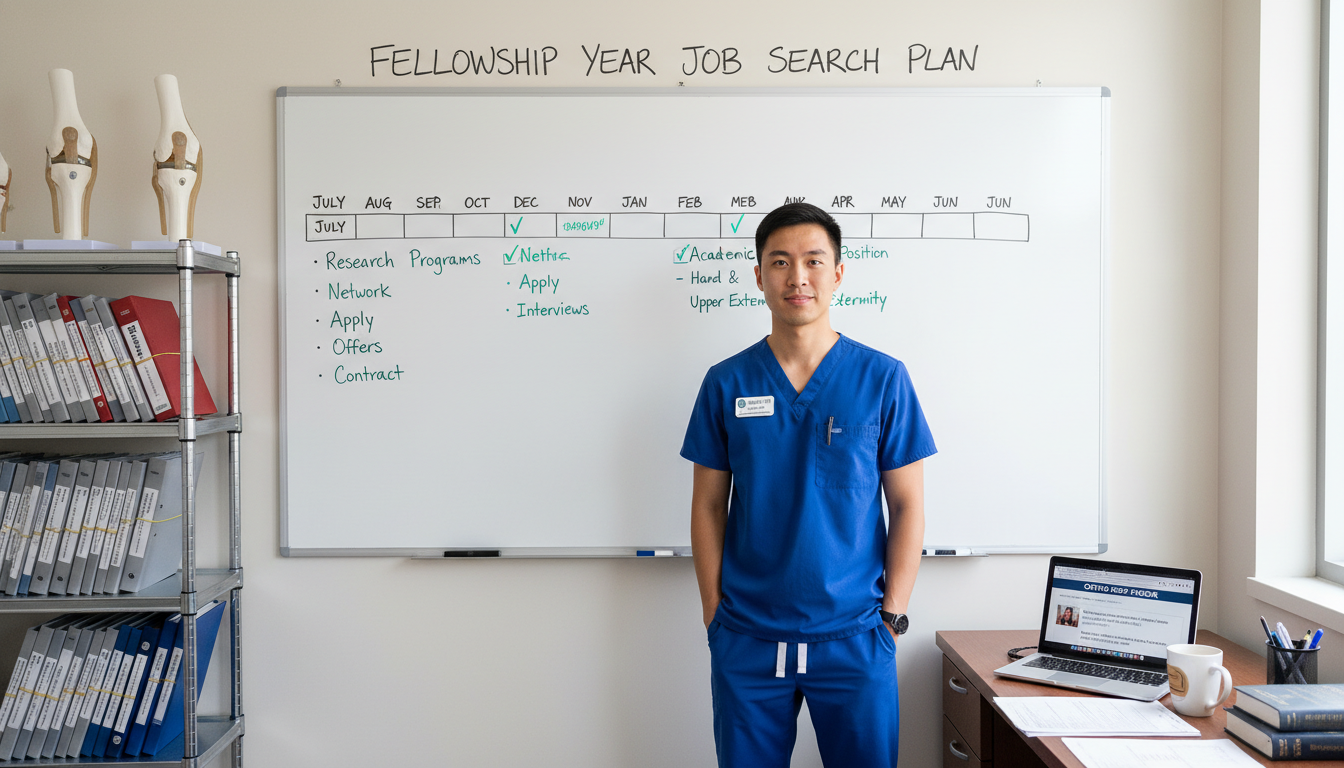
If You Are Doing a Fellowship: Adjusting the Timeline
Many DO orthopedic surgeons choose to subspecialize. Your job search timing must align with your fellowship calendar and the subspecialty’s dynamics.
Fellowship Year: Recommended Timeline
Assuming a one-year fellowship (e.g., joints, sports, trauma, spine):
Fellowship Months 1–3 (July–September)
- Focus on getting comfortable clinically
- Clarify what kind of attending practice you want (community vs academic, procedure mix)
- Refresh your CV, emphasizing fellowship training and cases
Months 3–6 (October–December)
- Begin active job search—this is often the prime window
- Let your fellowship director know your job goals and target locations
- Start taking recruiter calls and applying to positions in your subspecialty
- Attend fall meetings or winter conferences with a job search agenda
Months 6–9 (January–March)
- Conduct site visits
- Narrow your list to a few serious options
- Receive and negotiate offers
- Especially for desirable metros or big academic systems, aim to have a signed contract by the end of this window
Months 9–12 (April–June)
- Finalize licensing, credentialing, and relocation
- Solidify your personal and family transition plan
- Ensure your board exam and case log strategies fit within your early attending years
Subspecialty-Specific Notes
- Orthopedic surgery residency → Sports or Joints fellowship:
- High demand but location-sensitive. Very popular cities may require an earlier search.
- Spine:
- Good demand; mix of ortho and neurosurgery competition. Some markets saturate quickly; others are wide open.
- Trauma:
- Often hospital-employed roles; many trauma centers are eager to hire. The challenge is picking a lifestyle that’s sustainable.
- Hand / Pediatrics / Oncology:
- Fewer positions overall; may require more geographic flexibility and earlier networking.
Strategic Considerations for DO Graduates in Orthopedic Surgery
Being a DO graduate in orthopedics today is far more accepted than even a decade ago, particularly as the osteopathic residency match has merged into a single system. However, there are still nuances worth considering.
Leverage Your Training Background
Highlight:
- Your surgical volume and complexity
- Any exposure to rural or community trauma (high value for many employer hospitals)
- Multidisciplinary collaboration and patient communication skills
Use your DO background as an asset, not a disclaimer:
- Many community hospitals and patient populations value the holistic approach DOs are known for.
- Some osteopathic programs have particularly strong reputations in trauma or sports—make sure potential employers know this.
Understand Subtle Bias and How to Respond
Most employers primarily care about competence and collegiality, but if you encounter subtle bias:
- Redirect to objective strengths:
- “My residency was high-volume, and I’ll be bringing robust experience in [trauma/joints/sports] with more than [X] cases logged.”
- Focus on fit, outcomes, and reliability, not letters after your name:
- How you practice, communicate, and build a practice matters most.
- Use it as data:
- If a group shows repeated or explicit skepticism about DO training, think carefully about joining that culture.
Geographic Strategy
If your priority is a specific city or metro area:
- Start earlier (18+ months before completing residency or fellowship).
- Network heavily:
- Alumni from your med school or residency
- Fellowship faculty connections
- Local device reps and anesthesia groups
- Be aware that big markets (e.g., major coastal metros) may:
- Have more candidates than openings
- Be more competitive for new grads and may lean towards those with academic or prestigious program pedigrees
Smaller cities and mid-size markets often:
- Are more open to new DO graduates
- Offer stronger early volumes, faster path to partnership, and more OR time
Balancing Job Search with Board Exams and Life
Board Exams
- Plan job search stages around:
- Written exam dates (ABOS Part I / AOBOS primary)
- Case collection if you’re approaching Part II or oral exams soon after starting
- Ask potential employers:
- Will I get protected time or support for exam prep?
- How are other surgeons’ pass rates and support systems?
Personal and Family Factors
- Partners, spouses, and children will heavily influence where and when you sign.
- Consider:
- Spouse’s job market and licensing
- Cost of living relative to salary
- Proximity to extended family support
Avoiding Burnout in the Search
- Set time blocks during the week for calls and emails (e.g., one evening and one weekend block).
- Protect sleep and study time; this is especially important PGY-4–5 when clinical responsibilities are heavy.
- Remember: no job is worth sacrificing your long-term health or ethics. Be wary of red flags in culture, turnover, or opaque metrics.
Common Mistakes in Ortho Job Search Timing (and How to Avoid Them)
Starting too late
- Waiting until PGY-5 winter or fellowship spring to get serious limits your options.
- Prevention: Start exploration in late PGY-3 / early PGY-4 and active search by mid PGY-4 (or early fellowship for subspecialists).
Over-focusing on salary alone
- Highest initial salary doesn’t always predict long-term satisfaction.
- Look at call, culture, mentorship, support staff, and growth potential.
Ignoring licensing timelines
- Some state medical boards are notoriously slow.
- Apply for your target state license as soon as you sign or even a bit earlier if feasible.
Not using mentors and alumni
- DO graduates in orthopedics who are 5–10 years ahead of you are invaluable.
- They also remember what it felt like to be a new DO entering a competitive field.
Underestimating the ramp-up period
- Clarify:
- What your first year’s expected case volume is
- Whether you’ll inherit a retiring surgeon’s practice or build from scratch
- This affects your financial planning and injury to ego when your schedule isn’t full immediately.
- Clarify:
Frequently Asked Questions (FAQ)
1. When should a DO graduate in orthopedic surgery start looking for a job?
For most DO orthopedic residents going straight into practice, start serious job search efforts 12–18 months before graduation (around mid-PGY-4). If you’re planning to complete a fellowship, begin your attending job search 6–12 months before fellowship completion, earlier (up to 18 months) if you’re targeting highly competitive cities or academic roles.
2. Is there any disadvantage in the job search for DO graduates compared with MDs in orthopedic surgery?
In many settings, especially community and hospital-employed jobs, there is little to no practical disadvantage if your training and references are strong. Some academic or prestige-focused groups may remain subtly biased, but your program reputation, case volume, subspecialty training, and interpersonal skills generally matter far more. Use your DO background as an asset and choose environments that respect your training.
3. How early should I involve recruiters or apply to posted positions?
Start talking to recruiters and browsing postings around mid-PGY-4 (or the first third of your fellowship year). For most DO graduates, this is early enough to see a broad range of opportunities but not so early that employers hesitate to engage seriously. By early PGY-5 (or mid-fellowship), you should be scheduling site visits and moving toward offers.
4. What if I’m unsure about location—should I still start early?
Yes. You can start early with a broader geographic scope and then narrow as you learn more. Use PGY-4 and early PGY-5 to:
- Visit a few different styles of practice (urban vs suburban vs mid-size city)
- Compare hospital cultures, call schedules, and growth potential
As your personal and family situation clarifies, you can refine your target locations while still keeping your job search timing optimal.
By aligning your job search timing with your training stage, subspecialty interests, and personal goals—as a DO graduate in orthopedic surgery—you can approach the physician job market strategically instead of reactively. Start early, use your network, be honest about your priorities, and choose an opportunity that positions you for both professional growth and long-term well-being.