
Understanding the Big Picture: Why Job Search Timing Matters
For a DO graduate interested in global health, when you start your job search is almost as important as where you apply. The global health job landscape is fragmented—opportunities are spread across academic centers, NGOs, government agencies, faith-based groups, and international organizations. Many of these roles have long lead times, complex credentialing, and funding cycles that don’t align neatly with the standard U.S. residency calendar.
On top of that, as a DO graduate you may be juggling:
- Finalizing your osteopathic residency match or fellowship
- Completing visa requirements for international work
- Meeting licensure and credentialing timelines
- Deciding between a global health residency track, fellowship, or going straight into the workforce
Understanding the physician job market and the usual recruitment cycles will help you avoid two common pitfalls:
- Starting too late – leading to an unplanned employment gap or accepting a job that doesn’t match your global health goals.
- Starting too early – applying before your plans are clear, then burning bridges by backing out or renegotiating.
The goal of this guide is to give you a clear, month-by-month framework for your attending job search in global health, tailored for the DO graduate who either trained in a DO program or completed a DO graduate residency.
Key Timelines in Global Health Careers for DO Graduates
1. Two Parallel Timelines: Training vs. Employment
Most DO residents think of timing in terms of one dominant date: June 30, the end of residency. Global health careers add extra layers:
- Clinical employment timeline (hospital, FQHC, academic faculty)
- Global health program timeline (NGOs, fellowships, international medicine roles, multi-country projects)
These rarely line up perfectly. It’s common to:
- Start with a U.S.-based attending job while building global work through short-term trips or part-time roles.
- Accept a domestic attending job that includes a global health residency track–style component or protected time for international medicine.
- Complete a global health fellowship before or alongside your first attending position.
2. Typical Hiring Horizons by Role Type
Different employers hire on different timelines. As a DO graduate interested in global health, you may apply to more than one category at the same time:
A. U.S. Clinical Roles (Hospital, Clinic, FQHC)
- Begin recruitment: 12–18 months before start date
- Application sweet spot: 9–14 months before finishing residency
- Credentialing: 3–6 months once contract is signed
B. Academic Global Health Positions
- Begin recruitment: 12–24 months before position start, often tied to budget or grant cycles
- Application sweet spot: 12–18 months before planned start
- May require evidence of teaching, research, or prior global health work
C. NGO / International Organizations (International Medicine Roles)
- Large NGOs / UN agencies: recruiting cycles often 6–12 months before field deployment
- Smaller NGOs: sometimes 2–6 months before start, but visas and onboarding can extend this
- Funding cycles and grants can cause sudden openings or abrupt closures
D. Global Health Fellowships or Tracks (Post-Residency)
- Application windows: often 12–18 months before fellowship start
- Interview period: 9–12 months before start
- These may be formal global health fellowship programs or extended “global health residency track” opportunities for early-career attendings
The implication: if you want any global health–related component in your first job, you should be thinking seriously about your attending job search by mid-PGY-2 at the latest, and even earlier if you want a highly competitive academic or fellowship role.
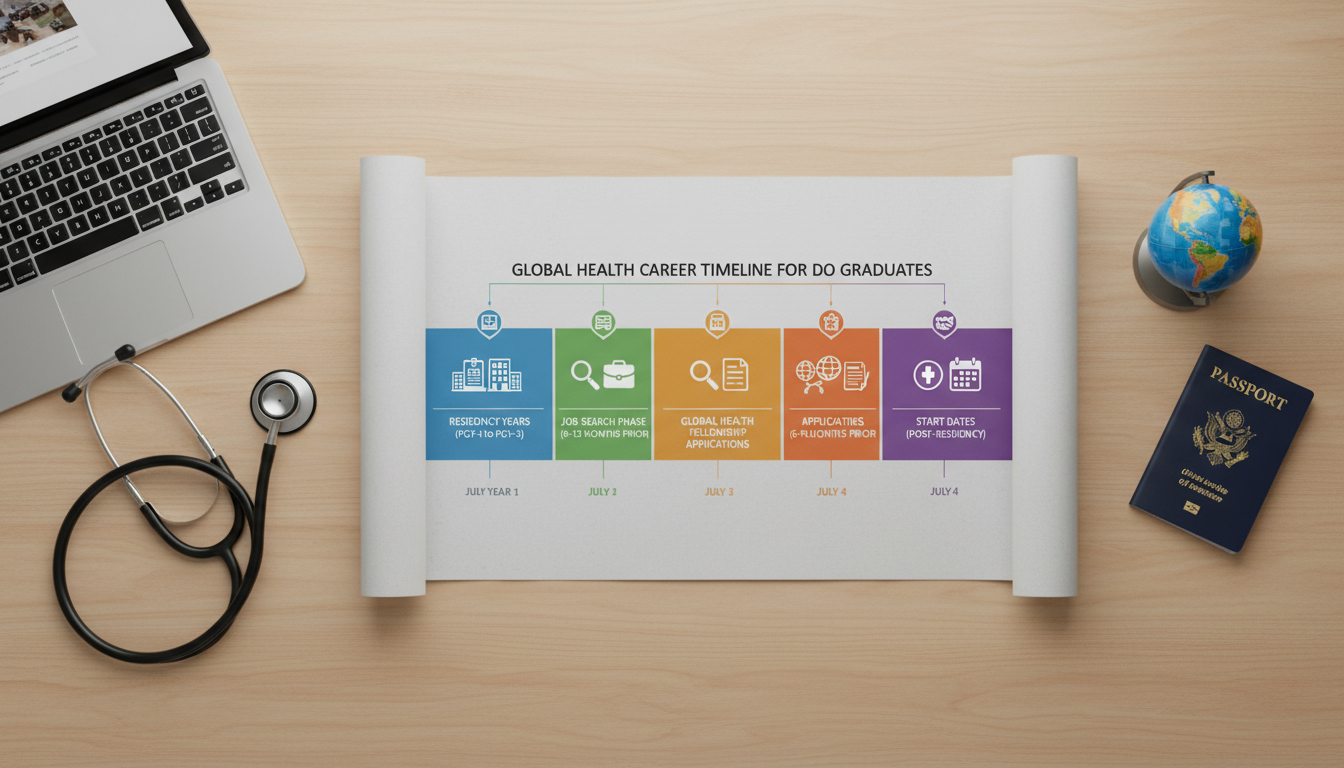
Month-by-Month Timeline: When to Start Your Attending Job Search
The timing will vary a bit by specialty and geography, but for most DO residents targeting global health–oriented careers, this is a realistic planning framework. We’ll assume a standard three-year residency ending in June of Year 3.
PGY-1: Explore and Position Yourself (18–30 Months Before Graduation)
You are not actively applying for jobs yet, but you’re laying the groundwork.
Goals:
- Clarify what “global health” means to you:
- Long-term international placement vs. U.S.-based with regular missions
- Academic global health vs. NGO/public health vs. clinical + outreach
- Identify how your DO background and training can be an asset (Osteopathic principles, holistic care, MSK skills, OMT in low-resource settings).
Actions:
Meet key mentors
- Find at least 1–2 faculty with global health or international medicine experience (even if they are MDs).
- Ask about:
- Their own job search timing
- Organizations that are DO-friendly
- Whether a global health residency track or fellowship is recommended in your field
Build your global health narrative
- Participate in:
- Global health interest group
- Quality improvement or research in health disparities, migrant health, refugee health, or rural/underserved work
- Document any prior international experiences (medical or non-medical) in a structured way on your CV.
- Participate in:
Begin light market research
- Browse roles on:
- Academic job boards
- NGO sites (MSF, Partners In Health, ICRC, etc.)
- Government agencies (CDC, USAID, state health departments)
- Do NOT apply yet—focus on:
- Which jobs ask for board certification vs. board eligibility
- Whether DO graduates are explicitly welcomed
- Terms like “global health,” “international medicine,” “underserved,” “FQHC,” “refugee health”
- Browse roles on:
Why this matters for timing:
By the end of PGY-1 you should know whether you’re likely to pursue:
- Direct attending job with some global health component, or
- A global health fellowship or structured post-residency track
This will determine how early you need to intensify your search.
Early–Mid PGY-2: Structure Your Plan (12–18 Months Before Graduation)
This is where timing becomes critical. If you want a global health position soon after graduation, you must start intentionally planning now.
Goals:
- Decide on your primary pathway:
- U.S.-based attending job with global health integration
- Global health fellowship or dedicated global health residency track extension
- NGO/international medicine role as a first position
- Identify geographic preferences (U.S. region, or specific countries/regions of interest).
Actions (12–18 Months Before Graduation):
Clarify career objectives in writing
- Draft a one-page “career vision”:
- Clinical interests and level of time abroad you want (e.g., 3 months per year vs. majority of time abroad)
- Academic vs. non-academic preference
- Populations of interest (refugees, HIV/TB, maternal-child health, disaster medicine, etc.)
- This will be invaluable for networking and interviews.
- Draft a one-page “career vision”:
Ask mentors specifically about timing
- When to start job search for your specialty and target setting
- Whether your specialty’s physician job market is tight or flexible in your preferred regions
- Which global health fellowships or tracks are realistic for your profile
Research the global health fellowship/training space
- Note application deadlines (often in the summer or early fall preceding graduation)
- Understand whether they:
- Accept DO graduates explicitly
- Count your osteopathic residency match and training as equivalent to ACGME programs (most now do, but check)
Polish your materials
- Update your CV with:
- Global health–relevant experiences
- Osteopathic experiences that highlight holistic care and adaptability
- Draft a general global health–oriented personal statement you can adapt later.
- Update your CV with:
Late PGY-2 – Early PGY-3: Active Job Search Begins (9–15 Months Before Graduation)
For many DO residents, this is the ideal time to move from exploration to formal applications. You are close enough to graduation that employers can see your board eligibility and training path, but early enough that positions are still widely available.
Goals (9–15 Months Before Graduation):
- Start formal outreach for attending roles and fellowships
- Schedule interviews for both domestic and global health positions where appropriate
- Narrow down your priorities between academic, NGO, and clinical roles
Actions:
Start contacting employers and programs
- For domestic clinical roles (with or without a global health focus):
- Contact hospital systems, FQHCs, and academic centers in your regions of interest
- For academic global health:
- Email program directors and division chiefs in global health or international medicine
- Ask about positions, attending roles with global work, and junior faculty tracks
- For NGO roles:
- Reach out to medical directors or human resources at organizations you're interested in
- Clarify:
- DO eligibility
- Licensure requirements
- Language expectations
- Field deployment cycles
- For domestic clinical roles (with or without a global health focus):
Apply to global health fellowships (if relevant)
- Typically start applications 12–14 months before fellowship start
- Plan to have:
- Updated CV
- Global health–focused personal statement
- Letters from sponsors who can speak to both your clinical skills and adaptability to low-resource settings
Discuss your DO background proactively
- Some institutions and global health employers may be more familiar with MD pathways.
- Be prepared to explain:
- Your osteopathic residency match
- ACGME-equivalence of your DO graduate residency (if needed)
- Any OMT skills that could contribute to musculoskeletal care in underserved regions
Begin first interviews
- Many interviews occur 6–12 months before start date.
- Consider grouping interviews geographically to control costs and time off.
Red Flag: Waiting until after winter of PGY-3 to start applying
By then, many top roles—especially in academic global health and fellowships—will already be filled or nearing final decisions. The later you start, the more likely you’ll have to compromise on location, salary, or global health scope.
Mid–Late PGY-3: Finalizing Offers (3–9 Months Before Graduation)
By this point, your main question is no longer “when to start job search” but rather “how to choose wisely among options and align start dates with your global plans.”
Goals (3–9 Months Before Graduation):
- Secure your primary post-residency commitment
- Align dates for onboarding, credentialing, and any overseas rotations
- Protect your future global health flexibility in your contract
Actions:
Compare offers with a global health lens
- For each offer, assess:
- Will you have any protected time for global health or international medicine?
- Are there existing global partnerships you can plug into (sister hospitals, exchange programs, telehealth)?
- Does the employer have a history of supporting DO graduates in global work (letters, flexible scheduling, unpaid leave)?
- For each offer, assess:
Negotiate global health–friendly terms
- Consider asking about:
- Option for short unpaid leaves (e.g., 2–4 weeks per year) for global health work
- Flexible scheduling (e.g., block scheduling that allows travel)
- Use of CME funds for global health conferences, tropical medicine courses, or international site visits
- Confirm how malpractice coverage works if you practice abroad under their umbrella, or if you need separate coverage.
- Consider asking about:
If accepting an NGO/international job:
- Clarify:
- Start date vs. training/orientation date
- Visa timelines (which can push your effective start date months later)
- Safety, housing, and family logistics
- Ask if you can start with a shorter assignment (e.g., 3–6 months) instead of making an open-ended commitment as a new attending.
- Clarify:
If accepting a fellowship or academic global health path:
- Secure offers 6–9 months before start, if possible.
- Plan financially—fellowship stipends are often lower than attending salaries, and global health travel may or may not be funded.
Plan a backup
- The international or NGO world can be unpredictable—funding changes, political crises, and visa complications can suddenly close doors.
- Secure a backup plan (e.g., U.S.-based attending job that starts slightly later, PRN locums, or telemedicine) in case your first-choice global health role is delayed.

Special Considerations for DO Graduates in Global Health
1. DO vs. MD in the Global Health Job Market
While DO and MD training are increasingly treated equivalently in U.S. settings, international recognition can vary.
Consider:
- Some countries are less familiar with the DO degree.
- Many NGOs and international programs focus mainly on licensure in your home country, not the specific letters after your name.
Action Steps:
- Emphasize:
- Board eligibility/certification in your specialty
- Completion of an ACGME- or ACGME-equivalent osteopathic residency
- Provide a brief explanation of the DO philosophy and training if you sense uncertainty.
- Use wording like: “Fully licensed U.S. physician in [specialty], board-eligible/board-certified, DO graduate.”
2. Licensing and Credentialing Timelines
Timing your job search means accounting for all the “hidden” time between offer and first day of work.
Typical timelines:
- State medical license: 2–4 months, sometimes longer
- Hospital privileging: 1–3 months
- Visa processing for international roles: 2–6+ months
Practical advice:
- Start your state license application as soon as you’ve committed to a region—even before you sign your contract, when appropriate and financially feasible.
- Ask potential employers how long credentialing usually takes and plan backward from your desired start date.
3. Balancing Student Loans and Global Health Salaries
Many global health jobs—especially NGO or academic positions—pay less than high-demand private practice roles. This reality affects when and how you search for jobs.
Strategies:
- Consider starting with a higher-paying U.S. attending role for 1–2 years while:
- Paying down highest-interest loans
- Building emergency savings
- Negotiating global health work into your schedule
- Explore:
- Public Service Loan Forgiveness (PSLF) if employed by nonprofits or academic centers
- Loan repayment programs tied to service in underserved U.S. regions, which can complement a global health ethos and strengthen your CV
The earlier you think about these financial pieces (ideally by late PGY-2), the more strategic and less rushed your attending job search can be.
4. Family and Life Logistics
Global health careers often involve travel, relocation, or living in resource-limited settings. The timing of your job search and first international role may need to align with:
- Partner’s career transitions
- Children’s school years
- Elder care or other family responsibilities
Discuss these timelines early with your support system so that:
- You can choose between shorter overseas missions vs. long-term placement.
- Your attending job search can prioritize flexibility and location stability when needed.
Practical Examples: Three Common DO Global Health Pathways
Example 1: DO Graduate Going Straight into U.S. Attending Role with Global Component
Timeline:
- PGY-2, 14 months before graduation: Starts reaching out to academic centers with global health programs.
- PGY-3, 10 months before graduation: Formal interviews at sites with established international medicine electives.
- PGY-3, 6 months before graduation: Accepts an assistant professor role with 20% time allocated to global health projects and short-term travel.
Key Timing Moves:
- Started job search early enough to access positions with protected global health time.
- Negotiated ability to take a 3–4 week trip annually with minimal disruption.
Example 2: DO Graduate Pursuing Global Health Fellowship First
Timeline:
- PGY-2, summer: Identifies 4–5 global health fellowship programs.
- PGY-2, fall: Submits applications (about 18 months before fellowship start).
- PGY-3, winter: Interviews and receives offers.
- PGY-3, spring: Accepts fellowship and delays U.S. attending job search until mid-fellowship.
Key Timing Moves:
- Treated fellowship applications like a second match, starting early.
- Used fellowship time to clarify long-term geographic and clinical preferences and then timed the first attending job search for mid-fellowship.
Example 3: DO Graduate Taking an NGO/International Role as First Job
Timeline:
- PGY-2, 15 months before graduation: Begins networking through global health conferences and faculty.
- PGY-3, 12 months before graduation: Contacts NGO medical directors, clarifying DO eligibility and licensure.
- PGY-3, 8 months before graduation: Receives conditional offer pending visa and security clearance.
- PGY-3, 3 months before graduation: Visa is still pending—activates backup plan with a U.S. locums agency.
Key Timing Moves:
- Recognized early that international placement can be delayed by visas and security issues.
- Built a backup plan to avoid unemployment if the NGO start date slipped.
Putting It All Together: A Simple Timeline Checklist
Use this as a quick reference for when to start your job search as a DO graduate interested in global health:
18–24 Months Before Graduation (Early PGY-2 / Late PGY-1)
- Clarify your global health interests and long-term vision
- Identify mentors and learn about global health fellowship options
- Start casual market research (academic, NGO, FQHC, international medicine roles)
12–18 Months Before Graduation (Mid PGY-2)
- Decide on main path: fellowship vs. attending job vs. NGO
- Prepare CV and draft global health–focused personal statement
- Identify preferred geographic regions (U.S. and/or international)
9–15 Months Before Graduation (Late PGY-2 – Early PGY-3)
- Actively apply to:
- Global health fellowships
- Academic and clinical positions with global components
- Select NGO roles and international medicine opportunities
- Begin interviews and site visits
3–9 Months Before Graduation (Mid–Late PGY-3)
- Compare and negotiate offers with a global health lens
- Finalize contract for primary post-residency commitment
- Start licensure, credentialing, and—if applicable—visa applications
- Solidify backup plan if international or NGO start dates are uncertain
0–3 Months Before Graduation
- Confirm start dates and orientation details
- Wrap up residency, ensure smooth handoff of projects
- Prepare personally and professionally for the transition to attending life and global health work
FAQs: Job Search Timing for DO Graduates in Global Health
1. When should I start my job search if I want a global health–oriented attending role?
For most DO residents, begin serious, active searching 9–15 months before graduation. That means late PGY-2 to early PGY-3. Start earlier (12–18 months) if you’re targeting competitive academic global health or fellowship positions.
2. Does being a DO change the timing of my job search compared to MD graduates?
The timing is broadly similar, but DO graduates should allow a bit of extra time to:
- Clarify how their osteopathic residency match and training map onto any ACGME expectations.
- Explain the DO degree to international or NGO-based employers who may not be familiar with it. Practically, this means leaning toward the early end of the 9–15 month window for competitive roles.
3. How do global health fellowships fit into the job search timeline?
Treat global health fellowships like a second residency match:
- Research them by early PGY-2
- Apply 12–18 months before the fellowship start date
- Expect interviews 9–12 months before start
After you start fellowship, plan your attending job search around 6–12 months before finishing that fellowship.
4. What if I’m undecided between global health and a purely domestic job when my job search should start?
You don’t have to decide everything up front. When you first ask yourself when to start job search, include both paths:
- Apply to a mix of domestic and global health–oriented positions.
- During interviews, probe each employer’s flexibility and opportunities for international medicine.
Aim to narrow your choice by 6–9 months before graduation, so you can commit to one primary role and complete licensure and credentialing without rushing.
Planning your attending job search with these timelines in mind will help you step into the physician job market with clarity and confidence, honoring both your DO training and your commitment to global health.