
Navigating the job market as a US citizen IMG in a preliminary surgery year is uniquely challenging. You’re still in training, your long-term path may be in flux, and the typical “PGY-5 to attending” trajectory doesn’t apply—at least not yet. Knowing when to start your job search (and what type of jobs to pursue at each stage) is critical for avoiding gaps, preserving visa flexibility (if relevant for colleagues), and keeping your surgical options open.
This guide focuses on job search timing for an American studying abroad who’s now back in the US in a prelim surgery residency and trying to map out next steps in the broader physician job market.
Understanding Where You Stand as a US Citizen IMG in Preliminary Surgery
Before talking timing, you need clarity on your position and your likely pathways.
1. What a Preliminary Surgery Year Really Means
A preliminary surgery year is usually:
- A one-year position (PGY-1; occasionally PGY-2)
- Without a guaranteed categorical slot in that program
- Designed to:
- Fill program service needs
- Provide training for those transitioning to other specialties (e.g., anesthesia, radiology)
- Serve as a bridge year while you seek a categorical surgical position or another residency track
For a US citizen IMG, the prelim year can be both a door-opener and a bottleneck:
- It gives you US clinical experience (a major asset for American studying abroad candidates).
- But it also expires quickly, and you can’t assume you’ll roll into a categorical PGY-2.
2. The Three Main Pathways After a Prelim Surgery Year
Your job search timing depends heavily on which of these you are targeting:
Another residency spot (most common goal)
- Categorical General Surgery
- A different surgical subspecialty pathway (e.g., integrated vascular, plastics)
- A different specialty entirely (e.g., anesthesia, radiology, PM&R, internal medicine)
Non-residency clinical job
- Surgical clinical research fellow
- Surgical ICU or hospital-based research positions
- Some hospital-based “physician” or “clinical associate” positions (state- and institution-dependent)
- Telemedicine roles (more limited for someone without board certification, but some contexts exist)
Non-clinical or hybrid roles
- Research-only positions
- Medical education, simulation, or curriculum roles
- Industry (medtech, pharma, consulting, health IT)
All three pathways often overlap in timing. The key for a US citizen IMG is not to wait until your prelim year is ending; you need to parallel-process residency and job searches.
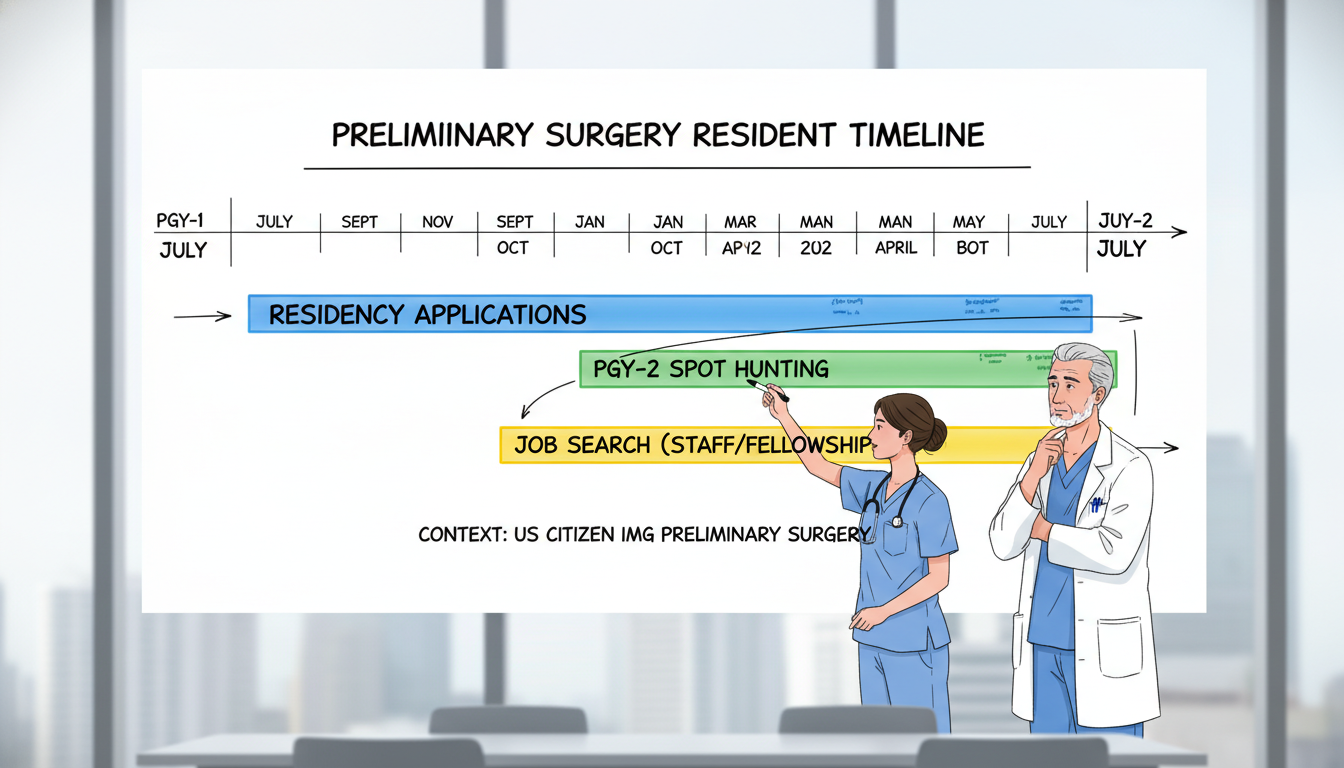
The Three Critical Timelines You Must Manage
To plan when to start your job search, keep track of three overlapping clocks:
- Residency application cycle (NRMP/ERAS)
- In-year PGY-2 categorical and off-cycle openings
- Physician and non-resident job market hiring cycles
1. The Standard Residency Cycle: Don’t Lose This Window
If you’re in a PGY-1 prelim surgery year and want any categorical residency, the NRMP/ERAS cycle is your main structured opportunity.
Typical timing (for positions starting July 1 the following year):
June–August (Prelim Year, Months 1–3)
- Clarify your target: categorical surgery vs. switch to another specialty vs. apply broadly.
- Request letters from medical school and any early attendings who know your work.
- Start drafting your personal statement with your prelim experience in mind.
September–October (Months 3–5)
- ERAS opens; programs start reviewing applications.
- You should submit your residency application no later than end of September to stay competitive.
- Continue obtaining strong letters—include at least one from your surgery PD or a core faculty member if possible.
November–January (Months 5–7)
- Interview season.
- You must schedule interviews around your call schedule—start asking your chief residents for flexibility early.
February–March (Months 7–9)
- Rank list certification and Match.
- SOAP participation if needed.
Key implication for job search timing:
While you’re going through this residency application cycle, you should not delay planning for backup job options in case you:
- Don’t match into a categorical position
- Decide to step away from residency temporarily after prelim year
- Need an interim year for strengthening your application
2. PGY-2 Categorical and Off-Cycle Openings
Many prelim surgery residents find categorical positions outside the main Match, often during or shortly after the prelim year.
These openings can appear:
- Late winter to spring (Months 6–10) for July 1 PGY-2 spots
- Anytime during the year when a categorical resident resigns, transfers, or is dismissed
Where to find them:
- Program emails and listservs (SCORE, ACS communities, specialty societies)
- APDS (Association of Program Directors in Surgery) job postings
- Institutional GME office notices
- Direct emails or calls from your PD to other PDs on your behalf
Timing strategy:
- Begin actively asking your PD about upcoming PGY-2 categorical or advanced positions by December–January of your prelim year.
- Regularly check surgery program job boards from January onward.
- Ask your PD explicitly whether they might be able to convert you to categorical—ideally by January–February. If the answer is “unlikely,” you need a robust Plan B.
3. Physician and Non-Residency Job Market Cycles
The attending job search timeline doesn’t directly apply to you yet, but the structure of the broader physician job market still matters.
Broad patterns:
- Hospitals and large groups recruit primarily for board-eligible/board-certified attendings, usually 6–12 months before start date.
- Non-residency roles suited for someone finishing a prelim year (e.g., research fellowships, clinical associate positions) may recruit:
- Annually (similar to fellowship cycles)
- On a rolling basis
- In response to grant funding changes or staff turnover
For someone finishing a prelim year, plan to start non-residency job searching:
- 6–9 months before your contract ends (typically November–January for a June 30 end date).
- This is early enough to compete for structured 1-year research or clinical positions starting July 1, and still flexible enough if a categorical spot appears.
Month-by-Month Job Search Strategy During a Prelim Surgery Year
This section assumes a July start for a PGY-1 preliminary surgery year. Adjust months proportionally if your start date differs.
July–September (Months 1–3): Foundation and Direction
Core goals now:
- Survive the steep learning curve
- Build early relationships
- Decide whether you’re going to pursue surgery long-term or pivot
Job search timing tasks:
Clarify your primary track:
- Track A: Stay in surgery (aim for categorical gen surg or integrated track)
- Track B: Switch specialty (anesthesia, radiology, IM, etc.)
- Track C: Exit residency after prelim (research, non-clinical, or non-US training)
Start residency application prep immediately if pursuing Track A or B:
- Identify letter writers (senior residents, faculty, PD).
- Draft personal statement addressing why you started in prelim surgery and where you’re headed.
- Update CV emphasizing:
- US medical graduate but IMG status (American studying abroad)
- US clinical experience during prelim year
- Any research or leadership roles
First conversations with PD/mentor:
- By the end of September, schedule a frank meeting:
- Ask: “Realistically, what are my chances of converting to categorical here?”
- Ask for guidance on targeting programs that accept prelims.
- By the end of September, schedule a frank meeting:
You are not yet applying for non-residency jobs, but you are laying groundwork in case you need them.
October–December (Months 4–6): Dual Focus—Residency Applications and Future Options
During this period, you’re fully immersed in residency interviews, yet you should also start scanning the job landscape.
Residency-related:
- Submit ERAS by late September/early October.
- Attend interviews November–January.
- Make sure letters from surgical attendings are uploaded early.
Job search timing actions:
Information gathering (not yet heavy applications):
- Identify institutions with robust research infrastructures (academic surgery departments, NCI-designated cancer centers, large trauma centers).
- Make a list of:
- Surgical research fellowships (HPB, trauma, transplant, colorectal, etc.)
- Non-ACGME surgical fellowships that may accept those without categorical surgery training
- Clinical associate or junior hospitalist-like roles where state rules allow physicians prior to full residency completion
Initial networking (October–December):
- Quietly ask attendings:
- “Do you know of any research or non-categorical roles that are historically open to prelims?”
- Reach out to residents who previously did a prelim year:
- “Where did you see people go after prelim?”
- Quietly ask attendings:
You’re still prioritizing the residency Match, but you’re also building a warm network for backup jobs.
January–March (Months 7–9): Critical Decision Window and Active Backup Job Search
This is the most important phase for job search timing if you’re in prelim surgery.
Key realities by January:
- You’ll have a sense of how interviews went.
- Your PD should have a reasonable idea if internal categorical spots may open.
- Many July 1 research fellowships or clinical positions are being filled in this window.
Actions in January–March:
Clarify with your PD by January:
- “Is there a realistic path to categorical here?”
- “If not, would you support me in seeking PGY-2 or research positions elsewhere?”
- Request strong, specific letters:
- For categorical/PGY-2 spots
- For research or other positions
Actively apply for backup roles starting January:
- Research fellowships in trauma, surgical oncology, transplant, etc.
- Clinical research coordinator or physician-researcher roles in surgery departments.
- Any structured “gap year” positions designed for residents.
Apply for off-cycle PGY-2 spots:
- Monitor APDS/GME job boards weekly.
- When an opening appears:
- Email same day with:
- Updated CV
- Brief cover email (“Currently a PGY-1 prelim surgery resident at X; seeking PGY-2 categorical/advanced position for July 1; US citizen IMG with strong US LORs.”)
- Letter from your PD if possible
- Email same day with:
Prepare mentally for three scenarios by March:
- You’re likely matching into a categorical or second residency.
- You’re strongly competitive for a PGY-2 spot that might materialize late.
- You will need a research or non-residency job for at least one year.
This is when you start seeing the physician job market as an actual option, not a distant future.
April–June (Months 10–12): Finalizing Contracts and Avoiding Gaps
By this point, you must lock in something for July 1—residency or non-residency.
If you matched or secured a PGY-2 spot:
- Finalize credentialing and move logistics.
- You may still keep informal lines of communication open in case of better fits or late opportunities, but your path is clearer.
If you did NOT match and have no categorical spot yet:
Aggressively finalize research or clinical roles (April–May):
- Many July 1 roles need contracts signed by May.
- Emphasize in applications:
- Your US citizen IMG background—no visa issues is a selling point.
- Your hands-on surgical experience and comfort with the hospital environment.
Look for short-notice or off-cycle positions (April–June):
- Occasionally, PGY-2 or additional prelim roles appear very late.
- A 1-year research fellowship starting later (e.g., August–September) can still be worthwhile.
Avoiding a gap:
- A gap of >3–6 months after a prelim year is much harder to explain.
- Even a short-term research assistant or clinical observation role is better than inactivity.
How Early Is “Too Early” or “Too Late” to Start a Job Search?

Because the attending job search model (start 12–18 months in advance) doesn’t directly fit a prelim, it’s helpful to think in principles:
1. It’s Too Early If…
- You’re within the first 1–2 months of the prelim year and don’t yet know:
- Whether you can handle surgery
- How your PD and attendings view your performance
- You’re sending generic mass emails before your own PD has seen what you can do
- You’re thinking in terms of permanent attending jobs rather than the next logical step (residency or bridging role)
At this stage, focus on:
- Building a stellar reputation
- Learning OR basics and ward management
- Gathering preliminary feedback
2. It’s Too Late If…
It’s April–May of your prelim year and you have:
- No residency match
- No PGY-2 prospects
- No research or job applications in motion
You’re relying solely on last-minute categorical positions without any backup plan.
For a US citizen IMG in prelim surgery, “too late” usually means you’ve allowed your contract to end without a clear, signed next step starting within 2–3 months.
3. The “Right” Timing in One Sentence
You should start actively planning your next step (residency or job) by Month 3, and actively applying for non-residency jobs or research roles by Month 7–8 if your long-term residency situation is still uncertain.
Special Considerations for US Citizen IMGs and the Job Market
Being a US citizen IMG brings both challenges and advantages in the physician job market after a prelim surgery year.
Advantages
No Visa Sponsorship Issues
- You’re immediately more attractive than non-citizen IMGs for many employers and research programs.
- Programs may be more willing to take a chance on you for “invented” or non-standard roles.
Flexibility in Location and Timing
- You can accept short-term contracts or off-cycle positions without immigration complications.
- Industry and non-clinical roles are more open because there’s no need for visas.
Challenges
Perception of Commitment or Direction
- Some PDs may worry that a prelim-only path reflects a less competitive or less directed candidate.
- You must frame your prelim year as:
- A deliberate strategic step
- A reflection of the intense competition in surgery
- Proof of resilience and adaptability
Complex Career Narratives
- As an American studying abroad, you may already be explaining why you trained outside the US.
- Add to that: why you started in prelim surgery, and where you’re heading now.
- Your personal statement and cover letters must be coherent and forward-looking, not apologetic.
Positioning Yourself in Job Applications
When applying for non-residency positions (research, clinical associate, etc.), emphasize:
- “US citizen IMG who completed a rigorous preliminary surgery residency at [US institution].”
- “Comfortable with OR workflows, acute care, and multidisciplinary teams.”
- “Seeks a 1–2 year position to deepen surgical research/clinical experience while pursuing a categorical residency.”
In the broader physician job market, this framing helps employers see you as:
- Trained
- Committed
- Immediately useful to a surgical team
Rather than as someone who “couldn’t get a categorical spot.”
Practical Action Plan: What to Do at Each Stage
To summarize when to start your job search and what to focus on:
Before Starting Your Prelim Year (If You Haven’t Started Yet)
- Clarify your target: surgery vs. other specialties.
- Research programs that historically convert prelims to categoricals.
- Line up letter writers from med school who can support your long-term goals.
Months 1–3 (Early Prelim)
- Focus: Performance and direction-setting
- Tasks:
- Ask for feedback early and often.
- Decide if you’re staying in surgery or pivoting.
- Begin preparing residency application materials if aiming for categorical positions.
Months 4–6
- Focus: Residency applications + early job market awareness
- Tasks:
- Submit ERAS; attend residency interviews.
- Begin informal networking about research and non-residency options.
- Keep your PD updated on your goals.
Months 7–9
- Focus: Decisive planning and active backup job search
- Tasks:
- Have an honest meeting with PD about categorical prospects.
- Apply to:
- PGY-2 and off-cycle positions
- Surgical research fellowships
- Clinical or hybrid positions in surgery departments
- Keep your schedule flexible for last-minute interviews.
Months 10–12
- Focus: Signing something concrete for after June 30
- Tasks:
- Finalize contracts for residency or research/clinical roles.
- If still unsolved by April–May:
- Intensify outreach (cold emails, calls)
- Target shorter-term or off-cycle roles
- Avoid gaps longer than 2–3 months if at all possible.
Frequently Asked Questions (FAQ)
1. As a US citizen IMG in a preliminary surgery year, when should I start applying for non-residency jobs?
Begin serious planning by Month 3–4 and active applications by Month 7–8 of your prelim year if your categorical prospects are uncertain. This lets you compete for July 1 research or clinical roles while you are still in the Match and pursuing PGY-2 categorical openings.
2. Is it realistic to find a categorical general surgery spot after a prelim year?
Yes, but it is competitive and depends on your performance, letters, and networking. Many prelim surgery residents do secure PGY-2 categorical positions through off-cycle openings or future-year conversions. Start asking your PD about internal options by January, and watch national job boards from January onward.
3. What if I don’t match into any residency after my prelim year—will my career be over?
No. Many physicians take 1–2 years in research or clinical positions after a prelim year to strengthen their applications. As a US citizen IMG, you have an advantage in the job market because you don’t require visa sponsorship, making it easier to secure research fellowships, clinical associate roles, or non-clinical positions while you reapply.
4. How different is my job search timing from an attending job search?
Attending job searches typically begin 12–18 months before the desired start date. In contrast, a prelim surgery resident should start planning the next step by Month 3, apply for residencies in the usual ERAS timeline, and begin applying for gap-year jobs 6–9 months before the end of the prelim contract. You’re not searching for a permanent attending job yet; you’re strategically securing your next training or bridging role in the physician job market.
By understanding these timelines and starting early, you can turn your preliminary surgery year from a stressful holding pattern into a launchpad—whether that’s into a categorical surgical residency, another specialty, or a well-chosen role in the broader physician job market.