
Finding your first attending job as an international medical graduate (IMG) in pediatrics is exciting—and stressful. One of the most confusing pieces is timing: when to start exploring, when to apply, when to sign, and how this interacts with visas, the peds match, and graduation.
This IMG residency guide focuses specifically on job search timing for pediatrics residents and fellows, with practical, step‑by‑step advice tailored to IMGs.
Understanding the Pediatric Job Market Timeline
The physician job market for pediatrics is different from competitive subspecialties like dermatology or orthopedics. In peds, there are many community and hospital-employed positions, but timing still matters—especially for IMGs with visa needs.
Typical Timeline for U.S. Graduates vs. IMGs
For U.S. graduates in pediatrics:
- Most start actively looking around PGY-2 winter / early PGY-3
- Many sign offers between 6–10 months before graduation
- Some wait longer if they are couples matching or geographically restricted
For an international medical graduate in pediatrics, the timeline should usually be earlier and more deliberate because of:
- Visa sponsorship (J‑1 waiver, H‑1B, O‑1)
- State licensing timelines
- ECFMG and board eligibility documentation
- Institutional policies on hiring non‑citizens
Bottom line: For IMGs, it’s rarely too early to start gathering information. It’s very possible to be too late.
Year‑by‑Year: When to Start Your Job Search in Pediatrics
This section breaks down exactly what to do each year of residency (and fellowship, if applicable), with timeframes and specific action steps.
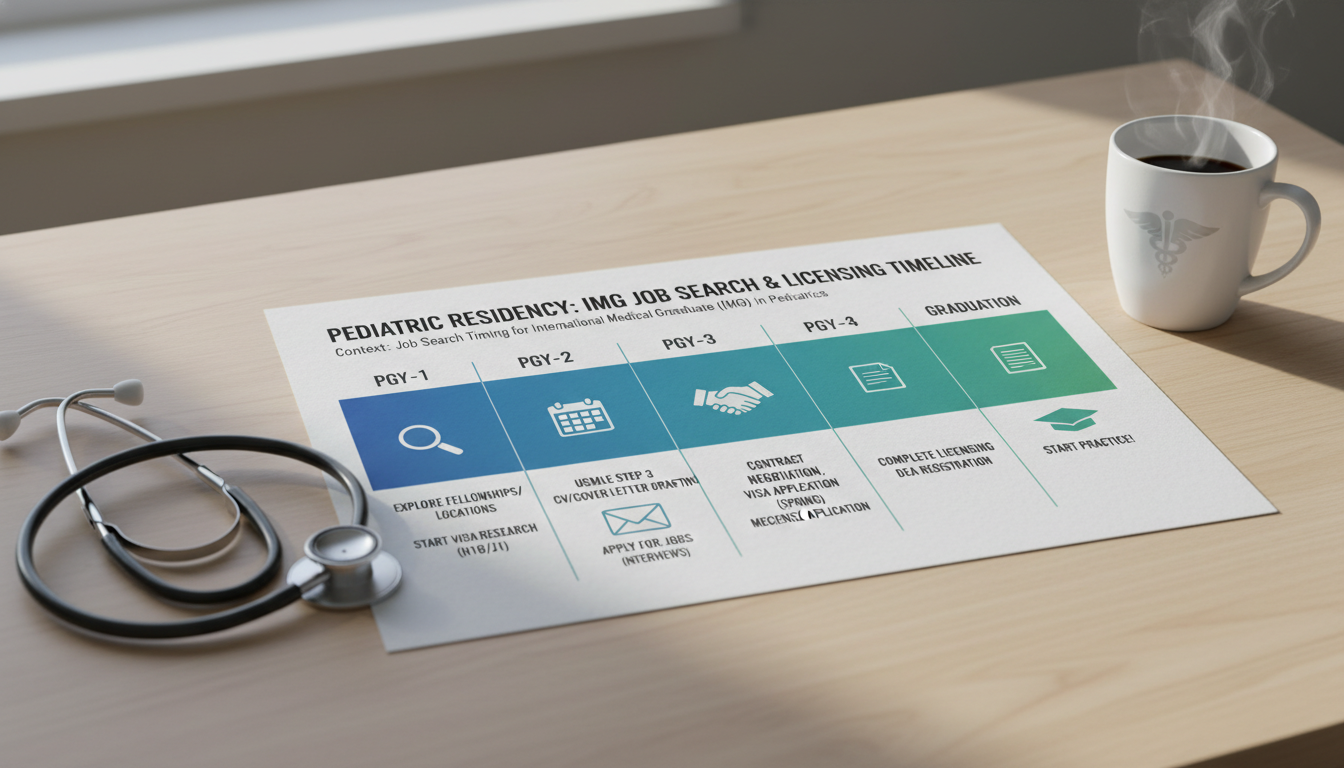
PGY‑1: Laying the Groundwork (Exploration Phase)
Most PGY‑1s are focused on adjusting to residency and passing Step 3, but timing starts here in subtle ways.
Key goals in PGY‑1:
- Learn the U.S. health system and pediatric care patterns
- Start clarifying what kind of pediatrics career you want
- Understand your visa situation and long‑term options
Action steps (PGY‑1):
Clarify Visa Status and Options
- If on a J‑1, understand the J‑1 waiver requirement (typically 3 years in an underserved area).
- If on an H‑1B, ask your GME office and immigration counsel about:
- Maximum duration of H‑1B
- Cap-exempt vs. cap-subject employment
- If considering O‑1, start documenting academic output (publications, presentations, awards).
Track Interests
- Keep a simple log of rotations you enjoy:
- General pediatrics vs. subspecialty
- Inpatient vs. outpatient
- Urban academic vs. suburban community vs. rural
- This will guide your attending job search later.
- Keep a simple log of rotations you enjoy:
Begin CV and Networking Lightly
- Maintain an updated CV (yes, even as PGY‑1).
- Connect with:
- Your program’s graduates on LinkedIn
- Faculty who practice in your dream locations
- No need to actively job hunt yet—focus on learning and relationship building.
Timing mindset (PGY‑1):
You are not applying yet. You are positioning yourself and understanding what the job search will eventually involve as an IMG in pediatrics.
PGY‑2: Strategy and Early Market Recon (Planning Phase)
This is the most important strategy year. You’re more confident clinically and it’s early enough to explore options before you feel rushed.
Key goals in PGY‑2:
- Decide on fellowship vs. general pediatrics
- Identify target regions and practice types
- Build a job search timeline that accounts for visas and licensing
If You Plan to Do General Pediatrics (No Fellowship)
When to start job exploration:
- Early to mid‑PGY‑2 (about 18–24 months before graduation)
Action steps:
Clarify Career Targets Ask yourself:
- “Where do I want to live?” (state/region, urban vs. rural)
- “Do I prefer outpatient clinic, inpatient hospitalist, urgent care, or mixed?”
- “Am I comfortable with underserved or rural practice for a J‑1 waiver?”
Research State Licensing Timelines
- Some states take 6–9+ months for a license, others are faster.
- If targeting slow-license states (e.g., California historically), you may need to sign earlier.
Talk to Graduating Seniors
- Ask PGY‑3s:
- “When did you start your job search?”
- “What would you have done earlier?”
- “Any IMG‑specific challenges you faced?”
- Ask PGY‑3s:
Begin Light Market Scanning
- Subscribe to:
- AAP (American Academy of Pediatrics) job boards
- Major physician job boards (PracticeLink, NEJM, JAMA Career Center, AAP Career Center)
- Pay attention to:
- How many jobs mention J‑1 or H‑1B sponsorship
- Desired start dates (“Start Summer 202X”)
- Settings: hospital-employed vs. private practice vs. FQHC
- Subscribe to:
Meet with Program Leadership
- Ask your PD or APD:
- “Given my visa status and career goals, when should I start applying?”
- “Do you know former residents who took J‑1 waiver jobs in pediatrics?”
- This builds support and helps with references later.
- Ask your PD or APD:
If You Plan to Apply for Fellowship
Your timing splits into two paths:
- Path A: Fellowship → Attendingship (you are not job hunting now, but after fellowship)
- Path B: Applying to fellowship but open to attending job if you don’t match
For Path A (committing to fellowship):
- PGY‑2 is mostly about fellowship applications, not the attending job market.
- Still:
- Be aware of fellowship‑to‑job timing (see dedicated section below).
- Keep your CV strong in case you need to pivot.
Timing mindset (PGY‑2):
You begin serious planning now. You still have flexibility, but your choices this year (fellowship vs. general pediatrics, region preferences, visa planning) shape your attending job timeline.
PGY‑3: Active Job Search and Signing (Execution Phase)
For most pediatrics residents going straight into practice, PGY‑3 is the primary job search year.
Ideal timing for IMGs in pediatrics:
Start active search:
- 12–18 months before your desired start date
- For a July start after graduation, aim to start August–December of PGY‑3 (or even late PGY‑2 for IMGs with visa needs).
Sign contract:
- 6–10 months before start date, earlier if:
- J‑1 waiver processing is needed
- State licensing is slow
- Position is in a competitive metro area
- 6–10 months before start date, earlier if:
Concrete Timeline Example (General Pediatrics, J‑1 IMG)
- July, PGY‑3 starts
- August–September:
- Finalize CV and cover letter
- Start applying to jobs that:
- Sponsor J‑1 waiver
- Are in states you like and can license in on time
- October–January:
- Interviews (virtual + on-site)
- Compare offers, ask about visa/legal support
- By January–March:
- Aim to sign contract, especially for waiver positions requiring early state or federal processing
- Spring–Summer:
- Complete licensing paperwork
- Process J‑1 waiver or H‑1B petitions
- Prepare for move and onboarding
- July:
- Start first attending pediatrics job
For H‑1B or O‑1 Candidates
- If moving from cap‑exempt to cap‑subject H‑1B, the April H‑1B lottery and October 1 start date can heavily impact timing.
- If transitioning from J‑1 to H‑1B through a waiver position, your future employer’s immigration counsel will help you plan:
- J‑1 waiver application
- H‑1B petition timing
- For O‑1, gather evidence early, as petitions can take several months unless premium processed.
Why IMGs Should Be Early:
Employers may:
- Need extra time to clear visa sponsorship through their administration
- Have limited annual slots for foreign national hires
- Require multiple rounds of committee approval
Starting your attending job search too late may mean you:
- Miss J‑1 waiver cycles or H‑1B windows
- Have to compromise on location or practice type
- Experience a gap after residency (riskier for visas)
Fellowship Timing: When to Start Job Search as a Pediatric Subspecialist
If you’re doing a pediatrics fellowship—NICU, PICU, heme/onc, cardiology, etc.—the timeline shifts, but the strategy is similar.

General Timeline for Pediatric Fellows (3‑year fellowship)
- Fellowship Year 1 (F1): Networking, clarifying goals, research productivity
- Fellowship Year 2 (F2):
- Start active job search 12–18 months before graduation
- This means mid-F2 to early F3 for many fellows
- Fellowship Year 3 (F3):
- Interviews and site visits: early F3
- Sign contract: usually 6–12 months before graduation
Because some pediatric subspecialties have smaller national job markets, being early is crucial, especially:
- If you need J‑1 waiver compatible subspecialty jobs (more limited than general peds)
- If you want a specific big‑city academic center
- If you have family/geographic restrictions
IMG-specific considerations for fellows:
- Confirm if your J‑1 time in fellowship adds to residency for total J‑1 duration and how that affects waiver timing.
- Some academic centers may not be able to sponsor your visa long-term; know this before you depend on them for a job.
How Far in Advance Do Pediatricians Usually Sign Their First Job?
Many pediatrics residents wonder “when to start job search” and “when do most people sign?” Here’s a rough overview:
Typical Signing Windows
General Pediatrics (Community / Hospital-Employed)
- Application window: 6–12 months before graduation
- Signing window: 4–10 months before start date
- IMGs often target earlier end of this window.
Rural or Underserved Positions / J‑1 Waiver Sites
- Application and signing often earlier:
- 10–18 months before start date
- Reason: state waiver caps, federal processing, and recruitment cycles.
- Application and signing often earlier:
Highly Desired Urban / Suburban Regions
- Positions may open later but fill quickly.
- You may need to monitor job boards and network consistently from PGY‑3 start onward.
Subspecialty Pediatrics (Post‑Fellowship)
- Academic jobs may be posted very early (more than a year before start).
- Private practice and community subspecialty jobs can open 6–12 months ahead.
Red Flags in Timing
Too late:
- It’s March of your PGY‑3 year and you’ve barely begun searching with visa needs.
- You’re finishing fellowship in 2–3 months and have no interviews scheduled.
Too early (for some situations):
- You’re a PGY‑2 without a clear geographic preference and accepting the first offer just because it came early.
- You commit to a job more than 18 months out without understanding visa details and licensing clearly.
Practical Strategies to Optimize Your Job Search Timing
Knowing the timeline is helpful; executing it well is critical. These strategies can help you be organized and proactive in the physician job market.
1. Create a Written Timeline (and Treat It Like a Rotation Schedule)
Draft a simple one-page timeline for your remaining residency/fellowship years with:
- Target start date for your first attending job
- Back-calculate:
- When to update CV and cover letter
- When to start applying (12–18 months before)
- When you hope to interview (8–12 months before)
- When you aim to sign (6–10 months before)
- Licensing application deadline for your state(s)
- Visa petition windows (J‑1 waiver / H‑1B / O‑1 timing)
Review this document every few months and adjust as needed.
2. Use “Soft Launch” and “Full Launch” Phases
Instead of thinking of your attending job search as a single on/off switch:
Soft launch (Exploration Mode):
- Reviewing postings
- Talking to alumni
- Sending a few exploratory emails to employers
- Usually during late PGY‑2 / early PGY‑3
Full launch (Application Mode):
- Actively applying to many positions
- Responding quickly to recruiters
- Scheduling interviews
- Usually PGY‑3 Fall/Winter for residents or F2–F3 for fellows
This helps you avoid the panic of doing everything in a 2‑month rush.
3. Leverage Recruiters, But Don’t Rely Only on Them
Recruiters can:
- Alert you to openings early
- Navigate visa questions quickly
- Help with contract logistics
But many jobs (especially academic pediatrics or smaller private groups) may:
- Not use external recruiters
- Rely on internal posting or word-of-mouth
So combine:
- Recruiter‑assisted search
- Direct outreach to hospitals, academic departments, and large pediatric practices
- Networking through AAP conferences and your training program
4. IMG‑Focused Visa Timing Checklist
For an IMG pediatrics resident, include visa steps in your timing:
J‑1 Visa Holders:
- Learn your home country 2‑year requirement rules.
- Understand each potential job’s:
- Willingness to sponsor a J‑1 waiver
- Experience with prior IMGs
- Align your signing date with:
- State J‑1 waiver application windows (many states open in October; some close quickly)
- Federal waiver approval timelines
- Start early (around PGY‑3 fall) to protect against delays.
H‑1B Eligible IMGs:
- Check whether the job is:
- Cap‑exempt (university-affiliated, some hospitals)
- Cap‑subject (private practice, non‑academic hospitals)
- For cap-subject positions:
- Understand the April lottery and October 1 start limitations.
- You may need transitional solutions (locums, research) or plan graduation vs. H‑1B carefully.
O‑1 Prospects:
- Allow extra time:
- Gather evidence (recommendation letters, publications, awards)
- Work with immigration counsel
- O‑1 can help when:
- You’re not eligible for J‑1 waiver but want flexibility in job location.
Common Pitfalls in Job Search Timing for IMGs in Pediatrics
Being aware of pitfalls allows you to avoid them or correct course early.
Pitfall 1: Waiting Until After Boards
Some residents delay job searching until after their pediatrics board exam, thinking they’ll be “more competitive” once they pass.
For pediatrics, most employers will hire you contingent on passing boards. Waiting for your exam result can cost you months in a tight timeline—especially if you’re an IMG needing a waiver or license.
Pitfall 2: Underestimating Licensing Time
Every state’s medical board is different. For IMGs, additional verification and ECFMG documentation can extend processing. If you’re aiming for a slow-license state and wait too long to sign, you may:
- Need to delay start date
- Lose the position
- Be forced to seek temporary locums elsewhere
Always ask any potential employer:
“What is the typical timeline for licensing in this state, and when should I submit my application to start on time?”
Pitfall 3: Assuming All Employers Sponsor Visas
Many smaller private pediatric practices:
- Have never sponsored a J‑1 waiver or H‑1B
- Are unsure how the process works
- May initially sound interested, then withdraw when they learn what’s involved
Clarify visa topics early in conversations, so you don’t waste precious time on options that aren’t feasible.
Pitfall 4: Not Considering Backup Plans
Even in a relatively stable physician job market, unexpected events (personal, financial, immigration policy changes) can disrupt timing. Have a Plan B, such as:
- A temporary academic or hospitalist position with a cap‑exempt employer
- A short extension of training (chief year, additional fellowship) while sorting out visas
- Locums work (where legally and visa‑wise feasible)
Putting It All Together: Sample Timeline for an IMG in Pediatrics
Here’s an integrated example timeline for a J‑1 IMG completing a 3‑year pediatrics residency and entering general pediatrics practice in July 2027.
PGY‑1 (July 2024–June 2025):
- Understand J‑1 rules and waiver requirements.
- Clarify whether you like inpatient vs. outpatient pediatrics.
- Update CV and start mild networking.
PGY‑2 (July 2025–June 2026):
- Decide: No fellowship, general pediatrics.
- Target states that:
- Offer J‑1 waivers
- Align with your geographic preferences
- October–March: Begin exploratory contact with employers in those states.
PGY‑3 (July 2026–June 2027):
- July–September 2026:
- Finalize CV and cover letter.
- Apply broadly to J‑1 waiver-eligible general pediatrics jobs.
- October 2026–January 2027:
- Interviews and site visits.
- Narrow to 2–3 top choices.
- By January–March 2027:
- Sign contract with employer committed to J‑1 waiver sponsorship.
- Start J‑1 waiver application as soon as state windows open.
- Spring–Summer 2027:
- Complete state licensing and credentialing.
- July 2027:
- Begin your first attending pediatric job under J‑1 waiver.
- July–September 2026:
FAQs: Job Search Timing for IMG Pediatricians
1. When should I start my job search as a pediatrics resident if I’m an IMG?
Aim to start serious planning in PGY‑2 and active job searching by early PGY‑3 (about 12–18 months before your desired start date). If you’re on a J‑1 visa or need an H‑1B, start earlier rather than later to allow time for waiver applications, visa petitions, and licensing.
2. Is it okay to sign a job contract before I pass my pediatrics boards?
Yes. Most employers in the physician job market will offer contracts contingent on you becoming board‑eligible or board‑certified. Waiting to sign until after you pass boards can unnecessarily delay your job search timing, especially risky for IMGs with visa constraints.
3. Should I look for jobs before I know if I’m doing a fellowship?
If you’re strongly committed to a fellowship, your attending job search can wait until fellowship training. But if you’re uncertain, start gathering information in late PGY‑2 and early PGY‑3 so you have options. If you don’t match to fellowship, you won’t be starting from zero.
4. How does timing differ for an IMG doing a pediatric fellowship?
For a 3‑year pediatrics fellowship, most fellows should start their attending job search around F2 (second fellowship year), about 12–18 months before graduation. IMGs should:
- Confirm long-term visa options with their training institution.
- Start earlier (mid‑F2) if they need a J‑1 waiver or complex H‑1B planning.
- Be ready to sign a contract 6–12 months before finishing fellowship.
Planning your attending job search as an international medical graduate in pediatrics is not just about finding any job—it’s about aligning the right position with the right timing for your career, visa status, and personal life. By starting early, organizing your timeline, and understanding how the physician job market operates for pediatricians, you can transition from trainee to attending with far less stress and far more control.