
Understanding the Big Picture: Why Timing Matters in the IR Job Search
For an MD graduate in Interventional Radiology, job search timing can shape not only your first attending role, but also your long-term career trajectory. The physician job market is evolving rapidly, and the interventional radiology residency → IR match → fellowship → first attending job pipeline is no longer linear or predictable.
Interventional radiology is a relatively small specialty with geographically uneven job distribution. Some markets are saturated; others are actively recruiting and willing to tailor positions to new graduates. Entering that market at the right time—with the right clarity about what you want—can mean the difference between:
- Accepting a “good enough” job because time ran out, versus
- Landing a position that matches your clinical interests, lifestyle goals, and growth potential.
This article focuses specifically on job search timing for MD graduates in IR: when to start, what to do at each stage of training, and how to align your search with the realities of the physician job market.
We’ll focus on the integrated and independent IR pathways, but the concepts apply broadly to any MD graduate pursuing interventional radiology.
The Timeline Overview: From IR Residency to First Attending Job
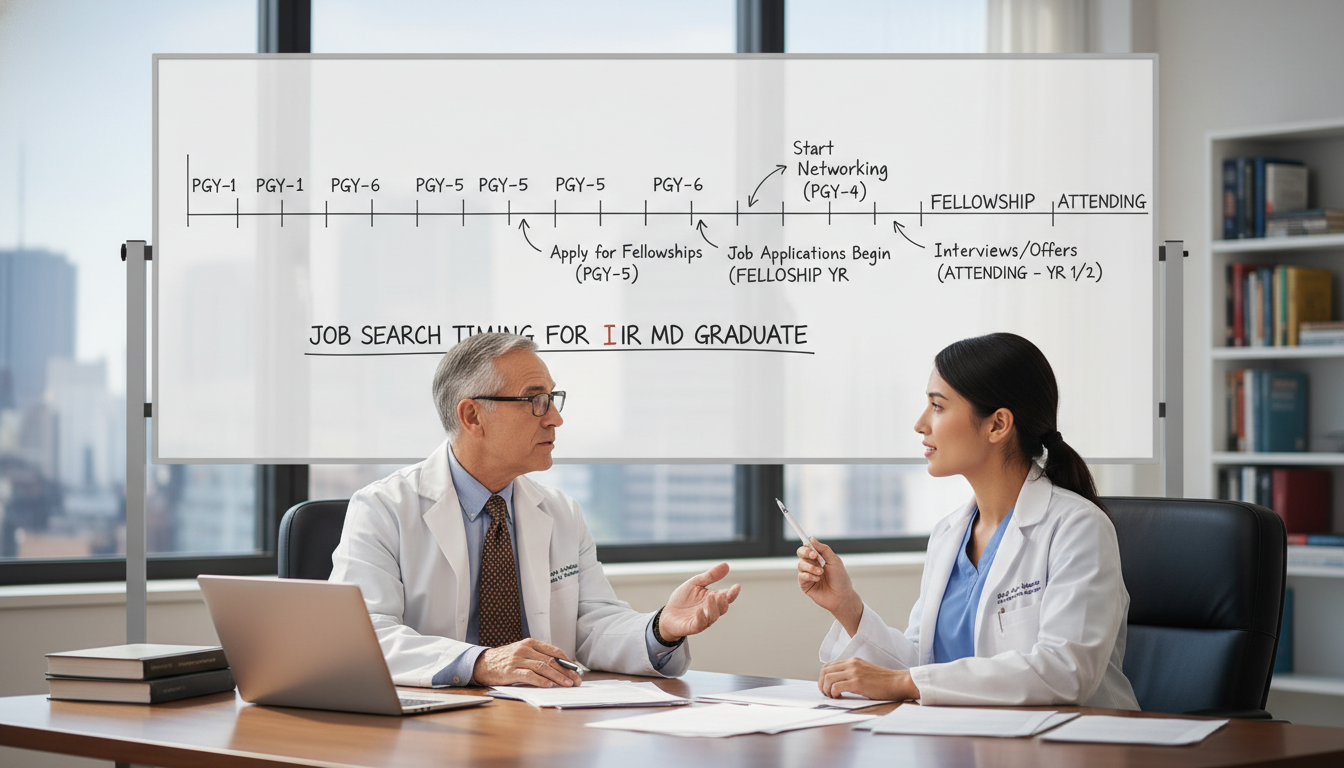
Before we break down the details, it helps to see the big-picture cadence. For most interventional radiology residency graduates, the attending job search should begin about 18–24 months before you want to start work.
Here’s a typical high-level timeline:
PGY-3 to PGY-4 (Early IR Resident Years)
- Clarify long-term goals: academic vs private practice, urban vs community, research vs purely clinical, etc.
- Begin informal networking with faculty, recent grads, and IR societies.
- Monitor job boards just to understand the market, not to apply.
PGY-5 / Early Independent IR Training or Early Senior IR Years (About 24–18 Months Before Graduation)
- Define your ideal and acceptable job parameters: case mix, location, call burden, compensation priorities.
- Start active networking, especially at conferences (SIR, state radiology societies).
- Craft a strong CV and update your online professional profile (LinkedIn, Doximity).
- Begin light outreach to programs and groups in desired regions.
PGY-6–7 (Final 18–12 Months Before Graduation, Depending on Pathway)
- Launch serious job search: formal applications, scheduled interviews, site visits.
- Engage mentors to connect you with hiring chiefs or practice leaders.
- Compare offers and negotiate thoughtfully; consider future partnership potential and case mix.
Final 6–9 Months Before Graduation
- Finalize contract and sign.
- Obtain hospital privileges, licenses, and payor enrollment (credentialing can take 3–6 months).
- Prepare for transition: licensure in the state, moving logistics, maybe moonlighting near your future practice if appropriate.
The key idea: If you want to start as an attending in July/August of Year X, serious job search and interviews should generally ramp up between January and June of Year X–1 (about 12–18 months out). In some competitive markets, you may want to start conversations even earlier.
Stage-by-Stage: When to Start Job Search Activities in IR Training
1. Early Residency (PGY-3 to PGY-4): Foundation & Career Direction
Goal for this phase: Understand the landscape and your preferences; don’t job hunt yet, but set yourself up for success.
What to focus on
Clarify your career vision
- Academic vs community vs hybrid model
- Procedural mix: oncology-heavy, peripheral vascular disease, venous interventions, PE response team, women’s health procedures, dialysis access, etc.
- Level of diagnostic radiology you are comfortable with or want to maintain.
- Location priorities (family, spouse/partner, cost of living, visa issues if applicable).
Learn the structure of IR jobs
- Pure IR vs IR/DR blended practices
- Hospital-employed vs private practice vs academic vs multispecialty groups
- Call responsibilities (in-house vs home call; trauma level; PE, stroke, aortic coverage)
Build early relationships
- Ask faculty where recent graduates have gone and what they learned from their job search.
- Reach out to alumni from your interventional radiology residency who are 1–5 years out to hear fresh perspectives.
Why not job hunt yet?
The physician job market in IR values trajectory and fit more than raw promise. At this stage, your skills, interests, and reputation are still forming. It’s more productive to:
- Strengthen your case log and technical breadth
- Build a reputation as a reliable, collegial trainee
- Start limited scholarly work if you’re considering a major academic center
These will make you more competitive when you actually enter the IR job market.
2. Mid-Training (PGY-5 / Early Independent IR or Senior Integrated IR): Market Recon & Light Networking
Timing: About 24–18 months before graduation
Goal: Understand the physician job market in your desired regions and quietly position yourself.
Concrete steps
Define your “must-haves” and “nice-to-haves”
- Must-haves (non-negotiables):
- Geographic boundaries (e.g., “within 2 hours of my partner’s job in Chicago”)
- Case types you require (e.g., must have strong oncology and venous work)
- Minimum acceptable compensation or partnership track
- Nice-to-haves:
- Protected academic time
- Opportunity to build new service lines (e.g., UFE, PAE)
- Level of ED and call volume you’re comfortable with
- Must-haves (non-negotiables):
Start watching the allopathic medical school match and pipeline
As an MD graduate, you already navigated the allopathic medical school match and IR match; now, you want to watch how many residents and fellows are flowing into regions you’re interested in. High local training volume can saturate a small market. Keep an eye on:
- How many integrated IR or IR/DR spots are in that region
- Whether local private groups tend to hire from their “home” training programs
- Whether hospital systems are building new IR service lines (a positive sign for job creation)
Network with intention
- Attend SIR (Society of Interventional Radiology) and regional meetings.
- Go to sessions specifically focused on the physician job market or early career IR.
- Introduce yourself to speakers who practice in your target cities or practice models.
- Ask senior residents and new attendings how early they started their search and what they would do differently.
Light outreach—not formal applications yet
- Email a brief, professional note to IR section chiefs or practice leaders in your top 5–10 locations.
- Introduce yourself, state your anticipated completion date, and ask whether they expect openings in the next 1–2 years.
- Emphasize that you’re exploring, not demanding an immediate interview.
This phase is about intel. Understanding how “tight” or “open” your preferred markets are will determine how aggressive you must be with timing.
3. Senior IR Training (Final 18–12 Months): Active Search & Interviews
Timing: This is when you truly begin your attending job search.
Goal: Secure interviews, evaluate offers, and narrow choices.
Depending on your training path:
- Integrated IR residents typically enter this phase in their final IR-heavy years (PGY-6/7).
- Independent IR residents (after DR) often begin this process in the first half of their final IR year.
Why 18–12 months is the sweet spot
- Many groups and hospital systems budget positions a year in advance.
- Credentialing and licensing can easily take 3–6+ months.
- Academic centers especially recruit at least a year out, sometimes longer.
Starting your search less than 9–12 months from graduation can drastically limit your options and bargaining power, especially in desirable urban areas.
Key steps in this phase
Polish your application materials
- CV tailored to IR:
- Highlight procedural volume, complexity, and any subspecialty strengths (e.g., complex PAD, embolization, complex biliary, trauma).
- Include IR-specific research, QI projects, and leadership roles.
- Short, well-constructed cover emails rather than generic letters.
- A concise one-page “professional summary” can help you clarify your brand.
- CV tailored to IR:
Launch your formal search
Use multiple channels:
- Informal networking and word-of-mouth
- Society job boards (SIR, RSNA, state radiology societies)
- Physician recruiters (especially for non-academic roles and certain regions)
- Cold outreach to target groups or hospital systems, especially where you have even a weak connection (alumni, shared mentors, etc.)
Schedule interviews strategically
- Try to arrange interviews in clusters (e.g., several in the same region over 3–4 days) to compare similar markets.
- Be prepared to discuss:
- Your expected training completion date and board eligibility.
- What kind of IR practice you want to build.
- How you’ve contributed to service development during training (e.g., helping standardize a PE response protocol).
Request and review draft contracts early
Once it’s clear there is mutual interest, ask for a draft contract or at least a term sheet summarizing:
- Compensation and bonus structure
- Partnership track details (for private practice)
- Call requirements and coverage expectations
- Non-compete radius and duration
- Protected time and resources for academic work if applicable
You don’t need to sign immediately, but you do need enough time to compare offers and seek legal or experienced mentor review.
4. The Final 6–9 Months Before Graduation: Closing the Deal & Preparing for Transition
Goal: Sign a contract, complete licensing and credentialing, and plan your transition.
By 9 months before graduation, most IR graduates who started early will have:
- Either signed a contract, or
- Narrowed to 1–2 final options they are choosing between.
Why you shouldn’t wait too long to sign
- Licensure: State licenses can take 2–6 months, sometimes longer.
- Hospital privileges and payor enrollment: Expect several months for full credentialing.
- Visa and immigration issues (if applicable): These can add substantial time and complexity.
Signing a contract 6–9 months before your start date is standard and practical. Signing later is possible in some markets, but it limits your ability to negotiate and may compress your transition.
Practical tasks in this phase
Finalize your contract and keep a signed copy easily accessible.
Initiate:
- State medical license (if new state)
- DEA registration in that state
- Hospital/health system credentialing packets
- Malpractice coverage arrangements (understand tail coverage responsibilities)
Begin personal logistics:
- Housing search, school research if you have children
- Spousal/partner job search if relevant
- Planning your move (ideally not right at graduation if you can help it)

Special Scenarios That Affect Job Search Timing for IR MD Graduates
1. Highly Competitive Locations (Major Coastal Cities, Certain Academic Centers)
If your goal is to work in a highly desirable city or a big-name academic institution, your timeline shifts earlier:
- Start serious networking 24–30 months before graduation.
- Let key faculty know your goals so they can advocate for you when positions open.
- Academic jobs may be budgeted on multi-year cycles; showing up 6 months before you’re available is often too late.
In these markets, being flexible about start date (e.g., being willing to start mid-year, or extend training with an advanced fellowship) can be helpful if your dream job isn’t fully funded yet.
2. Visa-Dependent Candidates (J-1, H-1B, etc.)
Visa status significantly influences when to start job search and how many options you will realistically have.
- Begin serious conversations 24–30 months before graduation.
- Make your visa needs explicit early in conversations (J-1 waiver, H-1B sponsorship, etc.).
- Partner with your institution’s GME office and potentially an immigration attorney to understand deadlines.
Certain rural or underserved areas may actively seek J-1 waiver candidates and will want to lock you in early, which can be an advantage if you’re flexible about location.
3. Switching Jobs Quickly After First Position
Some new IR attendings discover within 1–2 years that their first job is not the right fit—due to case mix, politics, compensation, or location.
If you’re considering a move:
- Start your second job search at least 12–18 months before you hope to transition, unless there’s an urgent reason to leave.
- Review your existing contract for:
- Non-compete clauses
- Notice requirements
- Tail malpractice costs
- Be honest but diplomatic when explaining your reasons for leaving to prospective employers.
Even as an early-career attending, job search timing and careful planning are critical to avoid gaps in income or licensure hurdles.
Understanding the Physician Job Market in Interventional Radiology
The physician job market in IR is dynamic and regionally variable. To time your search wisely, pay attention to:
1. National and Regional Supply–Demand
- Nationally, IR is in demand, but urban academic hubs may feel saturated.
- Smaller cities and community hospitals are often eager to grow IR services.
- Watch trends in:
- Hospital consolidations
- Shifts to outpatient/office-based lab (OBL) models
- Expansion of IR-driven clinical programs (e.g., PAD clinics, interventional oncology programs)
2. Practice Type and Job Stability
- Academic jobs:
- Often recruit earlier and more formally.
- May offer lower initial compensation but strong stability and academic growth.
- Private practice jobs:
- Sometimes recruit later in the cycle, especially if hiring is tied to recent retirements or volume spikes.
- Partnership track timing and structure matter as much as base salary.
- Hospital-employed IR jobs:
- Timelines can be strongly influenced by health system budgeting cycles and administrator approval processes.
Aligning your job search timing with these cycles can give you access to more—and better—options.
When to Start Job Search vs When to Decide: Avoiding Common Pitfalls
Pitfall 1: Waiting Too Long to Start
Some MD graduates in IR assume they can treat the attending job search like the allopathic medical school match or IR match—with fixed timelines and centralized processes. The attending job search is not like that:
- There is no centralized match.
- Positions open and close continuously.
- Early candidates get their pick; late candidates often choose from what’s left.
Actionable advice:
Mark a calendar reminder 18–24 months before your planned graduation to initiate a structured job search plan.
Pitfall 2: Accepting the First Offer Under Time Pressure
If you start too late, you may feel forced to accept the first “acceptable” offer because you need something lined up.
Mitigation strategies:
- Start early enough to compare at least 2–3 serious offers.
- Use mentors or neutral third parties (not directly affiliated with the hiring groups) to review each opportunity.
- Don’t rush to sign on the spot; ask for reasonable time to review (1–2 weeks, sometimes more if there are complexities).
Pitfall 3: Overcommitting Before You’re Ready
On the other end of the spectrum, signing a contract too early without full clarity about your priorities can backfire.
You might evolve significantly during your last 1–2 years of training:
- You may discover a stronger interest in interventional oncology, vascular work, or women’s health interventions.
- You may develop academic ambitions that a purely community job cannot support.
If you sign a contract more than 24 months before graduation, make sure:
- You understand how flexible the role is (can you build new service lines?).
- You’re comfortable with the non-compete and any penalties for not fulfilling the term.
- The group/hospital is stable enough that your position is secure long-term.
Practical Checklist: Your IR Job Search Timing Roadmap
24–30 Months Before Graduation
- Clarify long-term goals and preferred practice models.
- Start networking casually at IR and radiology conferences.
- Ask mentors how early they recommend you start in your specific markets of interest.
- If you are visa-dependent, begin serious planning now.
18–24 Months Before Graduation
- Define your geographic and practice-type priorities more concretely.
- Begin watching job boards regularly—don’t necessarily apply yet.
- Reach out informally to IR chiefs/groups in target regions to gauge upcoming needs.
- Update your CV and professional profiles.
12–18 Months Before Graduation
- Launch active search: applications, recruiter conversations, and serious networking.
- Schedule interviews and site visits.
- Obtain draft contracts or term sheets for roles of interest.
- Compare offers with trusted mentors.
6–9 Months Before Graduation
- Finalize and sign your contract.
- Start state licensing, DEA, and hospital credentialing.
- Plan move and personal logistics.
0–6 Months Before Start Date
- Complete all credentialing, finalize move.
- Stay in touch with your future group or department to ensure a smooth start.
- Reflect on your long-term goals and how you’ll build your practice in the first 2–3 years.
FAQs: Job Search Timing for MD Graduates in Interventional Radiology
1. As an IR resident, when should I officially start my attending job search?
For most interventional radiology residency graduates, you should begin formal job search activities 18–24 months before your planned start date as an attending. This means active networking, outreach, and monitoring of job postings. Interviews and serious offer consideration typically ramp up in the 12–18 months before graduation window.
2. I’m in an integrated IR residency. Does my timeline differ from independent IR graduates?
The principles are the same, but integrated IR residents sometimes underestimate how quickly graduation approaches. By PGY-5/6, you should already be in the market reconnaissance and networking phase. By early in your final IR-heavy year, you should be in active search mode, especially if you’re targeting academically competitive regions or major metro areas.
3. What if I’m not sure what type of IR practice I want (academic vs private vs hospital-employed)?
Uncertainty is common early in training. Use your PGY-3 to PGY-5 years to:
- Rotate in different practice settings if possible.
- Talk extensively with attendings in each model.
- Attend career panels at SIR and other meetings.
You don’t need absolute certainty 24 months out, but by 12–18 months before graduation, you should have narrowed your preferences enough to target specific types of positions. Starting your exploring phase early allows you to time your eventual job search well.
4. How does timing differ if I plan to do an additional advanced IR fellowship or research year?
If you add an advanced fellowship or research year after your core IR training:
- Decide early whether your job search will target post-fellowship or post-residency timelines.
- If the fellowship is clearly part of your plan (e.g., IR oncology, advanced vascular), treat your fellowship end date as your true target and back-time your job search 18–24 months from that date.
- Start networking during your fellowship, but don’t discount contacts built during residency—they can be reactivated later with updated timelines.
By approaching your IR job search as a long, structured process rather than a last-minute scramble, you’ll be far better positioned to secure a role that aligns with your skills, values, and vision for your career as an interventional radiologist.