
Understanding the Post-Residency Landscape in Radiation Oncology
Radiation oncology is a relatively small specialty with a unique training and job market profile. For an MD graduate in radiation oncology, understanding when and how to start your job search is almost as important as your fellowship or elective decisions.
Several realities shape the physician job market in radiation oncology:
- The specialty is geographically constrained: many jobs are linked to hospital systems, cancer centers, or private groups with specific regional footprints.
- The practice environment is varied: academic NCI-designated centers, hybrid models, hospital-employed groups, and private practices all hire differently and on different timelines.
- There is often a mismatch between location preference and job availability: highly desired metropolitan areas may have few openings, while smaller or more rural markets may have more opportunities.
- The pipeline is small but steady: the annual graduating cohort from allopathic medical schools and osteopathic programs entering radiation oncology residency is modest, but so is the number of new attending positions.
Because of this, the timing of your job search cannot be an afterthought. It should be planned just as deliberately as the rest of your training pathway—from your allopathic medical school match into residency, through your PGY-5 year, and beyond.
In this article, we’ll focus on:
- When to begin the job search as a rad onc resident (by training year)
- How timing differs by practice type and geography
- How to align job search timing with personal goals (family, visa, research, subspecialization)
- Practical timelines and checklists for the MD graduate entering radiation oncology residency or finishing it
The Big Picture: When to Start Your Job Search
One of the most common questions radiation oncology residents ask is: “When should I start my attending job search?” The answer depends on both your training stage and your target practice setting, but there are general benchmarks that work for most MD graduates.
Core Timeline for the Radiation Oncology Resident
Assuming a standard 5-year residency including the PGY-1 (intern) year:
PGY-1 (Intern Year):
- Focus: Adapting to clinical responsibilities, confirming interest in rad onc, laying groundwork for research and mentorship.
- Job search: Too early for formal job hunting, but not too early to start thinking about long-term career preferences (academic vs private, geographic priorities).
PGY-2 (First Rad Onc Year):
- Focus: Learn the field, identify early mentors, understand subspecialty options (CNS, GU, breast, thoracic, pediatrics, proton, etc.).
- Job search: Still early for active searching, but start noticing what types of attending jobs your near-graduates are getting and how long their rad onc match-to-job transition takes.
PGY-3:
- Focus: Solidifying clinical skills, building a research portfolio, networking at national meetings (ASTRO, ASCO, subspecialty societies).
- Job search: Begin informal exploration—talk to faculty about their job hunts, attend career panels, and clarify whether you’re leaning academic, community, or hybrid.
PGY-4:
- Focus: Leadership roles, teaching juniors, deeper subspecialty or research focus.
- Job search: This is when serious planning should begin.
- Actions:
- Clarify geographic preferences (must-have vs nice-to-have).
- Update your CV and create a skeleton cover letter.
- Start open conversations with trusted mentors about your competitiveness and realistic options.
- Attend national meetings with the explicit goal of networking for future jobs.
PGY-5 (Final Year of Residency):
- Focus: Transition to autonomy, finishing scholarly work, job acquisition.
- Job search: Active phase—most radiation oncology residents should start active job searching about 12–18 months before their intended start date, with the most intense period roughly 9–12 months prior.
If you are graduating June 30, 2027, for example:
- Begin structured planning by mid-2025 (late PGY-3 / early PGY-4).
- Begin active searching and applications by summer–fall 2026.
- Aim to have serious interviews by fall–winter 2026.
- Target final decisions by early 2027, leaving some buffer for negotiations, credentialing, and relocation.
Key Principle: Early Exploration, Timely Commitment
Radiation oncology jobs can appear and disappear quickly. Many positions are posted 6–12 months before the desired start date, but academic positions (especially for MD graduate residency alumni with strong research profiles) may be discussed informally 1–2 years in advance. Conversely, some private or hospital-employed roles may appear only 3–6 months before they’re needed due to unexpected departures or volume surges.
The safest strategy:
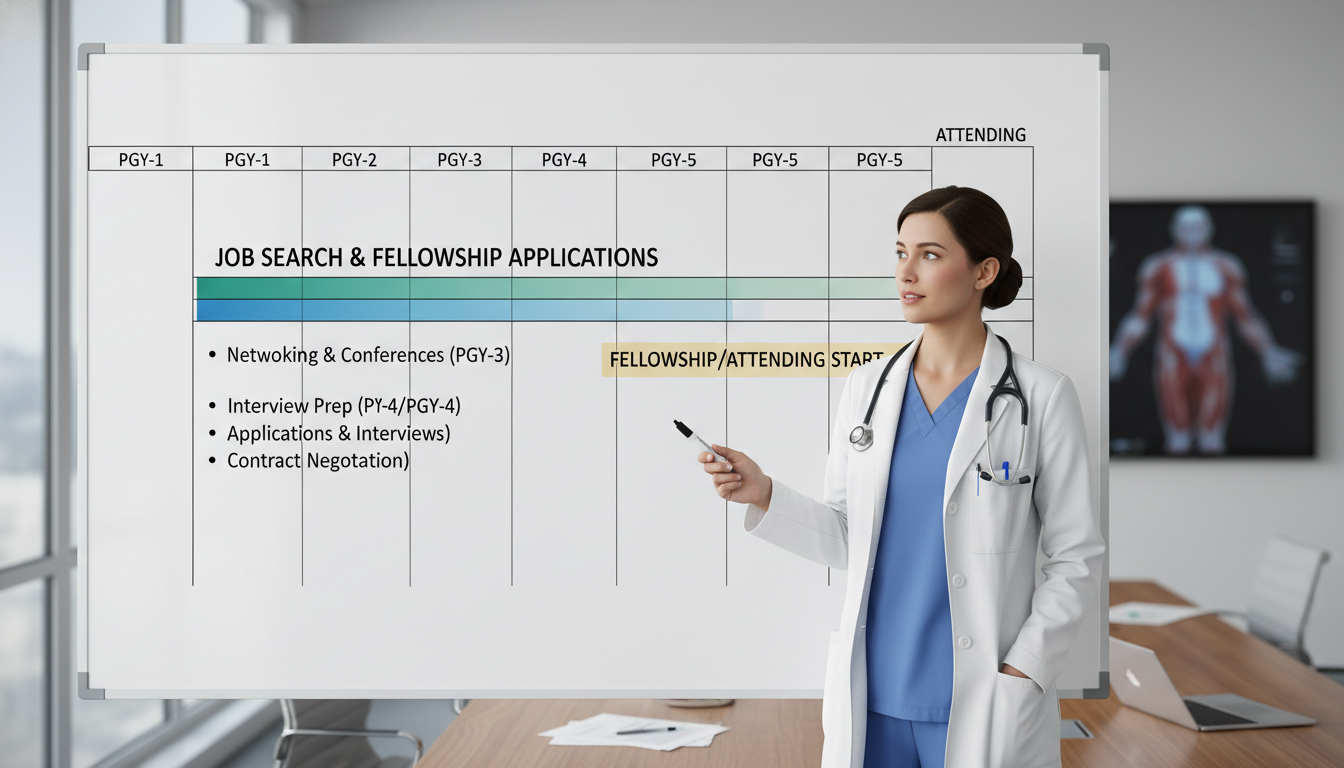
- Exploration early (PGY-3/4)
- Active applications and interviews in PGY-5, starting 9–15 months before your target start date.
How Practice Setting Changes Job Search Timing
Your timing should also reflect the type of position you’re pursuing. The allopathic medical school match gets you into radiation oncology, but the rad onc match to attending job is essentially a second, more individualized “match process” with very different rules.
Academic Radiation Oncology Positions
Academic jobs—especially at NCI-designated cancer centers or large teaching hospitals—tend to involve:
- Long lead times
- Multiple interview rounds
- Committee approvals
- Grant or research alignment considerations
Timing characteristics:
- Discussions can start 18–24 months before your planned start date, especially if you:
- Have a strong research CV
- Are being “groomed” locally as faculty
- Are targeting niche areas (proton therapy, stereotactic radiotherapy, brachytherapy, or rare disease programs)
- Formal job postings may appear 12–18 months prior, but for some positions the “shortlist” is already informally formed.
Practical recommendation:
- If you want an academic career, begin targeted networking and exploratory conversations by early PGY-4.
- Ask your mentors directly:
- “Do you think our department could hire me?”
- “Who should I talk to at other centers?”
- “Is there a niche or disease site I should emphasize?”
Example:
You’re a PGY-4 with 6 first-author publications in CNS radiation oncology. Your program director suggests that a nearby NCI center may expand its CNS program in the next 2–3 years. You arrange an informal visit, give a talk, and stay in touch with their chair. By early PGY-5, a formal job description is posted publicly, but you already have a clear sense of their needs and are a known candidate.
Private Practice and Community-Based Jobs
Community and private practice rad onc positions usually have:
- Shorter planning horizons
- Faster interview-to-offer timelines
- Stronger emphasis on clinical volume, workflow efficiency, and local fit
Timing characteristics:
- Many roles are posted 6–12 months before the desired start date.
- Some urgent needs (retiring physician, unexpected departure) may be posted 3–6 months before they want you to start.
- Contract negotiation and credentialing still take several months.
Practical recommendation:
- Begin scanning for postings 12–15 months prior to graduation.
- Start applying to serious leads 9–12 months prior.
- Be prepared to move relatively quickly through interviews and negotiations if the fit looks good.
Example:
You’ll finish residency in June 2026 and want to start as an attending by September 2026. In August 2025 (PGY-4), you start watching job boards and networking with alumni. By October 2025 (early PGY-5), a regional health system advertises an opening at two sites within your preferred state. You apply in November, interview in December–January, and receive an offer by February 2026, giving ample time to finalize licensing and housing.
Hybrid or Hospital-Employed Models
Many positions now blur the line between “academic” and “private”:
- Hospital-employed with academic title and teaching responsibilities
- Community-based but integrated with university tumor boards
- Large multisite systems using a unified clinical protocol structure
Timing characteristics:
- Often fall between academic and pure private practice in timing.
- New positions may be part of larger expansion projects, which are planned 12–24 months in advance.
- Others result from incremental growth and appear closer to the needed start date, around 6–12 months out.
Practical recommendation:
- Treat hybrid opportunities with the same seriousness you’d give either academic or private: start conversations early but stay flexible.
- Ask detailed questions about expectations: RVUs, teaching, call, research time, and path to leadership.
Aligning Job Search Timing With Personal and Professional Factors
“Job search timing” is not just about the external physician job market; it must also fit your personal life and professional goals. An MD graduate residency path in radiation oncology is intense and long, and your first attending job will shape your early career trajectory.
Geographic Priorities and Flexibility
Where you are willing to live heavily influences timing:
- Highly competitive urban/academic hubs (e.g., Boston, New York, San Francisco, Chicago):
- Fewer openings
- More applicants per position
- Longer and more competitive processes
- Mid-size cities or suburban regions:
- Moderate competition
- Balanced timing; jobs appear fairly regularly
- Rural or underserved areas:
- More frequent openings
- Often more flexible timelines and faster communication
If your geographic preferences are very narrow (e.g., “I must be in one particular metro area because of family and spouse’s career”), then you should:
- Start exploring earlier (PGY-3/4).
- Use mentors and alumni networks heavily.
- Consider temporary or locums positions if a perfect permanent role isn’t available immediately.
Visa and Immigration Considerations
For international medical graduates (IMGs) or MD graduates needing visas (J-1 waiver, H-1B, O-1), timing is even more critical:
- Employers need to understand and be willing to sponsor your visa category.
- Waiver processes (e.g., Conrad 30 for J-1) can take months and require advanced planning.
- Some academic centers have established visa support structures, while smaller private practices may be less familiar.
If you are on a visa:
- Start substantive job planning 18–24 months before graduation.
- Confirm early with potential employers that they can accommodate your visa needs.
- Coordinate with your GME office, institutional legal team, and immigration counsel.
Fellowship, Subspecialization, and Research Paths
While many radiation oncologists go directly from residency to attending jobs, some pursue:
- Research fellowships
- Special technology/proton therapy fellowships
- Additional targeted subspecialty training
These decisions can delay your entry into the physician job market by 1–2 years, but they also change your timing:
- If you know you want fellowship early in residency, your attending job search may start during your fellowship year, not during PGY-5.
- However, it is still wise in PGY-4/5 to gather information about:
- Which institutions prefer or require fellowship training
- How research vs clinical fellowships are perceived in your desired market

Step-by-Step Job Search Timeline for Radiation Oncology Residents
Below is a practical, high-yield timeline to guide you from early planning to signed contract. Adjust the months based on your actual graduation date.
Two Years Before Graduation (Late PGY-3 / Early PGY-4)
Goals: Clarify direction, build network, understand the market.
Actions:
- Reflect on your preferences:
- Academic vs community vs hybrid
- Disease site interests
- Geographic priorities
- Talk with:
- Program director
- Research mentor
- Recently graduated alumni
- Attend ASTRO (and other key meetings) with a career lens:
- Go to career panels and networking sessions.
- Introduce yourself to faculty from institutions of interest.
- Start a job search file:
- Running list of places and groups that appeal to you.
- Notes on practice models, call structures, and compensation trends.
15–18 Months Before Graduation (Mid-Late PGY-4)
Goals: Transition from general planning to targeted exploration.
Actions:
- Update and polish your CV:
- Ensure all publications, presentations, and leadership roles are current.
- Draft a flexible cover letter template:
- Emphasize training background, areas of interest, and what you can bring to a department.
- Communicate explicitly with mentors:
- “I’ll be looking for a job in [year]. Here’s what I’m thinking. Any advice or contacts?”
- Set up informational meetings:
- 20–30 minute conversations with contacts at institutions or groups you’re curious about.
12–15 Months Before Graduation (Early PGY-5)
Goals: Begin active search, identify real opportunities.
Actions:
- Start actively scanning the physician job market:
- ASTRO career center
- Major health system and academic career websites
- Specialty-specific listservs and social media
- Send targeted inquiry emails (even if no posting is listed):
- Introduce yourself.
- Express interest in future opportunities.
- Attach CV and brief cover letter.
- Discuss with your program leadership:
- Whether your current institution might have a role for you.
- What it would take to be considered for internal hiring.
9–12 Months Before Graduation (Peak Application and Interview Window)
Goals: Apply widely enough, interview, and refine preferences.
Actions:
- Submit formal applications to:
- Posted positions that fit your preferences.
- Institutions where you have strong interest and some prior contact.
- Prepare for interviews:
- Review your own CV and be ready to discuss any part of it.
- Prepare questions about volume, workflow, mentorship, promotion tracks, and call.
- Understand local market realities (competition, referral patterns).
- Attend on-site interviews (or virtual, if applicable):
- Evaluate team culture and multidisciplinary collaboration.
- Ask to meet junior and mid-career faculty in similar roles.
6–9 Months Before Graduation
Goals: Move from exploration to decisions and negotiation.
Actions:
- Follow up on pending applications and interviews.
- Compare offers in terms of:
- Compensation structure (base salary, RVUs, bonuses)
- Non-clinical time
- Clinical support (physicists, dosimetrists, APPs)
- Leadership opportunities
- Contract length, restrictive covenants, tail coverage
- Seek a healthcare attorney or experienced senior colleague to review any contract before signing.
- Clarify your start date and required timeline for:
- State licensure
- Hospital credentialing
- Board certification paperwork
- Relocation logistics
3–6 Months Before Graduation
Goals: Finalize logistics, transition to attending mindset.
Actions:
- Confirm all paperwork for:
- Medical license and DEA
- Hospital privileges
- Payer enrollment
- Secure housing and relocation plans.
- Coordinate with your new department’s leadership:
- Orientation schedule
- Initial clinic setup
- Research or academic commitments
- Continue to perform well in residency; your reputation follows you into your new role.
Integrating Job Search Timing With Long-Term Career Strategy
The attending job search is not a one-time event that ends when you sign your first contract. It marks the beginning of your career in a dynamic physician job market.
When to Start Job Search for Later Career Moves
- Many attending radiation oncologists re-evaluate or change jobs 3–7 years after starting their first position.
- If your first job is not your “forever” job:
- Begin subtle market awareness by year 2–3.
- Network at meetings even when you are not urgently searching.
- If you anticipate moving (e.g., spouse’s career, family needs), know that:
- You may need to lead time your attending job search similarly to your first—6–18 months depending on the setting and geography.
Evolving Physician Job Market in Radiation Oncology
Radiation oncology has seen significant evolution in:
- Treatment paradigms (SABR, hypofractionation, immunotherapy integration)
- Technology (MR-Linacs, adaptive planning)
- Reimbursement patterns and consolidation of practices
Stay informed on:
- ASTRO workforce reports
- Trends in rad onc match rates and applicant numbers
- National discussions on practice consolidation and site-of-service shifts
This lets you time your moves and keep your clinical profile aligned with emerging needs, enhancing both employability and job satisfaction.
FAQs: Job Search Timing for MD Graduate in Radiation Oncology
1. When should a radiation oncology resident begin their first attending job search?
Most residents should begin serious planning by PGY-4 and active searching and applications by early PGY-5, roughly 9–15 months before graduation. Academic careers may require even earlier relationship-building and informal discussions (up to 18–24 months in advance).
2. How does timing differ for academic versus private practice jobs?
Academic positions often involve:
- Longer lead times
- Extensive committee review
- A need to align with departmental research or programmatic goals
You may start conversations 1–2 years before your intended start date. Private practice and hospital-employed jobs typically have shorter horizons, with openings appearing around 6–12 months before they need you to start. Plan your timeline accordingly and be ready for faster decision-making in community settings.
3. I’m on a visa. How early should I start looking for a job?
If you require J-1 waiver, H-1B, or other employment-based visas, begin your targeted job search 18–24 months before the end of residency. Confirm early that potential employers understand and can support your immigration requirements, and involve your institution’s GME office or legal team to help align timelines.
4. Is it a problem if I don’t have a job by the middle of PGY-5?
Not automatically. The job search in radiation oncology can extend into the final months of residency, especially for candidates with narrow geographic or practice preferences. However, by mid-PGY-5, you should be actively interviewing and have multiple irons in the fire. If you are still struggling to find suitable opportunities at that point, speak openly with your program director and mentors—they can often connect you with additional leads or help you adjust your strategy.
By understanding the structure of the radiation oncology job market and aligning your job search timing with your training stage, career goals, and personal constraints, you can navigate the transition from MD graduate residency to attending in a deliberate, strategic, and less stressful way.