
Understanding the Timeline: From Residency to First Cardiothoracic Job
For an MD graduate in cardiothoracic surgery, job search timing is almost as critical as board exam timing. Positions are limited, highly competitive, and often tied to institutional budgets and long‑range service line planning. Starting too late can mean a gap year or accepting a suboptimal role; starting too early can mean wasted effort and offers that expire before you finish training.
This article walks through a practical, month‑by‑month framework to help you time your attending job search in cardiothoracic surgery—from the final years of residency and fellowship to contract signing and onboarding. We’ll focus on:
- When to start exploring vs when to start applying
- How the cardiothoracic surgery job market typically moves
- Key milestones (CV prep, networking, interviewing, contract review)
- How different practice settings (academic vs private vs hybrid) influence timing
Throughout, we’ll assume you’re:
- An MD graduate from an allopathic medical school match
- On the cardiothoracic surgery pathway (integrated I‑6 or traditional route)
- Targeting your first attending role in adult CT, congenital, or mixed practice
Big‑Picture Job Search Strategy in Cardiothoracic Surgery
Why Timing Matters More in Cardiothoracic Than Many Other Fields
Cardiothoracic surgery is a small specialty with:
- Limited positions per region
- Long recruitment cycles (often 9–18 months)
- High stakes for both you and the institution (OR access, call coverage, program growth)
Hospitals and groups often plan 1–2 years ahead when adding a cardiothoracic surgeon. They align new hires with:
- Planned retirements
- Program expansion (e.g., structural heart, ECMO, LVAD, lung transplant)
- Service line strategic plans and budget cycles
Because of this, the “right” time to start depends on:
- Your projected completion date (residency + fellowship)
- Whether you’re pursuing extra subspecialty training (e.g., congenital, transplant/LVAD, structural heart)
- Your geographic flexibility
- Whether you’re aiming for academic, private practice, or hybrid settings
In general:
- Cardiothoracic surgery hiring is early and slow—jobs are identified early and filled methodically.
- You should think in terms of phases over 12–24 months, not a quick 3‑month scramble.
Core Timeline Principles
Keep these guiding rules in mind:
Awareness Phase starts ~24 months before completion.
You’re not applying yet, but you’re learning the market and clarifying what you want.Active Search for most candidates begins 12–18 months before your end date.
This is when emails, networking outreach, and formal applications really start.Interviews and serious discussions typically cluster 9–12 months before you finish.
Most cardiothoracic surgeons sign their first contract 6–12 months before graduation.
Licensing and credentialing demand a 4–6 month buffer before your planned start date.
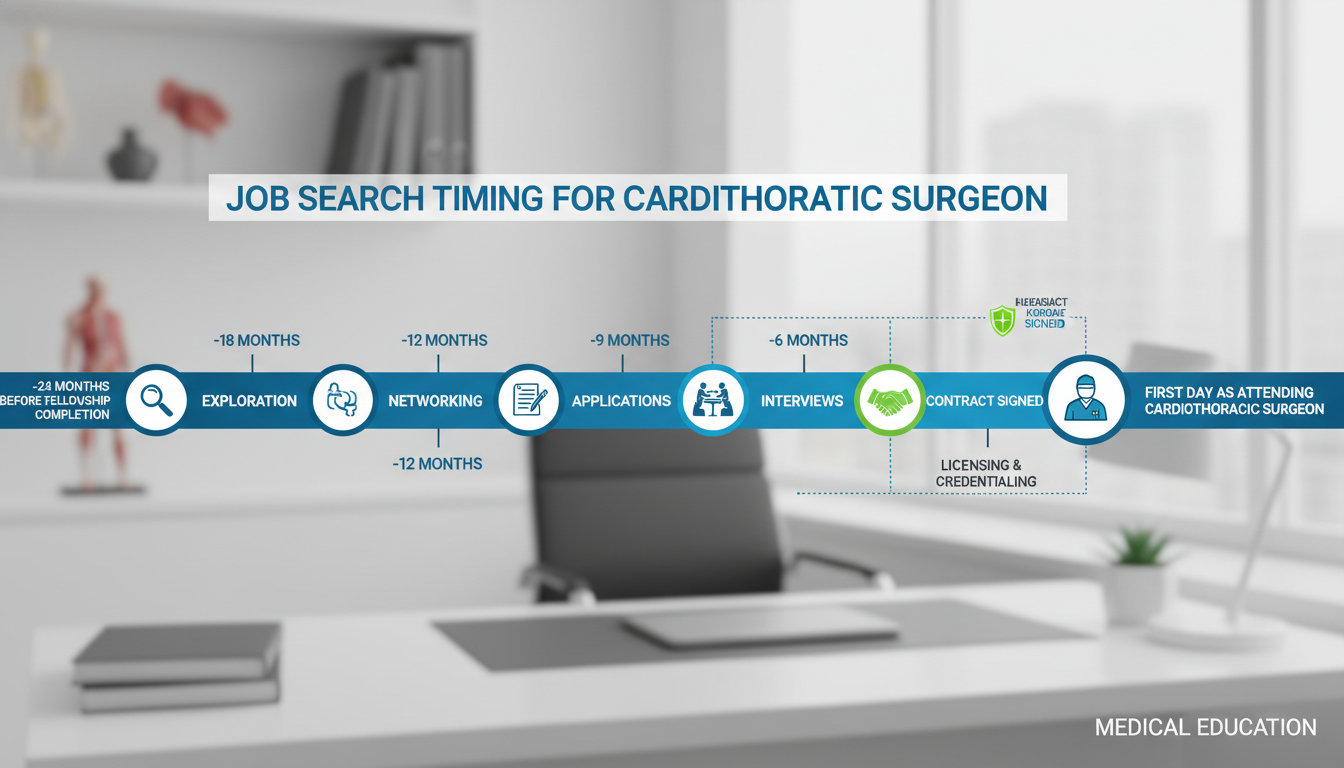
Year-by-Year and Month-by-Month: When to Start Each Step
Below is a typical timing framework for an MD graduate on the cardiothoracic surgery path, assuming you complete all training in June of Year 0 (Y0). Adjust for your actual end date.
24–18 Months Before Completion (Y‑2 to Y‑1, Early): Exploration and Positioning
Goal: Understand the physician job market for cardiothoracic surgery and define your targets.
Focus on:
Clarifying your career direction
- Adult cardiac vs thoracic vs mixed cardiothoracic
- Academic vs community vs hybrid
- Desire for additional fellowships (congenital, transplant, structural heart)
- Level of complexity: high‑acuity tertiary center vs regional referral vs smaller volume center
Gathering job market intelligence
- Talk to recent graduates from your program:
- When did they start looking?
- How many interviews did they do?
- What surprised them about timing?
- Attend national meetings (STS, AATS, ACC, regional CT societies):
- Go to early career and job market sessions
- Meet division chiefs and program directors informally
- Start tracking physician job market trends through:
- STS and AATS newsletters
- Specialty job boards (CTSNet, STS, hospital system careers sites)
- Big physician recruiters (Merritt Hawkins, Jackson Physician Search, etc.)
- Talk to recent graduates from your program:
Positioning yourself for the jobs you want
- Improve case log in your desired niche (e.g., CABG, valve, minimally invasive lung cancer surgery)
- Seek research, QI projects, or leadership roles that align with your target practice
- Ask mentors how your current trajectory will look on the market in 2 years
What you’re NOT doing yet:
- Sending CVs widely
- Asking for formal interviews
- Signing anything
This phase is about aiming the ship, not firing the torpedoes.
18–12 Months Before Completion (Y‑1, Mid): Early Outreach and CV Readiness
Goal: Be fully ready to apply and start light, strategic outreach.
By this point, most MD graduate residency paths in cardiothoracic surgery have clarified training end dates and any additional fellowships. Now you begin proactive preparation.
Build a polished, market‑ready CV
Include:- Clear header with name, MD, cell, professional email
- Education and training (listed chronologically)
- Case volumes and key procedures (brief highlight section)
- Publications, presentations, QI/leadership roles
- Board status, licenses (if any), and certifications (ACLS, ATLS, etc.)
- Professional memberships (STS, AATS, ACCP, etc.)
Draft a flexible cover letter template
- 1–1.5 pages
- Emphasize what you bring (specific skills, subspecialty focus, team style)
- Customize for academic vs community vs hybrid hospitals
Light, targeted outreach to potential employers
You’re not formally on the market yet, but you can start conversations:- “I am a cardiothoracic surgery trainee completing my program in June [Year 0]. I’m beginning to explore potential positions in [geographic region/type of practice]. I’d welcome the chance to learn about your program’s long‑term needs.”
- Reach out to:
- Alumni from your allopathic medical school match or residency
- Faculty you’ve met at conferences
- Division chiefs at centers where you might want to work
Align timing with setting type
- Academic cardiothoracic surgery jobs
- Often plan recruits 12–24 months in advance
- Start showing interest now, especially if you want a specific academic center
- Large hospital systems / heart institutes
- Typically decide 12–18 months ahead for big roles (transplant, structural heart)
- Private or small group practices
- May plan closer to need (9–12 months), but early contact helps you get on their radar
- Academic cardiothoracic surgery jobs
12–9 Months Before Completion (Y‑1, Late): Active Job Search and Initial Interviews
Goal: Fully launch your attending job search and begin first‑round interviews.
This interval is the sweet spot for most cardiothoracic surgery candidates.
Go fully active on the market
- Start applying to positions that match your interests
- Respond to recruiter outreach and job board postings
- Send personalized outreach emails to programs in your target geography, even if they haven’t posted a job yet
Increase networking intensity
- At national meetings, schedule short one‑on‑one coffee chats with division chiefs, practice leaders, or program directors
- Let trusted mentors know definitively: “I am now actively looking for cardiothoracic surgery positions starting July [Year 0] in [regions/practice type].”
- Ask mentors to make direct introductions where appropriate
Prepare for interviews
- Have a concise, clear narrative:
- Why cardiothoracic surgery
- Your subspecialty focus and procedural strengths
- What you want in your first job (case mix, mentorship, academic vs clinical balance)
- Be ready for common questions:
- “Where do you see yourself in 5–10 years?”
- “How comfortable are you with independent cases in [key procedures]?”
- “What type of institutional support do you need to succeed?”
- Have a concise, clear narrative:
Geography and flexibility
- If you have narrow geographic constraints (e.g., partner’s job, family), 12 months is the minimum you should allow
- If you’re geographically flexible, you may see more opportunities and leverage
Expected outcomes in this phase:
- Several phone or virtual interviews
- Some in‑person interview invitations
- A clearer sense of what the actual cardiothoracic physician job market looks like for you
9–6 Months Before Completion (Y‑1, Very Late to Y0, Early): On-Site Visits and Offers
Goal: Convert serious interest into concrete offers and begin contract review.
On‑site interviews
During this phase, many candidates:- Visit 3–8 institutions or practices
- Observe ORs, ICUs, clinic flow
- Meet anesthesiology, cardiology, intensivists, APPs, and OR staff
When interviewing, pay attention to:
- Volume and case mix: Will you get enough cases to grow quickly?
- Mentorship and call structure: How is call shared between partners?
- Support for new graduates: Double‑scrubbing early, structured ramp‑up, backup in the OR
Timing of offers in cardiothoracic surgery residency graduates
- Many offers are extended 6–9 months before your completion date
- Some systems move a bit earlier (9–12 months), especially for highly specialized roles
Contract review and negotiation
- Do not rush this step; even if timing feels tight, take several days to review
- Engage:
- A health care attorney familiar with physician contracts
- Senior cardiothoracic faculty mentors to sense‑check terms
- Attendings often underestimate non‑salary issues that strongly affect career and lifestyle:
- OR block time access
- Support from cardiology/referral streams
- Marketing and program development support
- Expectations for RVUs, outreach clinics, or nights/weekends
Decision pressure and holding multiple offers
- Some employers set short deadlines (1–3 weeks) for decisions
- If you have multiple interviews pending, be transparent:
- “I am very interested, but I have two more visits scheduled in the next 2–3 weeks. Is it possible to have until [date] to give you a final answer?”
Most cardiothoracic surgeons will sign no later than 6 months before finishing, often earlier. If you reach the 6‑month mark with nothing lined up, you need an aggressive, focused strategy (discussed below).
6–0 Months Before Completion (Y0, Mid to End): Finalizing, Licensing, and Contingency Planning
Goal: Lock in your position, secure licenses, and protect yourself with a backup plan if needed.
Licensing and credentialing timing
Hospitals and states move slowly. Plan for:- State licensure: 2–4 months (or longer in some states)
- Hospital credentialing and privileging: 2–4 months
- Payer enrollment (if relevant): 3–6 months
This is why you ideally sign at least 6 months before your start date.
Board exams and job start dates
- Understand how your board eligibility and examination timing intersect with employment start
- Some employers want clear board eligibility status before credentialing
- Plan your start date so that major exams (e.g., oral boards) and orientation periods don’t collide disastrously
What if you’re late to the market?
If you’re within 6 months of finishing and have no firm job:
Concentrated outreach:
- Email division chiefs in your preferred regions
- Contact national and regional recruiters
- Ask mentors if they know of last‑minute needs (retirements, unexpected departures)
Consider short‑term or bridge options:
- Additional fellowship or focused training year (e.g., structural heart, advanced thoracic)
- Short‑term locums or temporary staffing arrangements at high‑volume centers
- Research or quality roles within major heart programs while continuing the search
If you’re an international medical graduate or have visa needs, factor in extra time for immigration and institutional sponsorship procedures.
When to start job search if you’re still in general surgery or earlier training?
- If you’re in general surgery and planning CT fellowship:
- Start thinking about long‑term goals in your final 1–2 years of general surgery
- Concrete attending job search for cardiothoracic surgery usually begins during CT fellowship, using the same 18–12 month timeline
- The key is to separate:
- Fellowship application timing
- Attending job search timing
- If you’re in general surgery and planning CT fellowship:

How Practice Type Changes Your Optimal Job Search Timing
While the general 18–12 month rule for when to start job search holds, different practice environments in cardiothoracic surgery move at slightly different speeds.
Academic Cardiothoracic Surgery Positions
Typical timing:
- Earliest planners: 18–24 months ahead
- Common: 12–18 months ahead
- Contracts often signed: 9–12 months before start date
Why so early?
- Faculty positions must often go through:
- Institutional budgeting and approval
- Formal posting requirements
- Search committees and multiple interview rounds
Implication for you:
- If you want a highly specific academic center (e.g., your dream heart transplant program), start active exploration and networking up to 24 months ahead and be ready to apply as soon as the position opens.
- Your actual applications and interviews will still cluster around the 12–18 month window, but your relationship‑building should begin earlier.
Community and Private Practice Cardiothoracic Surgery
Typical timing:
- Identify need: 9–15 months before you start
- Interviews and offers: 6–12 months prior
- Sometimes fill urgent needs as late as 3–6 months before start
Drivers of timing:
- Retirement timelines of senior partners
- Sudden departures
- New program launches (e.g., starting an open heart or lung cancer program)
Implication for you:
- You can sometimes start a bit later and still be successful, especially if you’re open geographically.
- But you still gain an advantage by being known to key groups 12–18 months ahead—even if they’re not yet actively hiring.
Hybrid and Large Health System Jobs
Hybrids (clinical + academic roles, or large multi‑hospital systems) blend both patterns:
- Strategic hires (e.g., role in heart surgery training, transplant, valve center of excellence) may follow academic‑style timelines (12–24 months).
- Service coverage roles (general adult CT, thoracic oncologic surgery) resemble community timing (6–12 months, sometimes faster).
In either case, a structured timeline protects you: plan on actively searching 12–18 months ahead and be pleasantly surprised if something materializes a bit earlier.
Practical Tips to Align Timing With a Strong Application
Timing answers only half the question; you also need to be compelling when you hit the market. Here’s how to synchronize your preparation with the timeline.
At 24–18 Months: Get Ready to Be Competitive
- Maximize case exposure in your anticipated niche (CABG/valve, aortic, thoracic oncology, minimally invasive approaches).
- Start or complete 1–2 impactful projects: clinical outcome research, ERAS pathway, quality improvement.
- Ask your mentors directly:
- “What aspects of my profile will be most attractive or limiting in the current cardiothoracic physician job market?”
At 18–12 Months: Make Your Story Clear
- Solidify a coherent narrative:
- “I am an MD graduate in cardiothoracic surgery residency with a focus on [X]. I’m looking for [academic/community/hybrid] roles in [regions] where I can contribute in [specific ways].”
- Line up 3–5 strong references, including:
- Program director
- Key clinical mentors
- Someone who can speak to your teamwork and professionalism
At 12–6 Months: Execute With Discipline
- Track applications and contacts in a spreadsheet (institution, date, contact person, outcome).
- Keep your CV updated with any new cases, publications, or presentations.
- Practice your explanation of operative readiness:
- “These are the operations I can perform independently on day one.”
- “These are the areas where I’d still prefer backup for the first 6–12 months.”
At 6–0 Months: Protect Your Start and Your Future
- Budget personal time for:
- Moving and housing
- Board exam prep
- Family logistics
- Once you’ve signed, maintain professionalism with any other institutions you decline; cardiothoracic surgery is a small world, and reputations follow people for decades.
Frequently Asked Questions (FAQ)
1. When should an MD graduate in cardiothoracic surgery officially start the attending job search?
For most cardiothoracic surgery trainees, the ideal time to actively start the attending job search is 12–18 months before your training end date. Before that, around the 24–18 month mark, you should already be learning about the market, clarifying your goals, and building relationships, but not yet formally applying or interviewing.
2. Does being from an allopathic medical school match (MD graduate residency) change my timing?
Your status as an MD graduate from an allopathic medical school match doesn’t significantly change when you should start in cardiothoracic surgery; the specialty’s job cycle is fairly standardized. It does, however, sometimes influence networking opportunities and institutional familiarity, especially if your medical school or residency has strong cardiothoracic alumni networks. Use those relationships early (24–18 months out) to learn the market and get informal introductions.
3. How does pursuing additional subspecialty training affect job search timing?
If you plan an extra fellowship (e.g., congenital heart surgery, transplant/LVAD, structural heart), treat that fellowship as your final training stage for job search purposes. Begin your attending job search 12–18 months before the end of the final fellowship, not before your general CT residency ends. However, you can and should start informal conversations with future employers earlier if they are co‑sponsoring or aware of your planned subspecialty training.
4. What if I haven’t signed a contract by 6 months before graduation?
You’re not doomed, but you need to move fast and be strategic:
- Intensify outreach to division chiefs, hospital recruiters, and mentors.
- Expand your geographic search radius if possible.
- Consider short‑term options like an additional focused fellowship, research year in a CT department, or short‑term clinical roles while continuing the search.
Cardiothoracic positions sometimes open unexpectedly due to retirements or departures, so late opportunities do arise—but your chances improve dramatically if you are visible, responsive, and flexible.
By approaching your cardiothoracic surgery job search as a structured, multi‑phase process—starting exploration 24 months before completion and fully activating your search 12–18 months before finishing—you give yourself the best chance to transition smoothly from trainee to attending. Thoughtful timing, combined with a strong narrative, clear case readiness, and strategic networking, will position you well in a competitive but navigable physician job market.