
Understanding the Neurology Job Market After Residency
For an MD graduate in neurology, the timing of your job search can shape the first several years of your career. Neurology is generally a favorable physician job market—there’s high demand driven by an aging population, rising stroke prevalence, and increasing recognition of neurodegenerative and autoimmune neurologic disease. But “good market” does not mean you can start late and improvise.
Whether you trained at a large allopathic medical school match powerhouse or a smaller community program, your neurology residency and (if applicable) fellowship timeline should guide a structured and intentional job search. You’ll be balancing boards, research, fellowship applications, and personal life decisions, all while trying to secure the right first attending position.
This article breaks down:
- When to start your attending job search during neurology residency or fellowship
- How timing differs for academic vs community vs private practice positions
- A month‑by‑month job search timeline
- How your allopathic medical school match background and training program influence your options
- Common pitfalls in job search timing—and how to avoid them
Throughout, we’ll keep the focus on the neurology residency graduate ready to navigate the neuro match, complete training, and step into attending practice.
Big Picture: When to Start Your Attending Job Search in Neurology
The single most important timing principle:
You should typically begin your attending job search 12–18 months before your anticipated start date.
For most neurology residents and fellows, this means:
- PGY-3 / early PGY-4 (for those going directly into practice after residency)
- First half of fellowship (for those completing a 1–2 year neurology fellowship)
Why so early? Because:
Contract lead times are long.
From first contact to signed contract can easily take 4–9 months:- Initial outreach and screening
- Formal interviews (often multi‑step, sometimes including on-site visits with multiple stakeholders)
- Credentialing and hospital privileging discussions
- Negotiation of compensation, call schedule, and non‑compete terms
- Legal review and final sign‑off
Housing, relocation, and life planning take time.
Especially if you have a partner, children, or visa considerations.Licensure can be slow.
State medical licenses (and in some cases, DEA registration or controlled substance credentials) can take 2–6 months, sometimes longer. If you’re moving states, you’ll need to sequence your job offer with license applications.Boards and fellowships add complexity.
Many neurology MD graduate residents are also timing their first ABPN Neurology Board Exam, finishing research projects, or completing a neuro subspecialty fellowship (stroke, epilepsy, neuromuscular, MS, movement disorders, neurocritical care, etc.).
Simple Rule of Thumb
- Aim to have a signed contract 6–9 months before you start as an attending.
- Begin exploring and networking 12–18 months before that start date.
So if you’re finishing training on June 30, 2027:
- Start learning the market and networking: Jan–June 2026
- Begin serious applications and interviews: Summer–Fall 2026
- Aim to sign a contract: Late 2026 to early 2027
How Your Training Path Shapes Job Search Timing
Your job search timing is not one‑size‑fits‑all. It depends on:
- Whether you go straight into practice after neurology residency
- Whether you pursue a fellowship (and what type)
- Visa status and geographic constraints
- Academic vs community vs private practice goals
Let’s look at common pathways.

Pathway 1: General Neurology – Directly After Residency
Who this fits:
MD graduates who complete a 4‑year adult neurology residency (after internal medicine prelim or integrated) and plan to practice as general neurologists without fellowship.
Typical steps:
- PGY-2 (Early): Focus on core neurology foundations; minimal attending job planning.
- PGY-2 (Late) to PGY-3 (Early):
- Clarify whether you want academic vs community vs hybrid.
- Consider geographic preferences and personal/family needs.
- PGY-3 (Mid‑year): When to start job search
- Start exploring the physician job market: job boards, neurology societies (AAN, subspecialty societies), and program alumni.
- Update CV and begin informal conversations with mentors about your goals.
- PGY-3 (Late) to PGY-4 (Early):
- Begin formal applications for attending jobs, especially in competitive metro areas or academic positions.
- Arrange interviews during elective months when possible.
Why you don’t want to wait until late PGY-4:
- High‑quality positions in your desired location may be filled by then.
- Rushed decisions can lock you into a contract that’s a poor fit, especially around call expectations, RVU targets, and non‑competes.
Pathway 2: Neurology + Fellowship (Stroke, Epilepsy, MS, etc.)
For most subspecialty neurology positions, earlier is better—especially for academic faculty roles in stroke/vascular neurology, epilepsy, neurocritical care, and movement disorders.
Standard model for a one‑year fellowship (e.g., Vascular Neurology, Clinical Neurophysiology):
- Residency PGY-3 / PGY-4: Neuro match for fellowship. Once matched, you know your fellowship end date.
- Fellowship Year (Months 1–3):
- Clarify long‑term focus (academic vs community; tertiary center vs smaller hospital).
- Start informal networking—meet division chiefs, attend national conferences.
- Fellowship Year (Months 4–6): When to start job search
- Begin formal job applications for positions starting immediately after fellowship.
- Academic departments may recruit 12–18 months before start dates, so earlier outreach is useful.
- Fellowship Year (Months 6–9):
- Intensify interviewing and negotiations.
- Aim to sign by month 9–10, ideally no later than 6 months before graduation.
Two‑year fellowships (e.g., some neurocritical care or movement disorder programs):
- Start exploring options in the first year, with formal job search in the first half of year two.
Pathway 3: International Medical Graduates and Visa‑Dependent Neurologists
If you are an MD graduate in neurology on a J‑1 or H‑1B visa, timing is even more critical:
- Waiver positions and underserved areas often hire earlier and may have more rigid timelines.
- J‑1 waiver job search should realistically start 18–24 months before completion of training, due to:
- Waiver application cycles
- State-level timing and complexity
- Coordination between employer and immigration counsel
In these scenarios, talk early with:
- Your program director and GME office
- Immigration counsel (personally retained or through your institution)
- Employers familiar with neurology J‑1 waivers/H‑1B transfers
Pathway 4: MD Graduate Moving from One Attending Job to Another
Once you’re already in practice, the question of when to start job search comes up again—usually tied to contract renewal cycles and non‑compete periods.
As a rule:
- Start exploring 12–18 months before your contract ends or before significant non‑compete restrictions would be triggered.
- If you are relocating across states or hospital systems, give yourself a full year for licensure and credentialing.
Academic vs Community vs Private Practice: Timing Nuances
The type of neurology practice you want will influence your ideal timeline.
Academic Neurology Positions
Characteristics:
- Often located in major metro or referral centers
- Emphasis on subspecialty expertise, research, teaching
- More structured hiring cycles linked to academic years
Timing:
- Academic departments often plan 1–2 years ahead for new hires.
- Subspecialty positions (epilepsy, neuromuscular, neuroimmunology, movement disorders) may be posted 12–24 months before the anticipated start.
- For competitive institutions, early outreach matters. Even if there isn’t a posted opening yet, an email to division leadership can put you on their radar for upcoming retirements or expansion.
Practical approach:
- Start serious academic job search 18 months before you hope to start.
- Use national conferences (e.g., AAN) to meet chairs/division chiefs a year or more ahead.
Community Hospital Employment
Characteristics:
- Hospital-based employment with salary + RVU bonus or hybrid comp
- Mix of inpatient consults, EMU/stroke coverage (depending on subspecialty), and outpatient clinic
- Often in mid‑size cities or suburbs
Timing:
- Community systems often hire 6–12 months before start date, but highly sought areas may move earlier.
- Many postings appear on larger national job boards or hospital system career sites.
Practical approach:
- Begin outreach and applications 12–15 months before graduation/fellowship completion, especially if you have geographic constraints (e.g., partner’s job, children’s schools).
Private Practice and Hybrid Models
Characteristics:
- Small to mid‑size neurology groups, sometimes multispecialty clinics
- Partnership or buy‑in tracks common
- Income potential often higher but with more business risk
Timing:
- These groups may recruit more opportunistically, based on volume growth or retirement planning.
- Some will recruit aggressively 12–18 months ahead, others will be more last‑minute.
Practical approach:
- Network early with local neurologists or alumni in your desired region.
- Don’t assume all positions will be advertised; many are filled through word of mouth.
- Reach out 12–18 months before you want to start—especially if you’re targeting a specific city/region rather than a broad search.
A Month‑by‑Month Neurology Job Search Timeline
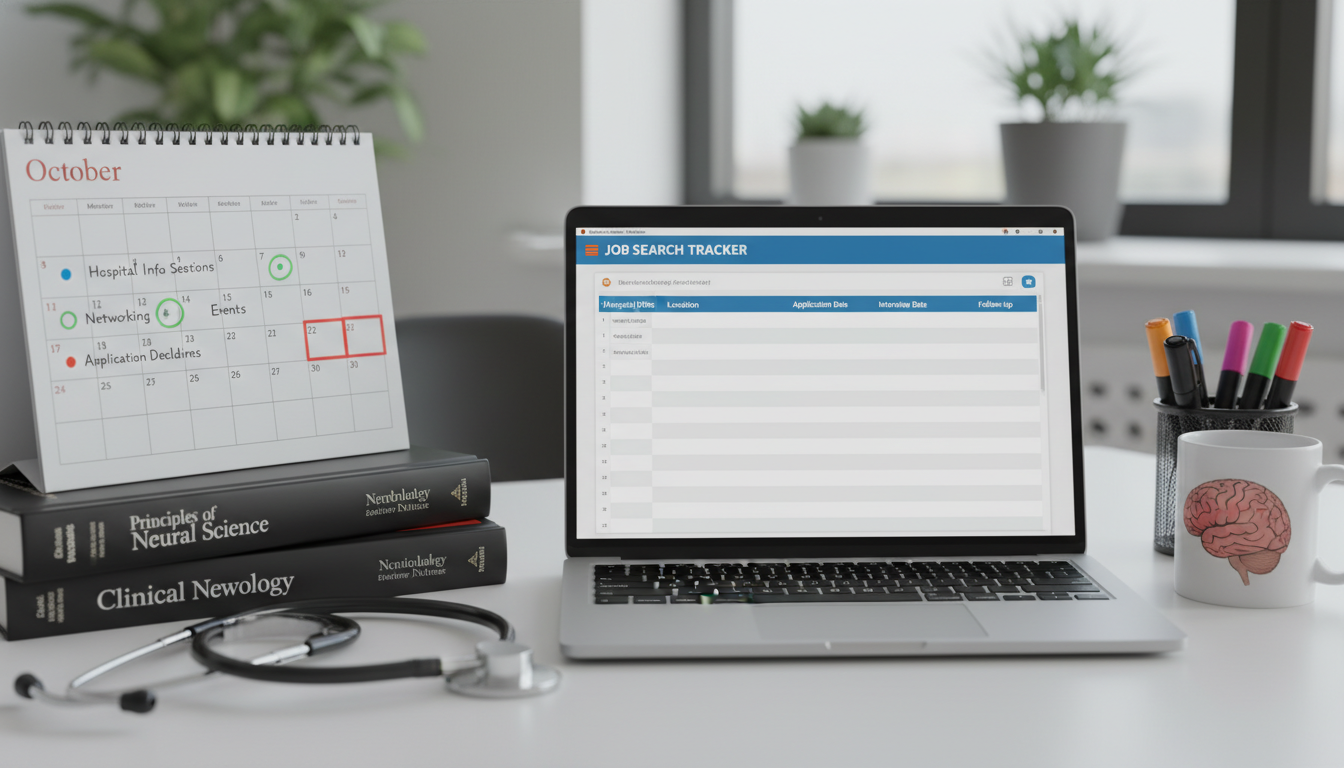
Below is a sample timeline for a neurology resident finishing training on June 30 and going directly into an attending role, with similar timing for fellows finishing a year later.
You can adjust slightly earlier for academic/subspecialty positions and for visa‑dependent searches.
18–16 Months Before Start Date (Jan–Mar, PGY-3 or early fellowship)
Goals: Exploration and preparation
Reflect on what you want from your first job:
- Academic vs community vs private practice
- Urban vs suburban vs rural
- General neurology vs subspecialty‑dominant practice
- Work–life balance, call, inpatient/outpatient mix
Update your CV with:
- Neurology residency details, leadership roles
- Research, QI projects, presentations, teaching experiences
Start informal conversations:
- Meet with your program director and mentors about your goals
- Ask where recent graduates have gone and if they’re happy there
- Connect with alumni in regions you’re considering
Start following the physician job market:
- AAN Career Center, NEJM Career Center, PracticeLink, etc.
- Hospital system job pages in your target areas
15–12 Months Before Start Date (Apr–Jun)
Goals: Early outreach and targeted search
Create a simple tracking spreadsheet for potential positions.
Draft a basic but adaptable cover letter template.
Begin targeted outreach to:
- Departments or groups in your top 3–5 cities/regions
- Chairs/division chiefs at academic centers you’re interested in
- Recruiters for large health systems
Attend conferences (AAN, subspecialty meetings):
- Visit career booths and speak with department representatives
- Ask for informational meetings even if there isn’t a formal posting yet
If you’re on a visa:
- Clarify J‑1 waiver requirements and timelines
- Let potential employers know your visa status early
12–9 Months Before Start Date (Jul–Sep)
Goals: Active application and interviews
Begin applying in earnest to positions that match your priorities.
Schedule phone and video interviews, followed by on-site visits when appropriate.
During interviews, pay attention to:
- Clinical volume and expectations
- Call schedule and backup structure
- Support staff, EMR, and ancillary services (EEG/EMG, neuroimaging access)
- Autonomy vs supervision in your first years
Request example contracts or term sheets when a position is serious.
Start thinking about state licensure:
- If you know the likely state you’ll work in, start the license application now.
9–6 Months Before Start Date (Oct–Dec)
Goals: Narrow options and negotiate
Compare offers side by side on:
- Base salary and bonus structure (RVUs, quality metrics)
- Call pay and protected time (for academics, research/teaching time)
- Non‑compete clauses and restrictive covenants
- Tail malpractice coverage (especially if employed vs independent contractor)
Seek advice from:
- Trusted faculty or mentors
- Senior neurologists in your subspecialty
- A healthcare contract attorney (strongly recommended for your first contract)
Aim to sign a contract within this window for a start the following July.
Once signed, notify other potential employers professionally and thank them.
6–3 Months Before Start Date (Jan–Mar)
Goals: Logistics and transition
- Finalize state licensure (if not already) and start hospital credentialing.
- Arrange relocation, housing, and schooling (if applicable).
- Schedule your ABPN Neurology Boards and plan for any study time around your move and job transition.
- Work with your new employer to set up:
- Orientation dates
- Initial clinic templates and scheduling preferences
- EMR training and onboarding
3–0 Months Before Start Date (Apr–Jun)
Goals: Onboarding and mental preparation
- Complete hospital and health system onboarding requirements.
- Confirm DEA and controlled substance registration, NPI, and payor enrollment processes.
- Review your job description and expectations one more time.
- Plan how you’ll transition into attending life—mentoring, peer support, and continued learning.
Common Timing Pitfalls—and How to Avoid Them
Even strong MD graduate residency alumni can stumble on timing. Here are frequent pitfalls neurology residents and fellows encounter:
1. Waiting Too Long to Start
Problem: Starting your search 6 months or less before graduation.
Risks:
- Limited options in your preferred geographic area.
- Accepting a suboptimal position out of urgency.
- Delayed start date if licensure/credentialing lag.
Solution:
- Set a personal deadline: begin exploring 12–18 months before, and aim to sign 6–9 months before.
2. Over‑Focusing on One City or Institution
Problem: Hyper‑focusing on a single academic center or city without contingency plans.
Risks:
- If that center has no opening or funding freeze, you scramble late.
- You may feel forced into a poor local fit just to stay in one region.
Solution:
- Define primary targets and secondary options (e.g., nearby cities, community systems with academic affiliation).
- Maintain two or three parallel paths until you have a signed contract.
3. Underestimating Visa Complexity
Problem: Starting the attending job search too late if you’re on a J‑1 or H‑1B visa.
Risks:
- Missing J‑1 waiver cycles or state deadlines.
- Ending up in a location or job you don’t want, simply because it’s the only one that could complete paperwork in time.
Solution:
- Start the process 18–24 months before training completion.
- Prioritize employers with experience in visa‑sponsorship for neurologists.
4. Ignoring Board Exam and Fellowship Timing
Problem: Treating boards, fellowship end, and job start as separate rather than interconnected.
Risks:
- Taking a new attending job right before boards, leading to stress and under‑preparation.
- Overlapping fellowship obligations (research projects, case logs) with early job start dates.
Solution:
- Map all major dates (fellowship completion, board exam windows, contract start) on one calendar.
- If needed, negotiate your job start date by a month or two to accommodate essential exams or personal milestones.
5. Not Using Mentors and Alumni Networks
Problem: Relying solely on generic job boards and recruiters.
Risks:
- Missing excellent “hidden” jobs never publicly advertised.
- Having limited insight into practice culture and turnover.
Solution:
- Leverage your neurology residency alumni network early.
- Ask recent graduates:
- “When did you start your job search?”
- “Would you take your job again?”
- “What do you wish you had known about timing?”
Strategic Tips for a Strong First Neurology Job
Timing is only one piece of the attending job search. As you plan when to start, keep these strategic principles in mind:
Match the job to where you are in your professional growth.
For many right out of an allopathic medical school match and neurology residency, a job with strong mentorship and reasonable call trumps a slightly higher salary.Think in 3–5 year horizons, not forever.
Your first job does not need to be your forever position. However, an early mismatch (especially with a harsh non‑compete) can limit your short‑term options, so timing and due diligence matter.Use timing to negotiate from a position of strength.
When you start early, you’re not desperate. You can compare multiple offers and walk away from those that don’t align with your professional goals.Keep your long‑term interests visible.
If you aim for a research‑heavy academic role or leadership in stroke programs down the road, choose an initial job that preserves those trajectories: protected time, mentorship, and clinical exposure aligned with your eventual niche.
FAQs: Job Search Timing for MD Graduate in Neurology
1. When should I start my neurology attending job search if I’m going straight into practice after residency?
Begin serious exploration 12–18 months before your planned start date (usually mid‑PGY-3 to early PGY-4). Aim to have a signed contract 6–9 months before you finish residency. This timeline helps you secure desirable positions, complete licensure, and plan relocation without rushing.
2. How does fellowship affect when I should start my job search?
For one‑year neurology fellowships (e.g., stroke, epilepsy, neurophysiology), start planning early in the fellowship and begin formal applications around 4–6 months into the fellowship year. For two‑year fellowships, begin active search in the first half of the second year. Academic subspecialty positions may recruit earlier, so initial networking 18 months before your desired start is wise.
3. I’m on a J‑1 visa. When should I start looking for a job to secure a waiver?
J‑1 waiver planning should start 18–24 months before your training completion. This accommodates waiver application timelines, state‑specific processes, and the search for employers experienced with visa sponsorship. Delaying the job search can severely restrict your options in the physician job market.
4. What if I don’t know which type of neurology practice I want yet?
Use PGY-2 and early PGY-3 (or the first half of fellowship) for exploration: rotating through subspecialty services, attending conferences, and talking with mentors and alumni. By the time you’re 12–15 months from graduation, you should narrow your goals enough to target academic vs community vs private practice and a few priority geographic regions. You can still keep a range of options open, but you’ll be better positioned to time your applications effectively.
By approaching your neurology attending job search with a clear, early, and structured timeline, you turn an overwhelming transition into a deliberate step in your career. Thoughtful timing—combined with mentorship, self‑reflection, and careful evaluation of offers—will help you move from neurology residency or fellowship into an attending role that supports both your professional growth and your life outside the hospital.