
Understanding the Big Picture: Why Timing Matters So Much for Non‑US Citizen IMGs
For a non-US citizen IMG in emergency medicine, the job search is not just about finding the “right” attending position. It’s also about:
- Synchronizing visas, licensing, and board eligibility
- Navigating a competitive and evolving physician job market
- Managing personal and family needs across borders
- Minimizing the risk of gaps in status or sudden unemployment
Unlike many US graduates, a foreign national medical graduate must build a job search strategy around immigration and regulatory timelines. That makes when to start job search just as critical as where to apply.
In emergency medicine, timing is even more complex. The EM job market has shifted in recent years, with:
- Some regions (urban, coastal) being more competitive
- Other regions (rural, underserved) having more open positions
- Large corporate groups (CMGs), academic centers, and democratic groups each hiring on different timelines
This article breaks down exactly when and how to start your attending job search as a non-US citizen IMG in emergency medicine, from late residency through your first attending year—focusing on realistic scenarios, visa constraints, and practical step-by-step plans.
Core Timeline: When to Start Your EM Job Search (Year-by-Year and Month-by-Month)
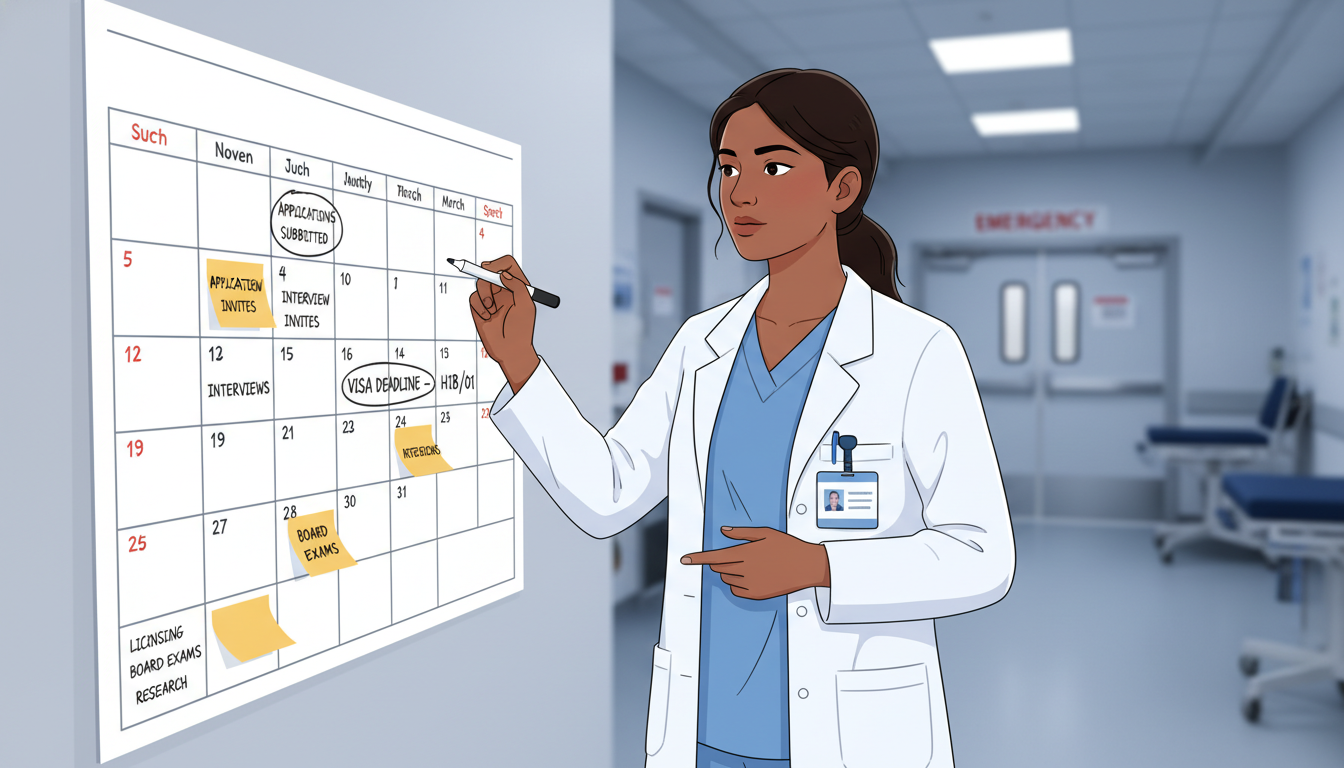
Below is a general timing roadmap, assuming a 3-year EM residency and graduation in June.
PGY-1 (Intern Year): Foundation and Planning
You are not actively applying yet—but the smartest candidates start laying groundwork.
Goals in PGY-1:
- Understand your visa situation:
- Are you on J-1 or H-1B (rare in EM but possible)?
- What are your long-term options (J-1 waiver, H-1B transfer, O-1, etc.)?
- Clarify your career direction:
- Community vs academic emergency medicine
- Urban vs rural; general EM vs subspecialty interest (like ultrasound, EMS, critical care, global EM)
- Build a competitive profile:
- Strong evaluations, procedures, leadership, research, QI projects
Timing actions:
- Fall–Spring PGY-1
- Meet with GME office and, if possible, an immigration attorney sponsored by your institution.
- Attend any career or job market talks by your department or program.
- Start tracking program alumni who are non-US citizen IMG EM attendings—where did they go? What visas did they use?
You are not hunting jobs yet, but you are building the information base that will shape your later decisions.
PGY-2: Prepare, Network, and Define a Strategy
PGY-2 is where you begin to think tactically about the attending job search.
Mid PGY-2 (January–March): Clarify Your Path
This is the time to define:
- Do you plan to do a fellowship?
- If yes → your attending job search shifts 1–2 years later, but visa planning must start now.
- What is your likely visa route after residency?
- J-1 → almost always need a J-1 waiver job (typically underserved or rural)
- H-1B → may do straight H-1B transfer to a new employer; fewer geographic constraints but more paperwork
- Other (O-1, TN, etc.) → more specialized situations
Key actions:
- Talk to:
- Your program director about career goals and references
- Recently graduated EM attendings who were J-1 or H-1B
- Start tracking:
- Which EM employers sponsor J-1 waiver or H-1B visas
- Which states you might want to practice in (licensing timing matters)
Late PGY-2 (April–June): Build a Job Search Framework
You still have time, but by the end of PGY-2 you should:
- Have a CV in near-final format
- Have a “short list” of:
- 3–5 states that are visa-friendly and realistic
- 2–3 types of employers you might pursue:
- Academic medical centers
- Large national EM groups
- Democratic/local EM groups or hospital-employed positions
You’re not fully on the market yet, but you should be ready to move quickly when PGY-3 starts.
PGY-3: The Critical Job Search Year
This is the most important year for job search timing, especially for a non-US citizen IMG on a visa.
A realistic, month-by-month framework:
July–August PGY-3: Prepare for Launch
- Finalize:
- CV
- Personal statement or cover letter (short, focused on EM + visa status + goals)
- List of 3–4 references (at least 2 EM attendings, ideally including PD or APD)
- Confirm:
- Your preferred US states and practice settings
- Your visa strategy (J-1 waiver vs H-1B transfer vs other)
If you’re J-1, understand the J-1 waiver job search timing in detail:
- Many waiver positions are posted 1–2 years before start date, but applications often intensify in your final year.
- State Conrad 30 programs have fixed annual cycles and limited slots—these timing windows matter.
September–October PGY-3: Actively Start Your Job Search
For almost all non-US citizen EM residents, this is when you should officially start your attending job search.
Key moves:
- Begin sending:
- Targeted emails to groups/hospitals in your preferred states
- Applications via job boards (EMRA, ACEP, SAEM, hospital websites, major EM staffing companies)
- Attend:
- ACEP Scientific Assembly (if possible)
- This is one of the strongest recruiting venues for EM; many employers and recruiters attend.
- As a foreign national medical graduate, clearly discuss your visa status and timeline.
- ACEP Scientific Assembly (if possible)
Important:
If you’re on J-1, you should:
- Focus heavily on J-1 waiver-compatible areas (often rural, medically underserved, or smaller communities).
- Ask explicitly in early conversations:
- “Do you sponsor J-1 waivers or H-1B for non-US citizen IMG candidates?”
November–January PGY-3: Interviews and Negotiations
This is peak interview time for many EM positions.
During this period:
- Interviews:
- Virtual and on-site visits
- Mix of panel interviews, ED shadowing, and leadership meetings
- Key questions to ask (especially as a foreign national medical graduate):
- “How many non-US citizen IMG physicians do you currently employ?”
- “Do you provide full legal support for J‑1 waiver/H‑1B/O‑1 processing?”
- “What is your typical timeline from verbal offer to signed contract?”
- “When do you usually file immigration petitions for new hires?”
This is also when you should begin comparing offers:
- Salary, RVU structure, and bonuses
- ED volume, acuity, support staff, coverage model
- Contract structure (employed vs independent contractor)
- Visa and immigration support written in the contract
February–April PGY-3: Finalizing a Job and Visa Plan
By this stage, most non-US citizen IMG EM residents should have:
- At least one solid job offer
- A defined visa strategy for post-residency
For J-1 waiver candidates:
- You must align:
- Job offer
- State waiver timeline
- USCIS processing times
For H-1B transfer candidates:
- Ensure the employer can:
- File H-1B transfer in time for your July/August start
- Allow you to maintain legal status continuously
Most program directors advise that EM residents finalize their first attending contract no later than March–April of PGY-3, especially if visa work is required.
May–June PGY-3: Transition Planning
You’re almost at graduation.
Focus on:
- Licensing:
- Ensure your chosen state medical license is active or close to final before residency ends.
- Credentialing:
- Hospital and payer credentialing can take 3–6+ months.
- Immigration:
- Monitor filings and requests for evidence (RFEs) with your immigration counsel.
This is also the time to prepare for the EM written board exam and oral boards path while transitioning into your new role.
Visa-Specific Timing Strategies (J-1 vs H-1B vs Others)
Because your immigration status drives so much of your attending job search, you need a visa-specific timing plan.
J-1 Visa: The Most Common Scenario for Non-US Citizen EM Residents
For a non-US citizen IMG on a J‑1 visa, the J‑1 waiver is usually essential to stay in the US after residency.
Key Concepts
- You must generally work 3 years in a designated underserved area (Conrad 30 or similar waiver program).
- Each state has its own:
- Application start dates
- Deadlines
- Position requirements
- Priority specialties (many do consider emergency medicine a high-need specialty)
Timing Guideline for J-1 EM Residents
- Early PGY-3 (July–September)
- Identify states with J-1 waiver slots open to emergency medicine
- Prioritize states with:
- Shorter processing times
- Non-competitive or underfilled EM positions
- September–December PGY-3
- Aggressively pursue ED jobs in your selected states that are willing and able to sponsor J-1 waivers.
- Make sure contract signing aligns with the state’s Conrad 30 application window.
- December–May PGY-3
- State submits your J‑1 waiver case (timing varies by state).
- After state approval, USCIS processes your waiver petition and work authorization.
Because EM is shift-based and many rural communities rely heavily on EDs, J-1 waiver EM positions do exist—but they go quickly, and early search is critical.
H-1B Visa: Different but Still Time-Sensitive
Some non-US citizen IMG EM residents are on H‑1B visas during training, often through university sponsorship.
Key differences:
- You usually do not need a J‑1 waiver, but you do need:
- An H‑1B transfer or new H‑1B cap-exempt position (depending on your current status)
- Employers must:
- File LCA (Labor Condition Application)
- File H‑1B petition with USCIS
Timing goals for H-1B:
- Secure job and signed contract by January–March PGY-3.
- Allow enough time for:
- LCA (1–2 weeks)
- H‑1B preparation and filing (4–8 weeks, depending on employer/attorney)
- USCIS processing (can be 15 days with premium processing; longer otherwise)
Because some EM groups are nervous about H‑1B complexity, you should:
- Prioritize employers with a track record of hiring non-US citizen IMGs on H‑1B.
- Ask early: “Do you have internal immigration counsel, or use an experienced firm?”
Other Paths (O-1, TN, etc.)
Less common but relevant for certain foreign national medical graduates:
- O-1: For physicians with evidence of extraordinary ability (research, national/international recognition, etc.). Complex but flexible.
- TN: Available only to Canadian and Mexican citizens, subject to specific EM job requirements.
For these, timing is similarly early (PGY-3 fall), and you should work closely with an immigration attorney.
Matching Job Search Timing to the Physician Job Market in EM
The physician job market in emergency medicine has shifted in recent years. This affects when and how aggressively you should search.
Regional Variation
Your timing strategy may depend on where you want to work:
- Urban/coastal academic centers (e.g., Boston, NYC, San Francisco):
- More competitive
- Often less willing to sponsor complex visas
- May recruit earlier and be pickier with non-US citizen IMG applicants
- Suburban and community hospitals:
- Generally steady demand
- Timing around late PGY-2 to PGY-3 is often reasonable
- Rural/underserved areas:
- High need, more open to visa sponsorship and J‑1 waivers
- Job offers may come relatively quickly if you show interest early
Employer Types and Their Typical Hiring Timelines
Large national EM physician groups / CMGs
- Recruit year-round, often with formal recruitment teams.
- Many are familiar with hiring foreign national medical graduates—but not all offices or sites sponsor visas.
- Good for early contact in September–November PGY-3.
Academic centers
- Often plan hiring 6–12+ months in advance.
- May be more bureaucratic about visa sponsorship.
- Start networking as early as late PGY-2, especially if you’re interested in academic EM.
Democratic groups / smaller private practices
- Great clinical experience and sometimes partnership tracks.
- May have less familiarity with J‑1/H‑1B processes.
- Their hiring can be more last-minute; you may need to educate them about visa timelines.
For a non-US citizen IMG EM resident, earlier is safer. Start serious outreach by September PGY-3, with the goal of having multiple viable options by January–February.

Practical Steps and Actionable Advice for Non‑US Citizen IMG EM Residents
Step 1: Clarify Your Constraints and Priorities
Make a written list:
- Visa type and expiration
- Preferred regions (1st, 2nd, 3rd choice)
- Type of practice (academic, community, rural, trauma center, etc.)
- Must-haves:
- Visa sponsorship
- Reasonable commute or relocation feasibility
- Specific practice conditions (e.g., no mid-level supervision only, certain ED volumes)
This clarity will guide efficient, targeted applications.
Step 2: Build a Professional, EM-Focused CV
Your CV should highlight:
- EM residency (with anticipated completion date)
- Board eligibility status (e.g., “ABEM board-eligible upon completion of residency in June 20XX”)
- Significant EM rotations and leadership roles (chief resident, QI projects, ultrasound director involvement)
- Research, especially EM or trauma-related
- Teaching experience (med students, residents)
Add a concise line:
“Citizenship/Immigration: [Your country], currently on [J‑1/H‑1B] visa; seeking [J‑1 waiver/H‑1B transfer/etc.] with employer-sponsored immigration support.”
Step 3: Use Multiple Job Search Channels
For the EM match you had a clear centralized system; for attending roles, the job market is fragmented. Use:
- Professional organizations:
- ACEP, EMRA, SAEM job boards
- Recruiters:
- Large EM group recruiters and specialized physician recruiters who know the physician job market
- Offline networking:
- Conferences, alumni, faculty recommendations
- Direct outreach:
- Email ED medical directors in your target regions, especially rural/underserved areas
Step 4: Be Transparent and Strategic About Your Visa
When to disclose visa status?
- Early email or first conversation:
- Mention you are a non-US citizen IMG and briefly note your visa situation.
- Reason:
- Saves time
- Signals professionalism
- Helps filter for genuinely visa-friendly employers
Example email phrase:
“As a non-US citizen IMG currently training in emergency medicine on a J‑1 visa, I am seeking a J‑1 waiver-eligible position starting July 20XX and am very interested in opportunities with your department.”
Step 5: Time Contract Signing Carefully
Important points:
- Do not rush to sign the first contract unless:
- It clearly supports your visa needs
- The community and practice pattern are acceptable
- You have discussed it with mentors/possibly an attorney
- But also:
- Do not postpone indefinitely; visa processing requires months, not weeks.
Typical sequence:
- Initial offer (verbal or email)
- Discussion of compensation, schedule, and visa terms
- Draft contract shared
- You review with a trusted mentor and (if needed) an attorney
- Finalize and sign—ideally by March PGY-3 for J‑1 or H‑1B jobs
Step 6: Plan for “Backup” Options
Because the physician job market and immigration rules can change, especially for a non-US citizen IMG, you should have at least one backup strategy:
- Alternative states or regions you are willing to consider
- Alternative employer type (e.g., from academic to community, or vice versa)
- Fellowship (with its own visa implications) as a bridge year if needed
While not ideal, a backup plan can protect you from sudden shifts in job availability or policy.
Common Pitfalls and How to Avoid Them
Starting the job search too late
- Risk: No time for J‑1 waiver/H‑1B processing; limited employer options.
- Fix: Begin active search by September PGY-3, earlier if J‑1.
Ignoring state licensing timelines
- Risk: You match with a job but cannot get a license in time.
- Fix: Start license applications as soon as possible in the state(s) you are targeting—often as early as late PGY-2 or early PGY-3.
Assuming “any employer will handle my visa”
- Risk: Offer rescinded when they realize the complexity; delays.
- Fix: Verify upfront whether they have experience and willingness to sponsor your visa type.
Not leveraging mentors and alumni
- Risk: Miss out on inside information about good vs problematic employers, regions, and visa-friendly groups.
- Fix: Request introductions to EM attendings who were non-US citizen IMG residents from your program.
Signing contracts without understanding non-compete or termination clauses
- Risk: Stuck in a location/job that doesn’t work or can’t move easily for your second job.
- Fix: Carefully review restrictive covenants and termination conditions before signing.
FAQs: Job Search Timing for Non‑US Citizen IMG in Emergency Medicine
1. When should a non-US citizen IMG in EM start looking for their first attending job?
Most EM residents should start serious job search efforts in September of PGY-3.
If you are on a J‑1 visa and need a J‑1 waiver position, consider preparing as early as late PGY‑2 and begin active targeting of waiver-friendly regions/employers right at the start of PGY‑3.
2. How does being a foreign national medical graduate affect my emergency medicine residency job search timeline?
Being a foreign national medical graduate mainly affects your timeline through visa and licensing requirements. You must:
- Start earlier than many US graduates
- Target employers and states that are visa-friendly
- Allow months for J‑1 waiver or H‑1B processing
The core EM job market calendar (interviews in fall/winter, contracts by spring) still applies, but you have less margin for delay.
3. Can I wait until after the EM match (or after boards) to start my attending job search?
For non-US citizen IMG EM residents, waiting until after graduation or after the board exam is too late. By then:
- Many desirable jobs may be filled
- You may not have enough time to complete visa processing
Aim to finalize your contract months before residency ends, typically by March–April of PGY-3.
4. What if I don’t find a J‑1 waiver job in my preferred state?
Options include:
- Expanding your search to more rural or underserved areas within that state
- Looking at neighboring states with more open waiver slots or more EM demand
- Considering a fellowship that can extend your J‑1 status while you continue job search (with legal advice)
Flexibility on geography usually improves your chances of securing a suitable waiver job in emergency medicine.
By understanding the interplay of EM job market dynamics, visa logistics, and residency timelines, a non-US citizen IMG can approach the attending job search with a clear, proactive plan. Start early, be strategic, and lean on mentors and immigration experts—you can absolutely build a successful emergency medicine career in the US with the right timing and preparation.