
Choosing the right moment to start your job search can be as important as your CV, interview skills, and references—especially if you are a non-US citizen IMG in otolaryngology (ENT) who must coordinate visas, licensing, and personal life across continents. This guide focuses specifically on job search timing for foreign national medical graduates in ENT, from the last years of residency through the first attending contract.
Understanding the Timeline: Training Milestones and Job Search Phases
Before you decide when to start your job search, you need a clear view of your training path and typical US timelines for otolaryngology match graduates.
Typical Training Path in Otolaryngology (ENT)
- Medical School (US or international)
- Otolaryngology Residency: 5 years
- Optional Fellowship (1–2 years), e.g.:
- Head and neck oncologic surgery
- Laryngology
- Rhinology and skull base surgery
- Otology/neurotology
- Facial plastic and reconstructive surgery
- Pediatric otolaryngology
Each step has its own implications for job search timing:
- If you are finishing residency and going straight into practice: You’ll start earlier than you might think—often in PGY-4.
- If you are doing a fellowship, your serious job search will typically start in the first half of your fellowship year (or earlier for two-year programs).
Why ENT Timing Is Different From Some Other Specialties
Compared with some primary care fields, the physician job market in otolaryngology is:
- More subspecialty-driven (e.g., academic tertiary-care centers for skull base, high-end facial plastics)
- Smaller and more network-based, with many jobs never widely advertised
- Often slower in decision-making (committees, department approval, group partner votes)
For a foreign national medical graduate, this slower institutional pace collides with:
- Visa deadlines (H-1B caps, cap-exempt vs cap-subject, J-1 waiver start dates)
- State licensure delays
- International relocation planning (family, spouse employment, schooling)
That means you must start the attending job search earlier than most US graduates, and you must be strategic about the sequence of steps.
Core Principle: Work Backward From Your Start Date
The most reliable way to answer “When should I start my attending job search?” is to work backward from your target employment start date.
Key Backward-Planning Timeframes
Assume you want to start your first attending job on July 1 after residency or fellowship:
- Visa & Credentialing (6–12 months, sometimes more)
- State medical license: 3–6+ months depending on state
- DEA registration: 2–3 months
- Hospital credentialing & privileges: 2–6 months
- H-1B or J-1 waiver processing: 4–12 months (varies widely)
- Contract Negotiation and Internal Approvals (2–4 months)
- Initial interview → site visit → offer → counterpoints → final contract
- Job Search and Interviews (3–9 months)
- Initial outreach
- Scheduled interviews (often spaced over months)
- Reference checks and committee meetings
If you add these phases:
Total lead time: 12–18 months before your intended start date
For a non-US citizen IMG in ENT, a safe planning rule is:
Start serious job search activities 12–18 months before your desired job start date.
Detailed Timeline by Training Stage
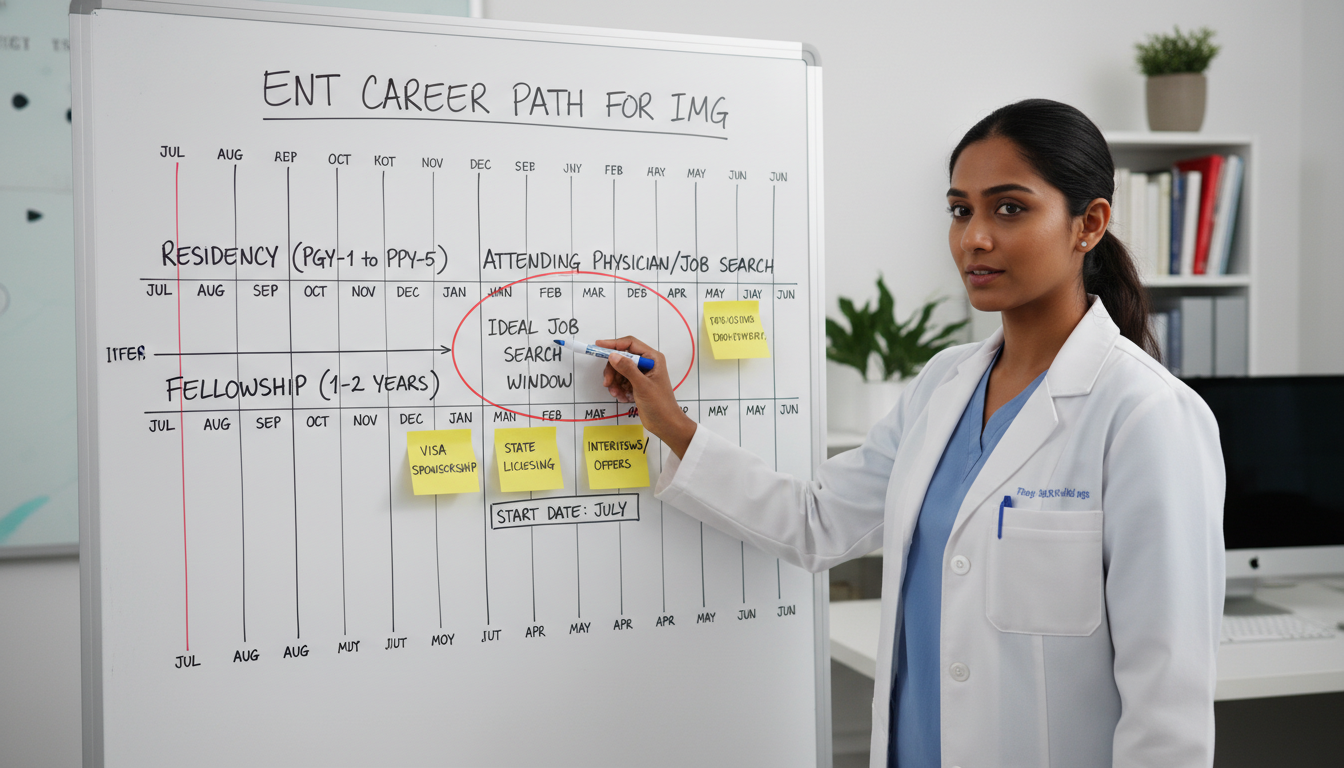
Let’s break it down for the last years of residency and fellowship, with a focus on foreign national medical graduates.
PGY-3 (or 2 Years Before Finishing All Training)
Your status: Mid-residency, still gaining core skills.
Job search goals in this phase:
- Clarify your long-term direction:
- Do you plan to:
- Practice general otolaryngology?
- Pursue fellowship?
- Aim for academic vs private practice vs hybrid models?
- Where geographically are you willing to live, realistically, considering J-1 waiver rules (if applicable)?
- Do you plan to:
- Understand your visa situation clearly:
- Current status (J-1, H-1B, O-1, green card, etc.)
- Do you need a J-1 waiver job? If yes, you will likely need a position in:
- Federally designated Health Professional Shortage Areas (HPSAs)
- Medically Underserved Areas (MUAs)
- Or state-specific Conrad 30 programs
- Start learning about the physician job market in ENT:
- Browse job postings (AAP, AAO-HNS, hospital systems, large ENT groups)
- Talk to upper-level residents and fellows:
- When did they start their searches?
- How long did credentialing and visas take?
- Begin informal networking: conferences, society meetings, alumni.
What not to do yet:
- You generally do not need to actively apply to positions this early, unless:
- You are absolutely not doing a fellowship and
- You know you want a rural or very specific location that may have only occasional openings
PGY-4 (or 18–24 Months Before Practice Start)
Your status: Senior resident; training end is visible.
This is when timing becomes critical for a non-US citizen IMG seeking an ENT residency graduate job.
Actions during this period:
Decide on Fellowship vs Direct Practice (as early as possible)
- If you will pursue fellowship:
- Your eventual attending job start date is 1–2 years later.
- Still, you should start understanding which job markets accept your preferred fellowship plus your visa type.
- If you will go directly into practice:
- Your target start date is July 1 right after PGY-5.
- You should be actively exploring jobs by early PGY-4, especially as a foreign national.
- If you will pursue fellowship:
Clarify Visa Strategy
- If you are on a J-1 visa:
- Understand Conrad 30 and other waiver programs in the states you’re considering.
- Many waiver-eligible jobs are in smaller cities or rural areas; positions may be posted earlier or fill quietly through networking.
- If you are on H-1B:
- Know whether you will be in a cap-exempt environment (e.g., academic centers) vs cap-subject private practice.
- Timeline is especially tight if a cap-subject H-1B is involved (April application, October start).
- If you are on a J-1 visa:
Light Touch Exploratory Outreach
- Email departmental chairs, ENT practice leaders, and alumni:
- Introduce yourself.
- Ask about future hiring projections for the year you’ll be finishing.
- Attend AAO-HNSF and subspecialty meetings and visit career booths.
- Email departmental chairs, ENT practice leaders, and alumni:
PGY-5 (Final Year of Residency)
If you are going straight into practice, PGY-5 is your main job search year.
When to start active applications:
- 12–18 months before start date:
- For a July 1 start right after PGY-5, start applying between January and September of PGY-4 (or at least by summer at the start of PGY-5).
- Practically, most US grads might begin 9–12 months ahead.
As a non-US citizen IMG, move that window earlier to buffer for visa/licensing delays.
Tasks and timing:
July–September (Start of PGY-5):
- You should ideally:
- Have a polished CV and personal statement-style introduction email.
- Know your state preferences and whether you need a J-1 waiver.
- Have a list of at least 10–20 potential employers:
- Academic ENT departments
- Large ENT groups
- Hospital-employed ENT positions in underserved areas (for J-1 waivers)
- You should ideally:
September–December (Mid PGY-5):
- Send formal applications and inquiries.
- Start virtual interviews.
- Schedule on-site visits (usually 1–2 days, often requiring time off).
- Ask about:
- Will they sponsor your specific visa type?
- Have they previously sponsored non-US citizen ENT attendings?
January–March (Late PGY-5):
- Aim to have at least one or two offers by this period.
- Negotiate contract terms:
- Call schedule
- OR block time
- Compensation and RVU thresholds
- Non-compete clause radius and duration
- Visa-related legal fees and support
- Initiate state licensure and credentialing as soon as you sign an offer.
April–June (End of PGY-5):
- For J-1 waivers: finalizing waiver and H-1B as applicable.
- For H-1B cap-subject: hope the petition is approved (many ENT jobs for foreign nationals avoid cap-subject scenarios by staying in academic or hospital-embedded roles).
- Completing onboarding paperwork, EMR training modules, and malpractice enrollment.
Fellowship Training: How It Changes Job Search Timing

Most new ENT attendings complete at least one fellowship. If you’re a foreign national medical graduate, this extra year can be a blessing for visa and networking—but it also shifts your timeline.
For One-Year ENT Fellowships
Example: You finish PGY-5 in June 2027 and complete a one-year fellowship, finishing June 2028.
When to start job search for attending positions:
- Primary window:
July–December of your fellowship year (12–18 months before a July 2029 start is ideal, but many fellowships are only 1 year).
That means you realistically start:- Early networking in late PGY-5 and before fellowship starts
- Active applications by August–October of fellowship year
Practical approach:
- Before fellowship starts:
- Identify 5–10 institutions or regions where your subspecialty is in demand.
- Confirm which of those typically hire foreign nationals and sponsor visas.
- During fellowship (first 6 months):
- Schedule interviews (many fellowships are clinically intense; plan ahead with your program director).
- Ask mentors to personally connect you with chairs and division chiefs interested in your specific subspecialty expertise.
For Two-Year Fellowships
If your fellowship is 2 years, you can use the first year to prepare deeply:
- Early in Year 1:
- Clarify long-term goals and geographic constraints (especially with J-1 waivers).
- Late Year 1 / Early Year 2:
- Begin serious applications and interviews.
- Still aim for 12–18 months before attending start for your first contacts and at least 9–12 months for concrete applications and site visits.
Special Timing Considerations for Non-US Citizen IMGs
For a non-US citizen IMG, job search timing is not just about employment—it’s about immigration law, risk management, and protecting your future career options.
Visa Category and Its Impact on Timing
J-1 Visa (ECFMG-sponsored)
- Most non-US otolaryngology residents are on J-1.
- After training, you must:
- Return home for 2 years or
- Obtain a J-1 waiver job (Conrad 30, federal, or hardship-based).
- J-1 waiver job search timing:
- Many waiver-eligible jobs open early and fill quickly.
- If you wait until late in final year, you may:
- Miss your preferred state’s Conrad 30 slots
- Be forced to accept a location that does not match your career goals
- Start exploring waiver-eligible positions 12–18 months before you finish residency/fellowship.
H-1B Visa
- Often used for:
- J-1 waiver jobs
- Direct hire from residency if you were on a different status
- Timing issues:
- H-1B cap-subject jobs must align with the USCIS lottery cycle.
- Many academic centers and nonprofit hospitals are cap-exempt, giving more flexibility.
- If your target job is cap-subject, you may need to secure an offer well before April to file an H-1B petition for an October start date (sometimes requiring a gap between training completion and job start).
- Often used for:
Other Statuses (O-1, Green Card, EAD)
- O-1 (extraordinary ability) can be strategically useful for high-achieving academic otolaryngologists (publications, national presentations).
- Green card holders have more flexibility in timing like US citizens but still need to consider:
- State licensure delays
- Hospital credentialing
Aligning Visa Steps With Job Search
To avoid last-minute crises, use this structure:
12–18 months before finish:
- Confirm with your institution’s GME office and immigration attorney:
- What status you will have at the end of training.
- Whether a waiver is required.
- Begin targeting employers known to sponsor your required status.
- Confirm with your institution’s GME office and immigration attorney:
9–12 months before finish:
- Have at least one serious potential employer who has confirmed:
- Willingness to sponsor your visa.
- Familiarity with timelines.
- Start formal immigration evaluation with the employer’s legal team.
- Have at least one serious potential employer who has confirmed:
6–9 months before finish:
- File J-1 waiver and/or H-1B/O-1 petitions.
- Maintain a backup plan (another job or state) in case of unexpected complications.
Practical Strategies to Optimize Your Job Search Timing
Beyond knowing the calendar, you need an actionable plan. Below are strategies tailored to a non-US citizen IMG in ENT.
1. Start Informational Interviews Early
When: 18–24 months before finishing training.
- Ask mentors to introduce you to:
- ENT department chairs in regions you like.
- Group practice partners who previously hired foreign nationals.
- Purpose is not to ask for a job immediately; it’s to:
- Understand their anticipated hiring needs for your graduation year.
- Ask what they look for in new ENT attendings.
- Ask if they have any historical challenges sponsoring visas.
2. Build a Shortlist of “Target Employers”
When: 12–18 months before finishing.
Criteria specifically important for you:
- Prior experience hiring non-US citizen IMG otolaryngologists.
- Willingness to:
- Sponsor your specific visa.
- Cover attorney fees.
- Support you through state licensure and credentialing.
Include a mix of:
- Academic centers (often cap-exempt; good for subspecialists)
- Hospital-employed ENT practices (common for J-1 waiver positions)
- Larger ENT groups that have infrastructure to handle immigration and onboarding
3. Time Your Applications With Internal Hiring Cycles
Different employers operate on different cycles:
- Academic ENT departments:
- Often plan positions 12–24 months in advance.
- Committee and board approvals can add 3–6 months.
- Hospital systems:
- May open positions as soon as a need is recognized but still take months to finalize.
- Private practices:
- May move faster but sometimes have less familiarity with visas.
To avoid missing windows:
- For academic jobs: Start outreach 16–24 months before finishing.
- For private/hospital jobs: Apply at least 9–12 months before your start date.
4. Create a Personal Job Search Timeline
Build a simple spreadsheet or Gantt chart:
- Rows: Employers / locations
- Columns: Months (18 months before graduation → 6 months after)
- Add:
- When you sent first contact
- Interview dates
- Offer dates
- Visa steps and status
- Licensure applications
Revisit it monthly and adjust efforts as needed.
5. Plan for a “Delay Scenario”
Even with perfect timing, delays happen (visa backlogs, licensure issues, personal emergencies). As a foreign national, being forced to leave the US or remain unemployed can be high-risk.
Contingency steps:
- Ask your residency or fellowship program director if short-term extension or moonlighting is feasible if needed.
- Consider backup jobs:
- A different state with faster waiver processing
- A cap-exempt institution if your cap-subject H-1B is not selected
- Save funds to manage 2–3 months of potential income gap if unavoidable.
Frequently Asked Questions (FAQ)
1. When should I start my job search as a non-US citizen IMG in ENT if I am not doing a fellowship?
For a typical July 1 attending start after PGY-5:
- Begin serious job exploration 12–18 months before you finish (late PGY-4).
- Send applications and inquiries no later than early PGY-5, especially if you need a J-1 waiver or H-1B sponsorship.
- This early start gives time for:
- Multiple interviews
- Contract negotiation
- Visa processing
- State licensure and credentialing
2. Does doing a fellowship delay when I should start my attending job search?
Yes and no:
- It delays the actual start date of your attending job by 1–2 years.
- However, for a one-year fellowship, you must start your attending search very early in your fellowship year (or even in late PGY-5).
- For two-year fellowships, you can:
- Use Year 1 for exploration and networking.
- Begin active applications in late Year 1 or early Year 2.
3. How does being a foreign national medical graduate affect my job search timing compared with US citizens?
Being a non-US citizen IMG adds layers that strongly argue for starting earlier:
- Visa processing can take months to over a year, especially J-1 waivers.
- Some employers need institutional approvals to sponsor visas.
- Certain states have slower licensure processes.
US citizens may manage with a 6–9 month search; for you, 9–18 months is much safer, depending on your visa path.
4. How do I balance my job search with a busy ENT residency or fellowship schedule?
Planning and communication are key:
- Talk early with your program director about needed interview days.
- Cluster interviews geographically to reduce travel time.
- Use evenings and weekends for:
- Researching employers
- Emailing contacts
- Reviewing contracts with mentors or attorneys
- Create a structured calendar with:
- Weekly job search goals
- Deadlines for applications, follow-ups, and visa steps
Timing is one of the few aspects of the attending job search you can fully control. As a non-US citizen IMG in otolaryngology, you face additional complexity, but with 12–18 months of thoughtful planning, you can line up the right job, in the right location, with the right visa support—without last-minute panic.
Use your senior years of training not just to refine your surgical skills but also to strategically position yourself in the physician job market, so that by the time you finish, your main focus is transitioning confidently into your new attending role, not scrambling for a position or visa at the eleventh hour.