
Understanding Job Search Timing as a Non‑US Citizen IMG in Psychiatry
As a non-US citizen IMG (international medical graduate) in psychiatry, the “when” of your job search is just as important as the “how.” Your timing has to account not only for the psychiatry job market, but also for visa rules, contract cycles, credentialing, and licensing timelines. Planning this out early can be the difference between a smooth transition and a gap in employment—or worse, a visa problem.
This article focuses specifically on job search timing for a foreign national medical graduate in psychiatry, from late residency through the first attending role. It assumes you are already in (or about to enter) a U.S. psychiatry residency and want to maximize your odds of a successful psych match to your first attending position.
The Big Picture: Timelines Unique to Non‑US Citizen IMGs
Before drilling into dates, you need to understand the moving parts that affect your timeline as a non‑US citizen IMG pursuing psychiatry residency and beyond:
Visa category and rules
- J‑1 visa (via ECFMG)
- H‑1B visa (through your residency or fellowship program)
- Other statuses (e.g., green card, EAD, O‑1; less common but important)
Licensure and board timelines
- State medical license (processing often 2–6 months)
- Board eligibility requirements (number of months of training, signed completion letter)
- Board certification exams (ABPN): not strictly required to start most jobs, but timing affects offers and compensation
Employer hiring cycles
- Large health systems and academic centers often recruit 12–18 months ahead
- Community hospitals and private practices may hire closer to need (6–12 months ahead), but not always
- Government and public sector roles (e.g., VA) may have longer onboarding timelines
Immigration processing times
- J‑1 waiver (if applicable)
- H‑1B cap vs cap‑exempt
- Premium vs regular processing
Key principle: As a non‑US citizen IMG psychiatrist, you should think of your attending job search as a 2‑year process, not a last‑minute scramble in your final months of training.
The Core Timeline: When to Start Your Attending Job Search
This section gives a general timing framework for a psychiatry resident who is a foreign national medical graduate. We’ll then adjust it for different visa paths and goals.
PGY‑2: Laying Foundations (Early Exploration Stage)
- Primary goal: Understand the landscape and set direction.
- This is not too early for a non‑US citizen IMG in psychiatry.
What to do in PGY‑2:
- Clarify long‑term goals:
- Academic vs community vs private practice
- Subspecialty interest (child, addiction, consult‑liaison, forensics, geriatrics, etc.)
- Geography (which states make sense given your visa needs?)
- Start informal market research:
- Talk to recent graduates from your program (especially other non‑US citizens)
- Ask: “When did you start your attending job search?” and “What would you do differently as a non‑US citizen IMG?”
- Learn state licensing requirements:
- Some states require 3 years of training, others 1–2.
- Identify 3–4 “target states” where you would realistically live and work.
- Clarify visa realities:
- Are you on J‑1 or H‑1B?
- If J‑1: Start reading about J‑1 waivers, Conrad 30, and hardship/persecution routes.
- If H‑1B: Understand cap vs cap‑exempt, portability, and potential transfer.
Timing takeaway: PGY‑2 is about information gathering. Do not sign anything yet, but do start mapping out a realistic post‑residency pathway tailored to your immigration status.
PGY‑3: Early Strategy and Soft Networking (Pre‑Search Stage)
This is when most psychiatry residents—especially non‑US citizen IMGs—should become intentional about timing.
Ideal window:
- 12–24 months before completion of training (often PGY‑3 for a 4‑year general psychiatry program)
Key tasks in PGY‑3:
Decide on fellowship (if any)
- If you plan a subspecialty (e.g., child & adolescent psychiatry, addiction), the fellowship itself will shift your attending job search 2–3 years later.
- Timing rule:
- Start exploring fellowship options at the start of PGY‑3.
- Fellowship applications are often due 1.5–2 years before expected start.
Clarify your “first job profile”
- Academic vs community
- Inpatient vs outpatient vs hybrid
- Telepsychiatry vs on‑site
- Populations (serious mental illness, veterans, children, the elderly, etc.)
- Visa sponsorship needs (critical for a foreign national medical graduate)
Start soft networking
- Attend national meetings: APA, AACAP (for child), AAGP (for geriatric), AAAP (addiction), ACLP (consult-liaison)
- Join listservs and professional societies
- Meet department chairs and program leadership at places you are interested in
- Let your home program faculty know your long‑term interests
Understand visa‑linked timing
- If on J‑1:
- Learn about the Conrad 30 program in several target states.
- Understand that many J‑1 waiver jobs open very early each cycle and fill quickly.
- If on H‑1B:
- Understand when you can start H‑1B transfer to a new employer after residency.
- Learn which employers are cap‑exempt (e.g., universities, non‑profit hospitals, some research institutions).
- If on J‑1:
Timing takeaway: PGY‑3 is when you should move from abstract ideas to a clear plan for job search timing, especially around J‑1 waiver or H‑1B strategy.
PGY‑4: Active Job Search and Offers (Primary Search Stage)
For most non‑US citizen IMGs in psychiatry, PGY‑4 is the crucial year to start and finalize attending job offers if you are not doing additional fellowship.
Recommended timeline:
12–18 months before graduation (early PGY‑4)
- Begin actively searching and applying, especially for:
- J‑1 waiver positions
- H‑1B sponsorship roles that require long onboarding
- Academic psychiatry positions
- Begin actively searching and applying, especially for:
9–12 months before graduation
- Aim to have several interviews lined up.
- Narrow your geographic and practice‑type preferences.
6–9 months before graduation
- Target signing a contract during this window.
- This allows time for:
- State licensing
- Credentialing
- Visa transfer/waiver approvals
3–6 months before graduation
- This is still feasible for some community or private practice roles, but riskier for non‑US citizens because of visa and licensing timelines.
- Use this window mainly for backup or additional options, not your primary plan.
Example:
You finish psychiatry residency on June 30, 2027.
- July–December 2025 (mid PGY‑3 to early PGY‑4): Clarify goals and start networking.
- July–December 2026 (PGY‑4): Actively apply and interview.
- By December 2026–February 2027: Aim to sign an attending contract.
- Spring 2027: Finalize license, credentialing, and visa paperwork.
- July–September 2027: Start your first attending job (depending on onboarding timelines).
Timing takeaway: As a non‑US citizen IMG psychiatrist, you generally want a signed contract no later than 6–9 months before graduation to safely cover license and immigration steps.

Visa‑Specific Timing: J‑1 vs H‑1B vs Other Statuses
Your visa type is one of the strongest determinants of when to start job search and how aggressive your timeline must be.
J‑1 Visa Holders: The Most Time‑Sensitive Path
As a J‑1 foreign national medical graduate in psychiatry, you are obligated to:
- Return to your home country for 2 years unless you secure a waiver, or
- Qualify for hardship/persecution waiver (rare and long processes)
Most non‑US citizen IMG psychiatrists on J‑1 choose to pursue a J‑1 waiver job.
Key timing facts for J‑1 waiver jobs:
Positions open early and can fill fast
- Conrad 30 slots (state waiver programs) often start accepting applications about 9–12 months before your completion date.
- Some states fill within days to weeks; others remain open longer.
- Many employers in underserved areas start recruiting 12–18 months ahead.
Waiver application is a multi‑step process
- Offer from an employer in a qualifying underserved area.
- State health department approval (Conrad 30 or similar).
- Federal (DOS and USCIS) processing.
- H‑1B petition based on the approved waiver.
You need time for both waiver and H‑1B processing
- Even with premium processing for H‑1B, delays can happen.
- You do not want to be hunting for a waiver job 2 months before graduation.
Practical timeline (J‑1 psychiatry resident finishing June 30, 2027):
- Summer–Fall 2025 (start of PGY‑3):
- Begin serious research on Conrad 30 states, rural/underserved psychiatry needs.
- Talk to program alumni who have done J‑1 waivers.
- Early–Mid 2026 (late PGY‑3 to early PGY‑4):
- Begin reaching out to potential employers in your target states.
- Ask specifically whether they have experience with J‑1 waivers in psychiatry.
- Mid–Late 2026 (PGY‑4):
- Interview actively.
- Try to secure one or more signed offers by the time your target states open their waiver cycles.
- Fall 2026–Early 2027:
- Employer files your waiver application as soon as your chosen states open.
- Once waiver approved, employer files H‑1B petition (often with premium processing).
- Mid–Late 2027:
- Start attending job under H‑1B status after residency completion and processing.
Timing advice for J‑1 psychiatry residents:
- Treat the start of PGY‑3 as your effective “go” date for structured planning.
- Begin active job searching 12–18 months before residency completion.
- Do not rely on last‑minute positions; high‑quality psychiatry waiver jobs are increasingly competitive.
H‑1B Visa Holders: More Flexibility, Still Need Lead Time
If you are already on an H‑1B visa during residency, or aim to transfer to H‑1B for your attending job:
Advantages:
- No home‑return requirement.
- More geographic flexibility compared to J‑1 waiver constraints.
- Some employers (especially academic and large health systems) are H‑1B‑friendly.
Timing considerations:
Cap‑exempt vs cap‑subject
- University and many large nonprofit hospital employers are cap‑exempt.
- Some private or community employers may be cap‑subject, tying H‑1B start dates to fiscal‑year cycles (e.g., October 1).
- Understanding whether your prospective job is cap‑exempt or not influences when they need to file petitions.
Credentialing and licensing still take time
- Even without a waiver, you still need many months for:
- State license
- Hospital privileges
- Insurance payor enrollment
- Even without a waiver, you still need many months for:
Job search start time
- Ideally 9–15 months before completion:
- Academic roles: 12–18 months
- Large health systems: 9–12 months
- Smaller practices: 6–12 months
- Ideally 9–15 months before completion:
Example:
If you finish residency June 30, 2027, and want an H‑1B‑sponsored outpatient psychiatry job in a suburban area:
- Summer–Fall 2026: Start networking and applying.
- Fall 2026–Winter 2027: Interview and sign a contract.
- Early 2027: License application and H‑1B petition (premium processing recommended).
- July–September 2027: Realistic start date.
Other Statuses (Green Card, EAD, O‑1, etc.)
If you already have permanent residency or employment authorization (e.g., EAD via spouse, asylum, or other routes), your job search timing becomes closer to that of a U.S. graduate—but still with some nuances.
Timing tips:
- You can engage more freely with private practices and small groups that may avoid visa sponsorship.
- Nonetheless, start 9–12 months before completion because psychiatry credentialing and licensing can still be slow.
- For academic psychiatry, 12–18 months is still standard.
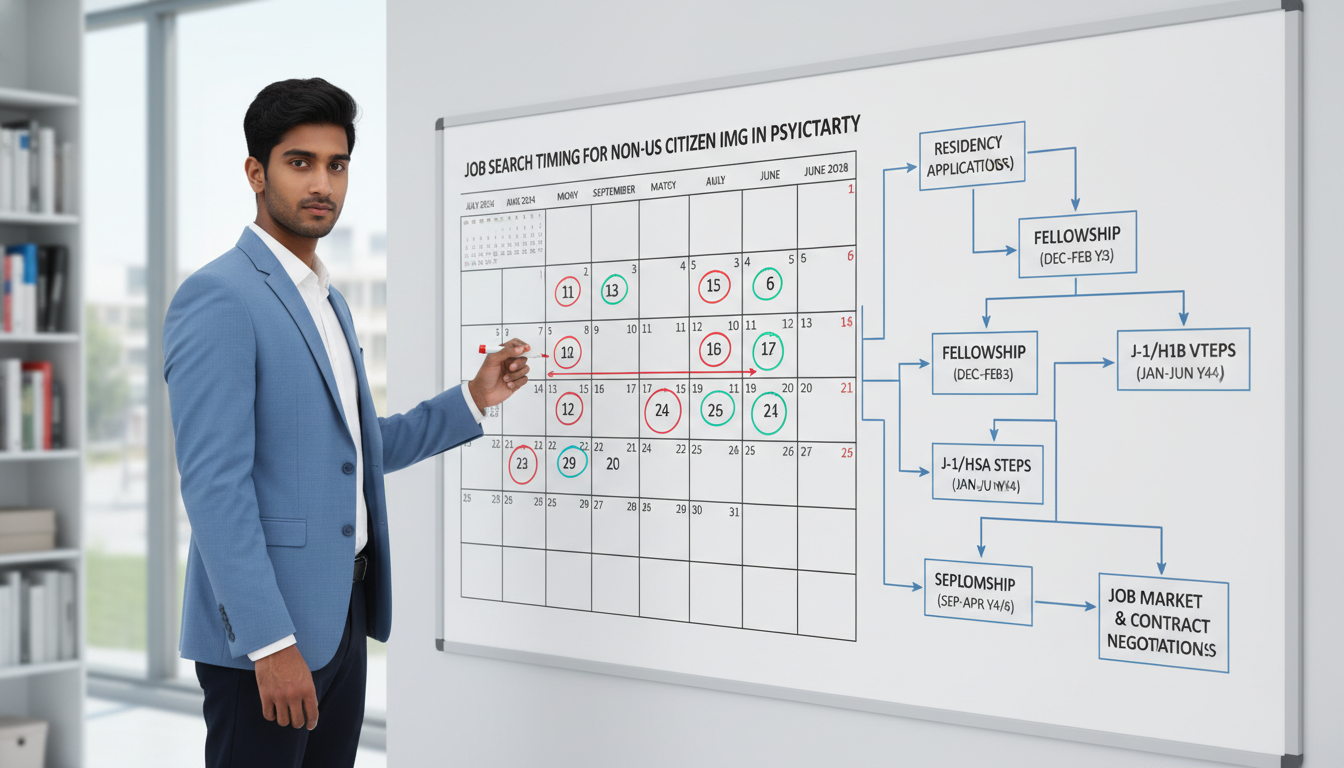
Practical Steps: Month‑by‑Month Action Plan
The phrase “when to start job search” can feel abstract. A concrete schedule can help you translate timing into action.
Assume:
- You are a foreign national medical graduate in psychiatry.
- You finish residency June 30, 2027.
- You are not doing additional fellowship (if you are, simply shift this entire schedule to your fellowship end date).
July 2025 – December 2025 (Start of PGY‑3)
- Clarify:
- Do you need J‑1 waiver, H‑1B sponsorship, or neither?
- What states and practice settings are realistic given your visa needs?
- Update your CV and draft a generic cover letter for psychiatry roles.
- Join psychiatry specialty societies (APA and relevant subspecialty organizations).
- Begin tracking:
- Licensing requirements and processing times for 2–3 target states.
- Conrad 30 or waiver programs if on J‑1.
January 2026 – June 2026 (Late PGY‑3)
- Start informational conversations:
- Email alumni from your program in your target states.
- Ask them about timing, salary ranges, and visa friendliness.
- Attend at least one national meeting and visit employer booths at job fairs.
- Narrow your preferences:
- Academic vs community
- Inpatient/outpatient mix
- Urban vs rural
July 2026 – September 2026 (Early PGY‑4)
- Begin serious applications:
- Email targeted CV + cover letter to institutions and groups in your preferred locations.
- Register on reputable psychiatry physician job market platforms (not just generic job boards).
- For J‑1:
- Prioritize employers in states known for strong psychiatry Conrad 30 programs.
- Schedule first wave of interviews (could be virtual).
October 2026 – December 2026 (Mid PGY‑4)
- Second interview wave (often on‑site).
- Compare offers:
- Salary, benefits, call expectations.
- Visa support: J‑1 waiver experience, H‑1B policies, legal support.
- Professional growth: mentorship, supervision opportunities, scope of practice.
- Aim to decide on one or two preferred offers by end of this period.
January 2027 – March 2027 (Late PGY‑4)
- Finalize and sign your primary attending contract.
- Start state license application immediately (gather documents: training verification, exam scores, background checks).
- Work closely with employer and immigration counsel on visa petition/wavier paperwork.
- If on J‑1:
- Employer should begin or continue Conrad 30 and waiver processes as soon as windows open.
April 2027 – June 2027 (Final Months of Residency)
- Follow up on:
- License processing.
- Hospital credentialing.
- Visa status updates.
- Keep communication open with your future employer regarding start date.
- Prepare for transition:
- Housing and relocation (if applicable).
- Anticipated panel types, documentation systems (e.g., EHR training).
- Multidisciplinary team introductions.
By July–September 2027:
You should be ready to start your first attending job with appropriate license, visa, and privileges in place.
Common Pitfalls and How to Avoid Them
Non‑US citizen IMGs in psychiatry face predictable timing errors. Knowing them helps you avoid costly delays.
1. Starting the Job Search Too Late
- Believing you can start “a few months before graduation” is risky for:
- J‑1 waiver needs
- States with long licensing times
- Health systems with prolonged credentialing
- Fix: For most non‑US citizen IMG psychiatrists, treat 9–18 months before completion as your essential window.
2. Ignoring Visa Constraints Early On
- Accepting interviews with employers that:
- Cannot sponsor J‑1 waivers.
- Will not do H‑1B.
- Have no immigration counsel or experience with foreign national hires.
- Fix: Ask specific visa questions before investing heavily in the interview process.
3. Over‑narrowing Geographic Preferences Too Early
- Limiting yourself to a single city or state can severely shrink options, especially for J‑1 waiver psychiatry jobs.
- Fix: Initially consider multiple states and practice settings; narrow only after you’ve confirmed realistic visa pathways.
4. Underestimating Licensing and Credentialing Delays
- Some state medical boards are slow; psychiatry background checks, fingerprinting, and primary source verification can drag on for months.
- Fix:
- Start the license application the moment you sign a contract (or earlier if allowed).
- Ask potential employers about typical onboarding timelines for psychiatrists.
5. Not Using Program Resources
- Many residents underuse their program director, GME office, or graduate alumni network.
- Fix:
- Meet with your PD or a faculty mentor early in PGY‑3 to map out a strategy.
- Ask your institution’s GME/immigration office for visa timing advice specific to psychiatry.
FAQs: Job Search Timing for Non‑US Citizen IMG Psychiatrists
1. When should I start my attending job search as a non‑US citizen IMG in psychiatry?
For most, you should begin structured planning by early PGY‑3 and active job searching 12–18 months before finishing residency or fellowship. If you are a J‑1 visa holder seeking a J‑1 waiver psychiatry job, err on the earlier side of that range.
2. I’m on a J‑1 visa in psychiatry. When do I need to secure a waiver job?
You should be actively searching and interviewing at least 12–18 months before residency completion. Aim to have a signed offer in place before your target states open their Conrad 30 or waiver application windows. Waiting until 3–4 months before graduation is unsafe and may result in gaps or forced return home.
3. I have H‑1B during residency. Do I still need to start early?
Yes. While you have more flexibility than J‑1 holders, the physician job market, especially in psychiatry, still involves:
- State licensing (2–6 months or more)
- Hospital credentialing and payer enrollment
- H‑1B transfer processing
You should begin your job search 9–15 months before completion and aim to sign a contract 6–9 months before you finish training.
4. Can I delay my job search to see exam results or decide about fellowships?
You can, but delaying too much compresses your timeline. A practical approach:
- Begin exploring and networking in PGY‑3.
- Apply to both fellowships and potential jobs if you are undecided.
- Once you commit to fellowship or direct practice, shift the job search timeline to end at your final training completion date, still giving yourself 9–18 months lead time before that date.
By anchoring your decisions in these timelines and adjusting for your visa status, you can approach the attending job search with confidence rather than anxiety. As a non‑US citizen IMG psychiatrist, thoughtful timing—combined with early planning—will put you in the strongest position to navigate the physician job market, secure a position that fits your goals, and transition smoothly from residency to your first attending role in psychiatry.