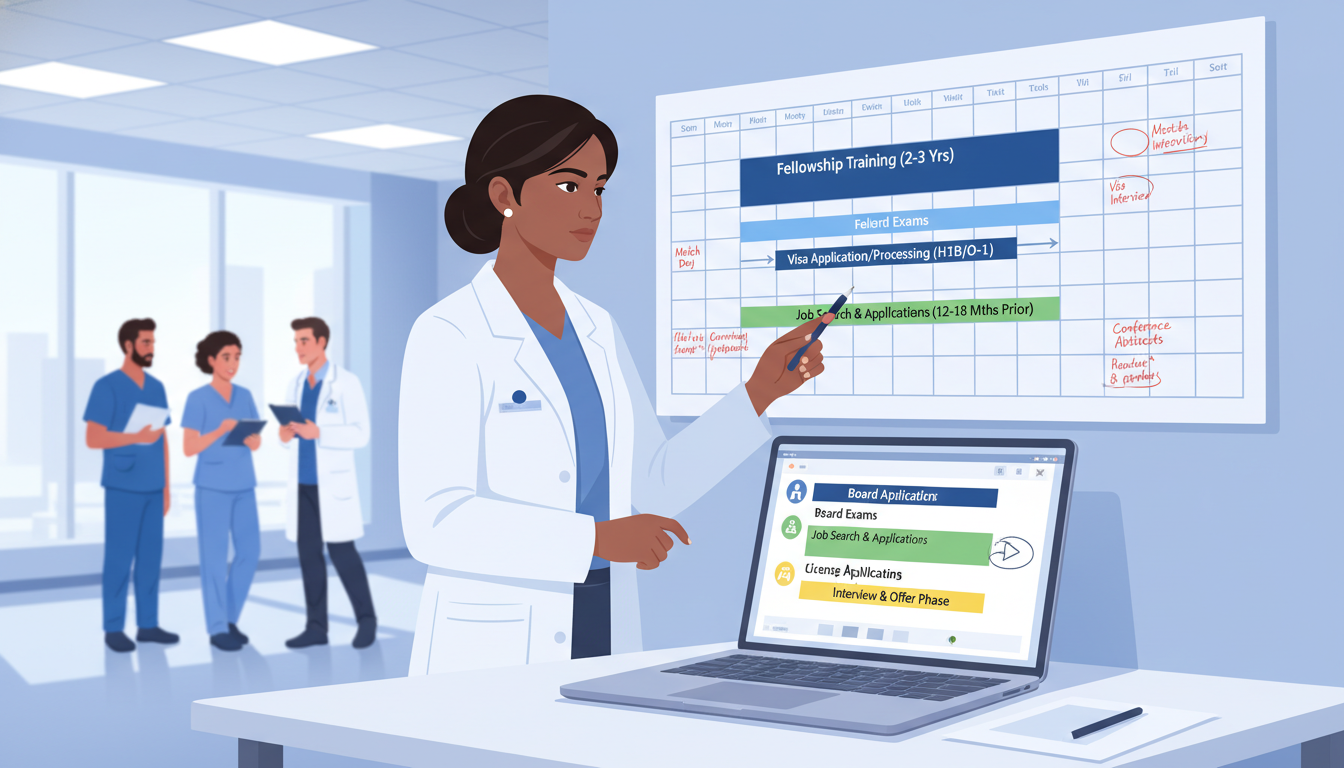
Understanding the Landscape: Why Timing Matters So Much for Non-US Citizen IMGs
For a non-US citizen IMG in radiation oncology, when you start your job search is almost as important as where you apply. Radiation oncology is a relatively small specialty, the physician job market is highly regional, and your immigration status shapes what is realistically possible at each step.
A foreign national medical graduate in radiation oncology must balance:
- The competitive nature of the rad onc match and fellowship spots
- Complex US immigration and visa timelines (J-1 waiver, H-1B cap, O-1, green card)
- Practice realities in a specialty with slower job turnover than primary care
- Institutional hiring cycles, budget approvals, and credentialing timelines
Misjudging the timing can lead to:
- Gaps in employment after residency or fellowship
- Losing attractive offers because your start date is too uncertain
- Visa lapses that damage your long-term ability to stay and work in the US
The good news: with adequate planning and early awareness, you can align your training, visa strategy, and job search so that you are market-ready when positions open.
This article walks through a structured, month‑by‑month framework for when to start job search activities as a non-US citizen IMG in radiation oncology, from early residency through your final year, plus detailed guidance on visas, contract timing, and common pitfalls.
Big Picture Timeline: From Residency to First Attending Job
Before diving into details, here is a high-level view of ideal timing for a non-US citizen IMG in radiation oncology who plans to work in the United States after training.
Residency PGY-2 (R1): Laying the Foundation
- Clarify long-term goals (academic vs community, US vs abroad)
- Begin learning about J-1 waiver and H-1B/O-1 pathways
- Start networking lightly (ASTRO, institutional contacts)
- No active attending job search yet, but start building your CV
Residency PGY-3 (R2): Clarifying Career Path & Visa Strategy
- Decide whether you will:
- Go straight into practice after residency, or
- Pursue a fellowship (e.g., brachytherapy, stereotactic, palliative, proton, research-heavy academic fellowships)
- If on a J-1 visa, start learning how waiver jobs in radiation oncology work (they’re less common than in primary care)
- Begin informational interviews with attendings and prior graduates
Residency PGY-4 (R3): Serious Planning and Early Outreach
- If going straight to practice after residency:
- Start follow-up networking with programs and groups that may hire in two years
- Clarify which regions are more visa-friendly
- If pursuing fellowship:
- Apply for fellowship (usually about 1–2 years before start date, depending on the program and subspecialty)
- Discuss visa strategy with your GME office and an immigration attorney
Residency PGY-5 (R4, final year if no fellowship): Active Job Search
This is a crucial phase.
- 12–18 months before completion (e.g., July–Dec of R4 for a June graduation):
- Begin active attending job search
- Update CV and create a targeted cover letter
- Start contacting chairs, practice leaders, and recruiters
- Attend ASTRO specifically to network for jobs
- 9–12 months before completion:
- Interviewing, site visits, evaluating offers
- Begin contract negotiations
- 6–9 months before completion:
- Finalize contract and initiate visa petitions
- Start credentialing and licensing in the state of employment
For many non-US citizens in radiation oncology, signing 6–12 months before graduation is optimal to protect your visa continuity and ensure a smooth start.
Fellowship Year (if applicable): Timelines Shift Earlier
If you do a one-year fellowship after residency:
- Fellowship start (June/July): You are already an attractive attending candidate
- 12–15 months before fellowship end: Start active job search (this may mean starting during your final year of residency if you know you’re doing a fellowship)
- At least 9–12 months before fellowship end: Aim to have verbal offers / contracts in progress
- 6–9 months before fellowship end: Finalize contract, launch visa process, start credentialing
Because the radiation oncology physician job market is relatively narrow and some academic jobs require long internal approvals, starting early is key, especially if you also need time for visa petitions.

Visa Status and Job Search Timing: J‑1, H‑1B, and O‑1 Considerations
Your visa category dramatically influences when to start job search and which jobs to target.
If You Are on a J‑1 Visa
J‑1 clinical training visas (via ECFMG) are common for non-US citizen IMGs in radiation oncology. Key points:
- After residency/fellowship, you must usually:
- Return to your home country for 2 years, or
- Obtain a J‑1 waiver job (typically in an underserved area or academic institution that qualifies under certain federal/state programs)
Impact on timing:
- Radiation oncology J‑1 waiver jobs are less abundant than those in primary care or psychiatry.
- Some academic centers may be able to sponsor waivers, but not all.
- You may also explore waiver-eligible community cancer centers in certain states.
When to start job search on J‑1:
18–24 months before your final training completion (residency or fellowship), you should:
- Research which states and institutions have historically sponsored J‑1 waivers for radiation oncologists
- Talk to recent graduates and faculty mentors who know the landscape
- Consult an immigration attorney to map realistic states and timelines
12–18 months before completion:
- Begin targeted applications to institutions in waiver-friendly states
- Ask explicitly in early conversations: “Do you have experience sponsoring J‑1 waivers for radiation oncology attendings?”
- Be prepared to explain the waiver process to smaller practices unfamiliar with it
9–12 months before completion:
- Lock in a job that is both clinically suitable and structurally able to support a waiver
- Work closely with the employer’s legal team to start waiver paperwork as soon as possible
Because J‑1 waiver deadlines and state-specific rules can be strict, you cannot afford to start late. Starting 18–24 months prior is highly advisable.
If You Are on an H‑1B Visa for Residency/Fellowship
Some radiation oncology residents are on H‑1B visas sponsored by their training institution.
Key characteristics:
- H‑1B is employer-specific and job-specific
- You may be subject to the H‑1B cap, unless you move from a cap-exempt employer (e.g., university or nonprofit hospital) to another cap-exempt employer
- You may also pursue permanent residency (green card) through an employer
Impact on timing:
- If your future job is in a university or nonprofit hospital, it may be cap‑exempt, simplifying transition
- If your future job is in a private practice or for-profit cancer center, you may need to consider cap timelines and lotteries, which increases uncertainty
When to start job search on H‑1B:
12–18 months before completion of training:
- Clarify with potential employers whether they can sponsor H‑1B and possibly green card
- Ask whether they are cap-exempt or cap-subject
- Involve immigration counsel early if moving from exempt to subject employer
9–12 months before completion:
- Aim to have a signed contract in place, so the employer can file H‑1B petitions on time
- If cap-subject, align the start date with H‑1B lottery and fiscal year constraints
Timing misalignment can lead to employment gaps; therefore, early job search helps create enough lead time for petitions and contingency planning.
O‑1 and Green Card Pathways
Some highly accomplished radiation oncologists (e.g., with strong publications, national presentations, leadership roles) may qualify for:
- O‑1 “extraordinary ability” visas
- Employment-sponsored green cards (EB‑1, EB‑2 NIW, or employer-sponsored EB‑2/EB‑3)
These can be powerful tools for long-term stability but require:
- Extensive documentation
- Early strategic planning
- Supportive employers (and often an independent immigration lawyer)
When to factor this into job search:
- PGY-3 to PGY-4: Begin building your academic/leadership profile if aiming for O‑1 or EB‑1
- During job interviews, ask whether the institution has a track record of supporting O‑1 or early green card sponsorship
- Ideally, discuss green card timelines during contract negotiations so they are included in the overall hiring plan
Month-by-Month Countdown: Detailed Attending Job Search Timeline
Below is a more granular timeline to answer the practical question: When to start job search as a non-US citizen IMG in radiation oncology? This assumes you are in your final year of training (residency or fellowship) and want to work in the US.
18–24 Months Before Completion
You may be in mid-residency or early fellowship.
Goals:
- Clarify your career direction:
- Academic vs community vs hybrid
- Urban tertiary center vs regional cancer center vs rural practice
- Focus areas (CNS, head & neck, GI, GU, pediatrics, brachytherapy, SBRT, palliative)
- Clarify your visa path:
- J‑1: Research waiver options, target states, academic vs community jobs
- H‑1B: Cap-exempt vs cap-subject employers
- O‑1/Green card: Assess feasibility with an immigration attorney
Actions:
- Attend ASTRO and local/regional oncology meetings
- Set up informational meetings with senior residents, fellows, and attendings who recently navigated the job search as non-US citizen IMGs
- Start tracking institutions and markets you are interested in (create a spreadsheet with columns for location, practice type, visa friendliness, contact person, notes)
15–18 Months Before Completion
This is where the earliest active job search may begin, especially if:
- You are on a J‑1 and need a waiver job
- You expect visa complexity
- You are aiming for competitive academic positions with slow hiring cycles
Goals:
- Identify and prioritize 10–20 potential institutions or groups
- Begin very early outreach to a shorter list of highly desired sites
Actions:
- Send brief, personalized emails to chairs/section chiefs such as:
- Who you are (non-US citizen IMG, current PGY level, program)
- When you will finish training
- Your interests and visa status in 1–2 sentences
- Ask whether they anticipate any openings during your graduation timeframe
Many will respond with, “We don’t know yet,” but this plants the seed and gets your name in front of decision-makers.
12–15 Months Before Completion
For most non-US citizen IMGs in radiation oncology, this is when you should deliberately start your attending job search.
Goals:
- Convert from passive networking to active applications
- Ensure your CV and cover letter are polished and targeted
- Begin a mix of formal and informal job applications
Actions:
Prepare your application materials:
- CV emphasizing clinical competencies, special techniques (e.g., SRS/SBRT, brachytherapy, proton), scholarly work, and leadership roles
- Cover letter customized for academic vs community positions
- Clear, concise statement of your visa status and what sponsorship you will need
Use multiple job search channels:
- ASTRO Career Center
- ACR job boards
- Institutional websites of cancer centers and universities
- Major healthcare job boards with physician filters
- Recruiters specializing in radiation oncology
Leverage your network:
- Ask your program director and chair whom they can introduce you to
- Reach out to alumni of your program now in practice
- Schedule Zoom calls with contacts to explore unadvertised opportunities
If you wait until less than 9–10 months before graduation to begin, you may be late for some of the most attractive or visa-capable positions.
9–12 Months Before Completion
This is typically the heaviest interviewing period.
Goals:
- Secure interviews and on-site visits (or virtual visits if needed)
- Narrow down your top choices
- Receive one or more offers
Actions:
Respond quickly to interview invitations; physician recruitment cycles can move irregularly, and responsiveness demonstrates professionalism
Prepare for interviews:
- Know your clinical strengths and areas you want to grow
- Be ready for questions about volumes you can handle, comfort with complex cases, and treatment planning experience
- Practice explaining your visa situation confidently and concisely
Ask targeted questions:
- “Do you currently employ any non-US citizen or visa-holder physicians?”
- “Does your institution have processes in place for H‑1B/J‑1 waiver/O‑1 sponsorship?”
- “How far in advance do you typically start visa and credentialing processes?”
By the end of this window, many US grads will have informal or formal offers. As a foreign national medical graduate, you want your visa timeline to be front-loaded, not an afterthought.
6–9 Months Before Completion
This is the ideal period to:
- Finalize your contract
- Initiate visa petitions and state licensure
Starting visa paperwork late is one of the most damaging timing errors.
Goals:
- Convert verbal offers into signed contracts
- Launch immigration and credentialing processes
Actions:
Contract negotiation:
- Clarify clinical expectations (number of fractions/consults per week, disease site focus)
- Discuss academic time, research support, call schedule
- For community jobs, clarify compensation model, partnership track, and non-compete clauses
- Confirm in writing which visa type the employer will pursue and whether they will sponsor permanent residency later
Immigration/legal process:
- Work closely with the employer’s legal team and your personal immigration attorney (if you have one)
- Provide all necessary documents promptly (CV, diplomas, licenses, letters, I-94, etc.)
- Track deadlines to avoid last-minute surprises
Licensing and credentialing:
- Initiate state medical license application if not already started (can take months)
- Begin hospital privileging and payer enrollment if possible
3–6 Months Before Completion
At this stage, the job search should be complete, barring unexpected changes.
Goals:
- Tie up loose ends
- Prepare for transition from trainee to attending
- Confirm visa approval and start date
Actions:
- Monitor visa approval; if any issues arise, escalate early
- Coordinate with your future department about onboarding, orientation, and any needed early site visits
- Request a graduation letter from your program to help with privileging
- If you have a spouse/partner on dependent status, confirm their immigration plans (e.g., work authorization if eligible)
If you still do not have a job at this point, you will need to accelerate your search aggressively and may need to broaden your geographical and practice‑type preferences, especially if you are on a J‑1 or H‑1B with limited flexibility.

Academic vs Community Jobs: How Timing Differs
The physician job market in radiation oncology is not uniform. Timing expectations differ between academic and community practices.
Academic Positions
Characteristics:
- Often slower to create and approve new FTE lines
- Multi-step hiring: department approval → institutional HR → sometimes hospital/health system board
- Typically more experienced with hiring international medical graduates
Timing implications:
- Academic jobs may open 1–2 years before the intended start date
- Internal candidates (research fellows, chief residents, in-house graduates) may be favored
- As a non-US citizen IMG, academic centers are often more comfortable with J‑1 waivers, H‑1B, and O‑1
Actionable timing advice:
- Begin networking with academic departments at least 18 months before your desired start date
- Let target departments know early that you are highly interested and ask them to keep you in mind if an FTE emerges
- For research‑heavy or leadership‑track roles, prepare for longer interview and approval times
Community and Private Practice Positions
Characteristics:
- Decision-making is often faster but can be more sensitive to short-term volume and financial performance
- Some have limited experience with visa sponsorship
- Jobs can appear closer to the desired start date, particularly when someone resigns or retires unexpectedly
Timing implications:
- Positions may be posted 9–12 months before start date, sometimes even closer
- Practices may prefer candidates who can start quickly and without complex visa needs
- However, many will be flexible if you are clear and proactive with your timeline
Actionable timing advice:
- For community jobs, start outreach 12–15 months before completion, but expect that some of the most attractive options may not be visible until 9–12 months out
- When you interview, demonstrate that your visa process is under control and that your expected start date is realistic and predictable
- Be prepared to educate smaller practices on visa processes; this may require you to bring in an immigration attorney early to reassure them
Common Pitfalls in Job Search Timing for Non-US Citizen IMGs in Rad Onc
1. Waiting Until Late in Final Year to Start
- Risk: By the time you begin applications (e.g., 6–7 months before graduation), top positions may be filled or far along with other candidates
- Visa petitions could be rushed, causing delays in start date or jeopardizing your status
Avoid this by: Treating your attending job search as a 12–18 month process, not a last‑minute task.
2. Ignoring Visa Implications Until After an Offer
- Risk: You accept a job, then discover the employer cannot sponsor your visa type or that the timeline doesn’t fit
- This leads to renegotiation, stress, or even lost opportunities
Avoid this by: Discussing visa requirements in the early stages of serious conversations (usually second call or interview), not after contract signing.
3. Overly Narrow Geographic or Practice-Type Focus
- Radiation oncology is small; if you insist on a single city or only top‑tier academic centers, the calendar may run out before a suitable job appears
Avoid this by: Having tiered preferences:
- Tier 1: Ideal cities/institutions
- Tier 2: Acceptable but less preferred regions/practices
- Tier 3: Backup options including more rural or underserved areas, especially for J‑1 waivers
4. Underestimating Credentialing and Licensing Timelines
- Even after you have a contract and visa petition, state licenses and hospital privileges can take months
- Some payers require additional lead time for enrollment, especially if the employer expects you to be billing from day one
Avoid this by: Starting licensing as soon as the contract is reasonably secure and responding quickly to all documentation requests.
5. Lack of Mentorship and Feedback
- Many non-US citizen IMGs feel they must navigate the system alone, leading to avoidable errors or missed opportunities
Avoid this by: Proactively seeking mentors:
- Within your department (faculty who trained as IMGs)
- Among alumni now in practice
- Through national organizations (ASTRO mentorship programs, IMG forums)
Frequently Asked Questions (FAQ)
1. As a non-US citizen IMG in radiation oncology, when should I first start thinking about my attending job search?
You should start thinking strategically by PGY-3 (R2). This doesn’t mean sending applications that early, but you should:
- Understand your visa path (J‑1, H‑1B, O‑1, etc.)
- Clarify whether you plan a fellowship
- Begin networking and learning which institutions and states are visa-friendly
By PGY-4 (R3), especially if you will not do a fellowship, you should have a concrete plan for starting applications 12–18 months before graduation.
2. When to start job search if I am doing a one-year radiation oncology fellowship?
You should start even earlier:
- During your final year of residency: begin exploring and networking, especially if you know your fellowship location and your intended post-fellowship geography
- 12–15 months before the end of fellowship, start active job search (often overlapping with the early part of your fellowship year)
- Aim to sign a contract 9–12 months before you finish fellowship, to allow enough time for visa and licensing processes
3. How does being a foreign national medical graduate affect competitiveness in the rad onc job market?
Clinically and academically, you are evaluated similarly to US graduates. However, your visa status adds an extra layer:
- Some practices avoid visa sponsorship due to perceived complexity
- Others, especially academic centers and larger systems, are comfortable and experienced with IMGs
- You can increase your competitiveness by:
- Being transparent and knowledgeable about your visa
- Offering flexibility in geographic location
- Bringing unique skills (e.g., specific disease-site focus, advanced techniques, prior research expertise)
From a timing perspective, you must start earlier than many US citizens to allow for visa and waiver processes.
4. What if I do not secure a US attending job by the time I finish residency or fellowship?
This is a high-stakes situation, especially under J‑1 or H‑1B rules. Options may include:
- Expanding your search to a broader geographic area or more rural/underserved settings (particularly relevant for J‑1 waivers)
- Considering additional training (e.g., a research or clinical fellowship) that can extend your status while you re‑apply for jobs
- Exploring opportunities in other countries where your training is recognized
- Urgently consulting an immigration attorney to avoid gaps in status
To minimize the risk of this scenario, begin your job search 12–18 months in advance, be realistic about your constraints, and keep multiple options in play simultaneously.
Key Takeaway:
For a non-US citizen IMG in radiation oncology, starting your attending job search 12–18 months before you complete training—and thinking about your visa and career path even earlier—is usually the safest and most effective strategy. Align your actions with your immigration needs, stay flexible about geography and practice type, and leverage mentors and professional societies so that timing becomes a strength, not a vulnerability, in your transition to independent practice.