
Why Job Search Timing Matters So Much for Non‑US Citizen IMGs
For a non-US citizen IMG in general surgery, timing your job search is not just about career planning—it is tightly linked to visa security, board eligibility, and long-term practice options. Missing key windows can mean:
- Fewer job offers and less leverage in negotiation
- Visa gaps and forced return to your home country
- Delays in board certification or fellowship plans
As a foreign national medical graduate, you must juggle three parallel timelines:
- Clinical timeline – finishing general surgery residency, possibly fellowship
- Credentialing timeline – licensing, board exams, case logs, references
- Immigration timeline – J-1 vs H-1B vs O-1, waiver jobs, green card strategies
This article walks through when to start each step of your attending job search, how that timing interacts with the surgery residency match and training pathway, and how to avoid the most common timing mistakes non-US citizen IMGs make.
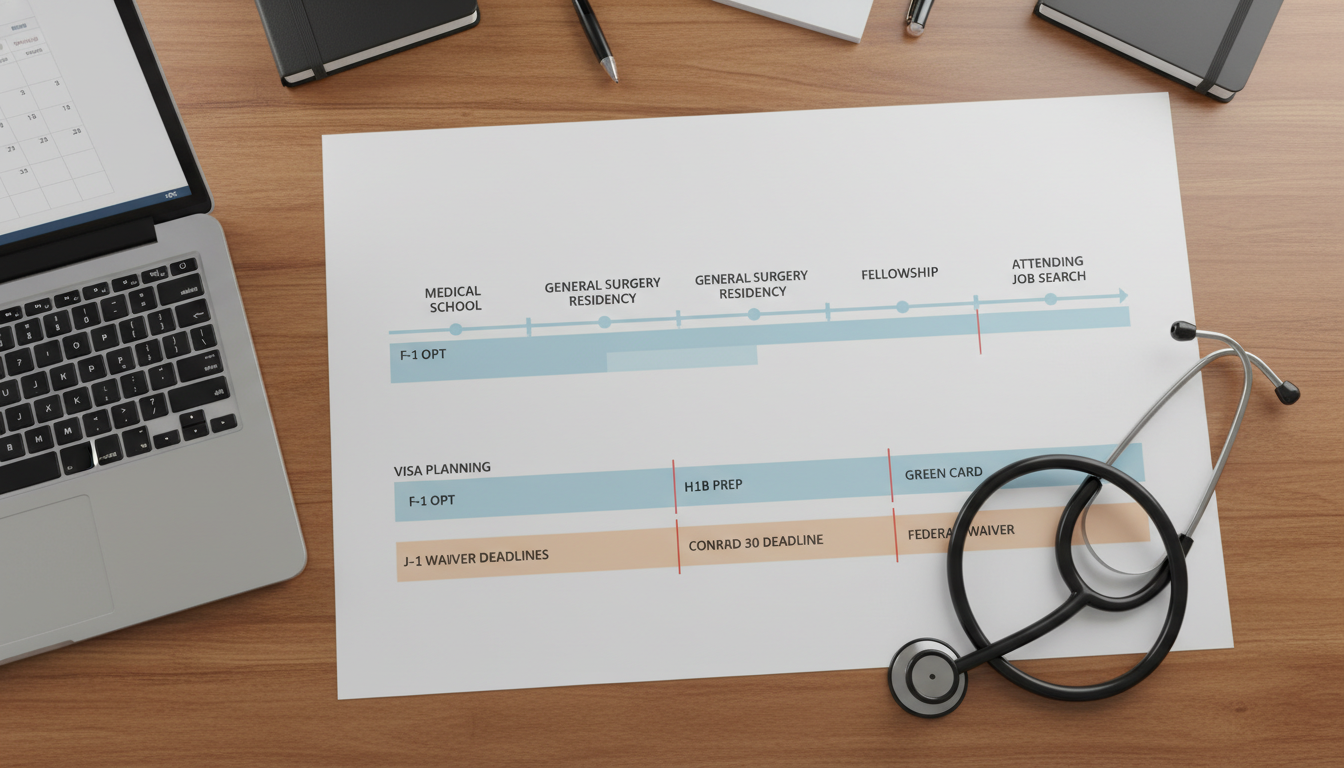
Big-Picture Timeline: From Residency to First Attending Job
Before diving into details, it helps to see the entire arc:
- MS4 (for those still in medical school abroad): Focus on general surgery residency match strategy. Job search is premature, but long-term thinking (visa type, academic vs community) is helpful.
- PGY1–PGY3: Build your CV and network; no active attending job search yet, but you should be gathering information.
- PGY3–PGY4: Decide between fellowship vs going straight into practice. This decision strongly shapes job search timing.
- PGY4–PGY5 (final 18–24 months of residency):
- Fellowship applicants: focus on fellowship match first, then job search during fellowship.
- Direct-to-practice residents: begin serious attending job search around 12–18 months before graduation (earlier if J‑1).
- Fellowship years (if applicable):
- Start attending job search 12–18 months before fellowship completion, especially if you are J‑1 waiver–dependent.
- 6–12 months before finishing training: Ideally, you have signed a contract, started state licensure, and your employer has begun visa processing.
- 0–6 months before end of training: You finalize credentialing and onboarding, allowing you to start as an attending soon after graduation.
The rest of this article breaks this down with specific guidance for non-US citizen IMGs in general surgery.
Understanding Your Visa and Its Impact on Job Search Timing
Visa status is the single biggest factor differentiating your job search timing from that of a US graduate. Before applying anywhere, you must understand what you hold now and what you want long-term.
J‑1 vs H‑1B: Why It Changes Everything
1. J‑1 Visa (Most Common for IMGs in Residency)
- Requires a 2-year home country physical presence after training unless you secure a J‑1 waiver job.
- J‑1 waiver jobs (e.g., Conrad 30, VA, HHS waivers) are typically:
- In underserved or rural areas
- Time-limited (3-year service requirement)
- Highly competitive and fast-filling in some states
Timing implications:
- You must align three clocks:
- Graduate from residency or fellowship
- Secure a waiver slot (often state-specific and time-sensitive)
- Start employment in time for credentialing and visa transfer
- For many states, J‑1 waiver applications open as early as October 1 in the year before you finish training.
- To compete for these positions, you typically need:
- A signed contract with an eligible employer months before the state waiver window opens.
- Time for the employer’s legal team to prepare waiver documents.
Result: As a J‑1 non-US citizen IMG, you often need to begin serious attending job search 18–24 months before your training end date, especially if you’re finishing only residency and not doing a fellowship.
2. H‑1B Visa (Less Common but More Flexible)
- No home-country return requirement
- More flexibility in job location and type
- Employer-sponsored; cap-exempt positions (universities, affiliated hospitals) are easier to manage
Timing implications:
- You still need 6–9 months lead time for:
- Job offer and contract
- State licensure
- Hospital credentialing
- H‑1B petition preparation and filing
- You do not face the state-by-state J‑1 waiver timing crunch, but delays can still lead to visa gaps if you do not plan early.
Result: With H‑1B, starting your attending job search about 12–18 months before training completion is usually sufficient, though earlier is rarely harmful and often helpful.
Green Card and Long-Term Planning
Some non-US citizen IMGs aim to transition from J‑1 or H‑1B to permanent residency. The physician job market is more favorable in certain settings for green card sponsorship:
- Academic centers and large hospital systems
- Multi-specialty groups with established immigration infrastructure
- Some rural/underserved employers who rely heavily on IMGs
If your long-term goal is a green card:
- The first job can be strategic, not just a paycheck.
- Discuss green card timelines during late-stage interviews, not on the first contact.
- For J‑1 waiver jobs, many employers will begin green card processing after 1–2 years of service.
Timed correctly, your first job can set you up for permanent residence instead of extending temporary visa cycles.
Year-by-Year Roadmap: When to Start Job Search Activities
During Residency: PGY1–PGY3 (Laying the Foundation)
At this stage, you’re not sending out attending applications yet, but timing still matters.
Key goals:
- Build a competitive general surgery CV: case volume, research, QI projects, teaching.
- Clarify your likely career direction:
- Community general surgery vs academic
- Trauma/critical care, MIS, colorectal, surgical oncology, etc.
- Understand your visa situation:
- Are you J‑1 or H‑1B?
- When do you complete your training (residency vs fellowship)?
- What will your waiver or H‑1B strategy look like?
Practical steps:
- Attend department and hospital career talks targeted at senior residents.
- Identify at least two mentors: a clinically strong surgeon and someone familiar with visa/academic pathways.
- Keep detailed records of your case logs, presentations, and publications—valuable for applications later.
No formal attending job search yet, but you’re building the base that will determine your options.
PGY3–PGY4: Decide Fellowship vs Direct-to-Practice
This is one of the most consequential timing decisions for a foreign national medical graduate in surgery.
1. If you plan to pursue a fellowship (e.g., MIS, colorectal, surgical oncology, trauma/CC):
- Focus first on hitting fellowship application timelines (often 18–24 months before fellowship start).
- Your attending job search will primarily occur during fellowship, not during residency.
2. If you plan to go straight into general surgery practice after residency:
- Start planning your attending job search strategy by late PGY3 or early PGY4.
- Clarify:
- Preferred geographic regions
- Academic vs community vs private practice
- Need for J‑1 waiver or H‑1B sponsorship
- Begin informational networking:
- Talk to graduates from your program.
- Attend regional or national meetings (ACS, specialty societies) with a “future job search” mindset.
At this stage, you are not yet aggressively applying, but you should know what kind of job you will be looking for and where.
Final 18–24 Months Before Completion: Active Job Search Window
This is the core of “when to start job search” for non-US citizen IMGs in general surgery.
J‑1 Residents/Fellows
Ideal timing:
- 18–24 months before graduation:
- Identify states and employers with a history of sponsoring J‑1 waivers for general surgeons.
- Research which states are most IMG‑friendly and when their Conrad 30 programs open.
- 15–18 months before graduation:
- Begin contacting potential employers.
- Attend major conferences with your CV ready.
- Have early interviews (often virtual first).
- 12–15 months before graduation:
- Aim to have serious offers from at least 1–2 employers.
- Negotiate and finalize a contract with an eligible waiver employer.
- Employer’s legal team starts preparing waiver materials.
Because J‑1 waiver positions are time-sensitive, you cannot wait until the last 6–9 months of training; by then, many waiver slots and the best opportunities are gone.
H‑1B Residents/Fellows
Ideal timing:
- 12–18 months before graduation:
- Start targeted outreach to hospitals and groups that sponsor H‑1B.
- Consider academic centers and large groups with established immigration support.
- 9–12 months before graduation:
- Aim to secure at least one signed contract.
- Employer begins H‑1B petition strategy and state licensure applications.
- 6–9 months before graduation:
- Complete licensing, credentialing, and immigration paperwork.
You have more flexibility than J‑1 physicians, but you still cannot leave this to the last minute—credentialing alone can take 3–6 months.
During Fellowship: When to Start Job Search
For non-US citizen IMGs in general surgery fellowships, the clock restarts but with shorter runway.
1-year fellowship (e.g., MIS at many centers):
- 0–3 months into fellowship:
- Update CV with fellowship and late residency accomplishments.
- Clarify your career goals (e.g., MIS-focused practice vs broad general surgery plus MIS).
- 3–6 months into fellowship:
- Start serious job search—this is 12–18 months before fellowship end.
- Reach out to programs/hospitals where your advanced skills are valued.
- 6–9 months into fellowship:
- Try to have a signed contract, especially if J‑1 waiver is needed.
2-year fellowship (e.g., many surgical oncology or transplant programs):
- Begin job search activities in the second half of your first year, not near the end of second year.
Where and How to Search: Practical Tactics for Non-US Citizen IMGs
Timing is only useful if you use the time well. Here is how to structure your search at each stage.
Months 18–12 Before Completion: Exploration and Outreach
What you should be doing:
- Update your professional CV tailored to general surgery and your subspecialty (if any).
- Create a concise personal statement/cover letter that:
- Highlights your skills (e.g., laparoscopy, endoscopy, trauma)
- Clearly states your visa needs (J‑1 waiver or H‑1B sponsorship) early, but professionally
- Register your profile on reputable physician job boards and your specialty society’s career center.
Approaches:
- Direct outreach:
- Email chairs or practice directors in geographic regions you prefer.
- Include CV and brief introduction, mentioning your training program and visa status.
- Leverage your network:
- Ask faculty and alumni who know your work to introduce you to potential employers.
- Join ACS and relevant subspecialty societies; attend their career sessions.
Months 12–9 Before Completion: Interviews and Negotiations
You should now be:
- Having formal interviews (often multiple rounds, both virtual and in-person).
- Visiting communities to evaluate fit: operative volume, call schedule, mentorship, support for being a new attending.
- Clarifying benefits and expectations, including CME support, protected time, and call buy-down options.
For non-US citizen IMGs, add:
- Confirm the employer’s experience with visa sponsorship:
- Have they done J‑1 waivers or H‑1Bs for surgeons before?
- Who manages immigration—internal legal department or external counsel?
- Confirm timeline:
- When will they file your waiver or H‑1B petition?
- How long is their typical credentialing process?
This is also when you begin to align your job start date with the end of residency/fellowship and visa validity.
Months 9–6 Before Completion: Paperwork and Contingency Planning
By this stage, ideally you have:
- At least one signed attending contract
- Started state medical licensure (this can take months)
- Confirmed the employer has initiated visa processing steps
Contingency planning:
- If you don’t yet have an offer:
- Immediately expand your geographic and practice-type preferences.
- Consider more rural or smaller community hospitals, which may be more open and urgently in need.
- Engage reputable physician recruiters who work with IMGs in general surgery.
For J‑1 physicians, this window can be critical as some state waiver slots may already be filled. If your preferred states are full, you may need to pivot rapidly to other regions.

Balancing Job Search With Boards, Licensing, and Life
Timing your job search cannot be isolated from everything else happening in your final training year.
Board Exams and Case Log Requirements
As a general surgery resident or fellow, you must:
- Complete ABMS board eligibility requirements (case numbers, continuity clinics, etc.).
- Plan for the QE (qualifying exam) and later the CE (certifying exam).
Do not schedule critical interviews during:
- Your heaviest call or trauma rotations
- The final weeks of case-log deadlines
- Intensive board prep periods
Instead:
- Cluster interviews around lighter rotations or scheduled academic time.
- Notify your PD early about your interview needs; programs expect senior residents and fellows to travel for job interviews.
Emotional and Financial Realities
As a non-US citizen IMG, the pressure of visa deadlines plus the responsibility of your first attending role can be intense.
To manage this:
- Start financial planning at least 12–18 months before graduation (loan payments, cost-of-living analysis, salary expectations).
- Seek peer support—recent graduates from your program often have the freshest perspective on timing and pitfalls.
- Recognize that the first job may not be your final destination. For many J‑1 waiver physicians, the waiver job is a stepping stone toward a more ideal long-term position once immigration status stabilizes.
Common Timing Mistakes Non-US Citizen IMG Surgeons Make
Avoiding these can be just as important as knowing when to start.
Starting the job search too late
- J‑1 surgeons waiting until 6–9 months before graduation often find waiver spots gone in their preferred states or even nationally in competitive regions.
Ignoring visa realities during early interviews
- Delaying the visa discussion until very late can lead to wasted interviews with employers who cannot or will not sponsor your needed status.
Over-focusing on a narrow geography too early
- For foreign national medical graduates, extreme geographic restriction can severely limit options, especially for J‑1 waiver roles.
Underestimating credentialing and licensure time
- Even after you sign a contract, it can take 3–6 months to obtain licenses and hospital privileges.
Delaying green card strategy discussions indefinitely
- If your goal is permanent residence, the first job should be chosen with that in mind, not as an afterthought years later.
Putting It All Together: A Sample Timeline
Here is an example for a non-US citizen IMG on a J‑1 visa completing a 5-year general surgery residency with no fellowship:
- PGY3 (2.5 years before completion):
- Decide to go straight into general surgery practice.
- Learn basics of J‑1 waiver programs; talk to alumni who did waivers.
- PGY4 start (2 years before completion):
- Identify 10–15 states that commonly sponsor J‑1 waivers for general surgeons.
- Start networking with potential employers at conferences.
- PGY4 mid to late (18–15 months before completion):
- Update CV and begin targeted outreach to hospitals in selected states.
- Have initial interviews (virtual and in-person).
- Early PGY5 (12–15 months before completion):
- Secure 1–2 offers and finalize contract with a qualifying waiver employer.
- Employer hires immigration counsel and prepares for state waiver application.
- PGY5 mid (9–12 months before completion):
- State opens Conrad 30 program; employer submits waiver package early in the cycle.
- Apply for state medical license in the job’s state.
- PGY5 late (3–6 months before completion):
- Waiver approved; visa status converted appropriately.
- Hospital credentialing finalized.
- You transition directly into your attending job after graduation with minimal visa risk.
A similar framework applies to H‑1B or fellowship-trained surgeons, just with different specific visa steps and somewhat more flexibility.
FAQs: Job Search Timing for Non‑US Citizen IMG General Surgeons
1. When should I start my attending job search as a non-US citizen IMG on a J‑1 visa?
You should begin serious attending job search 18–24 months before your anticipated completion of residency or fellowship. This allows enough time to identify J‑1 waiver-eligible positions, interview, sign a contract, and submit waiver applications as soon as state programs open.
2. I’m on an H‑1B. Do I still need to start this early?
Yes, but you typically have a bit more flexibility than J‑1 physicians. Aim to start connecting with employers 12–18 months before finishing training. You still need significant lead time for state licensure, credentialing, and H‑1B petition preparation, but you’re not constrained by state-specific waiver caps.
3. When should I start my job search if I’m planning a fellowship after general surgery residency?
Focus on the fellowship match first. Then, during fellowship, start your attending job search in the first half of your final training year—usually 12–18 months before finishing fellowship. For 1‑year fellowships, this means starting within the first 3–4 months.
4. Should I wait until after boards to start my job search?
No. Waiting for boards will usually make you late in the job market. Most employers are used to hiring final-year residents and fellows who are board-eligible but not yet board-certified. Plan your job search and interviews in parallel with your board exam preparation, and structure your exam date and heavy study periods to avoid conflict with key interviews.
By understanding and respecting these timelines, you can move from general surgery residency to your first attending role with more control and less stress—despite the added complexities of being a non-US citizen IMG navigating the US physician job market.