Why Job Search Timing Matters So Much for Non‑US Citizen IMGs in Clinical Informatics
For a non-US citizen IMG interested in clinical informatics, timing is not just a planning detail—it is a core strategy. Unlike many US graduates, you must align three moving pieces at once:
- The physician job market for clinical informatics and related roles
- The immigration and visa timeline (J‑1, H‑1B, O‑1, green card)
- Your residency/fellowship milestones (USMLE completion, board eligibility, fellowship graduation)
A well-timed attending job search can mean the difference between:
- Seamless transition from fellowship to an informatics or hybrid clinical–informatics job, or
- A gap in employment, loss of status, or having to accept a less-than-ideal role just to stay in the country
This article breaks down when to start job search planning for non-US citizen IMGs targeting clinical informatics fellowship, informatics-heavy faculty roles, or health IT training/industry positions—step by step, from 24+ months before graduation through your first attending contract.
Understanding the Clinical Informatics Job Landscape for Foreign National Medical Graduates
Clinical informatics is still a relatively small but rapidly growing niche. For a foreign national medical graduate (non-US citizen IMG), understanding this niche market is crucial before you even think about timing.
1. What roles are realistically open to you?
As a non-US citizen IMG, your viable options usually include:
- Clinical informatics fellowship (2-year ACGME-accredited, with or without concurrent clinical work)
- Attending roles with a substantial informatics component, e.g.
- Hospitalist + Associate CMIO (part-time)
- Primary care + EHR optimization lead
- Emergency medicine + clinical decision support champion
- Full-time informatics positions (less common directly after training, but possible with strong experience), e.g.
- Clinical Informaticist / Physician Informaticist
- Associate CMIO / CMIO in smaller organizations
- Health IT training and industry roles
- Medical director at an EHR vendor or digital health startup
- Clinical solutions specialist, implementation lead, or product physician advisor
- Data/AI teams needing a physician with informatics background
However, each category has different visa feasibility and timing pressures.
- Hospitals/academic centers: More familiar with H‑1B/O‑1 sponsorship; often slower hiring cycles; may prefer American Board of Preventive Medicine (ABPM) Clinical Informatics board-eligible or certified candidates.
- Large health systems: Increasingly invest in clinical informatics teams; often hire hybrid clinical–informatics physicians.
- EHR vendors/tech companies: Strong in health IT training and innovation work, but fewer are comfortable sponsoring non-US physician visas, especially if there’s any “clinical” component.
2. The physician job market vs. visa realities
For non-US citizen IMGs, the physician job market is filtered through immigration:
- Many employers won’t clearly address visa issues until late in the process.
- Some roles are theoretically suitable but impossible without H‑1B cap exemption or employer sponsorship.
- Clinical informatics fellowships may sponsor visas, but post-fellowship roles can be more complicated, especially if you are on J‑1 and must address the 2-year home residency requirement.
Because of this, you must begin your attending job search earlier and more strategically than US citizens, especially if your current status has hard end dates.
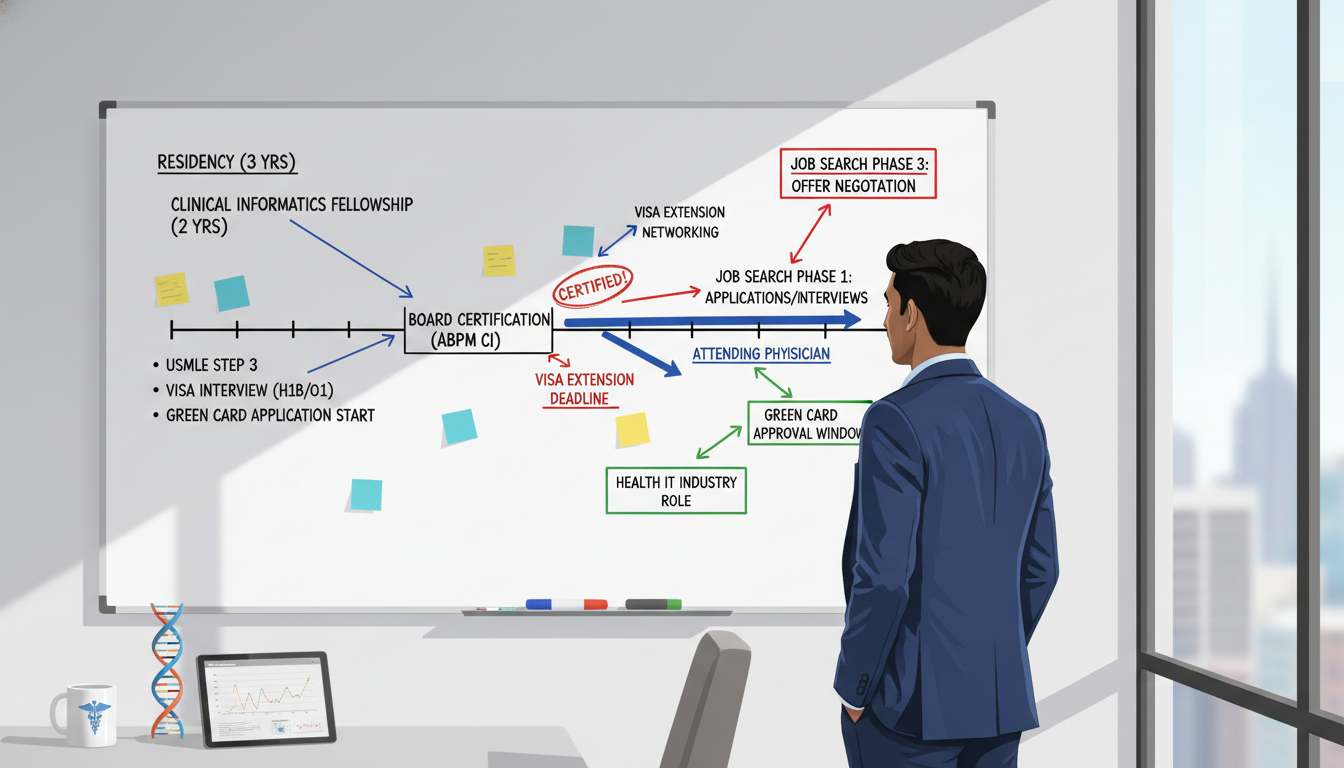
Job Search Timeline: 24+ Months Before Graduation to First Attending Job
This section lays out a practical, phased timeline for non-US citizen IMGs in or entering clinical informatics, with explicit recommendations for when to start job search activities.
For simplicity, assume you are currently:
- In a US residency or fellowship, and
- Planning to complete a clinical informatics fellowship or informatics track by Year X
You can adapt the timing if you’re entering directly from residency or from an international background.
Phase 1: Foundation & Positioning (24–18 Months Before Graduation)
Primary goals: Clarify your target roles, strengthen your profile, and map your visa pathway.
Key steps:
Clarify your long-term visa plan early
- J‑1 waiver? H‑1B cap-exempt academic role? O‑1 extraordinary ability? Industry green card sponsorship?
- Discuss with:
- Your institution’s GME office and immigration attorney
- A private immigration lawyer (worth the investment)
- Output: A written “visa reality check” that answers:
- What statuses are realistic for me at graduation?
- Do I need a J‑1 waiver job (e.g., underserved area)?
- Can I stay cap-exempt or must I go to a cap-subject H‑1B?
Define your ideal post-training roles Ask yourself:
- Do I want a hybrid role (e.g., 0.6 FTE clinical + 0.4 FTE informatics)?
- Would I accept 100% informatics/health IT training or industry work if clinical practice isn’t possible immediately due to visas?
- Am I targeting academic informatics, community hospitals, or industry (EHR, digital health, AI)?
Build visible credibility in clinical informatics During this period, focus on:
- Projects: Lead or co-lead at least one EHR optimization, decision support, data analytics, or workflow redesign project.
- Outputs:
- Posters/presentations at AMIA, HIMSS, or specialty society meetings
- A quality-improvement project with measurable informatics outcomes
- Skills: Basic data querying (SQL), understanding of FHIR/HL7, clinical decision support principles, usability concepts.
Network early and deliberately
- Join AMIA and your specialty’s relevant informatics committees.
- Attend at least one major informatics conference, even without presenting.
- Schedule informational interviews with:
- CMIOs at your institution
- Clinical informatics fellowship directors
- Alumni who are now informaticists or working in health IT
- Start a simple list: “Potential employers – informatics-friendly and visa-friendly.”
Why this timing matters:
By 18 months out, you want:
- A credible story as an “emerging informatics physician,” not just “a resident who likes computers,” and
- A realistic understanding of your immigration constraints so that your attending job search is targeted, not random.
Phase 2: Pre-Search Preparation (18–12 Months Before Graduation)
Primary goals: Make yourself market-ready and quietly start positioning in the physician job market.
Key steps:
Refine your CV for clinical informatics
- Create a version of your CV that:
- Highlights informatics projects under a distinct “Clinical Informatics & Health IT Experience” section
- Includes any EHR leadership roles (e.g., “Epic physician champion,” “OpTime super-user,” etc.)
- Lists informatics-related skills and tools (EHRs, data tools, basic SQL/R, FHIR knowledge)
- Create a version of your CV that:
Draft a targeted cover letter template
- Prepare versions that align with:
- Academic hybrid roles (clinical + informatics)
- Community hospital informatics participation roles
- Industry/health IT training roles (“clinical informatics liaison,” “clinical solutions physician,” etc.)
- Emphasize:
- Your dual perspective as a physician and technologist
- Unique value as a non-US citizen IMG with international insight (population diversity, cross-cultural workflows)
- Clear statement of board eligibility (specialty + future CI boards)
- Prepare versions that align with:
Deepen informatics presence at your institution
- Seek actual titles, even small ones:
- “Resident/Fellow informatics representative”
- “EHR optimization lead for [clinic]”
- Ask to join your hospital’s:
- EHR governance committee
- Clinical decision support committee
- Quality or data analytics working groups
- Seek actual titles, even small ones:
Quiet market sensing
- Start monitoring:
- Academic job boards (AAMC, institution websites)
- AMIA job listings
- Major hospital system career pages (“Clinical informaticist,” “Physician informaticist,” “Medical director, informatics”)
- Note:
- Which employers mention visa sponsorship
- Which roles look open to hybrid clinical/informatics work
- Start monitoring:
Clarify your board exam and certification timing
- Confirm your timeline for:
- Primary specialty boards
- Eligibility for ABPM Clinical Informatics boards (if doing an ACGME CI fellowship or alternative practice pathway)
- Employers often ask: “Will you be CI board-eligible at the time of hire?”
- Confirm your timeline for:
Timing takeaway:
You’re not actively applying yet, but you’re shaping your profile and mapping where informatics and visa-friendliness overlap. By 12 months out, you should know:
- The types of roles you’ll pursue first
- The organizations that are strong targets
Phase 3: Active Job Search – When to Start and How to Pace It (12–6 Months Before Graduation)
Primary goals: Actively apply and interview for roles that align with your visa timeline and informatics goals.
For non-US citizen IMGs, starting 12 months before graduation is often the safest strategy, especially if:
- You are on J‑1 and will need a waiver position or plan to leave the US
- Your H‑1B or other status has a hard stop at graduation
- You want an academic role that begins in July/August
1. When to start applying
- Academic and large health system roles:
- Aim to start serious applications 9–12 months before your desired start date.
- Many academic departments recruit on a yearly cycle similar to fellowship recruitment.
- Industry and health IT training roles (vendors, startups, payers):
- Their timelines can be shorter and less predictable—some hire 2–4 months before start.
- As a foreign national medical graduate, you still want to begin conversations by 9–10 months out because of visa questions.
Rule of thumb:
If your visa expires within 2–3 months after graduation, start your attending job search 12 months before to allow time for sponsorship discussions and potential backup plans.
2. Prioritizing applications: clinical vs. informatics vs. industry
For many non-US citizen IMGs, a pragmatic strategy is:
- Primary focus: Hybrid clinical + informatics roles at academic or large health systems that are used to sponsoring physicians.
- Secondary focus: Pure clinical jobs that:
- Are in informatics-aware organizations, and
- Offer formal participation in EHR, quality, or data projects as part of the job.
- Parallel exploration: Health IT and industry roles that:
- Explicitly sponsor international hires (e.g., some large tech or EHR vendors)
- Can tolerate your physician visa situation or sponsor non-physician work visas if the role is non-clinical.
3. Handling visa questions during the job search
Non-US citizen IMG candidates must manage the “when to bring up my visa” dilemma.
On applications:
- Answer honestly if there’s a direct question about needing sponsorship.
- If there’s an open text field, briefly note your current visa and approximate timeline.
During early interviews:
- Once you have a serious discussion (often 1st or 2nd interview), say something like:
“To ensure we’re aligned early, I’m currently on a [visa type] that will be valid through [date]. For a permanent position, I will need [H‑1B/O‑1/J‑1 waiver] sponsorship. Is your institution able to support that for physician hires in my profile?”
- Once you have a serious discussion (often 1st or 2nd interview), say something like:
With HR and legal:
- At the short-list stage, insist on a direct conversation with HR or the institution’s immigration specialist.
- Ask explicitly:
- Do you sponsor H‑1B for physician positions?
- Are you cap-exempt?
- Have you sponsored J‑1 waivers or O‑1 visas for prior physicians?
4. Interviewing with an informatics narrative
Informatics hiring managers want to hear more than “I like computers.” Shape your story around:
- A specific problem you helped solve (e.g., reducing alert fatigue, improving documentation time)
- The tools and methods you used (data extraction/reporting, user feedback, design)
- The measurable outcome (reduced clicks, improved throughput, decreased errors)
- How you collaborated with:
- IT analysts
- Nurses, pharmacists, and front-line clinicians
- Leadership (CMIO, CIO, chief medical officer)
Also be prepared to explain:
- Why your non-US citizen IMG background is an asset:
- Broader understanding of diverse healthcare systems
- Sensitivity to language, culture, and equity issues in designing decision support
- Ability to help global or multilingual product teams (especially in vendors/startups)
Phase 4: Finalizing Offers, Backup Plans, and Transition (6 Months Before Graduation to Start Date)
Primary goals: Secure a position, finalize visa sponsorship, and ensure you have a realistic backup plan.
1. Evaluating offers with an informatics and visa lens
When you receive an offer, consider:
Informatics content
- What percentage of your FTE is protected informatics time vs clinical?
- Is there a clearly defined role (e.g., Associate CMIO, clinical informaticist, EHR physician champion)?
- Are there expectations for nights/weekends that may interfere with informatics leadership?
Visa and stability
- Confirm in writing:
- Which visa category they will support
- Who pays the legal and filing fees
- The timeline for petition submission
- If J‑1 waiver–based:
- Location must meet waiver criteria
- Contract should align with the waiver obligation period (often 3 years)
- Confirm in writing:
Career growth
- Is there a path to:
- CMIO or higher informatics leadership
- Academic promotion and protected research time
- Transition to industry or system-level roles in the future?
- Is there a path to:
2. Backup strategies if the main plan fails
Non-US citizen IMGs should always maintain at least one Plan B, such as:
- Additional training (if visa allows):
- Second fellowship year with deeper informatics work
- Short-term research or data science position linked to your current institution
- Short-term clinical role in an informatics-friendly setting:
- Even 100% clinical for 1–2 years can be acceptable if it builds institutional trust and sets you up for informatics responsibilities later.
- Returning home country or third country with informatics roles:
- Leverage your US training to secure clinical informatics jobs in health systems or health IT companies abroad while maintaining professional ties to US informatics networks.
3. Preparing for your first 90 days
Use the pre-start period to:
- Arrange meetings with:
- CMIO/CIO
- EHR governance leaders
- Data science or analytics heads
- Review:
- Organizational informatics strategy documents
- Prior quality and safety reports
- Current EHR build and major ongoing projects
Arriving prepared to plug into existing initiatives will strengthen your position as an informatics leader from day one.
Special Considerations by Visa Type for Non-US Citizen IMGs in Clinical Informatics
J‑1 Physicians
If you are on a J‑1 visa:
- You likely face a 2-year home residency requirement unless you obtain a waiver.
- Many J‑1 waivers mandate work in underserved or rural areas, where:
- Clinical needs are high
- Informatics infrastructure and roles may be less developed
Strategies:
- Identify J‑1 waiver employers who:
- Use major EHRs (Epic, Cerner, etc.)
- Are part of larger health systems with an informatics department
- Pitch a role that includes:
- Clinical duties fulfilling the waiver obligation, and
- Formal responsibilities in EHR optimization, telehealth, or population health analytics.
H‑1B (Cap-Exempt vs Cap-Subject)
Cap-exempt H‑1B:
- Common in academic institutions and some non-profits
- More flexible timing, no lottery
- Attractive for clinical informatics training and early career roles
Cap-subject H‑1B:
- Typical in private practices or many industry settings
- Relies on the annual April lottery (for October starts)
Strategies:
- Whenever possible, favor cap-exempt H‑1B employers early in your informatics career to avoid lottery risk.
- If targeting industry roles, plan your attending job search around H‑1B timelines or explore O‑1 if your informatics achievements are strong.
O‑1 and Green Card Options
For some foreign national medical graduates, especially in academic informatics:
- O‑1 (extraordinary ability) can be pursued if you have:
- Several publications, invited talks, and leadership roles in informatics
- Strong letters from recognized leaders (e.g., AMIA leaders, CMIOs)
- Employment-based green card:
- Some academic health systems and informatics-heavy roles will begin sponsorship early.
- This strengthens your long-term stability in the physician job market.
Practical Examples: Timelines for Different Non-US Citizen IMG Scenarios
Scenario 1: J‑1 Internal Medicine Resident → Clinical Informatics Fellowship → Academic Hybrid Role
- PGY‑2 (24 months before fellowship end):
- Clarifies J‑1 status; learns about waiver options; joins AMIA.
- PGY‑3:
- Matches into ACGME clinical informatics fellowship.
- Fellowship Year 1:
- Leads an EHR-based sepsis alert optimization project; presents at AMIA.
- At 18–12 months before fellowship end: updates CV; identifies academic systems with J‑1 waiver history.
- 12–6 months before fellowship end:
- Applies to hybrid hospitalist + informatics roles in waiver-eligible areas; interviews.
- Outcome:
- Secures J‑1 waiver position in a safety-net hospital system with Epic; job includes 0.6 FTE clinical, 0.4 FTE informatics.
Scenario 2: H‑1B Cap-Exempt IMG → Clinical Informatics Fellowship → Industry Role
- Residency at academic hospital on cap-exempt H‑1B.
- Completes CI fellowship at same or related institution.
- 12–9 months before fellowship end:
- Begins conversations with EHR vendor and digital health startup recruiters.
- 9–6 months:
- Interviews with multiple companies; early, transparent visa discussions.
- Outcome:
- Receives offer from major EHR vendor willing to transfer cap-exempt H‑1B or sponsor as a non-clinical role; transitions into industry medical director role focusing on product design and implementation.
FAQs: Job Search Timing for Non-US Citizen IMGs in Clinical Informatics
1. When should I start my attending job search as a non-US citizen IMG in clinical informatics?
For most non-US citizen IMGs in clinical informatics, the safest window is to begin active searching and applications 9–12 months before your intended start date. If your visa status is particularly tight (e.g., J‑1 ending immediately after fellowship), aim closer to 12 months to allow room for complex sponsorship discussions and backup planning.
2. Is it realistic to get a full-time clinical informatics job right after fellowship as a foreign national medical graduate?
It’s possible but less common. Many employers prefer to hire early-career informaticists into hybrid roles (e.g., clinical + informatics). For a foreign national medical graduate, hybrid roles in academic or large health systems are often the best combination of:
- Visa sponsorship experience
- Structured informatics responsibilities
- Room for growth into more senior, sometimes full-time, informatics roles later
3. What if my dream informatics job doesn’t offer visa sponsorship?
Consider a stepping-stone strategy:
- Take a visa-friendly role (often academic or large health system) that allows you to:
- Practice clinically
- Build a strong informatics portfolio and leadership experience
- Maintain contact with your dream organization, collaborate informally (research, advisory work), and revisit formal employment once you have more leverage (boards, publications, O‑1 eligibility, or permanent residency).
4. How can I stand out in the physician job market as a non-US citizen IMG interested in clinical informatics?
Focus on three differentiators:
- Substantive projects with measurable impact (workflow redesign, decision support, data analytics).
- Visible contributions: presentations at AMIA/HIMSS, institutional awards, leadership titles.
- Clear narrative: a concise story of how your non-US citizen IMG journey, clinical experience, and health IT training uniquely position you to improve systems for diverse patient populations.
By combining thoughtful timing with strategic positioning, you can navigate the attending job search, immigration constraints, and the evolving world of clinical informatics in a way that creates a sustainable, impact-driven career.