
Understanding the Job Search Landscape for Non-US Citizen IMGs in Med-Psych
Medicine-psychiatry (med psych) is a powerful but relatively small specialty niche. As a non-US citizen IMG, your skill set is highly valuable—but your job search timing must account for:
- Immigration and visa processing
- State medical licensing
- Institutional hiring cycles
- The still-evolving physician job market for combined medicine psychiatry roles
If you start late, you may face gaps in employment or lose promising offers because paperwork can’t be completed in time. If you start too early, you may waste effort on positions that are not ready to hire yet.
This guide is designed specifically for the non-US citizen IMG in med psych residency (or fellowship), focusing on:
- When to start your attending job search
- How the calendar looks year-by-year
- Visa and licensing constraints that drive timelines
- Strategic approaches to maximize options in both medicine and psychiatry
Throughout, “non-US citizen IMG” and “foreign national medical graduate” are used interchangeably to reflect your situation.
Big Picture: When to Start Your Attending Job Search?
For most non-US citizen med psych residents, the optimal time to begin a serious attending job search is:
- 18–24 months before graduation:
- Start researching markets, visa options, and practice types
- Begin networking with potential employers
- 12–18 months before graduation:
- Start formal applications and interviews
- Narrow down geography and practice type
- 9–12 months before graduation:
- Negotiate and sign contracts
- Start visa and state licensure processes
This is earlier than many US graduates in more common specialties, and much earlier than many residents assume. As a foreign national medical graduate, you must build in redundancy and extra time for:
- H-1B or J-1 waiver processes
- State licensing delays (especially if you want dual internal medicine and psychiatry practice)
- Credentialing and hospital privileging
Why Med-Psych Requires Earlier Planning
The medicine psychiatry combined pathway gives you broad clinical flexibility, but the job market is still catching up:
- Fewer dedicated “med psych” attending positions exist than general internal medicine or general psychiatry positions.
- Many employers don’t fully understand how to use a med psych trained physician until you help them see the possibilities.
- Positions that truly use your full skill set (e.g., integrated consult services, medical-psychiatric units, collaborative care models) may require:
- Management approval
- New service line development
- Longer budgeting and hiring lead time
Starting early gives you more time to:
- Identify employers who value your dual training
- Educate them about what you can offer
- Navigate complex administrative pathways as a non-US citizen IMG
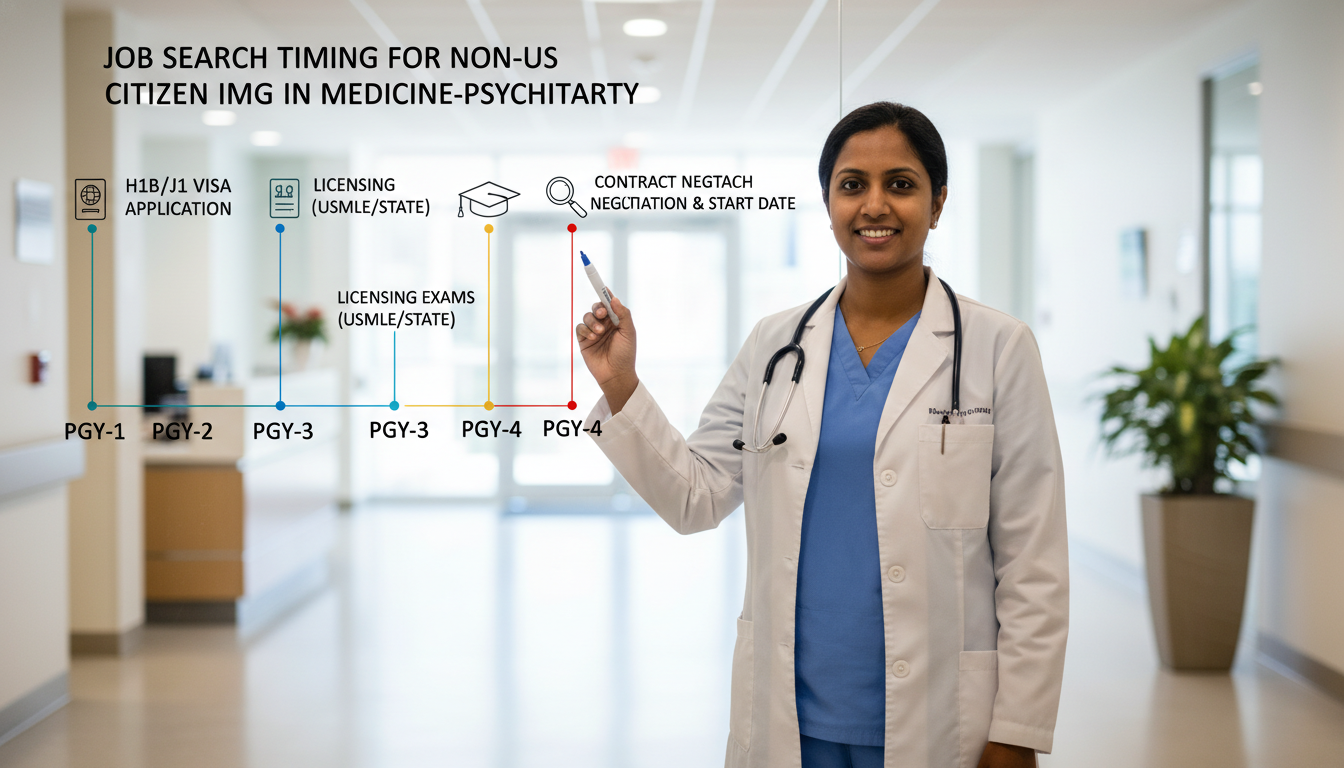
A Year-by-Year Timeline: From PGY-3 to First Attending Job
Below is a typical 5-year combined med psych residency timeline (adjust slightly if your program structure differs). Use this as a planning framework and adjust based on your personal situation.
PGY-1 and PGY-2: Laying Foundations (Too Early for Formal Search, Perfect for Strategy)
At this stage, you are not actively applying for jobs, but you should be strategic:
Key Goals:
- Clarify long-term immigration path:
- Are you on J-1 or H-1B?
- Are you aiming for a J-1 waiver (Conrad 30, academic waiver, VA waiver) or green card via H-1B?
- Build a mentor network including:
- At least one med psych faculty member who understands the combined specialty
- Someone experienced in J-1 waiver or H-1B job searches
- Explore practice interests:
- Inpatient vs outpatient
- Internal medicine vs psychiatry vs integrated med-psych settings
- Academic vs community vs VA vs FQHC
- Track board eligibility and state licensing requirements:
- Number of years of postgraduate training required in your target states
- Any special rules for IMGs
Recommended Actions:
- Start a simple “job search file” (digital or paper) with:
- CV template
- List of potential states and visa options
- Notes on licensure requirements
- Attend departmental or institutional career talks—even if they feel early.
- Have at least one informal meeting with your GME office or institutional immigration lawyer to clarify:
- Your current visa plan
- Consequences of switching between J-1 and H-1B
- Realistic timeline for your situation
PGY-3: Early Exploration (About 24–30 Months Before Graduation)
This is the first crucial year for job search timing.
Why PGY-3 matters:
- If you are a J-1 holder, you must understand J-1 waiver options early; some states and employers have tight deadlines.
- If you are on H-1B, you need to understand transfer timelines and green card strategies.
- This is the ideal time to start mapping where and how you want to practice your combined skill set.
Key Goals in PGY-3:
- Identify 3–5 target states or regions.
- Decide on a leaning:
- Primarily psychiatry with some medicine
- Primarily medicine with some psychiatry
- Explicit combined medicine psychiatry practice (consults, med-psych unit, collaborative programs)
- Start networking deliberately:
- Med psych listservs or specialty societies
- Program alumni—especially non-US citizen IMG graduates
- Academic contacts through conferences or poster presentations
Concrete Steps:
- Update your CV to be “attending-ready” in format (even though you’ll keep adding content).
- Attend at least one national meeting (e.g., APA, ACP, or combined programs meetings) and introduce yourself to:
- Program directors from other institutions
- Chairs or service chiefs on med-psych services
- Representatives from states that frequently sponsor J-1 waivers
- Begin informational interviews via email or LinkedIn:
- Contact med psych graduates to ask:
- When did you start your job search?
- How did your visa status impact timing?
- What would you do earlier if you could?
- Contact med psych graduates to ask:
Do you apply formally at this stage?
Generally no. But if an exceptional med psych job appears that aligns with your visa needs, you can reach out and express interest, clearly stating your expected graduation date.
PGY-4: Transition to Active Search (About 18–24 Months Before Graduation)
This year is where job search moves from background planning to structured action.
Key Goals:
- Move from “I’m exploring options” to “I’m targeting positions and institutions.”
- Understand clearly:
- Which states accept J-1 waiver candidates
- How competitive each state’s Conrad 30 program is
- Whether academic positions in your target institutions sponsor H-1B
Timeline Benchmarks:
- 18–24 months before graduation:
- Begin monitoring job postings regularly for:
- “Combined internal medicine and psychiatry”
- “Medicine psychiatry”
- “Psychiatrist with interest in medical complexity”
- “Consultation-liaison psychiatry with strong medicine background”
- Consider drafting a template outreach email you can adapt for each opportunity.
- Begin monitoring job postings regularly for:
- 16–20 months before graduation:
- Start soft applications:
- Email department chairs or service chiefs with a tailored message:
- Brief intro
- Training summary (med psych combined)
- Visa status and needs (J-1 waiver or H-1B)
- Your interest in integrated medical and psychiatric care
- Email department chairs or service chiefs with a tailored message:
- Start soft applications:
Practical Tip:
When you contact potential employers as a foreign national medical graduate, be transparent early about your visa status. This saves time and filters out institutions that cannot sponsor you.
Example Email Opening:
I am a PGY-4 resident in a five-year combined Internal Medicine and Psychiatry program, graduating in June 20XX. I am a non-US citizen IMG currently on a J-1 visa and will require a J-1 waiver position starting after graduation. My clinical interests include medical-psychiatric inpatient care and complex medically ill populations. I am writing to inquire whether your institution may have interest in a future position that uses both internal medicine and psychiatry skills.
PGY-5: Intensive Job Search, Interviews, and Contracting (About 9–18 Months Before Graduation)
This is the central window when most non-US citizen med psych residents should be actively interviewing and signing contracts.
9–18 Months Before Graduation: Core Tasks
Formal Applications and Interviews (12–18 months before):
- Apply to a range of positions:
- Pure psychiatry roles that encourage collaboration with medicine
- Hospitalist roles interested in medically and psychiatrically complex patients
- Hybrid or explicitly “medicine psychiatry combined” positions
- Don’t rule out institutions that haven’t posted a med-psych role; sometimes they will create a position once they understand your skills.
- Apply to a range of positions:
Clarify Practice Scope:
- Decide whether you will:
- Maintain active internal medicine practice
- Center your practice in psychiatry but take on medically complex populations
- Split between internal medicine and psychiatry services
- Decide whether you will:
Visa Strategy Discussions:
- Explicitly discuss your visa needs at or soon after the first or second interview:
- Are they Conrad 30–eligible (for J-1)?
- Do they have experience with H-1B sponsorship?
- Do they support future green card applications?
- Explicitly discuss your visa needs at or soon after the first or second interview:
Job Market Strategy:
- The physician job market in psychiatry is relatively favorable, but:
- Combined med psych roles are still niche.
- Rural and underserved areas are often more open to J-1 waivers.
- You may need to balance:
- Ideal clinical setup vs
- Locations that meet your visa and waiver needs
- The physician job market in psychiatry is relatively favorable, but:
9–12 Months Before Graduation: Negotiation and Signing
By this point, you should aim to:
- Have 2–4 serious prospects or offers.
- Negotiate:
- Protected time for med-psych integrated work (e.g., consults, complex care clinics).
- Clear expectations around working in internal medicine vs psychiatry.
- Academic involvement if desired (teaching, research in med psych).
- Sign a contract no later than 6–9 months before graduation if visa paperwork is needed.
Why the 6–9 Month Rule?
- J-1 waiver and H-1B petitions have:
- Document collection time
- Employer HR and legal processing time
- Government processing and possible delays
- Hospital credentialing alone can take 3–6 months, especially if you will be credentialed in both medicine and psychiatry departments.
Visa and Licensing: How They Shape Your Job Search Timing

J-1 Visa Holders: Special Time-Sensitive Considerations
As a non-US citizen IMG on a J-1 visa, your job search timing is tied to the J-1 waiver process.
Key Points:
- You must obtain a J-1 waiver job in a medically underserved or designated shortage area, or through qualifying academic/VA routes.
- Many states have their own Conrad 30 deadlines, commonly:
- Applications accepted once per year (often October 1, but varies by state)
- Some states fill all 30 slots quickly; others are more flexible
Practical Timeline for J-1 Residents:
- 18–24 months before graduation:
- Identify 3–5 states where you’d accept a job and that are:
- Open to psychiatrists
- Historically friendly to IMGs
- Have med-psych needs (e.g., large academic centers or integrated health systems)
- Identify 3–5 states where you’d accept a job and that are:
- 12–18 months before graduation:
- Secure an offer from an employer willing to sponsor your J-1 waiver
- Coordinate with employer’s legal team about state-specific timelines
- By 9–12 months before graduation:
- J-1 waiver application should be in process or submitted, depending on state rules
Common J-1 Pitfall:
Delaying the job search until 6–8 months before graduation often results in:
- Limited locations still having unfilled waiver slots
- Rushed decisions about practice setting and job fit
- Increased risk of gaps in employment or needing a temporary solution
H-1B Visa Holders: Flexibility with Hidden Constraints
If you are on an H-1B visa during residency:
Advantages:
- No J-1 waiver requirement
- Often easier to remain in academic or large health system roles
- Potential for green card sponsorship earlier in your career
Timing Considerations:
- H-1B cap-exempt vs cap-subject positions:
- Many residency programs and academic institutions are cap-exempt.
- Move to a cap-subject employer (e.g., many private hospitals or groups) may require attention to the April H-1B cap lottery.
- Your job search date is still ideally:
- 12–18 months before graduation to allow for H-1B transfer or new petition and state licensure.
State Medical Licensing and Dual Practice
As a med psych trained foreign national medical graduate, you often want to be licensed in both internal medicine and psychiatry.
Licensing Timeline Considerations:
- Many states require:
- Original documentation from medical school and residency (which can take weeks to assemble)
- Primary source verification services that can take 2–4 months or more
- If you plan to practice in both fields:
- Your hospital may need separate privileging processes for internal medicine and psychiatry.
- Build in extra time for hospital credentialing (often 4–6 months).
Action Steps:
- As soon as you sign a contract, start state licensure paperwork.
- Ask your future employer’s credentialing office:
- Expected timelines for licensure and hospital privileges
- Whether they have had experience with combined medicine psychiatry attendings
Strategy: Matching Your Med-Psych Skills to the Physician Job Market
The physician job market for med psych specialists is unusual:
- High demand for psychiatrists in general
- Moderate demand for internists
- Emerging but under-recognized demand for combined medicine psychiatry clinicians
Your advantage as a non-US citizen IMG in med psych is the breadth and depth of your training. Your challenge is helping employers understand how and when to use that.
Common Job Types for Med-Psych Graduates
When you ask yourself “when to start job search”, also ask “what kind of job am I targeting?” Job type influences timing.
Integrated Med-Psych Inpatient Roles
- Examples:
- Medical-psychiatric inpatient unit
- Psychosomatic medicine/consultation-liaison with strong internal medicine involvement
- Timing:
- Often at academic or large tertiary hospitals
- Hiring processes can be slower; start earlier (18–24 months)
- Examples:
Outpatient Psychiatry with Complex Medical Populations
- Examples:
- Primary care behavioral health integration
- Collaborative care models for chronic illness and mental health
- Timing:
- Strong demand; positions frequently posted
- Still, for non-US citizen IMG status, aim for 12–18 months in advance
- Examples:
Hospitalist or Internal Medicine Roles with Behavioral Focus
- Examples:
- Hospital medicine services that often manage patients with major psychiatric comorbidities
- Medicine-psych liaison between medicine floor and psychiatry consults
- Timing:
- Hospitalist recruiting can be year-round
- However, your visa/waiver processes still require ≥12 months lead time
- Examples:
Academic Med-Psych Career
- Examples:
- Faculty roles emphasizing teaching and research
- Development of med-psych curricula or services
- Timing:
- Academic searches can be slow and bureaucratic
- Begin conversations 18–24 months before graduation
- Examples:
Practical Job Search Tactics
- Use multiple channels:
- National job boards (e.g., NEJM CareerCenter, APA, ACP)
- Institutional websites in your target states
- Direct outreach to department chairs and program directors
- Emphasize your unique value:
- Ability to manage both complex medical and psychiatric illness
- Comfort in high-acuity settings (ICU consults, complex discharge planning)
- Utility in developing new integrated care programs
Example Pitch Statement (for Interviews):
As a combined internal medicine and psychiatry graduate, I can help bridge the gap between medical and psychiatric care. I’m particularly interested in building or expanding services for medically complex patients with significant psychiatric comorbidities, whether in an inpatient unit, consult service, or integrated outpatient clinic.
FAQs: Job Search Timing for Non-US Citizen IMGs in Med-Psych
1. When should I first start thinking about my job search as a med psych resident?
Start strategic planning as early as PGY-2–PGY-3:
- Clarify visa path (J-1 vs H-1B)
- Identify potential states and practice settings
- Begin building connections with mentors and alumni
Formal applications typically begin 12–18 months before graduation, but early groundwork is essential for non-US citizen IMGs.
2. As a J-1 non-US citizen IMG, is it realistic to find a med-psych specific job?
Yes, but it requires early and proactive planning:
- Many J-1 waiver–eligible regions have high psychiatric need and are open to innovative med-psych roles.
- You may not always find a position labeled “medicine psychiatry combined,” but you can negotiate a role that uses both skill sets.
- Target institutions that:
- Have existing consultation-liaison psychiatry or integrated behavioral health
- Employ other IMGs and are familiar with J-1 waivers
3. Can I delay my attending job search until 6 months before graduation?
For a non-US citizen IMG in med psych, waiting until 6 months before graduation is risky:
- Visa processing and state licensure may not be completed in time.
- Many J-1 waiver programs will already be full.
- You may be forced to choose suboptimal jobs or locations.
Aim for 12–18 months before graduation for formal applications, and earlier if you are seeking academic or highly specialized med-psych positions.
4. I want to keep both internal medicine and psychiatry active. How does that change my timing?
If you want true dual practice:
- Start conversations with potential employers early (18–24 months).
- Ensure:
- The employer is willing to support dual credentialing and scheduling.
- The state medical board and hospital bylaws allow your planned scope of practice.
- Build in extra time for:
- Two sets of privileging
- Clarifying call schedules and FTE split between medicine and psychiatry
For a non-US citizen IMG in medicine-psychiatry, successful job search timing means treating the process like a long, structured project. Begin early, understand your immigration and licensing constraints, and use your unique med-psych background as a selling point in a physician job market that increasingly values integrated, whole-person care.