
As a non-US citizen IMG in a combined Pediatrics-Psychiatry (Peds-Psych) or Triple Board residency, your job search is not just about finding the right position—it’s about getting the timing exactly right. Visa constraints, board eligibility, and the unique structure of peds psych residency training make timing more critical for you than for most of your US graduate peers.
Below is a comprehensive, step-by-step guide to when to start your job search, how the physician job market looks for a foreign national medical graduate in Peds-Psych, and how to align all of this with your visa and training milestones.
Understanding the Unique Context: Non-US Citizen IMG in Peds-Psych
Pediatrics-Psychiatry (often combined as Peds-Psych, or through Triple Board programs: Pediatrics, Psychiatry, and Child & Adolescent Psychiatry) is a niche with high demand but low supply, which can work strongly in your favor—if you plan ahead.
Why Timing Matters More for You
As a non-US citizen IMG and foreign national medical graduate, you are navigating:
- Visa sponsorship (J-1, H-1B, or O-1)
- Possible J-1 waiver requirements (Conrad 30, VA, HHS, etc.)
- Multi-board eligibility timing (Pediatrics, Psychiatry, Child & Adolescent Psychiatry, depending on your track)
- State licensure and board timelines
- Institutional onboarding, credentialing, and privileging (often 3–6 months)
Each of these elements has its own timeline. Your attending job search must sit right at the intersection of all of them.
Big Picture Timeline: When to Start the Job Search
To keep this concrete, assume a standard 5-year Triple Board or Peds-Psych track, finishing in June of Year 5. Adjust slightly if your program length or start date is different.
Ideal Overall Timeline
24–18 months before graduation
Exploration and positioning phase18–12 months before graduation
Active job search and first interviews12–6 months before graduation
Negotiate and sign contract, finalize visa strategy, start credentialing6–0 months before graduation
Licensing, final credentialing, relocation and onboarding details
For non-US citizen IMG physicians in Peds-Psych, a safe and realistic range for when to start job search is 18–24 months before your expected graduation date. Starting later than 12 months out significantly increases stress and may limit your options, especially if you need J-1 waiver or H-1B sponsorship.
Year-by-Year Guide: From PGY-2 to Final Year
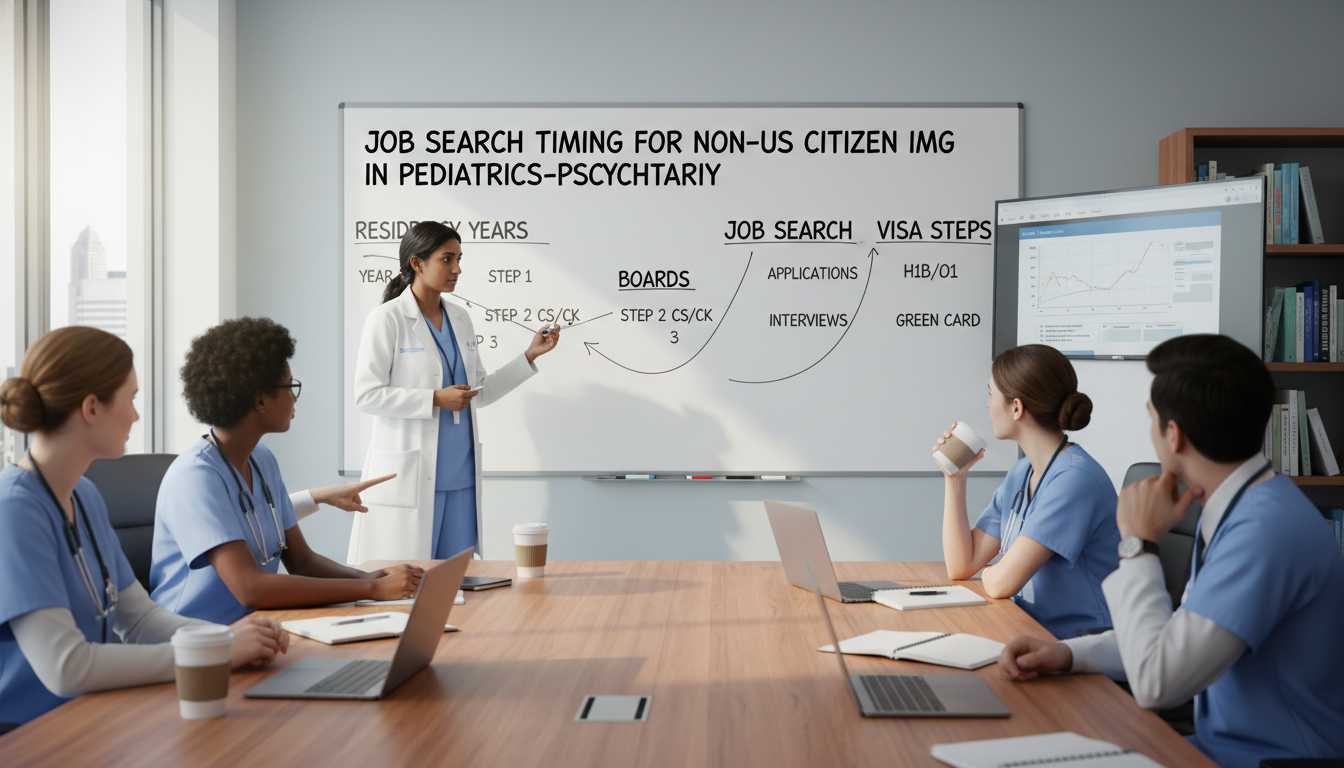
PGY-2 to Early PGY-3: Foundation and Exploration (30–24 Months Before Graduation)
You don’t need to apply yet, but this is when you quietly start positioning yourself.
Goals in this phase
Clarify your career direction
- Do you want:
- Primarily clinical pediatrics?
- Primarily psychiatry (adult, child, or both)?
- Integrated roles (consult-liaison, developmental-behavioral, autism programs, neurodevelopmental clinics)?
- Academic vs community practice?
- Example roles:
- Pediatric consultation-liaison psychiatrist in a children’s hospital
- Outpatient child & adolescent psychiatrist with pediatric primary care integration
- Medical director for a pediatric behavioral health program
- Split practice: 50% child psychiatry, 50% pediatric developmental clinic
- Do you want:
Understand your visa situation
- Confirm current status (J-1, H-1B, or other).
- If J-1:
- Learn about J-1 waiver options (Conrad 30, VA, HHS, state-specific programs).
- Determine if you will need to work in a designated shortage area.
- If H-1B:
- Check if you’re cap-exempt through your training institution and what that means for your first attending role.
- Consult your GME office or an immigration attorney early.
Start mapping the job market
- Search for:
- “Pediatric psychiatry jobs”
- “Triple board psychiatrist jobs”
- “Child and adolescent psychiatrist with pediatrics experience”
- Look at:
- Academic medical centers
- Large children’s hospitals
- Community mental health centers with pediatric focus
- Integrated behavioral health practices
- Search for:
Actionable steps
- Attend specialty career panels (AAP, AACAP, APA, AAP Section on Developmental & Behavioral Pediatrics).
- Join relevant listservs or specialty groups for Peds-Psych and Triple Board.
- Start an organized spreadsheet tracking:
- Institutions of interest
- States where you may want to live (and their licensure requirements)
- Visa sponsorship history at those institutions
Mid PGY-3 to Early PGY-4: Preparation and Networking (24–18 Months Before Graduation)
This is when the question “when to start job search?” becomes practical. You are not yet sending applications widely, but you are preparing to do so.
Goals in this phase
Narrow your target roles
- Decide on:
- Academic vs community
- Geographic regions
- Balance of pediatrics vs psychiatry
- Inpatient, outpatient, or mixed
- Clarify how you want to use your unique Peds-Psych or Triple Board training.
- Decide on:
Start targeted networking
- Connect with:
- Program alumni (especially other non-US citizen IMG graduates).
- Faculty with combined Peds-Psych roles.
- Mentors in both Pediatrics and Psychiatry.
- Ask direct questions:
- “Where have recent graduates taken positions?”
- “Which institutions are open to H-1B or J-1 waiver hires in integrated peds-psych roles?”
- “How early do they typically hire for these positions?”
- Connect with:
Prepare application materials
- Draft a CV tailored to Peds-Psych:
- Highlight rotations, electives, QI projects, and research that show integrated skills.
- Create a 1-page career summary:
- Who you are, what you’re trained in, and what type of position you’re seeking.
- Draft a generic but customizable cover letter emphasizing:
- Your combined training
- Your interest in integrated pediatric and psychiatric care
- Your long-term commitment to the US healthcare system
- Draft a CV tailored to Peds-Psych:
Actionable steps
- Present at regional/national meetings—future employers often attend.
- Ask mentors for sample CVs and cover letters from previous graduates.
- Have your CV reviewed by both Peds and Psychiatry faculty—each will notice different strengths.
Late PGY-4 to Early Final Year: Active Job Search Phase (18–12 Months Before Graduation)
This is the optimal time to actively launch your attending job search.
This is your primary window to start applying.
Goals in this phase
Start contacting employers
- Ideal time: 15–18 months before graduation.
- Target:
- Departments of Pediatrics
- Departments of Psychiatry
- Children’s hospitals
- Integrated behavioral health programs
- Include a clear, concise message:
- Your graduation date
- Your Peds-Psych/Triple Board training track
- Your visa status and what you will require
- Interested clinical areas (e.g., pediatric CL, developmental-behavioral, autism, integrated primary care)
Use multiple job search channels
- Online job boards:
- AAP, AACAP, APA, NEJM, and specialty platforms.
- Hospital and university career pages.
- Recruiters:
- Make your visa needs explicit from the first conversation.
- Word-of-mouth:
- Ask your mentors directly: “Do you know of departments looking for a combined Peds-Psych or Triple Board graduate?”
- Online job boards:
Schedule interviews
- Most institutions will start early interview discussions once they know your graduation date and training type.
- Academic positions may plan 12–18 months ahead.
- Community practices may move faster, but will still take months for credentialing.
Align with visa requirements
- If on J-1:
- This is when you must:
- Identify potential J-1 waiver-eligible positions.
- Confirm that the employer is willing and experienced in sponsoring J-1 waivers.
- Understand the state’s application deadlines (some states fill early).
- This is when you must:
- If on H-1B:
- Confirm if your first attending position needs:
- Cap-exempt H-1B (universities, research institutions)
- Or cap-subject H-1B (many private practices, non-academic hospitals)
- Discuss timing of H-1B petitions with prospective employers.
- Confirm if your first attending position needs:
- If on J-1:
Practical example
- A non-US citizen IMG in Triple Board training, graduating June 2027, begins:
- Contacting potential employers in January 2026.
- Has first interviews between February–May 2026.
- Receives offers by summer 2026.
- Signs a contract by fall 2026.
- Employer files waiver/H-1B paperwork late 2026 / early 2027.
- Starts attending role July or September 2027.
Final Year: Securing and Finalizing Your Position (12–0 Months Before Graduation)

By now you should be in the offer and contract phase.
Goals in this phase
Evaluate and negotiate offers (12–6 months before graduation)
Beyond salary, you need to consider:- Visa sponsorship specifics
- Are they familiar with J-1 waiver/H-1B/O-1 processes?
- Who pays legal and filing fees?
- Timelines for filing and expected approval.
- Scope of practice
- Does the job allow you to fully use your Peds-Psych or Triple Board training?
- Example: Are you able to:
- Run an integrated pediatric behavioral health clinic?
- See medically complex pediatric patients with psychiatric comorbidities?
- Have some time in pediatric CL and some in outpatient child psychiatry?
- Mentorship and support
- Are there other combined-trained or child psychiatrists on staff?
- Are you the “only” behavioral health provider for children? That can be overwhelming without support.
- Visa sponsorship specifics
Understand credentialing and licensure timelines
- State medical license:
- Start at least 6–9 months before your planned start date.
- Some states require board exam attempts or confirmation of graduation date.
- Hospital privileges:
- Can take 3–6 months after license issuance.
- Board exams:
- Plan Pediatric and Psychiatry board exam timing so they don’t collide with early months of your first job if avoidable.
- State medical license:
Coordinate your immigration timeline
- For J-1 waiver jobs:
- Confirm state or federal waiver application windows.
- Ensure your contract includes:
- Required service period terms
- Location details aligned with waiver application
- For H-1B:
- Determine if the employer is:
- Cap-exempt (usually academic or nonprofit)
- Cap-subject (subject to annual H-1B lottery)
- Align filing with your current status expiration and graduation.
- Determine if the employer is:
- For J-1 waiver jobs:
Prepare for transition into attending role
- Discuss:
- Orientation and ramp-up expectations.
- Call responsibilities.
- Protected time for administrative tasks and possibly research or teaching if academic.
- Discuss:
Physician Job Market for Peds-Psych and Triple Board Graduates
The physician job market for combined Pediatrics-Psychiatry and Triple Board training is generally quite favorable. Your dual or triple expertise is rare and highly valued.
Where Your Training Is Especially Sought After
Children’s hospitals
- Pediatric CL psychiatry
- Integrated behavioral health in subspecialty clinics (cardiology, oncology, neurology)
- Eating disorder programs
- Autism and developmental centers
Academic medical centers
- Split appointments between Pediatrics and Psychiatry departments
- Teaching residents and fellows
- Leading integrated care programs
Community health systems
- Integrated primary care behavioral health roles
- Community mental health with pediatric emphasis
- Federally Qualified Health Centers (FQHCs), sometimes J-1 waiver-eligible
Specialty behavioral health organizations
- Residential treatment programs for children/adolescents
- Partial hospitalization programs (PHP/IOP)
- Autism spectrum and neurodevelopmental clinics
How Being a Non-US Citizen IMG Affects the Market
Pros
- Many underserved and rural areas are open—and sometimes eager—to sponsor visas due to chronic workforce shortages, especially in child and adolescent psychiatry.
- Your unique skill set allows employers to fill two roles with one hire (peds + psych), increasing your leverage.
Challenges
- Some employers avoid visa-related complexity.
- Urban, highly competitive markets (e.g., central Boston, San Francisco) may be harder to access on specific visa types.
- Job postings often do not clearly indicate visa willingness—you must ask explicitly.
Actionable tips
When replying to ads or reaching out:
- Include a short, clear statement:
“I am a non-US citizen IMG currently on a J-1/H-1B visa and will require [J-1 waiver/H-1B sponsorship] to begin employment after graduation in [month/year].”
- Include a short, clear statement:
Highlight your long-term commitment:
- Many employers assume IMGs may leave; stating your intention to stay and build a career in their region can make a difference.
Common Pitfalls in Job Search Timing (and How to Avoid Them)
1. Starting Too Late
For a non-US citizen IMG in Peds-Psych, starting the attending job search only 6–9 months before graduation is often too late, especially with visa needs.
Avoid this by:
- Setting a firm internal deadline:
- Begin active job searching no later than 18 months before graduation.
- Using your calendar to map:
- When to email potential employers.
- When to attend major conferences for in-person networking.
2. Underestimating Visa Timelines
Visa processing, especially J-1 waivers, frequently takes longer than expected.
Avoid this by:
- Asking potential employers specific questions:
- “By what month would you need my signed contract to file timely for the waiver/H-1B?”
- “How many J-1 waiver physicians have you sponsored in the past 5 years?”
- Considering states with efficient J-1 waiver programs if you’re flexible geographically.
3. Ignoring State Licensure Requirements
Some states:
- Require additional documentation for IMGs.
- Take 6+ months to process.
Avoid this by:
- Choosing 1–2 “primary” states early (by ~24 months before graduation).
- Reviewing their licensure board websites or contacting them directly.
- Starting the application process as soon as you sign a contract, sometimes even earlier if allowed.
4. Not Leveraging Your Unique Training
Many job postings are written for standard pediatrics or child psychiatry roles and don’t explicitly mention Peds-Psych or Triple Board training. This can lead you to underestimate your options.
Avoid this by:
- Proactively pitching integrated roles:
- “Given my combined Peds-Psych/Triple Board training, I’m interested in helping develop or expand integrated pediatric behavioral health services in your institution.”
- Sharing examples of what you’ve done in residency:
- Created a consult pathway for children with complex medical and psychiatric needs.
- Led QI projects bridging both departments.
Putting It All Together: A Sample Timeline for a Non-US Citizen IMG in Peds-Psych
Assume:
- Triple Board resident, non-US citizen IMG, on J-1 visa
- Graduation: June 2027
2025 (PGY-3 – 24–18 months before graduation)
- Jan–Jun: Explore regions and institutional types; clarify long-term goals.
- Jul–Dec: Speak with mentors; update CV; identify states with supportive J-1 waiver programs.
2026 (PGY-4 / early PGY-5 – 18–12 months before graduation)
- Jan–Mar: Begin emailing potential employers; attend national meetings; do first virtual interviews.
- Apr–Aug: On-site interviews; narrow options; confirm visa experience with serious potential employers.
- Sep–Dec: Receive offers; negotiate; sign contract with a J-1 waiver-eligible employer; begin waiver paperwork preparations.
2027 (Final year – 12–0 months before graduation)
- Jan–Mar: Submit waiver application (depending on state timeline); apply for state license.
- Apr–Jun: Waiver approval; finalize licensure and hospital credentialing.
- Jul–Sep: Start attending role as Peds-Psych/Triple Board physician in integrated pediatric behavioral health.
This kind of structured plan minimizes last-minute crises and maximizes your choices.
FAQs: Job Search Timing for Non-US Citizen IMG in Pediatrics-Psychiatry
1. When should a non-US citizen IMG in Peds-Psych or Triple Board start their attending job search?
Plan to start actively searching and applying 18–24 months before graduation.
- Begin serious exploration and networking by PGY-3.
- Start contacting potential employers and interviewing in late PGY-4 or early final year.
This accounts for visa processing, licensure, and the time institutions need to create or adjust positions for a combined-trained physician.
2. Is the physician job market favorable for Peds-Psych and Triple Board graduates who are foreign national medical graduates?
Overall, yes. The physician job market for child and adolescent psychiatry and integrated pediatric behavioral health is strong. Your combined training allows you to:
- Fill niche, high-need roles in children’s hospitals and academic centers.
- Help build integrated care models that are in demand nationwide.
However, as a non-US citizen IMG, you must be more strategic about: - Targeting employers comfortable with visa sponsorship.
- Applying earlier to align with J-1 waiver or H-1B timelines.
3. How different is job search timing for J-1 versus H-1B physicians in Peds-Psych?
J-1:
- You must secure a waiver-eligible job and complete the waiver application process.
- Start the job search as early as possible—ideally 24–18 months before graduation.
- Some states have early or limited waiver slots, so delay can significantly restrict your options.
H-1B:
- Academic/university positions are often cap-exempt, making timing more flexible but still slow due to legal filings.
- Cap-subject positions (often private practices or non-academic hospitals) require attention to lottery cycles.
- In both cases, begin exploring and applying 18–24 months before graduation to keep multiple options open.
4. What if I’m not sure whether I want a primarily pediatrics or primarily psychiatry job after Peds-Psych/Triple Board training?
It’s common to be uncertain. Use PGY-3 and early PGY-4 to:
- Rotate through various integrated settings (peds CL, developmental clinics, outpatient child psychiatry, etc.).
- Talk to alumni with different types of jobs (more peds-heavy, more psych-heavy, and fully integrated). When you reach the 18–12 month pre-graduation window and begin your active job search, you should have:
- 1–2 preferred role structures (e.g., 60% child psych, 40% peds CL).
- A clear explanation in interviews of how you’d like to combine your training.
Employers often appreciate your flexibility, especially if you can cover multiple needs while still defining a clear professional identity.
With deliberate planning, early action, and clear communication of your unique value, you can turn the complexity of being a non-US citizen IMG in Peds-Psych or Triple Board into a strategic advantage in the post-residency job market. The key is not just where you apply, but exactly when you start your job search—and for you, that starts much earlier than you might think.