
Understanding the Job Search Landscape in Pediatrics–Psychiatry
Pediatrics–psychiatry is a small, highly specialized niche with unique pathways—most commonly the triple board route (Pediatrics / General Psychiatry / Child & Adolescent Psychiatry) or combined Pediatrics–Psychiatry–Child Psychiatry programs. Your hybrid skill set is in high demand, but the timing of your job search matters more than you might expect.
Several forces shape the physician job market for peds–psych:
Short supply, broad demand
- Hospitals and academic centers want you to bridge pediatric and behavioral health services.
- Community systems and large pediatric groups are desperate for child mental health access.
- Integrated care models (e.g., collaborative care in pediatrics) are expanding.
Slow institutional hiring timelines
- Academic centers and hospital systems often need 6–12 months to post, interview, approve, and onboard.
- Smaller private or community practices may move faster (2–4 months), but still require credentialing and insurance paneling.
Multiple viable practice models
- Academic triple board positions (inpatient peds, consult-liaison, outpatient child psych).
- Hospital-employed pediatric behavioral health or integrated care.
- Community mental health and FQHCs.
- Hybrid clinical + leadership roles (medical director for behavioral health, program building).
- Telepsychiatry or part-time portfolio careers.
Because of these factors, when to start job search activities should be deliberate and staged. If you wait until graduation or board certification to think about your next steps, you risk limiting your options or accepting a suboptimal job simply because it’s available quickly.
The rest of this guide walks you, step by step, from early residency through your first year as an attending, focusing specifically on optimal timing for each phase of your peds psych residency or triple board career.
Big-Picture Timeline: When to Start Your Job Search
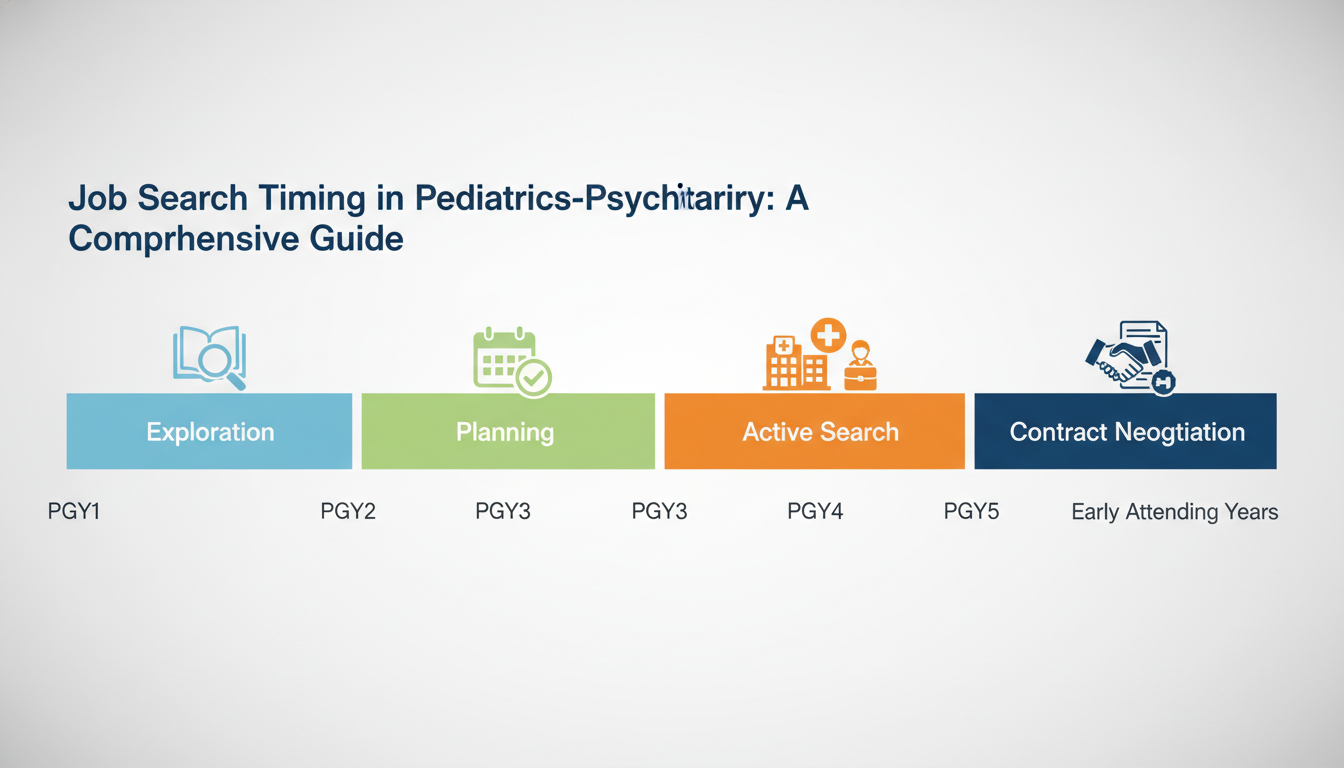
Before diving into details, here’s an overview timeline tailored to triple board or combined pediatrics–psychiatry residents. Adjust by 3–6 months depending on your program structure and whether you plan fellowship extensions.
PGY-1 to PGY-2: Explore and Observe (No formal search yet)
- Goal: Understand the field, settings, and yourself.
- Actions: Talk with mentors, note what you like/dislike, learn the language of contracts and FTEs.
PGY-3: Intentional Career Planning (Light, strategic preparation)
- Start: ~24–30 months before graduation
- Goals: Narrow down practice type, geography, and core interests (inpatient vs outpatient, peds-heavy vs psych-heavy, academic vs community).
- Actions: Build mentorship network, update CV, attend career panels, start tracking job trends.
PGY-4: Active Exploration and Networking
- Start: ~18–24 months before graduation
- Goals: Turn vague interests into concrete targets; clarify what your “ideal week” looks like.
- Actions: Attend conferences with a networking plan, find potential employers, start informal conversations.
PGY-5 (Final Year of Training): Formal Job Search and Negotiation
- Start formal applications: 9–15 months before graduation
- Interviews: 6–12 months before graduation
- Contract signed: Ideally 6–9 months before your start date
First Year as an Attending: Reassessment and Long-Term Positioning
- 6–12 months into attending life: Evaluate fit, identify gaps, and adjust for long-term growth (e.g., leadership pathways, academic promotion, or eventual job change).
This timeline reflects realities of the attending job search: hiring cycles, budget approvals, credentialing, and family planning considerations. Peds–psych is niche enough that early, thoughtful timing gives you leverage and choice.
Early Residency (PGY-1–PGY-2): Foundation and Subtle Positioning
You do not need to be job hunting as an intern. But you should begin laying the foundation so that when the time comes, your job search timeline isn’t compressed or panicked.
Key Goals in PGY-1–PGY-2
Understand the breadth of roles available to you
- Observe how attendings with your training practice:
- Pure inpatient pediatrics vs pure child psychiatry vs integrated clinics
- Emergency psych consults vs long-term outpatient therapy/med management
- Academic vs private vs community mental health structures.
- Ask: How did they end up in their current role? What would they change?
- Observe how attendings with your training practice:
Start light networking (without calling it that)
- Introduce yourself to division chiefs and program directors in both Pediatrics and Psychiatry; let them see your reliability early.
- Volunteer for small projects (case conferences, QI, curriculum) that put you on the radar of leaders who might later advocate or hire.
Identify mentors in both disciplines
- At least:
- One peds-based mentor who understands your pediatric identity and can connect you to children’s hospitals and pediatric groups.
- One psychiatry-based mentor (ideally child/adolescent) who knows the mental health landscape.
- A “hybrid” mentor (if available) who is triple board–trained or works in integrated care.
- At least:
Begin to notice what energizes vs drains you
- Do you enjoy:
- Fast-paced inpatient or ED consults?
- Longitudinal outpatient relationships?
- Complex developmental and psychosocial cases?
- Systems-level care (program design, behavioral health integration)?
- Do you enjoy:
Capture these reflections in a simple document or journal—you’ll use them later to refine your job search criteria.
What Not to Worry About Yet
- Specific job postings
- Contract terms or salary ranges (except in a broad sense)
- Choosing a final city or employer
Your only timing task now is making sure you are visible, reliable, and curious—this sets the stage for strong letters, internal offers, or opportunities you haven’t even imagined yet.
Mid-Residency (PGY-3–PGY-4): Strategic Planning and Market Awareness
By mid-training, especially in a triple board program, you have tasted enough of pediatrics and psychiatry to form early preferences. This is where thoughtful planning begins.
PGY-3: Clarifying Career Direction
Around 24–30 months before graduation, you should intentionally shift into career planning mode.
1. Decide on Your Likely Practice Mix
Ask yourself:
- What percentage of my time do I want in:
- Pediatrics vs psychiatry vs child & adolescent psychiatry?
- Inpatient vs outpatient vs consult-liaison vs ED?
- Academic vs community vs private/telehealth?
- How important are:
- Teaching and research?
- Leadership or program-building roles?
- Work–life flexibility, part-time options, or shift-based schedules?
Write a one-page summary:
“My ideal early-career role would look like…”
This becomes your internal compass while scanning the physician job market.
2. Study the Market—Quietly but Deliberately
This is the stage when to start job search research, not applications:
- Regularly scan:
- Academic job boards (AAP, AACAP, institutional sites)
- Major physician job boards (Doximity, NEJM, PracticeLink, etc.)
- State medical society postings
- Note patterns:
- Are jobs mostly outpatient child psych, or are there integrated peds–psych roles?
- What geographic areas seem to value your skill set the most?
- Typical advertised FTE split and salary ranges?
- Keep a simple spreadsheet:
- Position title, institution, region, clinical mix, contact person, and what appeals or concerns you.
This helps you understand the attending job search landscape without committing to any path yet.
3. Begin Soft Networking
- Use meetings, grand rounds, and conferences to:
- Introduce yourself as a future combined peds–psych or triple board graduate.
- Ask experienced physicians how they approached their first job and timing.
- Let mentors know you’re starting to think about your first role:
- “Over the next year, I’d love your advice on how to position myself for a job that does X/Y/Z.”
You are not yet formally job hunting, but you are building the network that will make your job search smoother when the time comes.
PGY-4: Piloting Your Future Career and Testing Assumptions
Some programs have a more psychiatry-heavy or child psych–focused PGY-4 year. Regardless, this is a key trial period.
1. Use Electives Intentionally
Think of electives as low-risk test beds for possible career paths:
- Integrated pediatric-behavioral clinics
- Consult-liaison roles (NICU, PICU, ED)
- Community mental health or school-based programs
- Telepsychiatry or collaborative care models
Ask supervising attendings directly:
“How did you find this job? When did you start looking? What would you tell someone in my shoes about timing?”
Their answers will give you real-world benchmarks for when to start job search efforts in different practice settings.
2. Refine Your Non-Negotiables
By the end of PGY-4, you should know:
- Must-have features (e.g., at least 40% direct child psychiatry; protected time for teaching; limited overnight call).
- Deal-breakers (e.g., full-time adult psychiatry inpatient; no time for integrated work; unsustainable call).
- Geographic constraints (partner’s job, family, licensing environment).
Write these down; they’ll drive which postings you pursue and how early you need to apply (more constraints = start earlier).
3. Prepare Materials Before the Final Year
- Update your CV with:
- All pediatric + psych experiences
- QI projects, teaching, leadership, committee work
- Draft a base cover letter:
- Highlight your combined training, your interest in integrated care, and how you bridge systems.
- Create a simple, polished professional bio (3–5 sentences) to share with mentors or recruiters.
Having these ready before PGY-5 makes it much easier to respond quickly when attractive positions appear.

Final Year (PGY-5): Executing a Timely, Strategic Job Search
Your last year (or last 12–18 months of training if your program structure differs) is when you move from planning to action. This is the critical phase for timing.
When to Start Formal Applications
In most cases, for a peds psych residency or triple board graduate:
12–15 months before graduation
- Start emailing potential mentors and division chiefs about possible upcoming positions.
- Submit early applications for highly competitive academic or geographically limited positions.
9–12 months before graduation
- Actively apply to posted positions that match your criteria.
- Engage with recruiters (hospital-based or national) if you’re open to a wider net of opportunities.
Why this window?
- Academic centers and large systems:
- Need time for internal approvals and sometimes national searches.
- Frequently coordinate hiring around academic year and budget cycles.
- Community and smaller systems:
- May not post as early, but you can still start conversations so they know you’re coming onto the market.
Step-by-Step Job Search Timeline in Your Final Year
1. 12–15 Months Before Graduation
- Meet with your key mentors and program leadership:
- Clarify your goals, target regions, and desired clinical mix.
- Ask directly: “Do you know institutions looking to build or expand peds–psych or integrated care?”
- Reach out to divisions or departments that align with your interests:
- Short intro email + CV, expressing interest in future positions.
- You are not asking for a job yet; you are signaling future availability.
2. 9–12 Months Before Graduation: Active Search Phase
This is the main window for attending job search activity.
- Apply broadly but strategically:
- Prioritize positions aligning with your “ideal week” and non-negotiables.
- Don’t over-apply just to “see what happens”—each interview requires significant time.
- Schedule first-round interviews:
- Virtual for initial screening; in-person for serious contenders.
- Ask detailed questions about:
- Clinical mix (exact pediatrics vs psych vs admin split)
- Teaching expectations
- Call schedule and weekend coverage
- Support staff (NPs, therapists, social workers, psychology)
Use a comparison spreadsheet; after 3–4 interviews, details will blur.
3. 6–9 Months Before Graduation: Narrowing and Negotiating
Most physicians in combined pediatrics–psychiatry find their top 1–3 options by this point.
- Second looks or additional conversations:
- Talk with junior and mid-career attendings, not just leadership.
- Ask, “What surprised you about this job after you started?”
- Begin negotiations:
- Start date (build in 1–2 months between graduation and job for rest, relocation, board prep).
- FTE (0.8 vs 1.0, possibility of phased ramp-up).
- Mix of pediatrics vs psychiatry vs admin.
- Protected time for program development or teaching.
- Aim to sign a contract ~6 months before your start date:
- This allows time for credentialing, licensing, and relocation logistics.
- For jobs requiring multiple hospital appointments or telehealth licensure in several states, more time may be necessary.
4. 3–6 Months Before Graduation: Contingency Planning
If you haven’t found a good fit by now:
- Revisit your constraints:
- Are you being too narrow about geography or setting?
- Could you accept a 2–3 year “bridge job” that’s good (but not perfect) while you gain experience?
- Consider:
- Short-term or locum tenens options with a clear end-date.
- A narrower practice (e.g., mostly child psych) with a path to adding more pediatrics or integrated care later.
Don’t panic—but do ramp up your search activity and broaden the net slightly.
Early Attending Years: Reassessing and Leveraging Your Experience
The job search does not fully end when you sign your first contract. Your first 12–24 months as an attending are critical for shaping your long-term trajectory in pediatrics–psychiatry.
1. Evaluate Your Fit at 6–12 Months
Questions to ask yourself:
- Does the actual clinical mix match the job description?
- Are my skills as a combined pediatric–psychiatry physician being used fully?
- How is the culture—support for integrated care, team-based approaches, and mental health access?
- Is there room for growth (medical director roles, program building, academic promotion)?
If the job is a decent fit but not perfect, think in 2–3 year horizons: sometimes you grow into better roles internally.
2. Keep a Light Eye on the Market
Even in a satisfying role:
- Glance at postings a few times per year to:
- Benchmark your salary and benefits.
- See how the physician job market is evolving (more telehealth, new integrated models, etc.).
- Maintain your professional network through:
- Conferences, grand rounds, and collaboration on projects.
- Staying in touch with former co-residents and mentors.
This low-level awareness helps you avoid being blindsided by institutional changes and gives you leverage if you consider adjustments or renegotiation.
3. If You Are Considering a Job Change
Timing a second job search is different:
- Most attendings stay in their first job for 2–5 years.
- If your job is clearly unsustainable, start exploring alternatives 6–12 months before you’d like to leave.
- Be strategic:
- Use your now-clear preferences and concrete experience.
- Leverage your integrated skill set—many systems are starting or expanding pediatric behavioral health initiatives and value your credibility on both sides.
Your second job search can be more selective; you know much more about what you want and what you will not accept.
Practical Tips to Optimize Your Job Search Timing
To bring it all together, here are actionable strategies specific to peds–psych and triple board trainees.
1. Align Your Search with Institutional Cycles
- Academic centers:
- Often plan budgets 6–12 months in advance.
- Search committees may meet seasonally; applying “off-cycle” can mean delays.
- Large health systems:
- May need time to justify a new combined role; early conversations help them build a job around you.
2. Use Your Niche to Your Advantage
You are not a generic pediatrician or psychiatrist:
- Emphasize your ability to:
- Bridge pediatric primary/tertiary care with mental health services.
- Support complex populations (neurodevelopmental disorders, chronic illness with co-occurring mental health conditions).
- Lead integrated behavioral health initiatives.
This uniqueness means:
- Some institutions may wait for you (flexible timelines).
- Others may need early awareness to create a position; thus, starting conversations 12–18 months before graduation is often beneficial.
3. Don’t Underestimate Credentialing Time
Especially if your role spans multiple facilities or telehealth:
- State licensure: Plan 3–6 months (or more in some states).
- Hospital privileging: Another 2–3 months, often overlapping.
- Insurance paneling (for certain outpatient or private practice roles): Several additional months.
This is why aiming to finalize your contract about 6 months before start date is so important.
4. Build Flexibility Into Your Life Timeline
Your job search timing interacts with:
- Board exam timing (pediatrics, psychiatry, child & adolescent psychiatry).
- Partner or spouse career shifts.
- Moving logistics and children’s school calendars.
Sketch a combined life–training–job timeline early in PGY-4 or PGY-5. This helps you decide if you want a brief gap between training and work or a direct transition.
FAQs: Job Search Timing in Pediatrics–Psychiatry
1. When should I start my first attending job search as a triple board resident?
Begin serious planning in PGY-3–PGY-4 and formal applications around 9–12 months before graduation. If you are targeting highly specific locations or competitive academic centers, start initial conversations and networking 12–15 months out so departments can anticipate your availability.
2. How does being triple board–trained affect my timing compared with single-specialty peers?
Your combined training often means:
- Fewer directly comparable peers competing for the exact same roles.
- More customization of positions—sometimes departments need extra time to develop or approve hybrid peds–psych roles.
Therefore, it helps to signal your presence early (12–18 months pre-graduation) so institutions can plan. But you don’t necessarily need to apply earlier than others; you just want to be on their radar.
3. What if I’m not sure whether I want a peds-heavy or psych-heavy role yet?
This is common in combined pediatrics–psychiatry training. Use:
- PGY-3 and PGY-4 electives to test different clinical mixes.
- Honest conversations with mentors about how their roles feel day-to-day.
- A written “ideal week” exercise to compare scenarios.
If you’re undecided by early PGY-5, apply to a range of roles (peds-heavy, psych-heavy, integrated) and let interview experiences help clarify your preferences—just start the process early enough (9–12 months before graduation) so you have options.
4. Is it a problem if I don’t have a job secured by three months before graduation?
It’s not uncommon, but it narrows your options. Many hospital and academic roles need more lead time. If you reach the 3–4 month mark without a signed contract:
- Consider widening your geographic or practice-type preferences temporarily.
- Look at shorter-term or locums roles to bridge time while you continue searching.
- Lean on mentors—they may know of last-minute openings or internal expansions.
You can still land a good job, but you’ll have less bargaining power and may have to accept more compromise in the short term.
By approaching your career exploration and job search as a multi-year, staged process, you give yourself the best chance to land a role that truly reflects your unique strengths in pediatrics–psychiatry. Thoughtful timing—paired with deliberate networking and clear self-knowledge—turns a stressful scramble into a strategic transition from resident to attending.