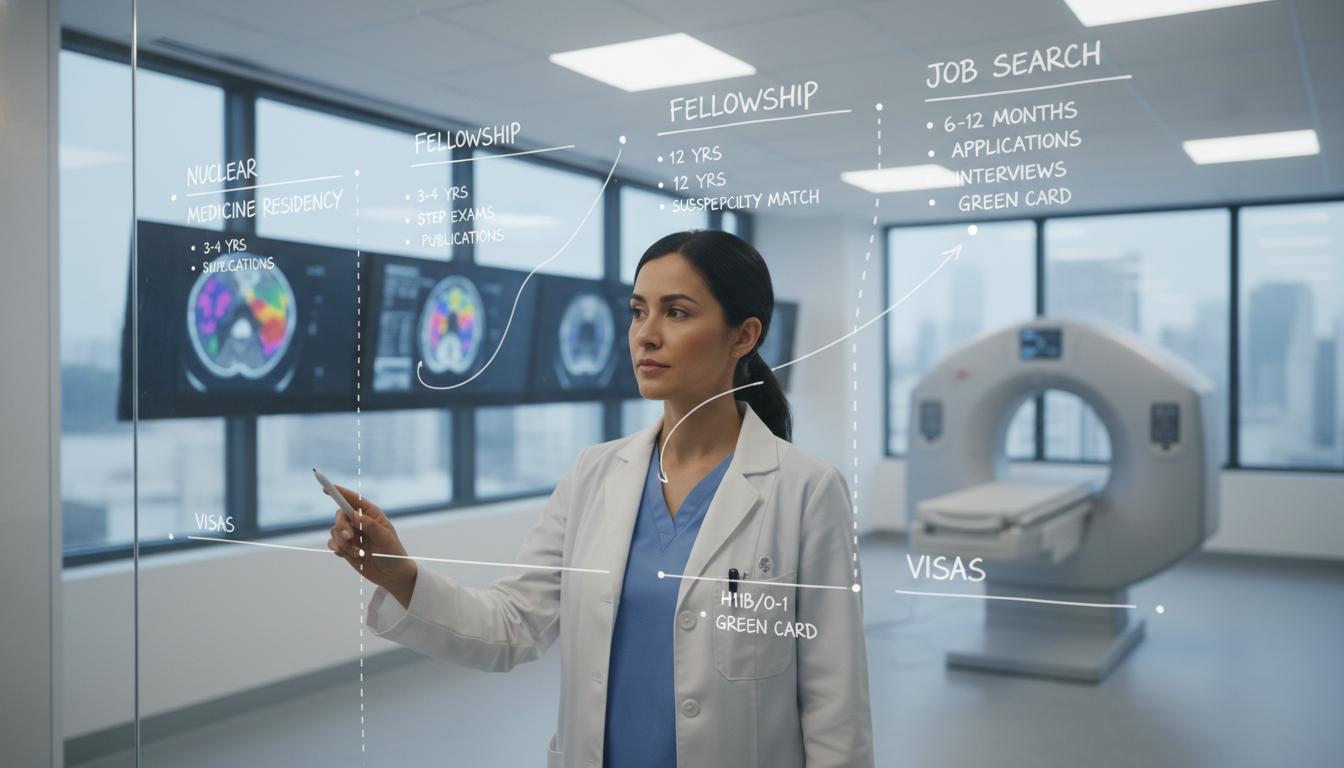
Understanding the Job Search Landscape for US Citizen IMGs in Nuclear Medicine
For a US citizen IMG (American studying abroad and returning for training), timing your job search in nuclear medicine is as strategic as matching into residency or fellowship. Because nuclear medicine is a relatively small specialty, jobs can be excellent—but they are not evenly distributed, and many positions are filled quietly through networks well before public posting.
You are also navigating multiple layers: visa-free status as a US citizen (a major advantage), your IMG background, and a niche field where practice patterns vary widely (diagnostic nuclear medicine, hybrid imaging, theranostics, and academic vs community roles).
This guide focuses specifically on job search timing for nuclear medicine residents and fellows who are US citizen IMGs: when to start, how to pace your efforts, and what milestones you should hit from PGY-1 through your first attending role.
Section 1: The Nuclear Medicine Physician Job Market – What Makes Timing So Critical?
1.1 Why Nuclear Medicine Is Different
The physician job market in nuclear medicine is shaped by several realities:
Small specialty, small pool of jobs
- Far fewer positions than in internal medicine or radiology.
- Many centers rely on radiologists with nuclear training instead of stand-alone nuclear medicine physicians.
Geographic clustering
- Most robust markets are in:
- Major academic medical centers
- Cancer centers
- Large multi-specialty groups with PET/CT and theranostics programs
- Smaller hospitals may only need part-time nuclear coverage or outsource interpretation.
- Most robust markets are in:
Rapidly evolving scope of practice
- Theranostics (Lu-177, I-131, and other radioligand therapies) is altering demand.
- Some places are scrambling to build programs and need nuclear medicine leadership.
- Others are consolidating or merging imaging services under radiology.
Because the physician job market is dynamic and relatively opaque in this specialty, starting early and networking intentionally are essential. Jobs can appear, be informally promised, and disappear before you ever see a formal advertisement.
1.2 Advantage and Challenge: Being a US Citizen IMG
As a US citizen IMG entering nuclear medicine:
Advantages:
- You do not need visa sponsorship, making you more attractive than non-US IMGs when institutions are hesitant about visa processes.
- You already understand US culture and likely the healthcare system to some degree.
- You are free to move states without immigration constraints, which matters when chasing niche opportunities.
Challenges:
- Some employers and departments may have lingering bias against IMGs, especially in competitive markets.
- If you trained abroad for medical school, you may have:
- Fewer US-based mentors or alumni networks.
- Less embedded access to “old boys’ clubs” or informal referral networks.
These realities make it even more important to time your nuclear medicine job search strategically and use your US citizenship as a strength while deliberately building US-based relationships.
Section 2: A Year-by-Year Timeline – From Early Residency to Post-Training
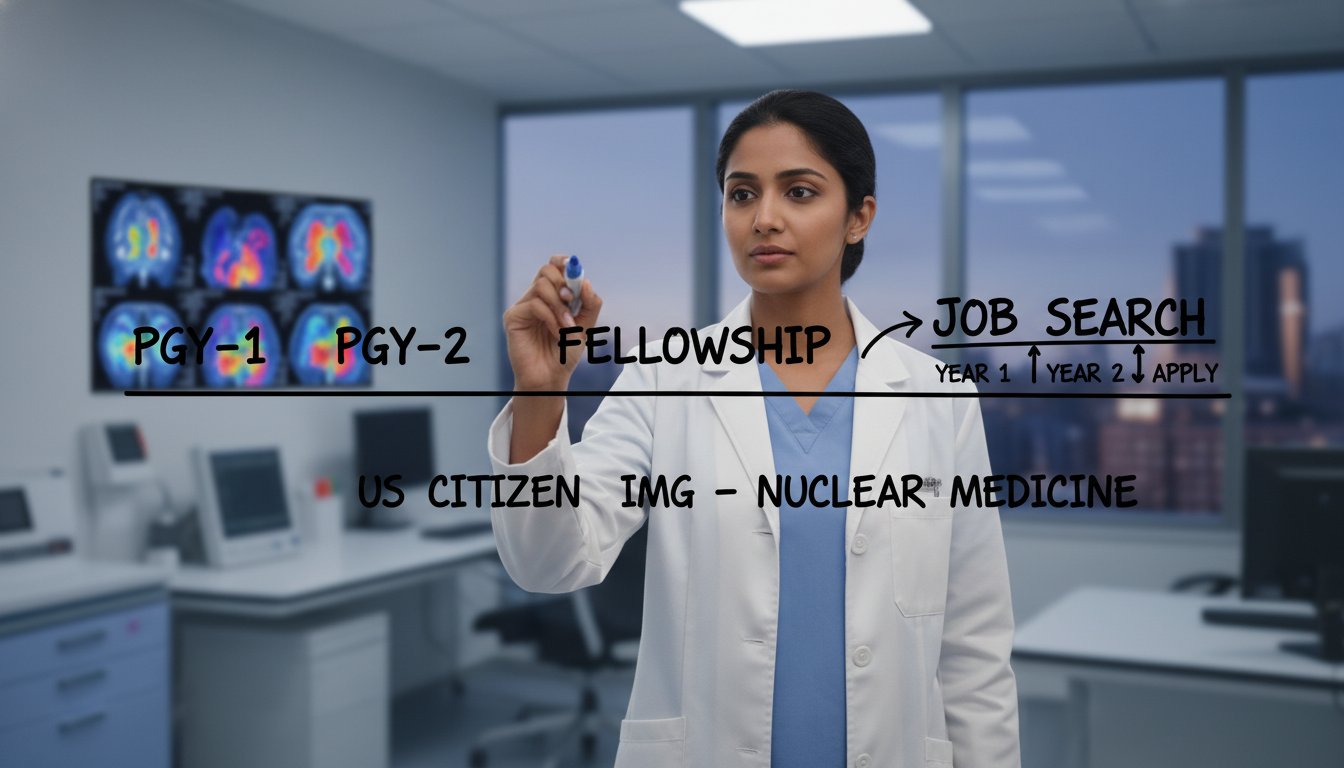
2.1 PGY-1 and PGY-2: Laying the Foundation
At this stage, your focus is on clinical competency and career exploration, not actively applying for jobs. But the groundwork you lay now will directly affect your future attending job search.
Primary goals:
Clarify your career vision:
- Academic vs community.
- Imaging-focused vs theranostics-heavy.
- Interest in research, teaching, or admin leadership.
Start early networking:
- Attend local radiology/nuclear medicine conferences and grand rounds.
- Introduce yourself to nuclear medicine faculty and ask about their career paths.
- If you are in a diagnostic radiology pathway with nuclear training, seek out the nuclear section early.
Practical action items:
Create a simple “career log” document
Track:- People you meet.
- Types of nuclear medicine practice they describe.
- Locations and institutions that appeal to you (e.g., strong in PET, theranostics, or research).
Begin a basic CV and update it at least twice a year.
Ask your mentors:
- “What do you wish you had known about the nuclear medicine job market when you were a resident?”
- “Which conferences are best for job networking in this field?”
You are not yet formally in the job market, but you are mapping it and building relationships that will matter when the time comes.
2.2 PGY-3 / Early Specialty Years: When to Start Thinking About the Nuclear Medicine Match vs Jobs
If your path includes:
- A dedicated Nuclear Medicine residency, or
- A Diagnostic Radiology residency with a strong nuclear focus, or
- A Nuclear Radiology fellowship
you will need to be clear about the distinction between your training match and your post-training job search.
Nuclear medicine match timing (for fellowship/residency) usually involves:
- Applications 12–18 months before the start date.
- Interviews 10–14 months before.
During this phase:
- Focus remains on training positions, but:
- Start tracking where recent graduates from your program are working.
- Note which institutions seem to be recruiting repeatedly for nuclear medicine roles.
Key question now:
“Do I plan to stop after nuclear medicine fellowship/residency and become an attending, or will I add another fellowship (e.g., body imaging, oncologic imaging)?”
Your eventual attending job search timing will be affected by whether you are:
- Single-training trajectory: Straight to nuclear medicine attending.
- Dual-trained: DR + Nuclear, or NM + subspecialty radiology.
2.3 Final Year of Training (Residency or Fellowship): The Core Job Search Window
This is the critical period for your attending job search in nuclear medicine. Most residents and fellows underestimate how far in advance hiring decisions are made.
General rule of thumb for when to start job search:
- 12–18 months before your planned start date for competitive or geographic-specific roles (e.g., major academic centers, specific cities).
- 9–12 months before for most community or regional roles.
For example:
- If you will finish June 2027:
- Start serious planning: July–September 2026
- Begin reaching out to departments: August–November 2026
- Expect interviews: October 2026–March 2027
- Offers and contracts: Often 6–9 months before you start (Nov–Jan for July start).
Because nuclear medicine is small, some jobs:
- Fill internally (current fellows, known candidates).
- Are created ad hoc when a new theranostics program is funded.
- Open suddenly when someone retires or leaves.
Your window to catch these opportunities depends on being visible and in conversations early, not just replying to public ads.
Section 3: Detailed Timeline – Month-by-Month in Your Final Training Year
Let’s assume you finish training in June 2027. Adjust the months for your actual completion date, but the relative timing principles remain.
3.1 18–15 Months Before Graduation (Jan–Mar 2026)
Objectives:
Clarify what you want:
- Academic vs community.
- Geographic needs (family, spouse, immigration issues of partner).
- Mix of clinical time: Imaging, therapy, research, admin.
Build a target list of institutions:
- 5–10 “ideal” programs (dream jobs).
- 10–20 realistic middle options.
- A few backup regions where you’d accept commuting/flying.
Actions:
- Meet with your program director and nuclear section chief:
- Ask: “What is the job market like for nuclear medicine right now?”
- Request: “Can you connect me with alumni working in [city/region/type of practice]?”
- Update CV and create a short professional bio for emails (3–4 sentences).
3.2 15–12 Months Before Graduation (Apr–Jun 2026)
This is where your job search truly begins.
Actions:
Quiet outreach to mentors and alumni
- Ask them directly:
- “Is your institution planning to hire in nuclear medicine or theranostics in the next 1–2 years?”
- “Who should I speak with informally about potential roles?”
- Ask them directly:
Attend key meetings (if possible):
- SNMMI (Society of Nuclear Medicine and Molecular Imaging)
- RSNA (Radiological Society of North America)
- Regional nuclear medicine or oncology symposia
Seek:
- Career development sessions.
- Informal networking at poster sessions, section meetings, or trainee events.
Start a simple job search tracking sheet:
- Institution, contact, date of outreach, reply, status, notes.
At this stage, most of your communication is exploratory, not formal applications. You are signaling that:
- You’re finishing in June 2027.
- You are open to opportunities in specific regions or settings.
- You are a US citizen IMG with flexibility on location and start date.
3.3 12–9 Months Before Graduation (Jul–Sep 2026)
This is the prime window when many nuclear medicine positions start to formalize.
Actions:
- Start sending targeted emails to:
- Division Chiefs / Section Heads of Nuclear Medicine.
- Department Chairs of Radiology / Nuclear Medicine.
- Medical directors of cancer centers or theranostics programs.
What to include in your outreach email:
- 2–3 sentences about who you are (US citizen IMG, training background).
- Your anticipated graduation date.
- Brief interests (e.g., theranostics, PET/CT oncology imaging, academic or community).
- Attach CV and say you’d welcome a brief conversation if they foresee upcoming needs.
Example phrasing:
“I am a US citizen IMG completing my Nuclear Medicine residency at [Institution] in June 2027. I have strong interests in oncologic PET/CT and theranostics program development. I’m beginning my search for attending opportunities to start July 2027 and would appreciate the chance to speak with you about any upcoming needs in your department or network.”
At this point, informal Zoom calls and preliminary interviews often begin.
3.4 9–6 Months Before Graduation (Oct–Dec 2026)
This is peak interview season for many specialties, including nuclear medicine.
Expected developments:
- Formal or semi-formal interviews (on-site or virtual).
- More concrete discussions about:
- Job description (clinical mix).
- FTE (full-time vs partial nuclear, partial radiology).
- Call responsibilities.
- Salary and benefits.
Key timing insight:
In nuclear medicine, some of the best jobs never hit public job boards. They are filled at this stage via word-of-mouth, alumni networks, and proactive outreach. If you wait until only public postings appear, you are often late.
Actions:
- Prioritize answering emails quickly and scheduling interviews.
- Begin comparing offers qualitatively, not just by salary:
- Are they committed to nuclear medicine growth or just covering an existing service?
- Will you have protected time for theranostics, teaching, or research?
- Is there a clear path to partnership (in private practice) or promotion (in academics)?
3.5 6–3 Months Before Graduation (Jan–Mar 2027)
By this stage, many residents and fellows have:
- One or more offers in hand.
- Ongoing conversations with a few institutions.
Timing considerations:
- Employers often want commitments 4–6 months before your start date, sometimes earlier in smaller markets.
- If you don’t yet have an offer by this time, you are not “too late,” but you must be proactive.
Actions if you already have offers:
- Evaluate each offer using:
- Practice type (academic vs private vs hybrid).
- Mentorship and growth potential.
- Family and lifestyle fit.
- Future marketability (will this experience help you pivot later if needed?).
Actions if you don’t have offers yet:
- Expand your geographic search.
- Re-contact mentors and explicitly say:
- “I am still looking for a position starting July 2027; are you aware of any upcoming hires in nuclear medicine or theranostics in your network?”
- Consider bridge options:
- 1-year advanced fellowship or hybrid imaging fellowship.
- Locum tenens assignments in nuclear medicine if feasible (varies by state/credentialing).
3.6 Final 3 Months Before Graduation (Apr–Jun 2027)
Ideally, you will have:
- Signed a contract.
- Started licensure and credentialing (which can take 3–6 months).
If you are still searching:
- You are now in a late-cycle, opportunistic market.
- Last-minute openings do appear:
- A faculty member leaves unexpectedly.
- A theranostics program expands quickly.
- A private group loses coverage unexpectedly.
Actions:
- Regularly check:
- Society job boards (SNMMI, ACR, ASCO for theranostics-adjacent).
- Major recruiting sites that filter for “nuclear medicine physician” or “nuclear radiology.”
- Contact large hospital systems or imaging groups directly, even if no posting exists:
- “I’m available to start immediately or within 1–2 months.”
Section 4: Special Considerations for US Citizen IMGs in Nuclear Medicine
4.1 Using Your IMG Background Strategically
As an American studying abroad who returned as a US citizen IMG, your narrative can be a strength if framed well.
When discussing your background in interviews or networking:
- Emphasize:
- Adaptability and cross-cultural communication.
- Unique perspectives from international training.
- Strong performance in US-based residency/fellowship, including board passage.
Avoid overly apologetic framing; instead, show:
“I trained in [country] for medical school and chose to bring that broadened perspective back to the US. Completing my nuclear medicine training at [US institution] has given me strong grounding in US clinical practice while keeping a global mindset, which is particularly valuable in an evolving field like theranostics.”
4.2 Leveraging the Visa-Free Advantage
Because many nuclear medicine jobs are in smaller cities or states where hospital systems are wary of visa sponsorship, your US citizenship gives you a timing edge:
- You can:
- Pivot quickly when a new position opens.
- Accept offers without institutional delays related to immigration.
- Market yourself as “low administrative friction” for credentialing.
Mention this discreetly but clearly in early conversations:
“As a US citizen, I am flexible regarding location and able to relocate without visa-related delays.”
4.3 Academic vs Community Timing Nuances
Academic roles:
- Often have longer hiring timelines:
- Multi-layered approval processes.
- More competition for limited funded lines.
- You may need to start earlier (18+ months) if you are targeting only major academic centers.
Community / private practice roles:
- Can be:
- More flexible with timing.
- More reactive (hire when someone leaves or volume spikes).
- Can also be filled quietly and quickly through professional networks, making your early outreach vital.
As a US citizen IMG, consider:
- Casting a wider net that includes:
- Academically affiliated community hospitals.
- Hybrid groups (private practice with academic appointments).
- These often provide a smoother entry and excellent experience, especially if your CV is still early in publications or grants.
Section 5: Practical Tips and Common Pitfalls in Job Search Timing
5.1 Practical Tips
- Start earlier than you think
- Treat 12–18 months before graduation as your “start line,” not 6 months.
- Network continuously, not episodically
- Every conference, email, and case discussion is an opportunity.
- Use your program’s alumni network
- Ask specifically: “Which alumni work in nuclear medicine or hybrid imaging that I could talk to?”
- Stay visible in professional societies
- Presenting at SNMMI or RSNA can lead to informal job inquiries.
- Track everything
- A simple spreadsheet avoids missed follow-ups and helps you coordinate timing.
5.2 Common Timing Mistakes to Avoid
- Waiting until January or February of your final year to start
- By then, many of the best nuclear medicine positions have identified preferred candidates.
- Limiting yourself to posted jobs only
- In a small field, a large percentage of roles are never widely advertised.
- Not communicating clearly when you’re free to start
- Always specify: “Available July 1, 2027 (earlier by mutual agreement if needed).”
- Ignoring credentialing timelines
- Factor in:
- State licensure (2–6 months).
- Hospital privileging (2–4 months).
- Nuclear regulatory requirements in some institutions.
- Factor in:
Section 6: Planning Beyond Your First Job – Long-Term Career Strategy
Your first attending position is important, but in a niche specialty like nuclear medicine, career longevity and adaptability matter even more.
6.1 Think Two Jobs Ahead
When evaluating a position, ask:
- “Will this role make me more or less marketable if I want to move in 3–5 years?”
- “Am I gaining:
- Theranostics experience?
- PET/CT oncology expertise?
- Leadership or program-building skills?”
These skills tend to be high-value in the future physician job market, especially as nuclear medicine merges more closely with oncology and interventional specialties.
6.2 Building a Portable Career Profile
As a US citizen IMG in nuclear medicine, focus on:
- Board certification and maintenance in nuclear medicine (and radiology if dual-trained).
- High-quality references from US faculty who are well-known in the field.
- Visible scholarly or programmatic contributions, even small ones:
- Quality improvement projects in theranostics.
- Protocol optimization for PET/CT.
- Educational talks locally or regionally.
This long-term perspective ensures that each job you take, and the timing of your moves, continue to strengthen your position in a small but evolving specialty.
FAQs: Job Search Timing for US Citizen IMG in Nuclear Medicine
1. When should I officially start my nuclear medicine job search as a US citizen IMG?
Aim to start actively searching 12–18 months before your training end date. For a June graduation, that typically means beginning outreach and networking no later than the prior July–September. Academic roles or highly specific geographic targets may require starting closer to 18+ months ahead.
2. Does being a US citizen IMG change my job search timing?
Your timing should be similar to non-IMG US grads, but your strategy must be more deliberate with networking. Because you may have fewer US-based mentors initially, start relationship-building earlier (PGY-2/PGY-3). Your lack of visa needs is a plus, but it doesn’t substitute for starting early.
3. If I don’t have a job offer by 6 months before graduation, am I in trouble?
Not necessarily, but you are in a late-cycle phase. At this point you should:
- Widen your geographic search.
- Reach out again to mentors and alumni.
- Monitor society and recruiter postings closely.
- Consider short-term or bridge options (additional fellowship, locum work) if needed.
Opportunities still arise late, especially when departments face unexpected departures or expansions.
4. How can I balance preparing for boards, finishing training, and job searching at the same time?
Treat job search as a structured, time-limited weekly task:
- 1–2 hours per week for emails and tracking.
- 1–2 larger blocks per month for interviews or networking calls.
By starting early, you can spread the workload and avoid intense last-minute pressure during board prep. Use a tracking spreadsheet and calendar reminders so that small, steady steps replace frantic activity late in the year.
By understanding when to start job search activities, pacing your efforts over your final 12–18 months of training, and leveraging both your US citizenship and your international background, you can position yourself strongly in the nuclear medicine residency-to-attending transition and navigate the physician job market with confidence.