Understanding the OB GYN Job Market as a US Citizen IMG
Timing your job search as a US citizen IMG in Obstetrics & Gynecology is as strategic as preparing for the Match. The physician job market in OB GYN is generally strong, but your status as an American studying abroad adds a few timing nuances you can turn into advantages.
Before discussing exact timelines, it helps to understand three realities that shape your strategy:
OB GYN is in demand, but unevenly
- High demand in: community hospitals, smaller cities, rural areas, safety-net systems, and some academic centers with high patient volume.
- Moderately competitive in: large coastal cities and “desirable” metro areas (Boston, NYC, San Francisco, San Diego, etc.).
- Subspecialty practice (MFM, Gyn Onc, REI, FPMRS) may concentrate in academic/large systems, which can be saturated.
Employers fill positions 6–18 months in advance
- Hospital-employed and large group practices frequently recruit 9–12 months before a desired start date.
- Academics may start discussions 12–18 months out, especially for fellowship-trained OB GYNs.
- Smaller private groups can recruit closer to need, sometimes 3–6 months prior.
US citizen IMG status matters most for residency, not your attending job search
As a US citizen IMG (an American studying abroad), your biggest hurdle is usually the obstetrics match (residency), not the attending job search. Once you’ve trained in the U.S.:- Board eligibility, US training pedigree, and references matter far more than where you went to medical school.
- Many employers won’t differentiate you from non-IMG colleagues if you have solid residency and/or fellowship training.
Your goal is to avoid a late scramble while also not starting so early that jobs vanish or you waste effort. A structured timeline tied to PGY year is the most reliable way to do this.
Global Timeline: When to Start Thinking About Your Job Search
The answer to “when to start job search?” as an OB GYN resident or fellow is: earlier than you think—mentally by PGY‑2, actively by mid‑PGY‑3.
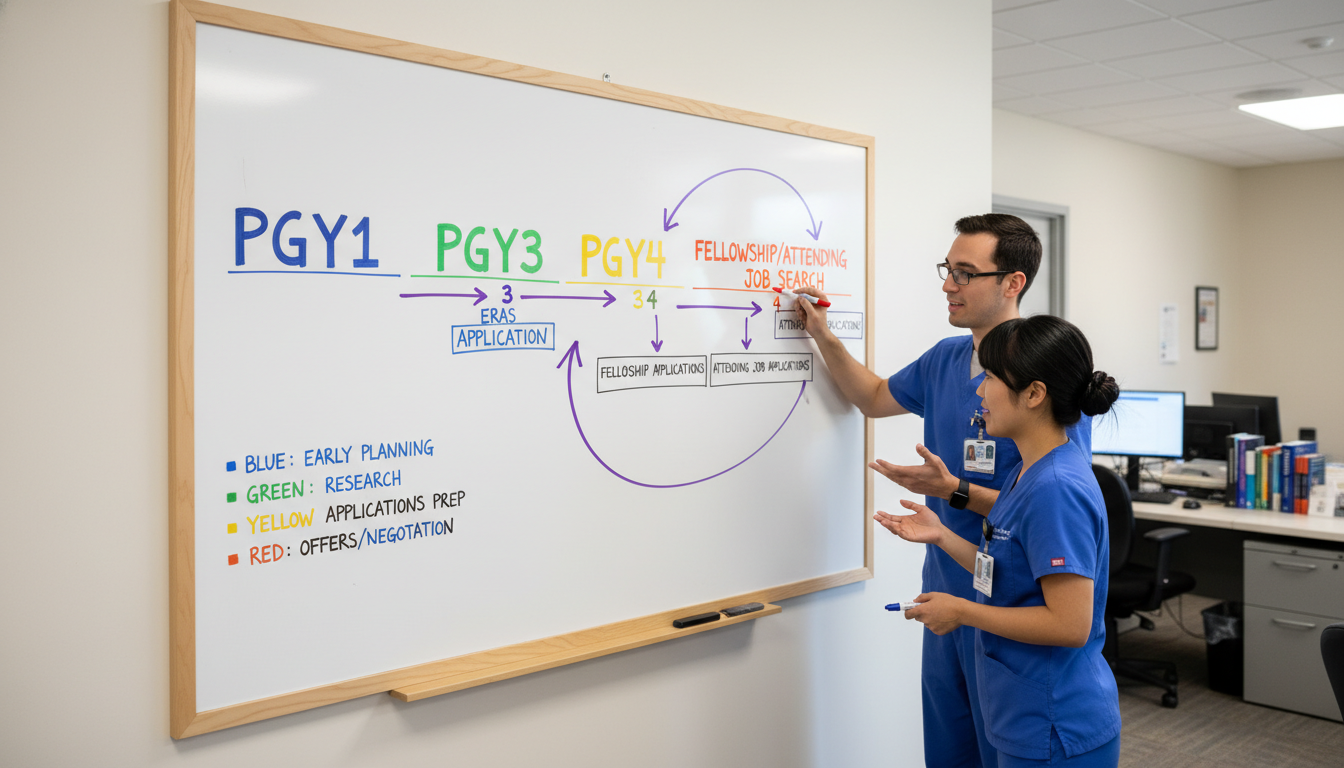
Below is a high-level overview, then we’ll break it down year-by-year.
PGY‑1 (Intern Year)
- Focus: clinical competence, reputation, understanding OB GYN lifestyle.
- Job search: almost none, except very light exploration and early networking.
PGY‑2
- Focus: consolidate skills, explore subspecialty interest.
- Job search: start thinking about career direction (academic vs community, fellowship vs generalist). Begin informal networking.
PGY‑3
- Focus: decide fellowship vs generalist path, clarify geography and job type preferences.
- Job search:
- For generalist OB GYN: begin structured search around 6–12 months before graduation (often late PGY‑3 to early PGY‑4).
- For fellowship-bound: begin exploring post‑fellowship job markets and networking in your target subspecialty.
PGY‑4 (Final Year of Residency)
- Focus: finalize job offers, contracts, and licensing steps.
- Job search: should be in full swing by early PGY‑4. Many residents sign by winter of PGY‑4 for summer/early fall start.
Fellowship Years
- 2–3 year fellowships (MFM, Gyn Onc, FPMRS, REI):
- High-level planning starts during first fellowship year.
- Active attending job search begins 12–18 months before fellowship graduation.
- 2–3 year fellowships (MFM, Gyn Onc, FPMRS, REI):
As a US citizen IMG, you should treat the earlier timing ranges as your target. You want more lead time to offset any unconscious bias and to take advantage of mentors and contacts.
PGY‑by‑PGY Guide: What To Do and When
PGY‑1: Build Foundations, Don’t Rush the Job Search
As an intern, your primary jobs are to:
- Become clinically solid and reliable.
- Build your reputation within your program.
- Observe real-life OB GYN practice models (call schedules, RVUs, night float systems).
Job search timing tasks in PGY‑1:
Clarify your long-term interests (very roughly).
Ask yourself:- Do I like high-acuity L&D and complex obstetrics?
- Am I drawn to surgery-heavy gynecology?
- Do I enjoy counseling and longitudinal care?
- Am I curious about research and teaching?
Start networking passively.
- Introduce yourself to attendings as someone interested in careers conversations (not asking for jobs yet).
- Attend departmental grand rounds and note which faculty are well-connected.
Track your experiences and early achievements.
- Keep a simple log: cases, QI projects, presentations, teaching.
- This becomes raw material for your future CV and job interviews.
What not to worry about yet:
- You do not need to contact recruiters.
- You do not need a polished CV or cover letter.
- You definitely shouldn’t feel behind if you haven’t thought about the physician job market yet.
PGY‑2: Early Strategy and Exposure
PGY‑2 is the right time to strategically observe and explore.
Core decisions to refine:
Fellowship vs generalist.
- Start exploring MFM, Gyn Onc, REI, FPMRS, MIGS, Complex Family Planning, etc.
- Talk to fellows and faculty in these areas.
- Consider lifestyle, call, long-term earning potential, and geographic flexibility.
Academic vs community vs hybrid.
- Academic: teaching, research, sub-specialty focus; potentially lower pay, more structure.
- Community/hospital-employed: solid compensation, high volume, less research.
- Private practice: variable; can be high-earning but demands business savvy.
Geographic preferences.
- Rank regions into: “Must-have,” “Nice-to-have,” and “Acceptable.”
- Remember the physician job market tends to be stronger outside of highly saturated coastal metros.
Targeted actions for PGY‑2:
Talk deliberately with your program leadership.
Ask:- “How have recent graduates fared in the obstetrics match for fellowships or job placement?”
- “Where are alumni working, and could you connect me with some?”
Attend career-focused sessions.
If your program or specialty society (ACOG, SMFM, SGO, etc.) offers career panels, go—and introduce yourself to speakers.Begin a professional CV.
Start early, update a simple Word or Google doc regularly. You don’t need perfection yet.
At this stage, you’re still not making cold calls to practices, but you’re laying the groundwork that will make PGY‑3 and PGY‑4 easier.
PGY‑3: The Year Job Search Timing Really Starts to Matter
PGY‑3 is the pivot year for timing your OB GYN residency-to-attending transition.
If You Plan to Practice as a Generalist Right After Residency
Ideal timeline:
Early PGY‑3 (summer–early fall):
- Clarify:
- Target regions (e.g., Midwest, Southeast, Pacific Northwest).
- Type of practice (hospital-employed, FQHC, private group, academic).
- Update your CV fully.
- Ask faculty if they’d be willing to serve as references.
- Clarify:
Mid PGY‑3 (late fall–winter):
- Begin light job market exploration:
- Browse large job boards (e.g., ACOG’s Career Center, PracticeLink, NEJM CareerCenter).
- Note salary ranges, call structures, sign-on bonus norms.
- Reach out to alumni in your target regions for “informational conversations,” not job asks yet.
- Begin light job market exploration:
Late PGY‑3 (spring–early summer):
This is when “when to start job search” becomes very real.- Start responding to postings with a short, professional email and attached CV.
- Consider contacting chosen health systems or practices directly even if no posting is visible; many have unadvertised or upcoming needs and recruit 6–12 months ahead.
- Engage with recruiters (hospital system recruiters or reputable physician search firms).
A reasonable goal: by the end of PGY‑3, you should have:
- A polished CV.
- A short professional summary paragraph or cover letter template.
- A sense of realistic salary/benefit expectations in your chosen regions.
- A list of 3–5 “priority markets” you’re actively exploring.
If You Plan to Apply for Fellowship
For fellowship-leaning residents, job search timing shifts:
- Primary focus in PGY‑3 is the fellowship applications/interviews.
- However, start thinking ahead to post-fellowship jobs:
- Ask fellows:
- “When did you start your attending job search?”
- “Did programs in your subspecialty recruit more than a year out?”
- Attend subspecialty society meetings and talk to faculty about market saturation and geographic hot spots.
- Ask fellows:
This early reconnaissance will save you time in your final fellowship year when you’re actively searching.
PGY‑4: From Exploration to Signing
By PGY‑4, your job search should move from “thinking and meeting” to “interviewing and negotiating.”
Approximate timing for a generalist OB GYN finishing residency in June:
July–September (early PGY‑4):
- Actively apply for positions with target start date of July–October the following year.
- Expect initial phone/virtual interviews with HR and clinical leaders.
- Start attending in-person interviews—often a full day, sometimes two.
October–January (mid PGY‑4):
- This is prime time for receiving and refining offers.
- Common timeline:
- Interview → verbal interest → formal offer letter within 1–3 weeks.
- Use this period to:
- Compare multiple offers.
- Request contract review by a healthcare attorney.
- Clarify call schedule, RVU expectations, tail coverage, and non-compete clauses.
January–March (late PGY‑4):
- Many residents try to sign by late winter, especially if relocation is involved.
- Once signed, start your state licensure and hospital credentialing process (can take 3–6 months).
- If moving, coordinate:
- House hunting or rental.
- Spouse/partner job search.
- Daycare/school if you have children.
April–June:
- Finish training strong and maintain professionalism; your residency references still matter.
- Complete licensure and credentialing paperwork aggressively to avoid start-date delays.
As a US citizen IMG, starting on the earlier side of this window (July–September) is wise to ensure you:
- Have enough offers to compare.
- Can mitigate any residual hesitancy from employers unfamiliar with IMG pathways (even though you are a US citizen).
- Avoid getting trapped into “take whatever is left” in late spring.
Fellowship Path: Timing for Subspecialty OB GYN Job Searches
If you complete fellowship (MFM, Gyn Onc, REI, FPMRS, MIGS, etc.), the job search timeline shifts earlier because:
- Academic departments may recruit 12–18 months ahead.
- There are fewer positions per region, and matching your interests (e.g., specific research area or procedural niche) can take longer.
For a 3-year fellowship finishing in June Year 3:
First Fellowship Year (Year 1):
- Focus: training, research, and defining your long-term niche.
- Job search: light; talk with faculty about where recent graduates have gone.
Second Fellowship Year (Year 2):
- Summer–Fall:
- Clarify priorities: academic vs hybrid vs high-volume community.
- Update CV with fellowship research, presentations, and procedures.
- Late Fall–Spring:
- Start exploratory conversations with division chiefs and department chairs at institutions of interest.
- Attend national meetings and actively network (e.g., SMFM, SGO, ASRM, AUGS). Bring copies of your CV.
- Summer–Fall:
Final Fellowship Year (Year 3):
- Summer–Fall (12–18 months before anticipated start):
- This is when to formally start your attending job search.
- Submit applications to posted positions and contact departments directly.
- Fall–Winter:
- Onsite interviews, departmental presentations, and negotiation.
- Winter–Spring (6–9 months before graduation):
- Aim to sign your contract, start licensure and credentialing.
- Summer–Fall (12–18 months before anticipated start):
As a US citizen IMG with U.S. fellowship training, you’re a very strong candidate. But starting early gives you leverage to find:
- A position that truly supports your research or procedural interests.
- Geographic options that fit your personal life.
Practical Strategies to Maximize Your Job Search as a US Citizen IMG
Beyond timing, your strategy should address the subtle challenges of being an American studying abroad who trained in the U.S.
1. Leverage Your Strengths, Don’t Hide IMG Status
By the time you’re on the attending job market, what matters most is:
- US ACGME residency (and fellowship, if applicable).
- Strong evaluations and references.
- Demonstrated teamwork and professionalism.
You can briefly frame your path this way in interviews:
“I’m a US citizen IMG who chose to study medicine abroad, then completed my OB GYN residency at [Program]. It gave me broad exposure to diverse health systems and patient populations, which I think strengthens my adaptability and cultural competence.”
Then pivot quickly to your U.S. clinical qualifications and productivity.
2. Use Alumni Networks Aggressively
For many IMGs, traditional “old boys’ club” networks are weaker. Counter this by:
- Asking your program director or department chair:
- “Could you connect me with alumni working in [Region or Practice Type]?”
- Contacting them with a focused email:
- 10–15 minutes of advice.
- Ask what their job search was like, what they wish they started earlier, and whether their institution is hiring.
Sometimes, these conversations quietly evolve into informal recruitment.
3. Approach Recruiters Strategically
Recruiters are most helpful if you:
- Know your non-negotiables (geography, minimum salary, call expectations).
- Are reasonably clear on timing (e.g., “I’m a PGY‑4 finishing June 2026; I’m seeking a hospital-employed OB GYN role in the Midwest with 1:4 or better call.”)
Avoid signing restrictive, exclusive agreements. Work with a few reputable firms and hospital-employed recruiters in parallel.
4. Understand Typical OB GYN Contract Features Before Negotiating
Before you start receiving offers (ideally by late PGY‑3 or early PGY‑4), learn the standard components:
- Base salary and duration of guaranteed period (often 1–2 years).
- Incentive structure (RVUs, quality metrics, call pay).
- Sign-on bonus and relocation assistance.
- Loan repayment options (particularly in rural/underserved settings).
- Non-compete clause details (distance and duration).
- Malpractice type and tail coverage responsibilities.
Understanding norms for your region helps you negotiate calmly and effectively, instead of scrambling to learn while under pressure.
Red Flags in Job Search Timing You Should Avoid
Starting the job search in February–March of your final year
- Risk: fewer positions, lost leverage, rushed evaluation of offers.
Not leaving enough time for state licensure
- Some states take 4–6 months for physician licensure. Delayed licensure can postpone your first paycheck.
Ignoring credentialing timelines
- Hospital privileging and insurance paneling also add weeks to months. Start as soon as you sign.
Waiting to see if fellowship applications work out before exploring jobs at all
- If you’re uncertain about fellowship or aiming for very competitive subspecialties, keep a parallel Plan B: light job searches or networking as backup.
Over-focusing on a single “dream city”
- Highly popular cities can have saturated OB GYN markets. Expand your geographic net early and only narrow if you truly find an ideal fit.
Putting It All Together: A Sample Timeline for a US Citizen IMG in OB GYN
Assume you’re a US citizen IMG matching into OB GYN residency in July 2025 and planning to be a generalist.
PGY‑1 (2025–2026):
- Build competence, reputation, and a basic CV.
- Start very light networking and career conversations.
PGY‑2 (2026–2027):
- Decide likely path (generalist vs fellowship).
- Clarify geographic preferences and practice style.
- Attend career events and talk with alumni.
PGY‑3 (2027–2028):
- Early year: polish CV, define target markets.
- Mid year: browse job boards, talk to recruiters and alumni.
- Late year (spring/summer 2028): begin responding to postings and doing early interviews.
PGY‑4 (2028–2029):
- Summer–Fall 2028: active interviews, site visits.
- Fall–Winter 2028–29: negotiate and sign.
- Early 2029: launch licensure and credentialing.
- July–September 2029: start as attending OB GYN.
If you pursue a 3-year fellowship afterwards, shift the “active attending job search” phase to 12–18 months before fellowship completion, but the principles stay the same.
FAQs: Job Search Timing for US Citizen IMG in OB GYN
1. As a US citizen IMG, should I start my OB GYN job search earlier than my non-IMG colleagues?
You don’t need a completely different timeline, but starting on the early side of the normal range is wise. For generalist jobs, begin structured searching around late PGY‑3 to early PGY‑4. For fellowship-trained roles, start 12–18 months before graduation. Extra lead time lets you build relationships and offset any unconscious IMG-related bias.
2. When should I start talking to recruiters and responding to job postings?
- Generalist out of residency:
- Initial browsing and light outreach in mid PGY‑3.
- More active applications by early PGY‑4 (about 9–12 months before you can start).
- Fellowship graduates:
- Begin outreach about 12–18 months before your desired start date.
3. How does my job search timing change if I’m unsure about doing a fellowship?
Keep two parallel tracks:
- Apply to fellowship according to subspecialty deadlines.
- Simultaneously use PGY‑3 to explore the physician job market—talk with recruiters and alumni, understand opportunities, and keep your CV ready. This way, if fellowship doesn’t work out or you change your mind, you’re not starting your job search from zero in late PGY‑4.
4. What’s the latest I can safely start my job search without risking unemployment after residency?
For most OB GYN residents, starting a serious search later than January–February of PGY‑4 is risky. You might still find work, but options narrow, and you may have to compromise significantly on location or job structure. Aim to be in active search mode by early PGY‑4, with contracts ideally signed by winter of your final year.
Timed well, your OB GYN job search can be a deliberate transition, not a last-minute scramble. As a US citizen IMG, you’ve already navigated complex systems to get into and through residency; channel that same planning mindset into your job search timeline, and you’ll be positioned to enter the attending job market with confidence and choice.