
Starting your career as a plastic surgeon is both exhilarating and high-stakes—especially as a US citizen IMG (American studying abroad) who has already navigated a more complex path into training. One of the most strategic decisions you’ll make after securing an integrated plastics match is when to start your job search and how to time each step.
This guide breaks down job search timing for plastic surgery residents from PGY-1 through fellowship and early attending life, with specific nuances and advice tailored to US citizen IMGs.
Understanding the Plastic Surgery Job Market Landscape
The physician job market in plastic surgery is very different from some other specialties. Timing your search correctly depends on understanding a few fundamentals.
1. Highly Regional and Network-Driven
Plastic surgery positions—especially aesthetic-focused roles—are often:
- Concentrated in metropolitan or affluent suburban areas
- Dominated by smaller practices or partnerships (vs large hospital systems)
- Filled based heavily on reputation, referrals, and word of mouth
For a US citizen IMG, this can be a double-edged sword:
- If you train in a strong US integrated plastics program, your attendings’ networks matter a great deal.
- If you’re geographically distant from where you want to practice, you’ll need to intentionally build connections in your target region much earlier.
2. Academic vs Private/Hybrid: Different Timelines
Your job search timing will differ by career path:
Academic Plastic Surgery
- Positions may be posted through:
- Institutional recruitment portals
- National societies (ASPS, ASAPS/ASAPS now The Aesthetic Society, ASSH, ASRM)
- Word of mouth from program directors and division chiefs
- Timelines:
- Often begin 12–18 months before graduation or fellowship completion
- Can still come together surprisingly late, but you should not rely on that
Private Practice / Private-Equity Backed / Group Practice
- Many jobs are:
- Never formally advertised
- Filled through alumni networks, conferences, fellowship connections
- Timelines:
- Core window is typically 9–18 months before you start
- Negotiations can take several months; credentialing and licensing add more time
3. Fellowship Considerations and How They Shift Timing
Many plastic surgeons pursue fellowship in:
- Aesthetic surgery
- Hand surgery
- Microsurgery / reconstructive
- Craniofacial
- Burn
Your job search could be:
- Fellowship-agnostic (securing a job that values your training but isn’t specific to the fellowship)
- Fellowship-specific (e.g., hand surgery position requiring CAQ hand, complex micro reconstruction role at cancer center)
As a US citizen IMG, if your integrated plastics match was at a US academic center, your U.S. training reputation will often outweigh your IMG status in the job search—especially after fellowship. But you must still be proactive and visible.
A Year-by-Year Timeline: When to Start Your Job Search
This section outlines the ideal timing roadmap from early residency to your first attending job, tailored to an integrated plastic surgery path.
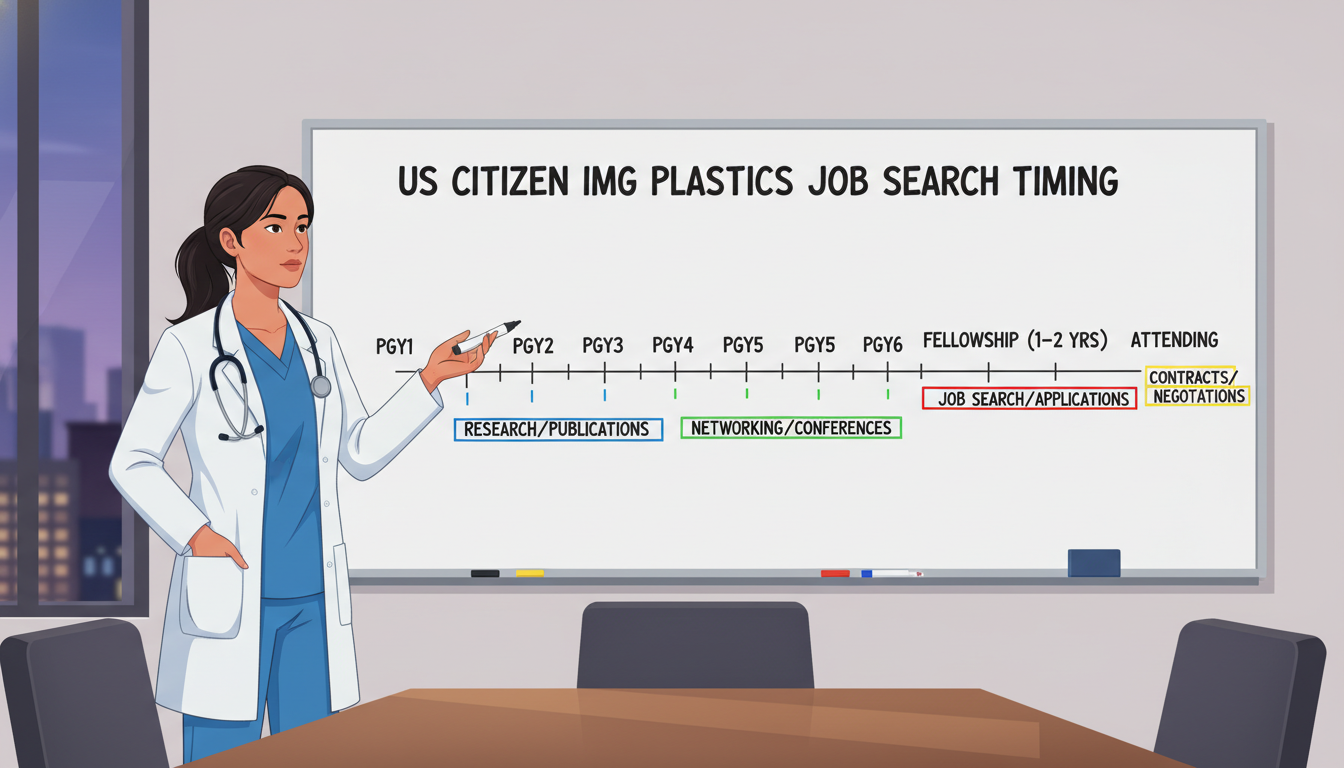
PGY-1 to PGY-3: Foundation and Visibility (Not Job Search Yet)
You are not actively job hunting at this stage, but you are building the platform that will make your eventual job search much more efficient.
Key goals:
- Clarify long-term interests:
- Aesthetics vs reconstructive vs hand vs micro vs academic vs private.
- Get involved in research that aligns with your potential niche.
- Attend national meetings (ASPS, The Aesthetic Meeting, regional society meetings) as soon as your program and finances allow.
- Network deliberately:
- Introduce yourself to faculty from programs/fellowships or regions where you might want to work.
- Maintain a simple spreadsheet of contacts, programs, and interests.
Timing actions:
- PGY-2–3: Start imagining where you might want to live/practice (coast, region, city size).
- PGY-3: Have at least one or two mentors who understand your long-term goals and can later advise on job search timing.
PGY-4 to PGY-5: Fellowship Decisions and Early Market Intel
This is when timing really starts to matter, especially if you are considering fellowship.
Step 1: Decide on Fellowship vs Direct-to-Practice
- Many integrated plastic surgery residents do at least one fellowship.
- For US citizen IMG residents, fellowship can:
- Enhance credibility and differentiation.
- Expand your network outside your residency institution.
- Smooth out any residual perceived bias tied to your IMG background.
Step 2: Learn the Job Market in Your Area of Interest
During PGY-4–5:
- Ask senior residents and recent graduates:
- When did they start their search?
- How many offers did they consider?
- How long did licensing and credentialing take?
- Start paying attention to:
- Job postings in your subspecialty
- Where graduates from your program are landing geographically
- Whether there is saturation in your target city (especially for pure aesthetics in popular metros)
You are still not formally applying to jobs, but you are scouting the field.
PGY-5–6 (Final Years of Residency): When to Start the Real Job Search
For an integrated plastics resident not doing fellowship, this is your critical window.
Target: Start Active Job Search 12–18 Months Before Graduation
- If you finish June 2028:
- Begin formal planning: July–December 2026 (PGY-5)
- Begin outreach and applications: January–June 2027
- Interviews: Mid-2027 onward
- Aim to sign a contract: By late 2027 to early 2028
Why so early?
- Plastic surgery hiring is slow and relationship-driven.
- Academic centers need budgeting and approvals, which can take 6–12 months.
- Private practices may want to meet you several times, including site visits and potential OR observation days.
For a US citizen IMG, early timing helps you:
- Compensate for any initial skepticism in crowded urban markets by showing you are serious, organized, and committed.
- Navigate any additional credentialing scrutiny that might appear from your foreign medical school (even though you are a US citizen).
Fellowship and Job Search Timing: Stagger or Combine?
If you are pursuing fellowship, your first attending job search typically starts during fellowship year—but smart candidates lay groundwork even earlier.

During Fellowship: Ideal Timeline
Assume a one-year fellowship ending July 2029. Here’s a practical breakdown:
12–15 Months Before Fellowship Ends (Late Residency, PGY-5–6)
- Finalize your fellowship choice and location.
- Begin identifying regions, health systems, and practices that align with your future goals.
- Ask your future fellowship director:
- How often fellows stay on as faculty or associates.
- Whether they can connect you with alumni in your desired region.
6–12 Months Before Fellowship Ends (Core Job Search Period)
This is the key window where you’re actively searching:
- Update your CV and create:
- A brief professional bio
- A one-page statement of practice interests (e.g., “aesthetic breast and body,” “complex micro/onc reconstructive,” etc.)
- Start reaching out to potential employers:
- Academic division chiefs
- Practice owners in target cities
- Hospital-employed groups
- Attend national meetings with a dual purpose:
- Present research.
- Hold informal job discussions, coffee meetings, and follow-up dinners.
Goal:
Secure serious leads and interviews 9–12 months before you plan to start, and aim to sign your first contract 4–8 months before your start date.
Staggered vs Combined Strategy
You have two main approaches:
1. Staggered Strategy (Fellowship First, Job Search Later in Fellowship)
- Focus completely on fellowship application and matching first.
- Once matched, use your fellowship year as your primary job search period.
- Best when:
- You’re still clarifying your niche.
- You might want to stay on at the fellowship institution or nearby.
2. Combined Strategy (Thinking About Job Targets Before or During Fellowship Match)
- You have a clear target city or practice style (e.g., “returning to Southern California to join an aesthetic practice”).
- You choose a fellowship deliberately in or near that market.
- You network during fellowship strategically with that region and practice type in mind.
For a US citizen IMG, the combined strategy can be powerful:
- It converts your fellowship into a year-long audition in your desired region.
- It leverages the prestige of your fellowship to neutralize any lingering bias about your international medical school.
Practical Timing Steps: From First Email to Signed Contract
Once you’re ready to actively job search, timing isn’t just about when to start—it’s about the sequence of steps.
1. 9–18 Months Before Start Date: Quiet Outreach and Exploratory Conversations
Actions:
- Email potential employers:
- “I am a PGY-5 integrated plastic surgery resident at [Institution], planning to complete [fellowship, if applicable] in [Month, Year]. I am interested in opportunities in [region/type of practice/clinical focus]. I’d appreciate the chance to learn more about your group’s structure and potential future openings.”
- Use:
- Program leadership
- Fellowship director
- Mentors and society contacts to facilitate warm introductions.
What you’re trying to accomplish:
- Discover unadvertised positions.
- Gauge whether a group might open a position for the right candidate.
- Identify where your skill set and goals align with a practice’s needs.
2. 6–12 Months Before Start Date: Formal Applications and Interviews
This is when the volume of activity is highest.
Tasks:
- Submit CV, cover letters, and recommendation letters (if requested).
- Schedule both video and in-person interviews.
- Visit ORs, clinics, and facilities.
- Ask specific timing-related questions:
- “When do you anticipate finalizing this hire?”
- “What is your typical timeline from verbal agreement to signed contract?”
- “How long does hospital credentialing usually take here?”
For US citizen IMGs:
- Be ready to supply extra documentation for credentialing:
- ECFMG verification (if used previously)
- Official transcripts/diplomas from your international medical school
- Start state medical license applications early—some states take 4–6 months.
3. 3–6 Months Before Start Date: Negotiation, Contracts, and Backup Plans
By this time, you should ideally:
- Have at least one strong offer or be in late-stage talks with 2–3 options.
- Be comparing:
- Compensation structure (base + productivity + bonus)
- Call expectations
- OR block time and clinic schedule
- Partnership track (if applicable)
- Non-compete clauses and relocation assistance
Timing considerations:
- Allow at least 2–4 weeks to review each contract with a health-care attorney.
- Some groups will apply pressure to sign quickly; protect yourself by:
- Clearly communicating your decision timeline.
- Avoiding exploding offers that require a same-week decision if possible.
Backup:
- Always maintain at least one alternate pathway (e.g., additional fellowship, research position, locums, or a different regional market) in case your primary plan unexpectedly collapses late in the process.
Special Considerations for US Citizen IMGs in the Plastic Surgery Job Market
Being a US citizen IMG means you’ve overcome major hurdles to secure an integrated plastics match. In the job market, your identity as a US-trained plastic surgeon usually carries more weight than where you went to medical school—but some subtleties still matter.
1. Control the Narrative Early
When discussing your background:
- Emphasize that you’re a US citizen IMG and a graduate of a U.S. integrated plastic surgery residency (and fellowship, if applicable).
- Frame your international medical education as:
- Evidence of adaptability.
- Broader cultural and global health exposure.
- A non-issue in light of your US training and board eligibility.
Be prepared to explain in a brief, confident way:
- Why you chose to study abroad as an American (often academic, personal, or financial reasons).
- How that experience has shaped your patient care and perspective.
2. Anticipate Extra Credentialing Steps
Some credentialing committees or hospital HR teams:
- May be less familiar with your international medical school.
- Might request additional verification, translations, or documentation.
Timing implications:
- Begin compiling your credentialing package 6–9 months before your planned start date:
- Certified translations (if any)
- ECFMG or equivalent verification documents
- Program completion letters
- Board-eligibility statements
3. Geographic Strategy and Timing
For US citizen IMGs, especially those from less well-known schools, your geographic flexibility and choice of training locations can heavily influence your first job options.
Strategic tips:
- Training and fellowships in the region where you’d like to practice usually give you a better shot at local jobs.
- If aiming for a highly competitive, saturated city (e.g., NYC, LA, Miami) for aesthetic practice:
- Start the job search earlier (12–18 months).
- Strengthen your brand with:
- Social media presence (if appropriate for aesthetic focus)
- Meeting presentations
- Faculty and fellowship endorsements
4. Leveraging Mentors Who Understand the IMG Experience
Seek at least one mentor who:
- Is an IMG themselves, or
- Has mentored US citizen IMGs through the integrated plastics match and job market.
Use them to:
- Reality-check your timeline (“Are you starting your search early enough for your target city and practice type?”).
- Review initial outreach emails and networking strategies.
- Practice answering sensitive questions about your background and training.
When to Start Job Search vs When to Start Job Planning
A common confusion for residents is mixing up job search timing with career planning timing.
- Career planning begins as early as PGY-1 or even medical school:
- Understanding the landscape.
- Identifying interests.
- Building a scholarly and professional profile.
- Actual job search (emails, interviews, negotiations) typically begins:
- 12–18 months before you want to start working as an attending in plastic surgery.
To summarize for a US citizen IMG in integrated plastics:
| Stage | Approx Year | Main Task |
|---|---|---|
| PGY-1–3 | Early residency | Build skills, research, network; no active job hunt |
| PGY-4–5 | Mid residency | Decide on fellowship, scout job market |
| PGY-5–6 (no fellowship) | Final years | Start active search 12–18 months before graduation |
| Fellowship year (if any) | Last trainee year | Core job search period, 6–12 months before end |
| 3–6 months before start date | Late in process | Finalize contract, credentialing, relocation |
If you’re uncertain whether to start now or wait:
- Ask seniors who graduated 1–3 years ahead of you in similar pathways and locations.
- Err on the side of starting earlier, especially for academic roles or highly desirable metro aesthetic jobs.
FAQs: Job Search Timing for US Citizen IMG in Plastic Surgery
1. As a US citizen IMG in an integrated plastics program, when should I start my job search if I’m not doing a fellowship?
Begin actively searching and contacting potential employers 12–18 months before your planned graduation. That means starting serious outreach in your final 1–1.5 years of residency—not waiting until a few months before finishing. Use your PGY-4–5 years to clarify goals, then move into direct outreach, interviews, and visits across PGY-5–6.
2. How does timing change if I’m doing a fellowship after integrated plastic surgery?
If you add a one-year fellowship, your primary job search window shifts to your fellowship year. Start serious outreach and applications 6–12 months before your fellowship ends. However, planning starts much earlier: be strategic in selecting fellowship programs and locations that align with your long-term job goals. Ideally, you’ll secure a signed offer 4–8 months before your start date as an attending.
3. As an American studying abroad, will my IMG background delay my ability to get a job compared with US MD/DOs?
Once you’ve completed a US integrated plastic surgery residency (and possibly fellowship), employers typically focus far more on your US training pedigree, references, and skill set than on your foreign medical school. That said, state licensing boards and hospital credentialing offices may require more documentation and verification from IMGs. This doesn’t usually block your job search, but it does mean you should initiate licensing and credentialing steps earlier (6–9+ months before your start date).
4. When should I start my attending job search if I know I want to work in a very competitive city (e.g., Los Angeles, New York, Miami) focused on aesthetics?
In highly saturated aesthetic markets, it’s wise to start earlier and more deliberately:
- Begin exploring opportunities and making contacts 18–24 months before your planned start date.
- Choose fellowship training in or near that city if possible, to spend a year networking and building presence.
- Have serious employment discussions and interviews 12–18 months before your desired start.
For a US citizen IMG, this early and intentional timing helps you stand out based on your skill set, branding, and relationships rather than purely on paper metrics.
By linking clear timing milestones to your training path and by proactively managing the extra details that come with your US citizen IMG background, you’ll transform an uncertain process into a structured, strategic transition from resident to attending in plastic surgery.