
Understanding the Job Search Timeline for US Citizen IMGs in Neurosurgery
For a US citizen IMG (American studying abroad) who has successfully matched into a neurosurgery residency, the job search after training is both exciting and uniquely challenging. Neurosurgery is a small, highly specialized field with a limited number of openings each year. On top of that, your background as a US citizen IMG can influence where you are most competitive and what kinds of institutions are most open to your application.
This article focuses specifically on job search timing—when to start, how fast to move, and how to align your decisions with fellowship plans, boards, and personal life. It is written for neurosurgery residents and fellows who trained as US citizen IMGs, but most principles apply broadly across neurosurgery.
We will cover:
- The structure of the neurosurgery training pathway and how it shapes your timeline
- When to start job searching for different career paths (academic, private practice, hybrid)
- How being an American studying abroad affects your attending job search
- Key milestones from PGY-4 through your first attending contract
- Practical strategies to stay competitive in the physician job market
Overview of Neurosurgery Training and Career Pathways
Before getting precise about when to start the job search, you need a clear sense of where you’re going and how training is structured.
The Neurosurgery Training Pathway
Most US neurosurgery residencies:
- Are 7 years long (PGY-1 through PGY-7)
- Include 1–2 years of research or enfolded fellowship
- Lead to eligibility for the ABNS (American Board of Neurological Surgery) board exam
Common post-residency paths:
- Direct-to-practice attending (no additional fellowship)
- One or more fellowships, e.g.:
- Spine
- Vascular/endovascular
- Functional/epilepsy
- Pediatrics
- Tumor/skull base
- Neurocritical care
- Hybrid: Partial fellowship + early attending role (e.g., junior faculty with protected fellowship-type training)
Each of these alters when you should start your job search and what signals you need to show to employers.
Career Settings That Shape Timing
Your job search strategy and timing will depend on the type of practice you aim for:
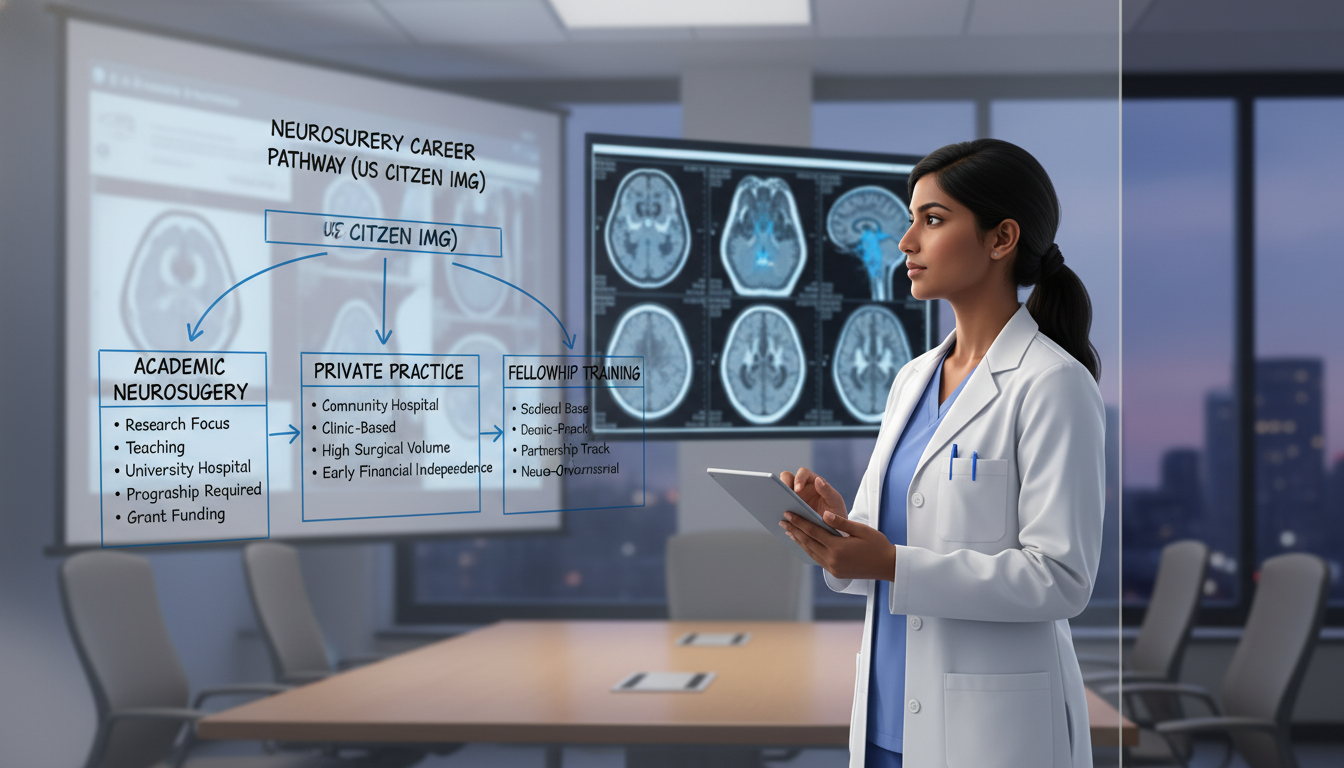
Academic neurosurgery (university/academic medical center)
- Focus: Research, teaching, subspecialty care
- Longer lead time for hiring, slower HR processes
- Heavy emphasis on publications, subspecialty training, and references
Private practice neurosurgery
- Focus: Clinical productivity, spine, community needs
- Variable timing; many opportunities arise closer to your graduation date, but early networking helps.
Hybrid / community academic / large multispecialty groups
- Mix of teaching, high-volume clinical work, and some research
- Timing similar to private practice, with some academic-style planning
As a US citizen IMG, you generally do not face visa-related delays, which is a major advantage in the physician job market. However, some academic institutions may weigh your foreign medical school differently, especially for research-heavy roles. This underscores how important your US-based performance during residency becomes.
When to Start Job Searching: A Year-by-Year Guide
A central question for many residents is: When should I start my job search? That answer changes as you progress through training.
PGY-1 to PGY-3: Lay the Foundation, Don’t Chase Jobs Yet
In the early years:
- Focus on clinical excellence, operative skills, and being reliable.
- Build your reputation at your home program; your PD and chair will later be your strongest advocates.
- Begin identifying what you enjoy:
- Complex spine vs cranial
- Vascular vs tumor vs functional vs peds
- Love for research vs pure clinical care
Job search timing implications:
- You are not yet actively searching for attending positions.
- However, you are actively building your future competitiveness:
- Start research projects
- Join national neurosurgical societies (e.g., AANS, CNS)
- Attend at least one national meeting by PGY-3 if possible
- As a US citizen IMG, this is your chance to demonstrate that any perceived gap from training abroad is more than overcome by your performance in US residency.
PGY-4 to PGY-5: Decide on Fellowship vs Direct Practice
These are decision years. The choices you make now will drive the job search timeline later.
Key tasks in PGY-4 to PGY-5:
Clarify your subspecialty interest
- Do you intend to be a “general neurosurgeon” in a community setting?
- Or a subspecialist (e.g., endovascular, complex spine, functional)?
Decide on fellowship training
- Many academic and high-end positions expect at least one fellowship.
- Certain subspecialties (e.g., pediatrics, endovascular, functional) are difficult to practice safely without fellowship-level training.
- For community spine-focused roles, some residents go directly into practice, especially if they have strong operative exposure.
Optimize for future letters
- Identify mentors whose recommendations will be impactful for both fellowship and job search.
- Make sure they see your operative skill, work ethic, and professionalism.
Timing for decisions:
- For those planning a fellowship, you will often:
- Start preparing applications during PGY-4 or early PGY-5
- Interview through PGY-5
- Finalize fellowship offers by late PGY-5 or early PGY-6
This means you often won’t seriously start your attending job search until you are well into fellowship (or later residency if no fellowship). But you should already be aware of the neurosurgery job market and your long-term geographic preferences.
PGY-6 to PGY-7 (Final Years of Residency): Active Job Market Awareness
Whether you go straight into practice or plan a fellowship, the last 1–2 years of residency are crucial.
If you are going directly into practice (no fellowship):
When to start job search:
- Begin serious exploration 12–18 months before graduation (early to mid-PGY-6 for 7-year programs).
- Start sending CVs and expressing interest 9–12 months before graduation.
- Aim to have a signed contract 6–9 months before you finish residency.
Why so early?
- Neurosurgery hiring may involve:
- Multiple site visits
- Hospital board or system-level approval
- Negotiations about block time, call, and support staff
- Some private practices only know their needs less than a year out, but academic centers and health systems often plan earlier.
- Neurosurgery hiring may involve:
If you have a confirmed fellowship after residency:
- You will have:
- 7 years of residency + 1–2 years fellowship
- Your attending job start date is 1–2 years later than graduation from residency.
- When to start job search (for your first attending role):
- Begin active planning toward the end of residency or early fellowship, but most interviewing happens mid-fellowship, about 12–18 months before you plan to start as an attending.
- Example:
- Finish residency: June 2027
- One-year spine fellowship: July 2027–June 2028
- Target attending start: August 2028
- Start outreach to jobs: Late 2026/early 2027 for initial networking;
serious search around summer/fall 2027 (early fellowship year). - Aim to sign a contract by early 2028.
For both paths:
- Use PGY-6 and PGY-7 to:
- Refine your CV and case log
- Collect and update letters of recommendation
- Clarify geographic and practice-type preferences
Fellowship, Boards, and Contracts: How They Interact With Timing
Your job search must sync carefully with board eligibility, fellowship timing, and contract details.
Board Eligibility and Certification
Neurosurgery employers care about:
- Board-eligible (BE): You have completed an ACGME-accredited residency and can sit for the ABNS exam.
- Board-certified (BC): You have passed the ABNS exams and completed the certification process.
Most first attending jobs hire you as BE, expected to become BC within a specified time frame.
Timing implications:
- You typically sit for the primary ABNS exam within 1–2 years after training.
- Many contracts:
- Require BE at the time of hire, and
- Require BC within a set number of years.
- Therefore, when negotiating and deciding when to start job search, be transparent about:
- Your anticipated board exam date
- Any delays or special circumstances
Fellowship Start and End Dates
If you are doing a fellowship:
- Jobs want clear information:
- Fellowship type
- Location and prestige
- Start and end dates
- Expected case mix and competence you will gain
Employers planning a subspecialty service line (e.g., complex spine or functional) may time their recruitment around your fellowship completion. Start conversations before fellowship ends—ideally 9–18 months before your intended attending start.
Contract Timelines
In neurosurgery, the contract process can be lengthy:
- Initial conversation → screening interview: 2–4 weeks
- First visit → second visit: 1–3 months
- Contract draft → negotiation → final signature: 1–3 months (sometimes longer in academics)
This means that if you wait until 3 months before graduation to start looking, you may:
- End up rushed
- Have fewer options
- Lose negotiating leverage
For most neurosurgeons, especially those in demand (e.g., spine, vascular, functional), the market is favorable—but poor timing can still limit your choices.
Strategic Considerations for US Citizen IMGs in the Neurosurgery Job Market
Your status as a US citizen IMG (American studying abroad) creates a distinct profile:
- No visa sponsorship needed (a big plus)
- Foreign medical degree, which some elite academic centers may interpret as a mild disadvantage compared to US MD/DO grads—unless offset by US residency performance and academic productivity
How Being a US Citizen IMG Affects Job Search Timing
Advantages:
- No visa-related delays in the job search timeline
- Some health systems and private practices favor candidates who do not need H-1B or J-1 waivers, simplifying onboarding
- You can pursue jobs in rural, suburban, or urban settings without immigration constraints
Challenges:
- Certain elite academic programs may scrutinize:
- Where you did medical school
- The strength of your research portfolio
- To compete for top-tier academic neurosurgery positions:
- Begin building a research track early in residency
- Attend national meetings, present abstracts, and publish
- Start informal networking at least 2–3 years before your attending job search
Timing action items for US citizen IMGs:
- PGY-3/4: Identify whether you’re aiming academic vs community.
- PGY-4/5: If academia:
- Intensify research output
- Build long-term mentorship with well-known neurosurgeons who can vouch for you
- PGY-5/6: Start discreet discussions with potential departments where you might like to work, especially if you’ve published or rotated with them.
Geographic Flexibility and Timing
The physician job market for neurosurgery varies significantly by region:
- Major coastal academic centers: Very competitive; recruit years in advance.
- Large community hospitals / regional systems: Regular but fewer openings; plan 9–18 months ahead.
- Rural / underserved areas: Often very eager to hire; may be more flexible on timing and negotiation.
If you have Rigid geographic preferences (e.g., “must be in New York City”), you’ll need:
- To start networking and research earlier
- To be prepared for a prolonged job search
- Possibly to accept trade-offs in salary or case mix
If you are more flexible geographically:
- You can often find competitive, well-compensated positions closer to your planned start date, especially in the Southeast, Midwest, and some Western states.
Practical Timeline: Month-by-Month Roadmap to Your First Attending Job
This section offers a sample roadmap for a neurosurgery resident who is a US citizen IMG, planning one year of fellowship followed by an attending position. Adjust the dates to match your actual training end.
Assume:
- Finish residency: June 2027
- Fellowship: July 2027 – June 2028
- Attending job start: August 2028
24–30 Months Before Attending Start (Mid–Late PGY-5)
- Clarify your subspecialty interest (e.g., spine, vascular, tumor).
- Confirm whether you’ll pursue fellowship; begin looking at programs.
- Update your CV with:
- Publications
- Presentations
- Major cases and leadership roles
- Start informal conversations with mentors about long-term career goals (academic vs private, type of hospital, location preferences).
18–24 Months Before Attending Start (PGY-6)
- Apply to fellowships (if not already settled).
- Attend at least one national meeting and:
- Visit booths for hospital systems and large neurosurgical groups
- Introduce yourself to chairs/section chiefs from programs of interest
- As a US citizen IMG, use this time to demonstrate your US-based strength:
- Present posters/oral presentations
- Network with people who may later interview you
15–18 Months Before Attending Start (End of Residency / Early Fellowship)
- Finalize fellowship choice and sign your fellowship contract.
- Start structured exploration of the job market:
- Decide on preferred regions (e.g., Northeast, Southeast, Midwest).
- Research salary benchmarks and call responsibilities for neurosurgery in each region.
- Start drafting a list of:
- 10–20 target institutions or groups
- Key contacts (chairs, chiefs, practice managers)
12–15 Months Before Attending Start (Early Fellowship)
Begin active outreach:
- Send customized emails with CV and short cover letter to department chairs or practice managers.
- Reach out to alumni from your residency or fellowship program.
Register with 1–2 reputable neurosurgery-focused recruiters (optional, but many neurosurgeons find them helpful).
Start taking screening calls and initial interviews.

9–12 Months Before Attending Start (Mid-Fellowship)
Visit top 3–6 sites for in-person interviews.
Evaluate:
- OR block time
- Call schedule
- Subspecialty support (e.g., interventional neuroradiology, neuro-oncology)
- Infrastructure (ICU, APP support, clinic space)
For academic roles, clarify:
- Research time
- Start-up funding
- Expectations for grants and publications
Begin negotiations with your top 1–3 choices:
- Salary and bonus structure
- Call differential
- Partnership track (if private practice)
- Non-compete clauses
- Support for board preparation and CME
6–9 Months Before Attending Start (Late Fellowship)
Aim to sign a contract by this window.
Start:
- Licensing applications in the state you’ll work
- Hospital credentialing paperwork
- Malpractice coverage arrangements (often through employer)
Confirm start date and expectations for:
- Clinic ramp-up
- OR scheduling
- Marketing/introductions to referring physicians
3–6 Months Before Attending Start
- Finalize:
- Board exam registration timeline
- Moving logistics
- Orientation schedule
- Maintain communication with your future employer:
- Request case lists from your future institution to understand typical volume.
- Discuss early-career support and mentorship (especially important as a new attending).
Frequently Asked Questions (FAQ)
1. When should I start my job search if I’m going directly into practice after neurosurgery residency?
If you are going straight into a brain surgery residency–to-attending path without fellowship:
- Begin serious market exploration around 18 months before graduation (early PGY-6 in a 7-year program).
- Start applying and interviewing 9–12 months before graduation.
- Aim to sign a contract 6–9 months before you finish residency.
This gives enough time for site visits, negotiations, and credentialing without rushing your decisions.
2. Does being a US citizen IMG change when to start the job search?
The timing is similar to US MD/DO graduates, but there are a few nuances:
- You have an advantage in not needing visa sponsorship, which can speed hiring.
- You may need slightly more time and strategic networking if you are targeting elite academic positions, where research output and US training reputation matter a lot.
- Start building your academic profile earlier (PGY-2/3) if you intend to go into academia, so by the time you begin your job search (PGY-6/fellowship), your CV is strong.
3. When should I start an attending job search if I’m doing a neurosurgery fellowship?
Plan the attending job search based on your final training end date, not just residency:
- For a one-year fellowship:
- Start structured exploration around 18 months before fellowship ends (late residency / early fellowship).
- Begin serious applications and interviews 12–15 months before your intended attending start.
- Aim to sign a contract 6–9 months before starting as an attending.
The key is to let employers plan their service lines around your subspecialty skills and availability.
4. How does the neurosurgery physician job market look for US citizen IMGs?
The neurosurgery physician job market remains favorable overall because:
- Neurosurgeons are in chronic short supply, especially outside major metro academic centers.
- Community and regional hospitals often strongly prefer neurosurgeons who do not require visas, giving US citizen IMGs a meaningful edge.
However:
- The most competitive urban academic positions can be tight, and they heavily weigh research output and residency pedigree.
- To maximize your opportunities:
- Develop a clear clinical niche (e.g., complex spine, functional, tumor).
- Maintain strong professional relationships with mentors who can advocate for you.
- Start networking and planning your job search earlier than you think you need to—especially if your geographic preferences are narrow.
By aligning your job search timing with your neurosurgery training milestones, fellowship plans, and long-term goals, you can enter the attending workforce with confidence and control. As a US citizen IMG, your path may have begun overseas, but your performance and planning during residency and fellowship will define your trajectory in the US neurosurgery landscape.