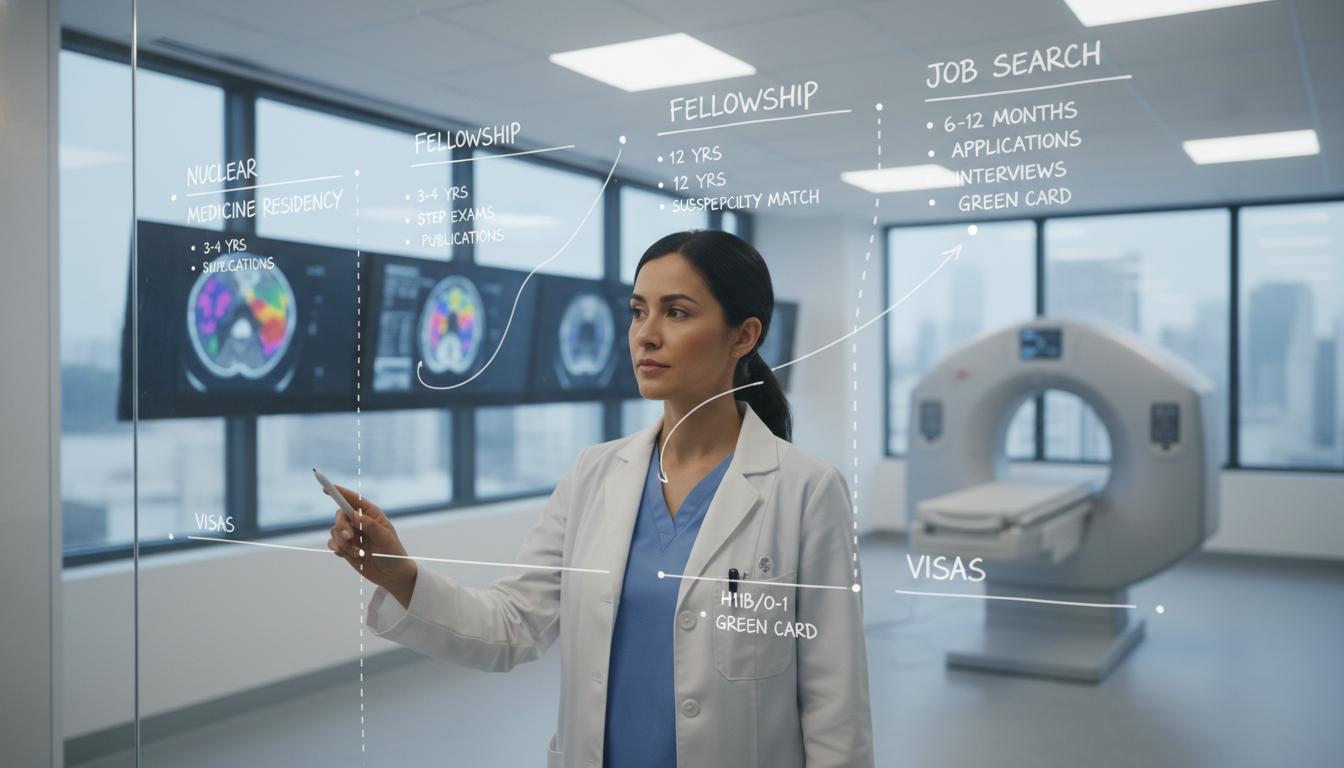
Navigating the physician job market in the United States is challenging for any resident—but as a non-US citizen IMG in neurology, timing your job search correctly is absolutely critical. Your visa status, training timeline, neurology residency demands, and neuro match history all intersect in ways that make planning essential.
This guide focuses entirely on when to start your job search, what to do at each stage, and how to avoid timing mistakes that can cost you strong offers—or even your ability to stay in the U.S.
Understanding Your Timeline: Training, Visas, and the Neurology Job Market
Before deciding when to start your job search, you need to clearly map out three timelines and how they interact:
- Residency/Fellowship timeline
- Immigration/visa timeline
- Physician job market timing in neurology
1. Residency and Fellowship Milestones
For most neurology residents (including foreign national medical graduates), the core structure looks like:
- PGY-1: Internal medicine prelim or transitional year
- PGY-2 to PGY-4: Adult neurology residency
- Optional PGY-5+: Neurology fellowship(s) (stroke, epilepsy, neurophysiology, movement disorders, neurocritical care, etc.)
Key dates you must know:
- Residency start date: Usually July 1
- Residency end date: Typically June 30 of PGY-4 year
- Fellowship start/end dates: Typically July 1 to June 30
Your job search timeline is always anchored to the end date of your last ACGME-accredited training program (residency if you stop there, or fellowship if you continue).
2. Visa Status and Its Impact on Timing
As a non-US citizen IMG, your job search timing is heavily shaped by your visa type:
J-1 visa (ECFMG-sponsored)
- You are subject to home-country physical presence requirement (2-year rule) unless you obtain a waiver.
- If you plan to stay in the U.S. and work clinically, you will likely need a J-1 waiver job (e.g., Conrad 30, Appalachian Regional Commission, Delta Region, DoD waiver, etc.) and then H-1B.
H-1B visa (residency/fellowship)
- You may continue on H-1B in your attending role, but timing depends on cap-exempt vs. cap-subject employers.
- Academic institutions and some health systems are cap-exempt, allowing more flexible timing.
- Private groups and some hospitals may be cap-subject, tying your job start to the H-1B lottery and October 1 start date.
Other pathways
- O-1 (extraordinary ability) or green card routes change your flexibility but still interact closely with job start dates and sponsorship.
Because of this, your job search is not just about finding a job; it is about finding a job that fits your visa strategy and can be timed correctly with immigration processes.
3. The Neurology Physician Job Market
The neurology job market is generally favorable:
- High demand for neurologists, especially in:
- Stroke neurology
- Neurohospitalist roles
- General neurology in community settings
- Regions outside large metropolitan areas
- Less saturated than some other specialties, but:
- Academic jobs (highly specialized or research-heavy) may be more competitive
- Desirable locations (coasts, large cities) can still be competitive
This means:
- You can often secure a job even if you start the search later.
- But as a non-US citizen IMG, the visa factor means you should usually start earlier than your US citizen peers.
Core Rule: When to Start Your Job Search as a Non-US Citizen IMG in Neurology
For most neurology residents and fellows, a reliable rule of thumb is:
Start serious job search activities 18–24 months before your intended start date as an attending, with earlier leaning strongly preferred for J-1 visa holders.
General Timeline by Training Stage
Assuming you will finish all training in June Year X:
24–20 months before end of training (Approx. August–December of PGY-3 for residents, or summer of penultimate training year for fellows):
- Start researching the job market, understanding visa options, clarifying goals, and building your CV.
18–15 months before (Approx. January–March of PGY-3; early final fellowship year):
- Begin actively searching for positions, networking, and contacting recruiters, especially if you will need a J-1 waiver or cap-subject H-1B.
15–12 months before:
- Actively apply, interview, and narrow down job options.
- For J-1 waiver jobs, this is often the critical window to secure a qualifying position.
12–9 months before:
- Negotiate and sign contract for most jobs.
- Complete institutional credentialing, licensing, and start immigration paperwork (waivers, H-1B, etc.).
9–0 months before:
- Finish licensure, DEA, hospital privileges, and final immigration steps.
- Prepare for transition to independent practice.
This might feel “too early,” especially during a busy neurology residency or fellowship, but starting early grants you:
- More job options
- Better leverage in negotiation
- Time to fix visa/waiver problems
- Less stress in your final year of training
J-1 vs H-1B: How Visa Type Changes Your Job Search Timing
As a foreign national medical graduate, your visa type is the single most important factor that changes when to start your neurology job search.
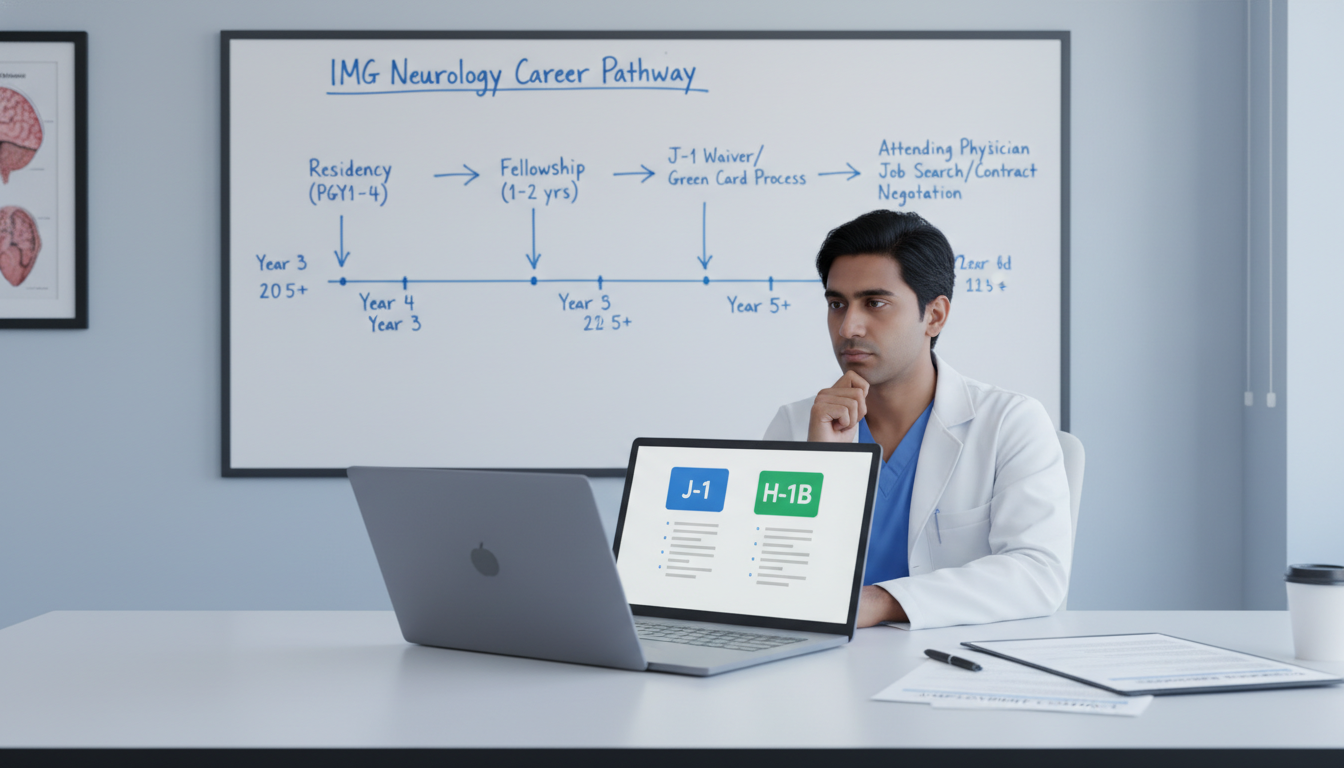
Job Search Timing for J-1 Visa Neurology Residents/Fellows
If you are on a J-1 visa, you almost always need a J-1 waiver job to remain in the U.S. in a clinical role. That constraint tightens your timeline.
1. Understanding J-1 Waiver Programs
Typical waiver options for neurologists:
- Conrad 30 (state-based, 30 slots per state per year; usually primary care is prioritized, but neurology often qualifies as a needed specialty especially in underserved or rural areas)
- ARC/Delta waivers (regional programs)
- VA or DoD positions (special federal pathways)
- Some federal shortage area programs
These programs have:
- Application windows and deadlines
- Location requirements (often rural or underserved)
- Specific employer and contract requirements
- Limited annual numbers (highly variable by state)
Because of this, if you are J-1:
Start exploring waiver options at least 24 months before your training end date.
This includes:
- Talking with current and past J-1 neurology graduates
- Meeting with an immigration attorney early
- Reviewing which states and regions are more IMG- and waiver-friendly
- Understanding which states favor neurology as a shortage specialty
2. J-1 Timeline Example
Assume you finish a vascular neurology fellowship June 30, 2027, on a J-1 visa:
July–October 2025 (24–20 months before):
- Clarify: Do you want to stay in the U.S.?
- Research states with strong Conrad 30 programs for neurology.
- Start tracking state waiver application open dates for 2026–2027.
November 2025–March 2026 (20–15 months before):
- Begin contacting employers in underserved areas that may sponsor J-1 waivers.
- Connect with recruiters who specialize in J-1 neurology placements.
- Prepare your CV, reference list, and talking points about your fit for underserved work.
Spring–Summer 2026 (15–12 months before):
- Interview and seek verbal commitments from waiver-eligible employers.
- Ensure contracts and job descriptions meet the state’s specific waiver criteria.
Fall 2026 (9–6 months before):
- Employer files for J-1 waiver once state application window opens.
- State forwards approved cases to the Department of State; DOS then to USCIS.
- Parallel planning for H-1B after waiver approval.
In this timeline, if you start job search activities only 9–12 months before graduation (like many US grads do), you may miss your waiver window and be forced to leave the U.S. for 2 years.
Job Search Timing for H-1B Neurology Residents/Fellows
If you are already on an H-1B visa during residency or fellowship:
- You may continue with the same or new employer, but timing depends on:
- Cap-exempt vs cap-subject status
- Remaining H-1B years available
1. Cap-Exempt vs Cap-Subject
Cap-exempt: Universities, affiliated teaching hospitals, some nonprofit institutions
- Can file H-1B any time of the year
- No lottery
- Very helpful for timing flexibility
Cap-subject: Many private practices, some community hospitals
- H-1B applications must be filed during the H-1B cap season (usually March)
- If approved, H-1B start date is October 1, which may not match your July 1 availability
Because of this:
- If moving from cap-exempt to cap-subject, start your job search at least 18–24 months before training end.
- If staying within the cap-exempt world (academic neurology, some large systems), you have more flexibility, but still should aim for 12–18 months before.
2. H-1B Timeline Example
You finish neurology residency June 30, 2026, on an H-1B at a university program:
Summer–Fall 2024 (24–21 months before):
- Decide: academic vs community vs private neurohospitalist role.
- Clarify if potential employers are cap-exempt or cap-subject.
Early 2025 (18–15 months before):
- If aiming for a cap-subject job, you may need to:
- Match job start to an October 1 date
- Or use cap-exempt-to-cap-exempt transfer initially, then move later
- Start applying and interviewing.
- If aiming for a cap-subject job, you may need to:
Mid to Late 2025 (12–9 months before):
- Sign a contract.
- Employer prepares H-1B petition and, if cap-subject, targets the next lottery cycle.
Failing to align your job search with the H-1B cap season can lead to delayed start dates or inability to work despite completing training.
Month-by-Month Job Search Roadmap for Neurology IMGs
Below is a more granular roadmap focused on when to start each step of your neurology attending job search as a foreign national medical graduate.
Assume you finish all training (residency or final fellowship) on June 30, Year X.
24–18 Months Before Graduation (Early PGY-3 or Early Final Fellowship – Exploration Phase)
Goals:
- Understand the physician job market in neurology
- Clarify your career direction
- Map out your visa strategy
Key actions:
Meet with:
- A trusted immigration attorney
- Program leadership or mentors familiar with non-US citizen IMG issues
- Recent neurology graduates who were J-1 or H-1B
Clarify:
- Academic vs community vs private practice
- Hospital-employed vs group-employed
- Subspecialty vs general neurology vs neurohospitalist
- Geographic priorities (and which states are more IMG/waiver friendly)
Start a job search tracker spreadsheet:
- Columns for potential employers, location, visa sponsorship, waiver friendliness, contacts, deadlines, and notes.
If you ask “when to start job search?” the honest answer, as a non-US citizen IMG in neurology, is here—not in your final year.
18–15 Months Before Graduation – Active Preparation and Soft Outreach
Goals:
- Build a polished, targeted CV and cover email
- Begin networking and informal conversations
- Identify neurology positions or departments aligned with your visa needs
Key actions:
Update CV focusing on:
- Neurology rotations and electives
- Subspecialty exposure (stroke, EMU, ICU, movement, etc.)
- Research, QI projects, teaching roles
- Any leadership, committee, or patient safety work
Prepare a concise email template to send to potential employers, including:
- Your current training status and neurology focus
- Expected completion date
- Visa type and needs (explicitly)
- Highlight of skills (e.g., stroke call, EMU experience, EEG interpretation)
Start soft outreach:
- Email departments in your preferred regions
- Connect with alumni from your program working in your target states
- Attend neurology conferences (AAN, subspecialty meetings) with job search in mind
For J-1 residents, this is a crucial time to start evaluating which states routinely sponsor neurology J-1 waivers and what their timing looks like.
15–12 Months Before Graduation – Full-Scale Job Search
Goals:
- Enter the application and interview phase
- Narrow down realistic options that meet your visa and career criteria
Key actions:
Actively apply for:
- Hospital-employed general neurology or neurohospitalist positions
- Academic faculty positions if aiming for that track
- Stroke, epilepsy, or other subspecialty roles if you have fellowship training
Clarify visa issues early in conversations:
- “I am on a J-1/H-1B and will require a J-1 waiver/H-1B sponsorship; is this something your institution supports for neurology?”
Attend interviews:
- Discuss neurology clinical load, call schedules, EMR, stroke center designation, tele-neurology options, etc.
- Also discuss: experience with J-1 waivers or H-1B sponsorship for neurologists.
For J-1 residents, you should have at least one to two serious waiver-eligible leads by 12 months before graduation.
12–9 Months Before Graduation – Decision and Contract Phase
Goals:
- Choose an employer
- Secure a signed contract
- Launch waiver and/or H-1B processes
Key actions:
Compare offers:
- Compensation, workload, call, benefits
- Academic vs community responsibilities
- Location and long-term visa/green card pathways
Negotiate (within reason):
- Consider sign-on bonus, relocation, CME, non-compete terms, and scheduling.
Confirm immigration steps with the employer:
- J-1 waiver process and state deadlines
- H-1B petition timeline and cap issues
- Any institutional attorney support
For J-1 candidates, a delayed contract can mean missing a waiver window, so do not wait until the last few months to make decisions if possible.
Special Considerations: Academic Neurology, Fellowships, and Changing Directions

Academic Neurology Positions
If you are aiming for an academic neurology residency faculty or subspecialty faculty role:
- The market is somewhat more structured and slower-moving.
- Departments often recruit 12–18 months before desired start date, sometimes earlier for highly specialized roles (e.g., neuromuscular, neuroimmunology).
Timing tips:
- Let your program leadership know early (18–24 months before) that you are interested in staying in academics.
- Seek research productivity and teaching opportunities during residency/fellowship to strengthen your academic profile.
- Many academic divisions will create or adjust a position for a strong internal candidate—this can speed up the process and simplify visa sponsorship.
Additional Fellowship vs Going Directly Into Practice
Many neurology residents consider doing a fellowship to delay or improve job options. As a non-US citizen IMG:
Fellowship can:
- Extend your time in the U.S.
- Strengthen your profile (esp. in stroke, epilepsy, EMU, neurocritical care)
- Improve physician job market positioning
But it may also:
- Require new visa paperwork
- Delay your ability to start paying off debt or support family
- Not eliminate J-1 waiver rules if you stay on J-1
If you consider fellowship largely to “buy more time” for job search, discuss this with:
- Your program leadership
- An immigration attorney
- Neurology mentors who have walked the same path
The optimal timing of job search for fellowship graduates is often similar—start 18–24 months before fellowship end, not residency end.
Changing Direction Late (Subspecialty, Location, or Visa Strategy)
Sometimes residents decide late to change:
- Target location (e.g., from Midwest to West Coast)
- Subspecialty focus (e.g., from general neurology to neurocritical care)
- Visa strategy (e.g., J-1 to home return vs waiver vs research track)
If this happens within 12 months of graduation, you may still succeed, but:
- You may have to be more flexible with:
- Location (e.g., rural or underserved areas)
- Practice type (e.g., hospital-employed vs very specific private group)
- Salary vs visa support trade-offs
The earlier you clarify your direction, the more options and negotiating power you will have.
Practical Strategies to Optimize Timing and Reduce Risk
To make your neurology job search smoother as a non-US citizen IMG:
1. Treat the Job Search Like a Long-Term Project
Use a spreadsheet or project management tool:
- Employers contacted
- Deadlines (waiver windows, H-1B lottery dates)
- Interview dates
- Follow-up reminders
Schedule protected time monthly to work on:
- Updating CV
- Sending emails to potential employers
- Checking in with immigration counsel
2. Be Completely Transparent About Visa Needs—Early
Hiding your status or minimizing your needs wastes time. Instead:
State clearly in your first or second conversation:
- “I am a non-US citizen IMG on a J-1 visa finishing neurocritical care fellowship in June [Year]. I will require a J-1 waiver-sponsored position and subsequent H-1B. Is this something your institution has supported for neurologists before?”
For H-1B:
- Clarify cap-exempt vs cap-subject and ask:
- “Has your institution previously sponsored H-1B for specialists, and do you anticipate any issues with timing for a July 1 start?”
- Clarify cap-exempt vs cap-subject and ask:
3. Leverage Your Neuro Match and Training Network
- Connect with:
- Alumni from your neurology residency/fellowship
- Former co-residents now in attending roles
- Guest faculty who visited your program
Ask them:
- How early they started their job search
- Which employers were visa-friendly
- What they would do differently as a non-US citizen IMG
4. Stay Flexible but Non-Desperate
Starting early lets you:
- Be selective about:
- Practice environment
- Workload and lifestyle
- Academic vs clinical balance
If you delay and find yourself 3–6 months from graduation without a signed contract, you may feel forced to accept less favorable terms. Early timing protects your ability to choose, not just accept.
FAQs: Job Search Timing for Non-US Citizen IMG Neurologists
1. When exactly should I start looking for a neurology job as a J-1 non-US citizen IMG?
You should begin serious planning 24 months before the end of your final training and active searching 18–15 months before. For J-1 waiver positions, this early start is crucial to:
- Identify states and employers that sponsor neurology waivers
- Align with state waiver application windows
- Leave enough time for waiver and H-1B processing before your training end date
Waiting until the final 9–12 months often creates severe time pressure or lost opportunities.
2. I am on H-1B in neurology residency. Is 12 months before graduation enough time to start my job search?
Sometimes it is, but it can be risky. You should ideally start:
- 18 months before if you are considering cap-subject employers, because of H-1B lottery timing and October 1 start dates.
- At least 12–15 months before even for cap-exempt employers, to:
- Negotiate a good contract
- Complete hospital credentialing and state licensing
- Ensure smooth H-1B transfer or extension
Starting earlier gives you more job options and reduces the chance of gaps in employment.
3. Can I wait to see how my fellowship goes before starting my attending job search?
You can, but as a foreign national medical graduate, you should avoid waiting too long. Even if you are unsure about your final subspecialty direction:
- Begin researching the physician job market and visa options early in fellowship.
- Start networking and exploratory conversations 18–24 months before the end of fellowship.
- You can refine your goals as you gain experience, but you should not postpone all job search activity to the last year.
4. What if I am less than 9 months from graduation and have not started my neurology job search?
You still have options, but you must act quickly and strategically:
- Immediately clarify your visa needs with an immigration attorney.
- Be geographically flexible, especially toward underserved or rural areas that urgently need neurologists and are more likely to sponsor J-1 waivers or H-1B.
- Use recruiters and your training network aggressively to identify urgent neurology openings.
- Be prepared for compressed timelines and potentially less negotiating leverage—but you can still aim for jobs that align with your long-term career path.
For a non-US citizen IMG pursuing neurology, the job search timing is not just a professional choice; it is a legal and logistical necessity. Starting early—well before your final year—gives you the best chance to secure a position that matches your skills, supports your visa, and sets up a sustainable, fulfilling career in neurology.