
Understanding the Nuclear Medicine Job Market
Nuclear medicine sits at an interesting intersection of diagnostic imaging, theranostics, and radiology. That unique position strongly influences the timing of your job search and the strategies you should use.
Key Features of the Nuclear Medicine Physician Job Market
- Smaller specialty, fewer positions: Compared to radiology, internal medicine, or surgery, nuclear medicine is a relatively small field. The total number of open positions at any given time is lower, so being intentional about timing and networking matters more.
- Hybrid roles are increasingly common: Many positions are titled “Nuclear Medicine / Radiology” or “Nuclear Medicine / Molecular Imaging,” especially in larger centers. This can broaden or restrict your options depending on your training background and whether you also have radiology certification.
- Theranostics and oncology are major drivers: The growth of theranostic agents (e.g., Lu-177 therapies, PSMA agents) and oncology imaging has expanded demand, but often in larger academic centers or specialized private practices.
- Geography significantly shapes opportunity: Academic centers with robust nuclear medicine divisions may be clustered in certain regions. Community hospitals may only need one nuclear physician (or may rely on radiologists), leading to fewer openings but also less competition for those specific roles.
These dynamics affect how early you should start thinking about jobs, how aggressively to search, and how flexible you may need to be.
When to Start Your Job Search: A Timeline From Match to First Job
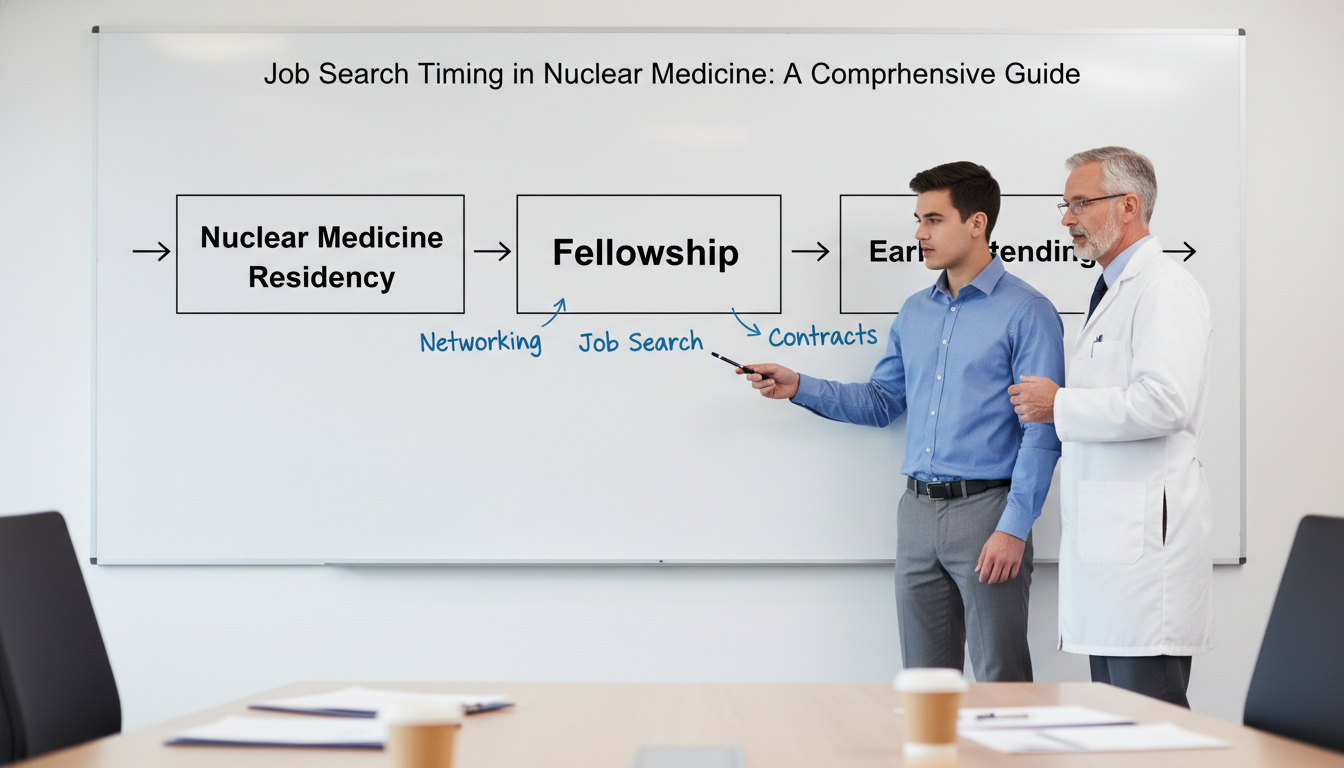
The timing of your job search should span multiple stages of training, beginning during your nuclear medicine residency or fellowship and continuing even into early attending life. You don’t need a perfect plan at day one, but you do need to be deliberate.
Phase 1: Early Residency (PGY-1 to Early Nuclear Medicine Training)
Whether you entered nuclear medicine through a dedicated nuclear medicine residency, nuclear radiology pathway, or a hybrid route, early training is the time to:
Clarify long‑term goals
- Academic vs community practice
- Emphasis on theranostics vs diagnostic imaging
- Desire for research, teaching, or leadership
- Geographic priorities (family, spouse/partner, lifestyle)
Start background research on the attending job market
- Browse job boards (SNMMI Career Center, ACR, institutional websites) to understand:
- Typical job titles
- Common requirements (e.g., ABNM vs ABR, theranostics experience)
- Salary ranges, benefits, call responsibilities
- Talk to recent graduates from your program about:
- How long it took them to find jobs
- What surprised them in the process
- Whether they changed regions or career paths
- Browse job boards (SNMMI Career Center, ACR, institutional websites) to understand:
Goal at this stage: Awareness, not applications. You’re learning what the nuclear medicine residency and fellowship graduates typically do, and what jobs will be realistic for you.
Phase 2: Mid‑Training (About 18–24 Months Before Graduation)
This is where timing becomes more strategic. If you’re asking “when to start job search?”, for nuclear medicine the answer is typically:
- Start serious planning and informal networking about 18–24 months before graduation.
You are not necessarily applying yet, but you are positioning yourself for the jobs you want.
Key steps:
Refine your career target
- Academic nuclear medicine faculty vs mixed clinical/academic vs private practice nuclear/radiology hybrid.
- Focus on PET/CT, SPECT/CT, cardiac nuclear, or theranostics.
- Decide if you will need additional training (e.g., 1 year of nuclear radiology, additional radiology exposure, or a theranostics-focused fellowship).
Align your CV with your chosen path
- Academic focus:
- Increase publications, abstract submissions (SNMMI, RSNA, regional meetings).
- Seek teaching roles (resident lectures, medical student sessions).
- Community/private practice focus:
- Emphasize high-volume clinical skills.
- Gain exposure to practice efficiency, report turnaround, and cross-sectional imaging interpretation if relevant.
- Theranostics focus:
- Seek involvement in clinical trials or implementations of new therapies.
- Document your case volumes and procedures.
- Academic focus:
Begin targeted networking
- Ask faculty where they see growth in nuclear medicine (theranostics centers, regional hubs, integrated oncology programs).
- Attend national meetings not just to present, but to meet:
- Division chiefs
- Program directors
- Industry partners (who often know about upcoming program expansions)
- Let trusted mentors know your rough geographic and practice-type preferences.
At this point, you’re building a foundation so that when you move into active applications, you won’t be starting from scratch.
Phase 3: The Active Job Search (9–15 Months Before Graduation)
For many nuclear medicine physicians, the core job search window is:
9–15 months before your planned completion date.
This is when the bulk of interviews and offers occur, especially in academic centers and large groups. It can shift earlier or later based on geography and practice type.
Why this window?
- Academic centers often budget and hire on an academic year cycle, aiming for July 1st starts.
- Institutional HR processes and credentialing can take 4–6 months or longer.
- Visa issues, licensure, and hospital privileging add additional time.
- Smaller private practices may hire closer to need, but still may want 6–12 months lead time for a nuclear medicine role.
Practical steps during the active job search window
Polish core documents
- CV formatted clearly for academic medicine or private practice.
- Customized cover letter highlighting:
- Specific interests (e.g., theranostics, cardiac nuclear, PET/CT).
- How you fit that particular program or practice.
- Reference list with at least 3 colleagues who can speak to:
- Clinical competence
- Work ethic
- Teamwork and communication
Begin applying strategically
- Academic jobs:
- Apply 9–15 months out (sometimes earlier for highly competitive or niche roles).
- Watch institutional sites and SNMMI or ACR job boards.
- Private practice / community hospitals:
- Start outreach 6–12 months out, but stay flexible; some roles open much closer to the actual start date.
- Don’t hesitate to send cold emails to large radiology groups or hospitals that might be considering expanding theranostic or nuclear services.
- Academic jobs:
Engage your mentor network
- Ask mentors to:
- Make email introductions.
- Give honest commentary about group reputations.
- Help you understand local nuances (e.g., politics of radiology vs nuclear medicine coverage).
- Ask mentors to:
Be prepared for a variable timeline
- Some offers may come very early, especially in regions with fewer candidates.
- Others may surface later in the year or be contingent on internal approvals or funding.
Phase 4: Final Year of Training (0–9 Months Before Graduation)
If you haven’t secured a position by the time you are 9 months from completion, it’s not a crisis—but it is time to be purposeful and broad in your search.
From 6–9 months before graduation:
- Intensify your job applications:
- Expand your geographic range if possible.
- Be open to hybrid roles (e.g., nuclear medicine plus some diagnostic radiology, if you’re credentialed and comfortable).
- Consider one-year bridge positions (e.g., additional fellowship, instructor positions) at desirable institutions if a full faculty slot isn’t yet open.
From 3–6 months before graduation:
- Finalize:
- Contract terms and start date.
- State licensure applications.
- Credentialing paperwork.
- Malpractice coverage and tail coverage details (if applicable).
If you are <3 months out and still searching:
- Use your mentors and professional society resources intensely:
- Contact SNMMI leadership and ask about unposted or emerging needs.
- Notify your program director; many know of last-minute vacancies due to unexpected departures, expanding services, or contract changes.
- Consider short-term or locum tenens work if necessary to bridge to a more permanent job.
Timing Differences: Academic vs Private Practice vs Hybrid Roles
The attending job search timing in nuclear medicine is not one-size-fits-all. The practice setting dramatically shapes how early and how structured your search must be.

Academic Nuclear Medicine Positions
Timing Pattern:
- Start informal discussions: 12–24 months before availability.
- Submit formal applications: 9–15 months before start date.
- Interviews: Often clustered around academic meeting seasons and late fall to spring.
- Offers: May come 6–12 months before start, contingent on approvals.
Why earlier?
- Faculty positions often require:
- Department and institutional approvals.
- Budget cycle alignment.
- Multi-step hiring and HR processes.
- Visa sponsorship, if needed, can add 3–6+ months.
Practical tips:
- Present at SNMMI, RSNA, or subspecialty meetings and signal your interest as an early-career faculty member.
- Ask about:
- Protected academic time.
- Start-up support for theranostics programs or research.
- Integration with oncology, radiology, or radiation oncology.
If you are highly focused on a particular academic center, consider early conversations even 2 years before graduation, especially if you can align your training or fellowship year with their needs.
Private Practice and Community Hospital Positions
Timing Pattern:
- Exploratory outreach: 9–12 months before desired start.
- Main hiring window: Often 6–12 months before start—but can be closer to 3–6 months if tied to sudden changes (retirements, contract turnovers, expansion of nuclear services).
- Rolling decisions: Unlike academic posts, private practices may hire as needs arise, not on a fixed annual schedule.
Why more flexible?
- Decisions may be driven by:
- Service expansion (e.g., adding a theranostics line or PET/CT).
- Losing a partner.
- New hospital contracts.
- Smaller organizations can sometimes move from interview to offer in weeks, not months.
Practical tips:
- Don’t rely solely on posted jobs; many nuclear medicine openings are never formally advertised.
- Send targeted emails to:
- Large radiology groups known to cover multiple hospitals.
- Community hospitals with PET/CT or nuclear cardiology programs.
- Oncology centers launching theranostic services.
When you reach 6–9 months before finishing training, it’s appropriate to become more assertive with cold outreach and follow-ups.
Hybrid and Theranostics-Focused Positions
The most rapidly evolving area is theranostics (e.g., Lu-177 PSMA, Lu-177 DOTATATE, I-131 therapies), often residing in multi-disciplinary environments.
Timing Pattern:
- Often similar to academic timelines:
- Planning 12–24 months out.
- Hiring decisions 6–12 months before the program goes live or expands.
- Some roles arise midyear when health systems decide to launch or scale a theranostics service quickly.
Practical tips:
- Emphasize:
- Your procedural experience and comfort with therapies.
- Collaboration with endocrinology, medical oncology, and radiation oncology.
- Knowledge of regulatory and safety aspects (e.g., radiation safety, licensing).
- Ask directly if they are planning to:
- Expand a theranostics line.
- Add dedicated nuclear medicine expertise to existing oncology service lines.
Strategic Questions: How to Time Your Search Based on Your Goals
1. How does the nuclear medicine match timeline relate to job search?
If you are currently in nuclear medicine residency or a nuclear radiology fellowship, you’ve already navigated the nuclear medicine match or a related selection process. The key is to shift your thinking early from match-focused to job-focused planning:
- First half of training: Build skills and reputation.
- Second half of training: Combine clinical excellence with targeted job search behaviors.
For those still in the nuclear medicine match pipeline, it is helpful to ask prospective programs:
- Where have recent graduates gone?
- How long did it take them to find positions?
- What kind of support does the program offer in the attending job search?
Programs with strong nuclear medicine networks can significantly shorten your search and help you understand the physician job market early.
2. How geography and flexibility affect your timeline
Your flexibility in location is one of the biggest determinants of how long your search will take.
If you have strict geographic limits (e.g., family in one city, spouse’s career constraints):
- Start planning and networking earlier (12–24 months).
- Cast a wide net within your target region (academic, community, private practice).
- Be prepared for fewer total open positions and longer waits between opportunities.
If you are geographically flexible:
- You can typically secure a job within the standard 9–15 month window.
- You’ll have more latitude to compare:
- Salary vs academic time
- Case mix
- Lifestyle and call structure
Regardless of flexibility, clarify your non-negotiables early (e.g., theranostics involvement, PET/CT volume, academic component) so you don’t accept a role that closes doors you care about.
3. Planning for the Long Game: Career Transitions and Market Shifts
Even after you secure your first attending position, understanding job search timing remains important. The physician job market in nuclear medicine can shift with:
- New theranostic approvals.
- Changes in reimbursement for nuclear imaging.
- Hospital mergers or radiology contract turnovers.
- Regional competition for PET/CT or SPECT/CT services.
Practical advice:
- Maintain relationships with:
- Former faculty and co-residents.
- Colleagues at national meetings.
- Industry contacts in radiopharmaceuticals and imaging equipment.
- Periodically review:
- Regional and national nuclear medicine job postings.
- Trends in volume, reimbursement, and new indications.
- If you anticipate a career move (e.g., relocating closer to family, shifting from academic to private practice):
- Begin informal exploration at least 12–18 months ahead of your desired move.
- For cross-country moves or visa issues, allow additional runway.
Thinking of your career as a continuous arc rather than a one-time “find my first job” event will help you navigate future transitions more smoothly.
Practical Action Plan: Month‑By‑Month Example
Below is a sample timeline for a nuclear medicine resident or fellow finishing training on June 30, 2027.
July 2025 – June 2026 (24–12 Months Before Completion)
- Clarify interests: academic vs private vs hybrid.
- Talk with mentors about likely opportunities.
- Present at one national or regional conference.
- Begin a simple spreadsheet tracking:
- Places you might want to work
- Contacts you have there
- Notes on open or upcoming positions
July 2026 – December 2026 (12–6 Months Before Completion)
- Finalize CV and general cover letter template.
- Start searching job boards weekly.
- Ask mentors to connect you with potential opportunities.
- Begin emailing places of high interest:
- “I’m finishing nuclear medicine training in June 2027; I’d love to talk if you are considering expanding or hiring.”
January 2027 – April 2027 (6–3 Months Before Completion)
- Complete the bulk of your interviews.
- Negotiate offers and clarify:
- Clinical duties and mix (PET/CT, theranostics, general nuclear).
- Salary, bonuses, and call responsibilities.
- Academic expectations (if any).
- Submit license and credentialing applications immediately after signing.
May 2027 – June 2027 (Last 2 Months of Training)
- Confirm start date, orientation schedule, and mentorship structure.
- Wrap up research and clinical duties in residency/fellowship.
- Stay in touch with colleagues and mentors; they remain vital to your future career.
This type of structure ensures that you are never “too late” and reduces the anxiety that often surrounds the attending job search.
FAQs: Job Search Timing in Nuclear Medicine
1. When should I start my nuclear medicine attending job search?
For most nuclear medicine physicians, the ideal window to begin a serious job search is 9–15 months before completing training. Start informal planning and networking even earlier (18–24 months), especially if you have geographic constraints or are aiming for competitive academic or theranostics-focused positions.
2. Does the timing differ between academic and private practice nuclear medicine jobs?
Yes. Academic positions often require more lead time:
- Informal discussions: 12–24 months out.
- Formal applications and interviews: 9–15 months out.
Private practice and community hospital roles generally hire closer to need:
- Exploratory outreach: 9–12 months out.
- Most hiring decisions: 6–12 months out, sometimes later for sudden vacancies.
3. What if I don’t have a job by the final 6 months of training?
It’s still very possible to secure an excellent role, but you should:
- Expand your geographic and practice-type flexibility if you can.
- Leverage mentors: ask them to make calls and send emails on your behalf.
- Look for:
- Unadvertised positions.
- Last-minute expansions of nuclear or theranostics services.
- Short-term or bridge roles (e.g., additional fellowship or instructor posts).
Focused, proactive outreach in those final months can still yield strong opportunities in the physician job market.
4. How does my participation in the nuclear medicine match affect job search timing?
The nuclear medicine match shapes your training path, not your job timeline; however, the same networking and institutional knowledge that helped you match well can be leveraged for attending jobs. During your residency or fellowship:
- Ask programs about graduate outcomes and job placement.
- Maintain relationships with faculty who can later support your attending job search.
- Treat your final 18–24 months of training as both a clinical education period and the launch pad for your long-term career.
By understanding and respecting the timing nuances of the nuclear medicine residency pipeline, academic cycles, and the attending job market, you can move from trainee to attending with far more control and far less uncertainty.