Starting residency in the United States as a non-US citizen IMG in nuclear medicine is a big achievement—especially given the visa, licensure, and match hurdles you’ve already cleared. But once you’re in training, a new strategic question appears very quickly:
When should you start your job search as a foreign national medical graduate in nuclear medicine—and what is different for non-US citizens?
This article lays out a clear, realistic timeline from the first year of residency through your attending job search, highlighting immigration constraints, certification milestones, and market realities specific to nuclear medicine. The goal is to help you avoid “too late” or “too early,” and instead plan a smart, phased job search that aligns with visas, exams, and the physician job market.
Understanding the Nuclear Medicine Job Landscape for Non-US Citizen IMGs
Nuclear medicine is a small, highly specialized field. For a non-US citizen IMG, the structure of the physician job market is shaped by three main forces:
Size and nature of the specialty
- Nuclear medicine is smaller than radiology, internal medicine, or surgery.
- Many positions are:
- Academic (university hospitals, NCI cancer centers)
- Hybrid: nuclear medicine + diagnostic radiology or nuclear cardiology
- Embedded in large health systems or private practice radiology groups
- Pure nuclear medicine attending positions (without cross-coverage expectations) do exist but are limited.
Credentialing and board expectations
- ABNM (American Board of Nuclear Medicine) certification is the central credential.
- Many employers prefer or require:
- ABNM eligibility/certification, and sometimes
- Completion of a diagnostic radiology residency, or
- Additional fellowship (e.g., PET/CT, theranostics, molecular imaging).
- This strongly affects when programs and practices are willing to interview you.
Immigration + employer appetite
- As a non-US citizen IMG, you are almost always on:
- J-1 or H-1B during training, then
- J-1 waiver, H-1B, or O-1 in practice; potentially leading to green card.
- Not all employers will sponsor visas.
- Some will only hire if:
- You already have a J-1 waiver in progress, or
- You are already on H-1B and they can do a transfer.
- Federal and some state institutions may have their own restrictions.
- As a non-US citizen IMG, you are almost always on:
Implication for timing:
Because the market is niche and visa-restricted, you need more lead time and more targeted outreach than a US citizen radiology graduate looking for a general private practice job.
Overview Timeline: When to Start Your Job Search (Year by Year)
Below is a high-level guide for a typical nuclear medicine trainee who is a non-US citizen IMG. Adjust based on your pathway (e.g., DR + Nuclear Medicine, direct Nuclear Medicine residency, post-residency fellowship).
PGY-1 / First Year in the U.S. (Transitional / Preliminary / First Nuclear Medicine Year)
Primary goals:
- Adapt to US clinical culture
- Understand your visa situation and long-term options
- Map out your credentialing timeline
Job search timing focus:
- No formal attending job search yet.
You’re laying the foundation.
Key actions:
- Clarify your immigration status:
- Are you on J-1 or H-1B?
- What are your options after training? (J-1 waiver vs. H-1B transfer vs. O-1)
- Schedule a consultation with an immigration attorney familiar with physicians.
- Research nuclear medicine career models:
- Academic vs. community vs. hybrid radiology/nuclear practice.
- Geographic patterns: many J-1 waiver jobs are in underserved or rural areas; nuclear medicine jobs are often concentrated in academic centers or large metros.
- Begin informal market research:
- Read job postings (even if you are years away).
- Talk to senior residents, fellows, and faculty:
- “Where do your graduates usually go?”
- “How visa-friendly is our region?”
- Work on portfolio basics:
- Start a CV that you update regularly.
- Get involved in projects (research, QA, theranostics, PET protocol optimization) that demonstrate niche skills.
You’re not actively searching for a job, but you are learning how the nuclear medicine job market works and what employers value.
Mid-Training (PGY-3 to PGY-4 Equivalent): When Planning Becomes Strategy
For many foreign national medical graduates in nuclear medicine, this is the planning phase that will determine your eventual flexibility.
Key questions you should answer now:
What will my final training date be?
- Identify the exact month/year of completion of:
- Nuclear medicine residency, and/or
- Fellowships (e.g., PET/CT, theranostics, nuclear cardiology).
- Identify the exact month/year of completion of:
What are my board eligibility timelines?
- ABNM exam eligibility date.
- Any additional certification timelines (e.g., ABR if you are also doing diagnostic radiology).
What will my visa status be at graduation?
- J-1 that will need:
- A J-1 waiver job (Conrad 30, academic waiver, VA, etc.), or
- Home-country return for 2 years (often not preferred).
- H-1B that can be:
- Transferred to a new employer.
- Potential for O-1 (for strong researchers/academics).
- J-1 that will need:
Job search timing focus in mid-training:
- Start alignment, not active applications.
- For nuclear medicine residents with 2+ years remaining:
- Clarify if you will do an additional fellowship.
- Identify target career models:
- Example: “I want to work as an academic nuclear medicine physician with a focus on theranostics.”
- Build skills to match your future CV to those jobs:
- Theranostic clinics
- Advanced PET/CT, cardiac PET
- Experience in protocol development, AI in imaging, or radiation safety leadership.
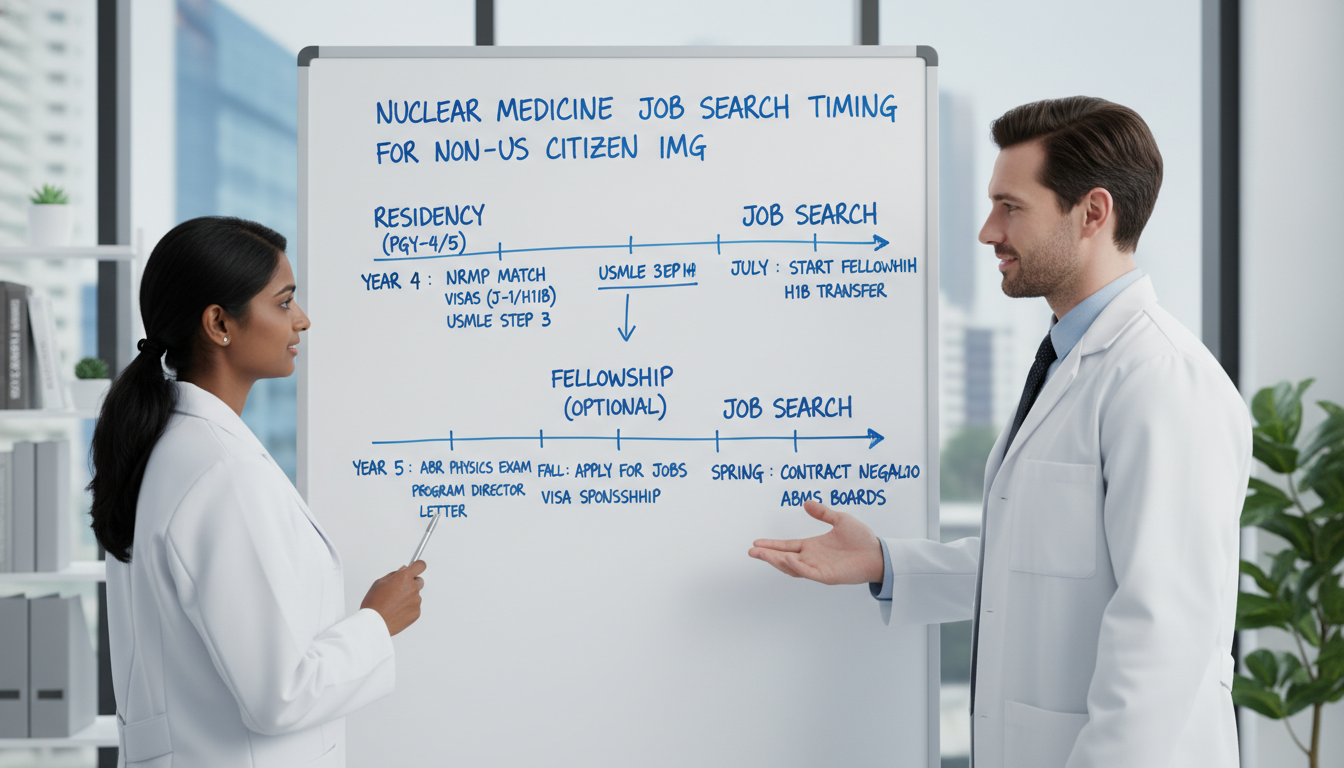
Important nuance for non-US citizen IMGs:
If you are on a J-1 visa, your job search timing must be aligned with waiver programs, which often have application deadlines 9–12+ months before your start date. That means you may need to be thinking about your job search earlier than your co-residents.
Final Year of Training: The Critical Window for the Nuclear Medicine Job Search
This is where timing becomes mission-critical. For a non-US citizen IMG in nuclear medicine, the final 12–18 months before finishing training are when the actual attending job search should become structured and active.
12–18 Months Before Graduation: Preparation + Early Outreach
This is often the “sweet spot” to start your attending job search.
At this stage:
You should:
Finalize your career direction
- Decide (as much as possible):
- Academic vs. community
- Pure nuclear medicine vs. hybrid with radiology
- Geographic preferences (and your flexibility).
- Decide (as much as possible):
Polish core materials
- Updated CV tailored to nuclear medicine:
- Highlight PET/CT, SPECT, theranostics, dosimetry, and relevant procedures.
- Show research, presentations, and leadership (e.g., radiation safety committee).
- Draft a generic cover letter that you will customize:
- Introduce yourself as a non-US citizen IMG.
- Be transparent but concise about visa status and timing.
- Update your LinkedIn profile (yes, it matters for some recruiters and academic leadership).
- Updated CV tailored to nuclear medicine:
Clarify visa strategy in detail
- If J-1:
- Review Conrad 30 and other waiver options.
- Target states or employers known to sponsor waivers.
- If H-1B:
- Understand cap-exempt vs. cap-subject employers.
- Learn timelines for H-1B transfer.
- If you have strong research/academic credentials:
- Discuss O-1 or EB-1 options with an immigration attorney.
- If J-1:
Start soft networking
- Talk to:
- Faculty mentors.
- Recent graduates from your program.
- Speakers at nuclear medicine and radiology conferences.
- Ask:
- “When did you start your job search?”
- “What regions are more open to visa sponsorship?”
- “Do you know anyone hiring nuclear medicine faculty/attendings in the next 1–2 years?”
- Talk to:
When to start sending early inquiries?
- For academic nuclear medicine positions:
- 12–18 months before your planned start date is reasonable for initial emails to department chairs or division chiefs, especially if:
- You have a strong research or theranostic background.
- You are likely a competitive candidate for faculty roles.
- 12–18 months before your planned start date is reasonable for initial emails to department chairs or division chiefs, especially if:
- For community or private practice roles:
- Many of these groups think in 6–12 month horizons, not 18–24 months.
- Early outreach can help you identify visa-friendly groups and anticipate future needs, but they may not commit that far in advance.
9–12 Months Before Graduation: Active Applications and Interviews
For a non-US citizen IMG in nuclear medicine, 9–12 months before completion is usually the time when you should:
- Actively apply to posted positions.
- Proactively contact departments or practices where:
- You have a connection, or
- The practice aligns with your specific nuclear medicine skill set.
Why this timing works:
- Employers:
- Can plan for onboarding, credentialing, and licensing.
- See your ABNM eligibility timeframe clearly.
- For J-1 waivers:
- Many programs and states require significant lead time for paperwork and approvals.
- For H-1B:
- Petitions and transfers take months, and academic centers often have fixed HR cycles.
Practical steps at 9–12 months:
Apply to formal job postings
- Use:
- SNMMI, RSNA, ACR, institutional job boards
- Major academic hospital career sites
- Target keywords in your search:
- “Nuclear medicine physician”
- “Theranostics”
- “Molecular imaging”
- “Radiology and nuclear medicine”
- Use:
Send targeted inquiry emails
- Especially to:
- Academic divisions where you’ve met faculty at conferences.
- Institutions known for theranostics or advanced PET work.
- Keep messages short:
- Who you are (non-US citizen IMG, training path).
- When you finish.
- Your visa status and needs.
- Your niche skills.
- Especially to:
Leverage mentors
- Ask for direct introductions:
- “Would you feel comfortable emailing Dr. X to introduce me as I apply for this position?”
- This can make a large difference in small specialties like nuclear medicine.
- Ask for direct introductions:
Begin interviews
- Some employers, especially academic centers, will start interviewing 9–12 months before start date.
- Be prepared to discuss:
- Your visa and what exactly you need from them.
- How your nuclear medicine skill set will expand their capabilities:
- New theranostic service?
- More coverage for cardiac PET?
- Leadership in radiation safety/quality?
6–9 Months Before Graduation: Negotiation, Visa Filings, and Backup Plans
By 6–9 months out, most foreign national medical graduates in nuclear medicine should ideally be:
- In late interview stages, or
- Close to signing a contract, especially if a visa is involved.
Key priorities now:
Narrow down offers and negotiate
- Clarify:
- Job description (pure nuclear vs. hybrid with radiology).
- Call responsibilities.
- Academic expectations (research, teaching).
- Compensation and benefits.
- Confirm:
- That the employer understands your non-US citizen IMG status.
- That they will sponsor your required visa or waiver.
- The exact timeline for petitions and filings.
- Clarify:
Start license and credentialing processes
- State medical license applications can be slow.
- Hospital credentialing and privileging often take 3–6 months.
- Work with HR/medical staff offices to prevent delays.
Ensure immigration steps are underway
- J-1 waiver:
- Employer must submit waiver applications within program/state deadlines.
- H-1B:
- File petition with enough buffer time.
- O-1:
- Gather evidence (publications, citations, recommendation letters).
- J-1 waiver:
Maintain backup options
- Keep one or two additional search avenues open until your visa and contract are secure.
- Stay in touch with alternative opportunities:
- “I am currently in the final stages with one institution, but if anything changes, may I reconnect about your position?”
If at 6 months before graduation you still have no concrete offer, it is not hopeless—but it is urgent. At that point:
- Consider:
- Broader geography, including rural/underserved areas.
- Hybrid roles where you may participate in both nuclear medicine and general radiology if credentialed.
- Intensify networking:
- Ask every attending you trust:
“Do you know any nuclear medicine or radiology groups that might be open to a visa-dependent nuclear medicine physician in the next year?”
- Ask every attending you trust:
Special Considerations: Visas, Waivers, and Market Realities
The overlap between the physician job market, nuclear medicine residency, and immigration law is where most timing mistakes happen. Here’s how to approach it strategically.
J-1 Visa and Waiver Timing
If you trained on a J-1 visa, the J-1 waiver often becomes the central driver of your job search.
Key timing points:
- Many waiver programs (e.g., Conrad 30) have annual cycles and state-dependent deadlines.
- Waiver jobs must usually be:
- In Health Professional Shortage Areas (HPSA), or
- Serve underserved populations.
- Nuclear medicine–only jobs in underserved regions can be scarce; hybrid roles or positions that include general radiology or internal medicine may be more common.
Practical advice:
- Start learning about J-1 waiver options at least 18–24 months before finishing.
- When you ask “when to start job search,” for a J-1 holder, the answer is usually:
“Earlier than you think—especially if you want a waiver job that fits your specialty interests.” - Consider talking to:
- An immigration attorney.
- Program alumni who completed waivers.
- Employers in smaller cities or states with underused Conrad 30 slots.
H-1B and O-1: Flexibility and Lead Time
If you are on H-1B:
- Employers may see you as less complex than a J-1 (no waiver).
- But:
- Academic centers may still need months for institutional approval.
- H-1B cap issues can arise if moving from cap-exempt (university hospital) to cap-subject (private practice) roles.
If you are a high-achieving academic foreign national medical graduate:
- O-1 or EB-1 routes can provide more long-term stability.
- These routes tend to require:
- Significant publications, citations.
- National/international recognition.
- Strong letters from leaders in nuclear medicine or radiology.
- Start documentation early—well before your attending job search.
Practical Examples: Good vs. Risky Job Search Timing
To make this concrete, here are a few scenarios.
Example 1: Academic Nuclear Medicine with J-1 Waiver Needs
- You are a non-US citizen IMG finishing a 3-year nuclear medicine residency followed by a one-year theranostics fellowship on J-1.
- You want an academic theranostics-focused job, ideally in a metro area.
Good timing:
- 24 months before completion:
- You learn about waiver options; realize some academic centers have waiver pathways.
- 18 months:
- You identify 5–8 academic nuclear medicine divisions actively expanding theranostics.
- 12–15 months:
- You contact division chiefs, share CV, discuss both faculty interest and J-1 waiver possibilities.
- 9–12 months:
- You formally apply, interview, and secure a faculty offer with a waiver plan.
- 6–9 months:
- Waiver and H-1B petitions are filed and processed.
Risky timing:
- You wait until 6–9 months before completion to start thinking about waiver + job.
- Many waiver slots or academic hiring budgets are already allocated.
- You may be forced to accept:
- A job misaligned with your theranostics focus, or
- A less-preferred location under time pressure.
Example 2: Community Nuclear Medicine / Radiology Hybrid on H-1B
- You are a foreign national medical graduate completing a diagnostic radiology residency plus nuclear medicine fellowship, on H-1B.
- You want a community radiology group where you can be the nuclear specialist but also read general studies.
Good timing:
- 12–15 months before finishing:
- You attend regional radiology society meetings; talk to groups about nuclear needs.
- 9–12 months:
- You apply to groups advertising for “radiologist with nuclear medicine expertise.”
- You explicitly state you will need H-1B transfer and that you’re ABR/ABNM eligible.
- 6–9 months:
- You negotiate and sign; the group files H-1B and starts credentialing.
Risky timing:
- You assume community practices hire only 3 months before start date.
- You start looking at 3–4 months before finishing:
- Many groups have already filled positions.
- H-1B timelines become uncomfortably tight.
- You could face a gap in employment or need to scramble for a locums or temporary role.

Putting It All Together: Actionable Timeline Checklist
Below is a compressed timeline specifically for a non-US citizen IMG in nuclear medicine asking “when to start job search” for an attending role:
24–18 Months Before Graduation
- Understand your exact visa category and constraints.
- Map out board eligibility and final training end date.
- Start targeted skills development (theranostics, cardiac PET, etc.).
- Begin researching J-1 waiver and H-1B realities if applicable.
18–12 Months Before Graduation
- Decide on broad career direction (academic vs. community; pure nuclear vs. hybrid).
- Polish CV and generic cover letter.
- Talk to mentors about typical nuclear medicine match into jobs from your program.
- For J-1: identify states/institutions with waiver potential.
- Start soft outreach to academic centers and key contacts.
12–9 Months Before Graduation
- Begin formal job search:
- Apply to posted positions (academic, community, hybrid).
- Send targeted inquiry emails to departments that fit your profile.
- Attend conferences with a networking mindset.
- Start interviews.
9–6 Months Before Graduation
- Focus on final interviews and offers.
- Negotiate terms and confirm visa sponsorship.
- Start state licensing and hospital credentialing.
- Ensure waiver or H-1B/O-1 petitions are being prepared.
6–3 Months Before Graduation
- Finalize contract and immigration paperwork.
- Communicate your start date clearly to all parties.
- Maintain one backup option if possible until visa approval is secure.
FAQs: Job Search Timing for Non-US Citizen IMG in Nuclear Medicine
1. When should a non-US citizen IMG in nuclear medicine start their attending job search?
For most nuclear medicine trainees, 9–12 months before your training end date is the ideal time to begin actively applying and interviewing. However, if you are on a J-1 visa and will need a J-1 waiver, you should start planning and exploring waiver-friendly employers 18–24 months in advance because of state deadlines and limited positions.
2. How does being a foreign national medical graduate affect my timing compared with US citizens?
As a non-US citizen IMG, you need additional lead time for:
- Visa sponsorship (H-1B, O-1) or J-1 waiver processing.
- Finding employers willing and able to sponsor you.
- Navigating institutional HR and legal departments, which can be slower for visa cases.
While US citizens might safely start their search 6–9 months out, you should typically add at least 3–6 months to that timeline.
3. Should I wait to have ABNM certification before applying for jobs?
No. Most employers are comfortable hiring you if you are board-eligible and scheduled to take the ABNM exam. Applications and interviews commonly begin before the exam date, often 9–12 months prior to your start. Just be clear in your CV and cover letter about:
- Your ABNM eligibility.
- Your planned exam dates.
- Any additional board certifications (e.g., ABR).
4. How early should I start networking for the nuclear medicine job market?
Networking can—and should—start as soon as you begin training in the US, even if you are not formally job searching. By:
- Attending SNMMI/RSNA meetings.
- Asking faculty about their contacts.
- Presenting your research and theranostics work.
You improve your visibility and learn where opportunities may open in 1–3 years. When it is time for your attending job search (9–12 months out), you will already have relationships to leverage instead of starting from zero.
By approaching your job search as a multi-year strategy rather than a last-minute scramble, you can navigate the nuclear medicine job market, align it with your immigration needs, and position yourself competitively as a non-US citizen IMG entering practice in the United States.